Korean Age in 2026: The Law Unified It, but Three Systems Still Coexist
Last Updated on August 23, 2026
Quick Answer
Since June 2023, international age (만 나이) has been Korea’s legal default, so most guides now say Korean age is gone. Three systems still coexist. International age governs documents and contracts; year age (연 나이), which ignores your birthday and counts by birth year, governs a specific set of laws; and counting age still runs everyday conversation. Which one applies depends entirely on the context.
The Full Answer
For years, the standard traveller explanation of Korean age was: you are a year or two older here than at home, because Korea counts differently. Then in 2023 Korea passed a law unifying to international age, and the standard explanation flipped to “Korean age is abolished, you’re the same age as everywhere else now.”
Both versions are incomplete. The 2023 law was real, but it did not delete the other systems — it set a default for law and administration while leaving specific carve-outs and everyday habits in place. I checked the relevant statutes and official explainers in July 2026, because the version now circulating in English guides is over-corrected.
What “default” means here is narrower than it sounds, and it is worth stating plainly. Where a law or an administrative form refers to an age without specifying which system it means, it now means international age. Where a statute writes year age into its own text, that statute still runs on year age. And nothing in the 2023 change reaches everyday speech, which never switched at all. So the question a visitor actually needs answered is not “is Korean age gone” but “which system is this particular situation using.”
The Three Systems
All three still exist. Which one applies depends on the context.
| System | How it counts | Example (born Dec 2000, today Jul 2026) |
|---|---|---|
| International (만) | Birthday-based, like everywhere | 25 |
| Year age (연) | Current year minus birth year | 26 |
| Korean/counting (세는) | Born at 1, +1 each New Year | 27 |
Local tip — The 2023 law made international age (만 나이) the default for administrative and civil matters. But it did not abolish the other two — year age remains written into specific laws, and counting age survives in everyday conversation. English guides that say “Korean age is gone” have simplified away the parts that still bite.
Working Out Your Own Three Ages
Every one of the three numbers comes from two facts: your birth year, and whether your birthday has already passed this year.
- International age (만 나이) — current year minus birth year, then subtract one more if your birthday hasn’t happened yet. This is the number a Korean form wants unless it says otherwise.
- Year age (연 나이) — current year minus birth year. That is the whole calculation. Your birthday plays no part, so this number changes for everybody at once, at midnight on 1 January.
- Counting age (세는 나이) — current year minus birth year, plus one. You are 1 at birth and gain a year each New Year rather than on your birthday.
Two shortcuts follow from that. Counting age is always exactly one more than year age. International age either matches year age — if your birthday has already passed this year — or sits one below it. So the spread between your highest and lowest number is one for most of the year if you were born in early January, and two if you were born in late December.
This is also why the old traveller shorthand (“you’re two years older in Korea”) was only sometimes right. It described the widest case and treated it as the rule.
Where Year Age (연 나이) Still Governs
Year age is the system English guides drop when they say Korea “switched.” It did not disappear in 2023 — it is still doing work, both in statutes and in the decrees that implement them. The three areas below show it operating in three different ways: one where the parent Act counts in international age but the decree produces a year cohort anyway, one where the Act states the year rule outright, and one where the cutoff sits inside a legal definition.
The reason a law would pick year age over international age is administrative rather than cultural. Year age makes an entire birth cohort change status on the same day, so nobody has to track individual birthdays. Everyone born in a given year is treated identically for the whole calendar year.
School Year Placement
School entry runs on a calendar cohort rather than on individual birthdays, and it takes two provisions to get there. The Elementary and Secondary Education Act sets the date: Article 13(1) requires a child to start primary school on 1 March of the year following the year in which they turn six. The enforcement decree then decides who is on the list — Article 15(1) has each local office compile its school-entry register from children whose age reaches six at any point between 1 January and 31 December of that year.
The effect is that children born in the same calendar year start school on the same day, whether their birthday falls in January or December. It isn’t absolute: Article 13(2) lets a guardian apply to start a year early or a year late, and the decree sets the application window for both.
Local tip — Here the mechanism and the effect don’t match, and separating them is the whole point. The Act itself counts in international age — “the year in which the child turns six” — and then pins entry to a fixed date. It is the enforcement decree that draws the register using a 1 January to 31 December window, the same construction the Military Service Act uses for year age. So school placement produces a birth-year cohort without the parent statute ever writing year age into its own text. I read both directly on law.go.kr in August 2026, in the versions in force: the Act effective 20 August 2026 (Act No. 21659), the decree effective 26 May 2026 (Presidential Decree No. 36345), with the register provision last amended 27 June 2023.
Military Service
Military service is the clearest statutory case of year age, because the Military Service Act writes the counting rule into its own text. Article 2(2) states that where the Act expresses the timing of a service obligation as an age, “from age N” means from 1 January of the year in which that age is reached, and “until age N” means through 31 December of that year. Every duty in the Act written as an age therefore attaches to a birth-year cohort on one shared day rather than arriving on each individual’s birthday.
Few visitors will have any direct contact with this. It earns its place here because it is the plainest example of year age stated as a rule rather than inferred from an effect — I opened the current text on law.go.kr in August 2026, the version in force since 9 June 2026 (Act No. 21769), and that clause has stood unchanged since a full revision on 9 June 2009.
Alcohol and Tobacco
Purchase eligibility for alcohol and tobacco is also set by year age, under the Youth Protection Act. The cutoff sits inside the definition itself: Article 2(1) defines a minor as a person under 19, then excludes anyone who has reached 1 January of the year they turn 19 (current text, in force since 1 July 2026). In practice the line is that 1 January, not your 19th birthday. That single sentence is the entire age half of the question — everything downstream of it, such as which ID a seller will accept and what a business is required to check, is a separate subject covered in the drinking age guide.
Local tip — Year age is not a folk custom that happened to survive 2023; it is written into statute, and it ignores birthdays completely. Because of that, a whole birth-year cohort can change legal status on 1 January without anyone ageing a day. English guides describe the 2023 change accurately and then leave out the system that still does this — which is why they read as complete and are not.
Where Each System Actually Shows Up
| Context | System used | Where it’s written |
|---|---|---|
| Legal documents, contracts, medical | International (만) | Default since June 2023 |
| Alcohol / tobacco purchase | Year age (연) | Youth Protection Act Art. 2(1) |
| Military service eligibility | Year age (연) | Military Service Act Art. 2(2) |
| School year placement | Year age (연), via the decree | Elementary and Secondary Education Act Art. 13(1); decree Art. 15(1) |
| Casual conversation, “how old are you?” | Often counting (세는) | Custom, not law |
Local tip — When a Korean asks your age socially, they may still be thinking in counting age, so your answer and theirs can differ by a year or two even in 2026. It rarely matters practically, but it explains why someone might call you a year older than you’d say — the everyday habit outlived the legal change.
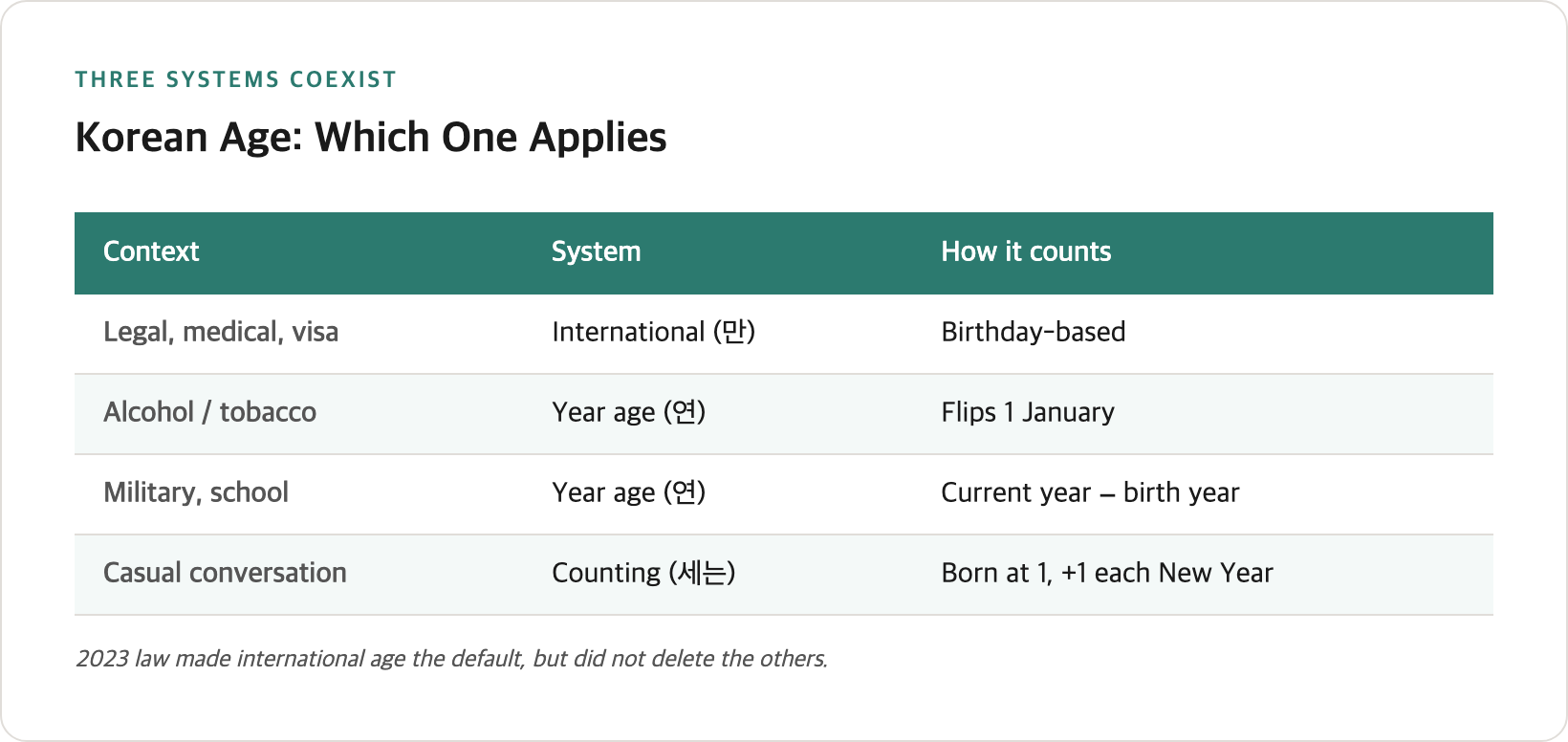
Photo by Luke Paris on Unsplash
What You Need to Know
-
International age is the legal default since June 2023 for most purposes.
-
Three systems still coexist — the 2023 law set a default, it did not delete the others.
-
Year age ignores your birthday entirely — current year minus birth year, changing for everyone on 1 January.
-
School placement, military service and alcohol or tobacco eligibility all run on year age.
-
Counting age is always year age plus one; international age is year age, or one below it if your birthday hasn’t passed.
-
Counting age survives in conversation, so social age answers may differ by a year or two.
-
For most visitors the only place any of this surfaces is a form asking your age — and that means international age.
Practical Tips
-
Assume international age for anything official — documents, bookings, medical. A Korean form that doesn’t specify a system is asking for 만 나이.
-
Work out all three of your numbers once, before you travel. Birth year subtracted from the current year gives you year age; add one for counting age; subtract one from year age if your birthday is still ahead.
-
Ignore guides that say “Korean age is abolished” as the whole story. It isn’t — the law set a default and left carve-outs.
-
Don’t be surprised if a local’s age maths differs from yours. Counting age lingers socially and can put you a year or two above your own answer.
-
Where year age governs, the line is your birth year rather than your birthday — that covers school placement, military service, and buying alcohol or tobacco.
-
Treat “how old are you” in conversation as a different question from the one on a form. The social answer and the legal answer can legitimately differ.
-
This won’t affect visa or entry — those use international age. See the visa guide and the K-ETA guide.
Frequently Asked Questions
Did Korea get rid of Korean age?
Partly. Since June 2023, international age has been the legal default for administration and civil matters, so an age written on a document or a form means 만 나이 unless stated otherwise. But year age is still written into specific statutes, and counting age still runs everyday speech. The 2023 change set a default rather than abolishing the alternatives.
How do I calculate my Korean age?
Start from your birth year. Current year minus birth year gives you year age (연 나이). Add one to that for counting age (세는 나이), the traditional number where you are 1 at birth and gain a year each New Year. For international age (만 나이), take year age and subtract one if your birthday hasn’t happened yet this year. Counting age is always exactly one above year age, so once you have one number you have all three.
What is year age (연 나이), and how is it different?
Year age is simply the current year minus your birth year — your birthday is not part of the calculation, so the number changes for everyone simultaneously on 1 January. It exists because it lets a law treat an entire birth-year cohort identically for a whole calendar year instead of tracking individual birthdays. School year placement, military service eligibility and alcohol or tobacco purchase all use it. For the alcohol case specifically, the drinking age guide covers what happens after the age question is settled.
Which age do I use for official things?
International age, since 2023, for documents, contracts and medical matters — including visa and entry. If a Korean form asks for your age without naming a system, it means international age.
Does Korean age affect my visa, K-ETA or entry?
No. Immigration and entry procedures use international age, so the age on your passport is the age that counts at the border. Nothing about year age or counting age changes a visa calculation or a K-ETA application.
Why does a Korean think I’m older than I said?
They may be using counting age, an everyday habit that survived the 2023 legal change. Counting age sits one above year age, and up to two above your international age if your birthday is still ahead this year.
Do I actually need to know this as a visitor?
For a short trip, mostly not — international age covers documents, bookings and entry, and that is the number you already know. It matters in two situations: when you are near an age threshold that a statute sets by year age rather than birthday, and when someone asks your age in conversation and answers with a different number than you expected.
Related Questions
- Drinking Age in Korea: ID Rules, Seller Penalties, and No-Drinking Zones
- Do You Need a Visa for Korea? The 90-Day Rule
- Do You Need a K-ETA to Visit Korea?
- eSIM vs SIM vs Pocket WiFi in Korea: What the Affiliate Guides Won’t Tell You
- Korea VAT Refund in 2026: The Instant Route, and the Rule That Just Changed