Do You Need a K-ETA for Korea? And Should You Get One Anyway?
Quick Answer
Through 31 December 2026, travellers from many visa-waiver countries can enter Korea without a K-ETA at all, under a temporary exemption the Ministry of Justice extended on 23 December 2025. So “do I need one?” is often “no.” Applying anyway costs ₩10,000 and waives the arrival card — but that card is now free to file online, so the case for paying is thin.
Verified against Ministry of Justice sources on 10 August 2026. Confirm your own nationality on k-eta.go.kr before booking.
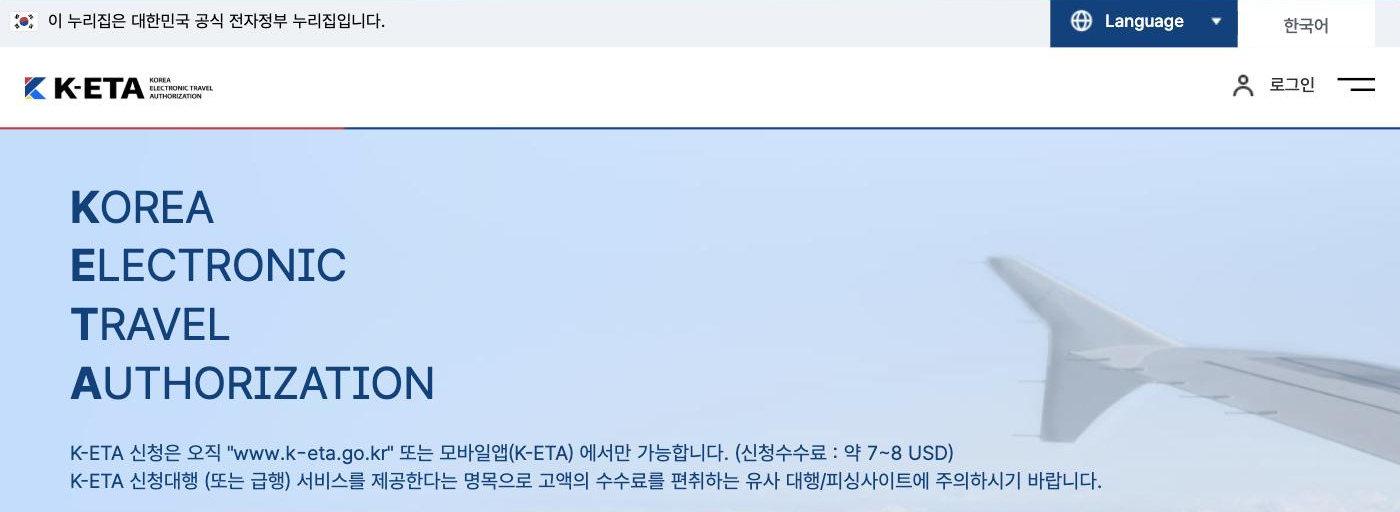
Photo by Ross Parmly on Unsplash
The Full Answer
The K-ETA question is unusually well covered in English — official sites, immigration lawyers and news outlets all explain the temporary exemption accurately. Where the coverage stops is the decision it leaves you with, which almost no guide addresses: if you’re exempt but can apply anyway, should you?
That decision hinges on one benefit — skipping the arrival card — and most guides describe it as though the alternative were still a paper form filled in with a borrowed pen on the plane. It isn’t, and hasn’t been for a while.
I went through the Ministry of Justice sources directly on 10 August 2026: the K-ETA notice board, the fee and eligibility pages on k-eta.go.kr, the Immigration Service’s K-ETA policy page, and the separate e-Arrival Card site. Three things came out of that which change the answer, and they’re laid out below.
This is general information, not immigration advice — always confirm your nationality’s current status on the official K-ETA site before travelling.
First: Are You Exempt?
The temporary exemption is the headline, and it runs on a calendar year.
Local tip — The Ministry of Justice notice dated 23 December 2025 extended the temporary K-ETA exemption by one more year, for the period 1 January 2026 to 31 December 2026 (KST). It applies to the countries already covered — the notice extends the existing list rather than changing it. This is a year-by-year measure renewed more than once, and the confirmation came just nine days before the previous period lapsed. Older English articles go stale fast here.
There is a catch that no English guide I found mentions. The official K-ETA site does not publish a standing list of the temporarily exempt countries. The December 2025 notice says you confirm your own status from a pop-up labelled “K-ETA 면제 대상” (K-ETA exemption applies) that appears when you scan the photo page of your passport partway through an application — not from a country dropdown, and not from a published table. In practice that means the only authoritative check is to start an application and watch for the pop-up, or ask your nearest Korean embassy.
Separately from the country exemption, some travellers never have to apply regardless of nationality. Korea Immigration’s eligibility page lists eight categories excluded from the K-ETA requirement outright:
- Diplomatic and official passport holders
- Active-duty personnel under the US-ROK SOFA
- Aircrew and ship crew
- ABTC (APEC Business Travel Card) holders
- Transit passengers
- Registered foreign residents, and anyone holding a visa
- UN laissez-passer holders
- Anyone aged 17 or under, or 65 or over, as of the date of entry — in force since 3 July 2023
Two of these are worth pulling out. If you’re 66 and reading a guide that tells you to apply, that guide is wrong — though you may still apply voluntarily if you want the arrival-card waiver. And if you’re only changing planes at Incheon without clearing immigration, you’re outside the requirement entirely.
The Real Question: Apply Anyway?
Here’s the decision the guides skip — and the part most of them get wrong.
Even if you’re exempt, you can apply for a K-ETA voluntarily. It isn’t free, and it buys one specific convenience: the arrival card waiver. Korea Immigration’s own K-ETA page states it plainly — a K-ETA holder is exempt from filling in the arrival declaration.
That much is true. What almost every English guide leaves out is what the alternative actually looks like now.
Local tip — The arrival card is no longer a paper form you scramble to fill in on the plane. Korea runs a separate government site, e-arrivalcard.go.kr, where you file the same declaration online; its official guide states in as many words that the e-Arrival Card is free and that submitting it means you do not need to fill in a paper arrival card. Filing opens three days before arrival (KST). The same site’s “Individuals Subject to Declaration” page also settles who owes what: citizens of countries temporarily exempt from the K-ETA are in the group that must file, while K-ETA holders are in the group excluded from it. So relying on the 2026 exemption still leaves you an arrival declaration — you just file it free online rather than paying ₩10,000 to be waived. One wrinkle from the same page: hold a K-ETA but enter on a visa, and the waiver doesn’t apply. The real trade is ₩10,000 versus a free online form you can do at home.
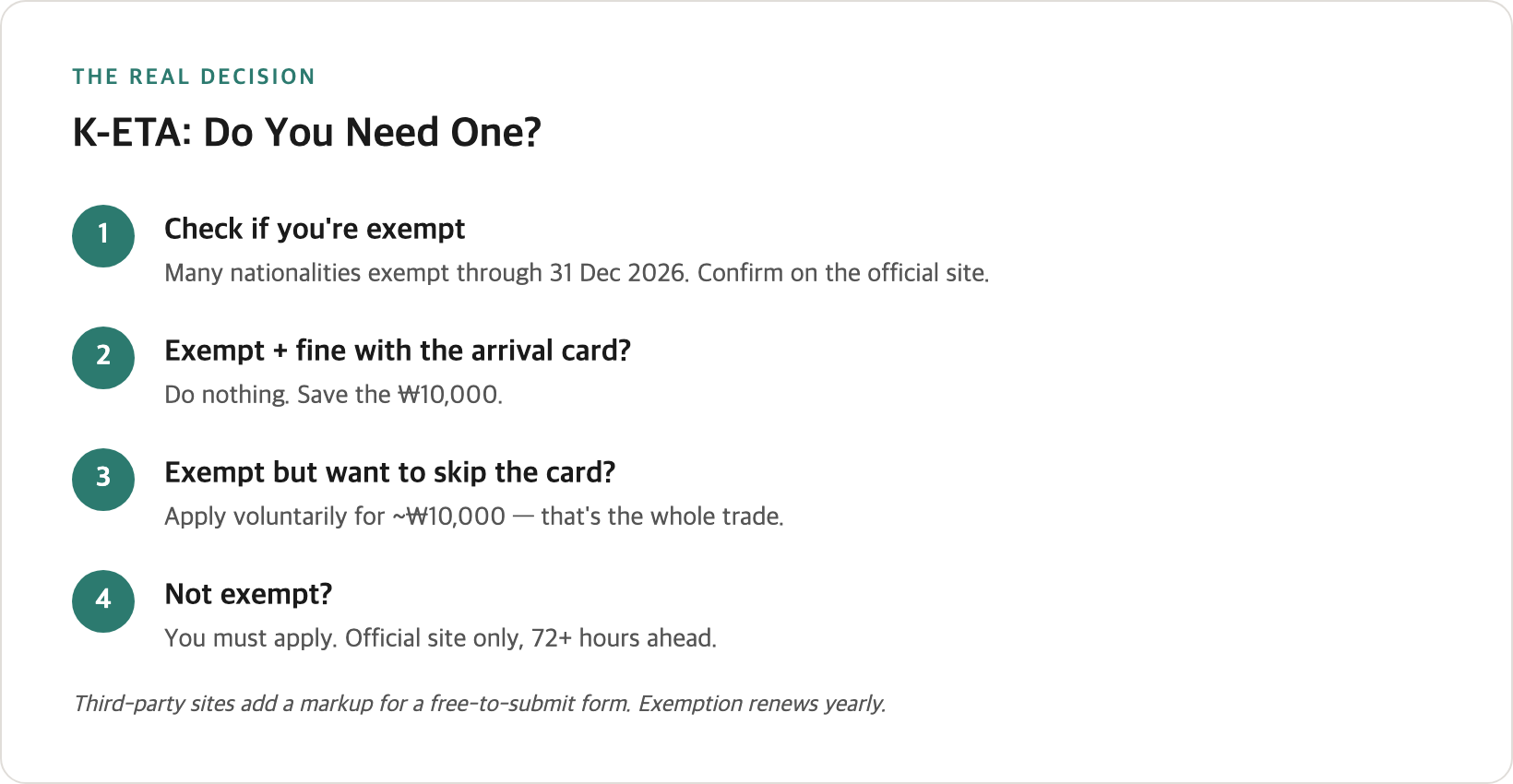
So the decision tree is short:
- Exempt and willing to spend five minutes online? → File the free e-Arrival Card, save ₩10,000
- Exempt and want the declaration waived entirely? → Apply voluntarily for ₩10,000 (plus the card fee surcharge below)
- Not exempt, and not in one of the eight excluded categories? → You must apply
Put bluntly: for most travellers option 1 is the sane one. The ₩10,000 buys you out of a free form.
If You Do Apply
- Where:
www.k-eta.go.kror the official K-ETA mobile app — nowhere else - Fee: ₩10,000 per person (about US$7–8)
- Processing: generally within 72 hours; Immigration recommends applying at least 72 hours before boarding
- Validity: up to 3 years from approval, or until your passport expires if sooner
- Need: valid passport, valid email address, a face photo, and a card that works internationally
Two costs the fee page states that guides rarely repeat:
Local tip — The ₩10,000 is not the final figure. The official fee page adds that an online payment surcharge of roughly 3% is applied on top, and that the fee is non-refundable regardless of the outcome — it pays for the assessment, not the approval. It also lists the accepted cards (Visa, Mastercard, JCB, Amex, Diners Club, Discover, UnionPay, Alipay+) and warns that a card with overseas payments blocked will simply fail. That last one is a common and avoidable trip-up.
And one that can stop you at the gate:
Local tip — A K-ETA cannot be edited after submission. The Ministry of Justice’s standing notice on the scheme states that if the details on your authorisation don’t match your passport — name, passport number, date of birth — you cannot board the aircraft or ship, and the fix is to re-apply and pay again. The same notice is blunt about the other limit: a K-ETA is not a visa and does not guarantee entry; the final decision belongs to the immigration officer at the border. Check every field before you pay.
Local tip — Apply only through the official K-ETA website or app. The government’s December 2022 notice states that it has not designated any official K-ETA agents at all, so every “fast-track” or “agency” site is unofficial by definition. They replicate the form and charge a markup on top of the ₩10,000 government fee for nothing extra. The same trap has now spread to the arrival card: HiKorea currently warns about imitation e-Arrival Card sites, noting that the official site is
www.e-arrivalcard.go.krand that any site asking for payment details for an arrival card is not the real one, because that service is free.
The 2027 Trap
One forward-looking point that matters for planning.
Local tip — The exemption is renewed annually, and the announcement lands late. The notice extending it into 2026 is dated 23 December 2025 for a period beginning 1 January 2026 — nine days of notice. If the same pattern holds, anyone planning a January 2027 trip will be booking flights before Korea has said whether the exemption survives. Two practical consequences: don’t assume 2026’s rules carry over, and re-check
k-eta.go.krclose to departure rather than trusting an article written this year. If it lapses, you’d need a K-ETA approved before boarding — which is a 72-hour job, not an airport one.
What You Need to Know
-
Many nationalities are exempt for 1 January – 31 December 2026 — often no K-ETA needed.
-
The exemption is renewed yearly and announced late — the 2026 extension came on 23 December 2025.
-
Eight categories never need one regardless of nationality, including transit passengers and anyone 17-or-under or 65-or-over on the day of entry.
-
You can apply voluntarily for ₩10,000 plus roughly 3% in card charges, to be waived from the arrival declaration.
-
But the arrival card is free online at e-arrivalcard.go.kr, from three days before arrival — which is what makes the voluntary fee hard to justify.
-
A K-ETA can’t be edited and isn’t refundable, and it doesn’t guarantee entry.
-
Apply only on the official site — Korea has designated no agents at all.
-
This is separate from the visa question — see the visa guide.
Practical Tips
-
Check whether you’re excluded outright first — transit, age 17-or-under or 65-or-over, crew, ABTC, diplomatic passport, existing visa. If so, none of the rest applies.
-
Confirm your nationality’s exemption by starting an application on the official site and watching for the exemption pop-up at the passport-scan step.
-
If exempt, file the free e-Arrival Card at e-arrivalcard.go.kr from three days before arrival, and keep the ₩10,000 in your trip budget.
-
Apply for a K-ETA voluntarily only if being waived from the declaration entirely is worth ₩10,000 plus card charges to you.
-
Use the official site only — no agent is authorised, and the same scam now targets arrival cards.
-
Apply 72+ hours ahead if you do — not at the airport, where you’ll be heading into Seoul anyway.
-
Re-check close to departure for 2027 trips — the extension has landed in late December two years running.
Frequently Asked Questions
Do I need a K-ETA to visit Korea?
Often no, in 2026. A temporary exemption running 1 January to 31 December 2026 covers many visa-waiver nationalities, and eight further categories — including transit passengers and travellers aged 17-or-under or 65-or-over — are excluded from the requirement regardless of country. Because the exemption list isn’t published, confirm your own status on the official K-ETA site before you book.
What’s the point of applying if I’m exempt?
It waives you from the arrival declaration at immigration. That was a stronger argument when the declaration meant a paper form. Korea now runs a free online arrival card at e-arrivalcard.go.kr, so a voluntary K-ETA mostly buys you out of a form you could complete free in five minutes.
How much does a K-ETA cost?
₩10,000 per person, roughly US$7–8, through the official site or app. The official fee page notes an online payment surcharge of about 3% on top, and the fee is not refundable whatever the outcome. No agent is authorised by the Korean government, so any site charging more is unofficial.
How long does it take to get approved?
Generally within 72 hours. Korea Immigration recommends applying at least 72 hours before you board, so treat it as a few-days-ahead task rather than an airport one.
How long is a K-ETA valid for?
Up to three years from the date of approval, or until your passport expires if that comes first — extended from two years on 3 July 2023. It covers multiple entries in that window, but each stay is still capped by your nationality’s visa-free limit, not by the K-ETA.
Is a K-ETA the same as a visa?
No — they’re separate, and a K-ETA does not guarantee entry. The final decision rests with the immigration officer at the border. See the visa guide; you can be visa-exempt and still face a separate K-ETA question.
Will I need a K-ETA in 2027?
Unknown until Korea announces it. The exemption is renewed annually and the last two announcements arrived in late December, days before the previous period lapsed. Re-check the official site close to departure rather than relying on any 2026 article.
What else should I sort before flying?
Data via an eSIM or SIM, a rough budget, and knowing where cash is still needed.
Related Questions
- Do You Need a Visa for Korea? The 90-Day Rule
- Korean Age in 2026: Why the Drinking Age Still Uses the Old System
- Incheon Airport to Seoul: Every Option, Including the Night Bus
- Drinking Age in Korea: Who Can Legally Drink, and How It’s Counted
- Korea VAT Refund in 2026: The Instant Route, and the Rule That Just Changed