Which KBO Stadium Should You Go To — 10 Teams, 8 Cities
Last Updated on August 13, 2026
Table of Contents
- Quick Answer
- The Full Answer
- How Ticket Booking Splits Across Three Vendors
- The 10-Team Comparison Table
- Why Team Names Don’t Tell You the City
- Getting to the Hardest Stadiums to Reach
- Gocheok Sky Dome Also Hosts K-pop Concerts
- What You Need to Know
- Practical Tips
- Frequently Asked Questions
- Related Questions
Quick Answer
Ten KBO (Korean Baseball Organization, 한국야구위원회) teams play across eight cities and nine stadiums, and picking one comes down to two things: how far you’re willing to travel and which ticket vendor your team uses. Booking splits three ways — Ticketlink, NOL (Yanolja), or a club’s own site. Eight of the ten clubs publish a full single-game price chart; only Doosan and NC don’t. Jamsil and Incheon are the easiest stadiums to reach without a car.
The Full Answer
The confusing part about choosing a KBO game isn’t the baseball. It’s that ten teams are named after the companies that own them rather than the cities they play in, and each team routes its ticket sales through a different vendor with no single English-language page that lays out which is which.
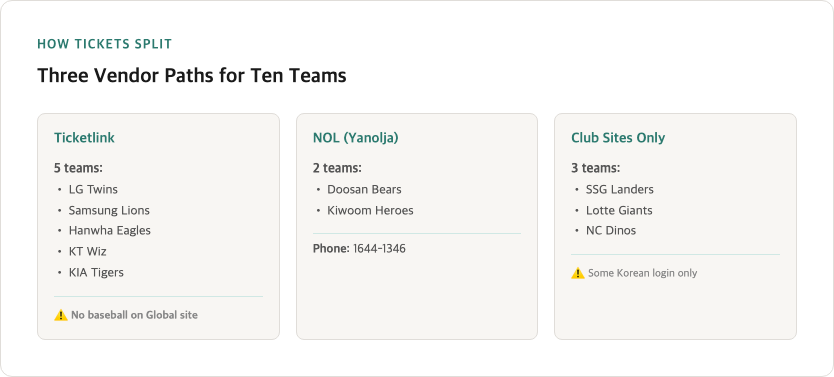
I checked the KBO official ticketing map directly on August 11, 2026, and the split is this: five teams (LG, Hanwha, Samsung, KT, KIA) sell through Ticketlink; two teams (Doosan and Kiwoom) sell through NOL, which is Yanolja’s (야놀자) ticketing brand; three teams (SSG, Lotte, NC) sell only through their own club sites. Five English-language guides I read for this piece — including a Korea Times feature from March 2026 — describe this as “the team’s site or Ticketlink Global or Interpark Global,” which flattens three genuinely different booking paths into one vague sentence. None of them specify which team uses which channel, and one guide that did attempt a team-by-team breakdown misassigned NC to the wrong platform entirely.
This matters beyond ticket-buying logistics. If you’re planning a trip around a specific team or city — say you’re based in Seoul for a few days but want to see Busan, or you’re only free on a weekend and need to know if a stadium is reachable without renting a car — the comparison table below is built to answer that directly, city by city, rather than sending you to ten separate team websites to piece it together yourself. If you haven’t been to a KBO game before, our guide to going to a KBO game covers start times, rain refunds, and what happens at the gate; this piece is only about which stadium to pick.
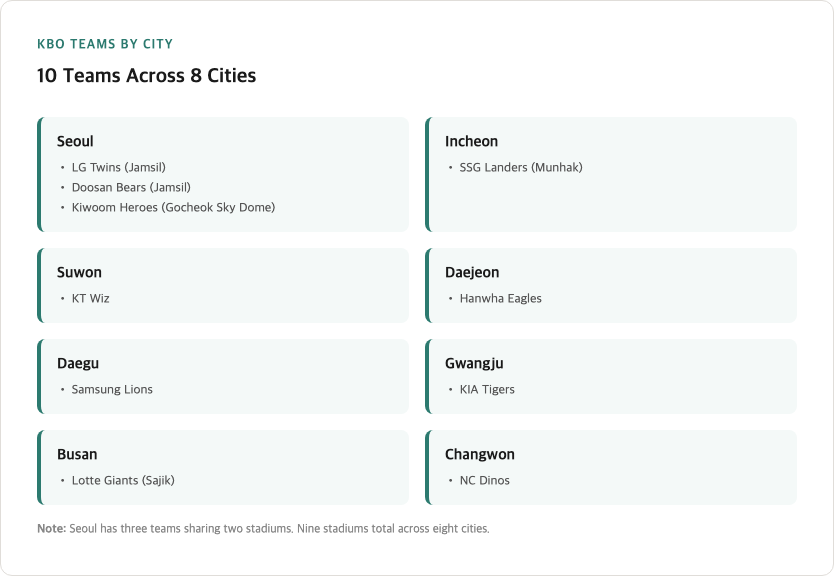
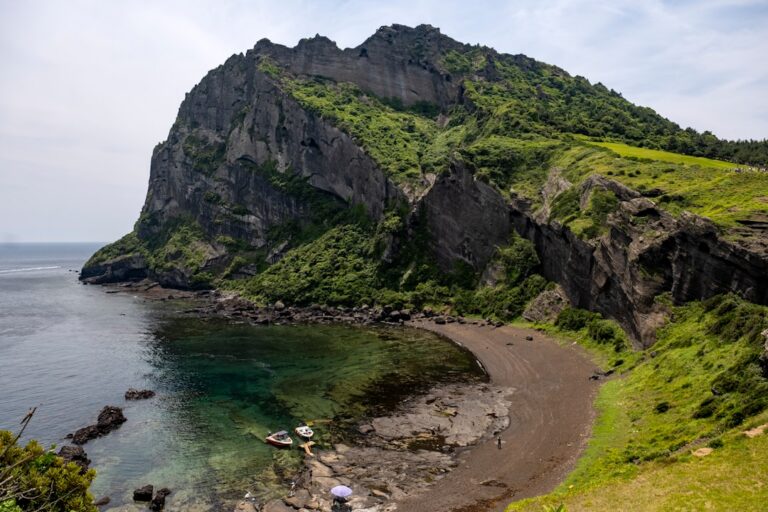
Photo by Diana Polekhina on Unsplash
How Ticket Booking Splits Across Three Vendors
Before the comparison table, it helps to know what “ticket vendor” actually means for each team, because the wrong assumption here is the single most common mistake in English-language KBO guides.
Local tip — I checked the KBO official ticketing map on August 11, 2026, and re-checked the page source on August 12: Doosan and Kiwoom now route through NOL, Yanolja’s ticketing platform. The column is still headed with Interpark’s name, but the phone number printed under it is 1644-1346 and the link goes to
nol.yanolja.com— not the 1544-1555 Interpark number most English guides still cite. Interpark’s ticketing business was folded into the NOL brand, and the guides recommending “Interpark” for these two teams have not caught up. The vendor names on that page are logo images, so this only shows up if you read the underlying links.
A second, more consequential mix-up is what “Global” actually covers. Several guides recommend Ticketlink Global or NOL World as the safe, English-friendly way to buy KBO tickets with a foreign card.
Local tip — I opened Ticketlink’s international site directly on August 11, 2026. Its category menu runs Musical, Concert, Theater, Classical & Dance, Family, Exhibition, eSports, and a Jeju × FC Bayern tie-in — there is no Sports or Baseball category at all. This is not the same as “the platform doesn’t sell baseball”: the domestic Korean-language version of the same company, at
ticketlink.co.kr/sports/baseball, sells KBO games normally. The inventory exists. It just isn’t on the page built for English-speaking customers.
The same pattern holds for NOL. The domestic site (nol.yanolja.com/ticket/genre/sports) lists Doosan and Kiwoom games; the English-facing NOL World does not carry a sports category at all. If a guide tells you to use the “Global” version of either platform for baseball, that instruction was accurate for concerts and stopped being accurate for baseball some time ago.
The step-by-step workaround is a separate topic, covered in our guide to buying KBO tickets as a foreigner — including which sites require a Korean phone number to register and what to do if yours doesn’t have one. This piece is about mapping who sells what, city by city, so you know which stadium’s booking path you’re dealing with before you commit to a team.
Local tip — I checked Klook’s and Trazy’s Korea listings directly on August 11, 2026. Klook returned no KBO ticket products at all. Trazy listed exactly one, covering Seoul Sports Complex (Jamsil) only, priced well above what the same seat costs at the box office. Some English guides describe travel agencies as a general fallback for KBO tickets — as of this check, that fallback only exists if your team happens to be LG or Doosan. OTA catalogues change week to week, so check both yourself before assuming either way.
The 10-Team Comparison Table
Stadium size varies more than the team names suggest — capacity runs from Gocheok Sky Dome’s 16,744 seats up to roughly 25,000 at the shared Jamsil stadium, per Wikipedia’s List of baseball stadiums in South Korea (these figures haven’t been independently re-verified against current seating configurations, so treat them as approximate).
Every price below is quoted for a general adult ticket and comes from the club’s own published 2026 chart, so the rows are comparable to each other. Eight of the ten clubs publish one. Finding them takes some digging: LG puts its chart up as an ordinary HTML table (with an English version beside it), but Samsung, KT and Hanwha publish theirs as a single long image, and KIA’s is drawn from data behind an interactive seat map. SSG and Lotte publish theirs as ordinary web pages. Only Doosan and NC publish no public single-game chart at all — for those two the price appears once you’re already inside a booking flow, so their cells are left as “not published” rather than filled in with a number scraped from a blog post.
One thing that comparison makes obvious, and that none of the English guides I read for this piece mentions: the clubs don’t even price the same way, and four of them don’t use a simple weekday/weekend split at all.
- Samsung sorts games into three day-grades — grey for ordinary Tuesday-to-Thursday games, white for Fridays, Sundays and midweek event games, blue for Saturdays, holidays and weekend event games.
- Hanwha uses five demand tiers, and — unusually — publishes a colour-coded calendar showing which tier every home date falls into, so you can check what your date costs before you book. Its chart also notes that five unscheduled home games have no price yet.
- Lotte goes furthest with seven demand grades, the top one priced case by case.
- Kiwoom is the only club with a seasonal surcharge.
So “how much is a KBO ticket” has no single answer even for one seat in one stadium — it depends on which club you picked and which day you go. The same turns out to be true of what you can carry through the gate: bag sizes and alcohol rules are set club by club too, which our guide to KBO stadium rules, bags, and food works through stadium by stadium.
| Team | City | Stadium | Ticket Vendor | Price Range (as of Aug 2026) | Nearest Station | Travel from Seoul |
|---|---|---|---|---|---|---|
| LG Twins | Seoul | Jamsil Baseball Stadium (잠실야구장) | Ticketlink | ₩10,000 weekday / ₩11,000 weekend outfield, up to ₩100,000 premium | Sports Complex Station (Line 2/9), at the gate | In Seoul |
| Doosan Bears | Seoul | Jamsil Baseball Stadium (shared with LG) | NOL (Yanolja) | Not published on the club’s own site — prices appear inside NOL’s booking flow | Sports Complex Station (Line 2/9) | In Seoul |
| Kiwoom Heroes | Seoul | Gocheok Sky Dome (고척스카이돔) | NOL (Yanolja) | ₩9,000–115,000, seat- and season-dependent (summer surcharge May 19–Sep 6) | Guil Station west exit, 3-min walk (direct to the dome) | In Seoul |
| SSG Landers | Incheon | Incheon SSG Landers Field (문학) | Club site (ticket.ssg.com) |
₩13,000–91,000 across 19 seat zones — the highest entry price in the KBO | Munhak Stadium Station Exit 2, 3-min walk | Line 7 → transfer at Bupyeong-gu Office → Incheon Line 1 |
| KT Wiz | Suwon | Suwon KT Wiz Park | Ticketlink | ₩12,000–70,000, weekday (Tue–Thu) / weekend split | Hwaseo/Seonggyungwan-daehak Station (Line 1) | Direct via Subway Line 1 |
| Hanwha Eagles | Daejeon | Hanwha Life Ballpark (2025) | Ticketlink | ₩12,000–168,000, priced in five demand tiers with a published tier calendar | No official transit guidance published; central Daejeon, 대종로 373 | KTX to Daejeon Station, then bus or taxi |
| Samsung Lions | Daegu | Daegu Samsung Lions Park | Ticketlink | ₩9,000–65,000, priced in three day-grades (grey / white / blue) | Suseong Alpha City Station (Daegu Metro Line 2), beside Gate 21 | KTX to Dongdaegu Station, then transfer |
| KIA Tigers | Gwangju | Gwangju-Kia Champions Field | Ticketlink | ₩10,000–60,000 for regular seats, weekday / weekend split | No subway; nearest Nongseong Station is 30+ min on foot, bus recommended | KTX to Gwangju-Songjeong, then bus |
| Lotte Giants | Busan | Sajik Stadium (사직야구장) | Club site (ticket.giantsclub.com) |
₩4,000–150,000, priced by demand grade (7 tiers), not weekday/weekend | Sajik Station (Busan Metro Line 3), ~5-min walk | KTX to Busan Station, then metro transfer |
| NC Dinos | Changwon | Changwon NC Park | Club site (ticket.ncdinos.com) |
Not published — official notice lists only a ₩399,000 season package | Masan Station, ~1.6km / ~30-min walk | Train to Masan Station (KTX Changwon-jungang station is farther from the stadium) |
Local tip — the station name in most English guides for Daegu is out of date. English write-ups still send you to “Daegongwon Station” for Daegu Samsung Lions Park. That station was renamed Suseong Alpha City Station in 2024, and Samsung’s own 2026 stadium graphic labels it that way, sitting directly beside Gate 21 (the home-side entrance). The station even carries “Samsung Lions Park” as a secondary name now. Search the old name in a Korean map app and you may not find it.
Changwon has the opposite problem — nobody official says anything. NC Dinos’ own site (
ncdinos.com/dinos/stadium.do) gives driving directions and parking only; its section headed “public transport and parking” contains no bus, train or subway information at all, which is why blog posts about reaching Changwon NC Park contradict each other. Distance data across multiple sources puts Masan Station at roughly 1.6km and a 30-minute walk, the figure used above. A widely repeated claim that KTX Changwon-jungang Station is five minutes away doesn’t hold up against that distance data.Local tip — Kiwoom is the only KBO club that charges a summer surcharge, and it is not a flat percentage. Reading the club’s official 2026 price chart row by row, the surcharge window is printed as May 19 to September 6, and the increase is set seat by seat: about 10% on a wheelchair seat, 11% on a standard outfield or fourth-floor seat, and as much as 25–33% on the outfield couple seats. Picking a different seat class changes how much summer costs you. No English-language guide mentions the surcharge at all.
Why Team Names Don’t Tell You the City
Every KBO team is named after its corporate owner rather than its home city — Samsung Lions play in Daegu, not anywhere with “Samsung” in the name; SSG Landers play in Incheon; Hanwha Eagles play in Daejeon. This is a well-documented feature of how Korean pro sports sponsorship works, and it isn’t something worth re-explaining at length here.
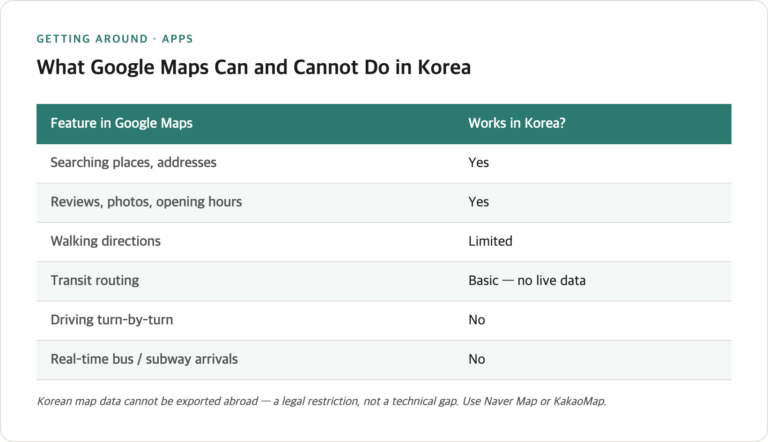
What’s more useful is what this naming convention actually causes for a visitor: you can’t tell which city to book a KTX ticket to from the team name alone, and mapping apps don’t reliably close that gap either. An investigative piece published in November 2025 made this exact point about baseball stadiums specifically — that Google Maps’ driving and walking directions do not work inside Korea, because high-precision Korean map data generally cannot be exported abroad, so getting to a ballpark means switching to Naver Map or Kakao Map. Worth noting that the same piece doesn’t treat that switch as a clean fix: the foreign fans it followed described Naver Map as hard to use without Korean, with patchy English labelling. If you haven’t set up an alternative navigation app before you land, our guide to Google Maps alternatives in Korea covers what actually works.
Getting to the Hardest Stadiums to Reach
Access varies more than most guides suggest. Seoul, Incheon, Busan and Daegu all put their stadiums within a few minutes’ walk of a subway exit. Gwangju and Changwon do not, and Daejeon’s club publishes no transit guidance at all.
Gwangju-Kia Champions Field has no direct subway connection at all, and the nearest station on the city’s single operating line is over a 30-minute walk. A second line has been under construction for years, with its opening date pushed back repeatedly, so rail isn’t a near-term fix. In practice you arrive by KTX at Gwangju-Songjeong and take a bus or taxi from there. Gwangju Station sits much closer to the ballpark — roughly a ten-minute bus ride — but it isn’t a KTX stop, so don’t plan your inter-city leg around it. Changwon NC Park sits closer to Masan Station than to the KTX-served Changwon-jungang Station, but “closer” still means roughly half an hour on foot — realistically a bus or taxi trip rather than a walk.
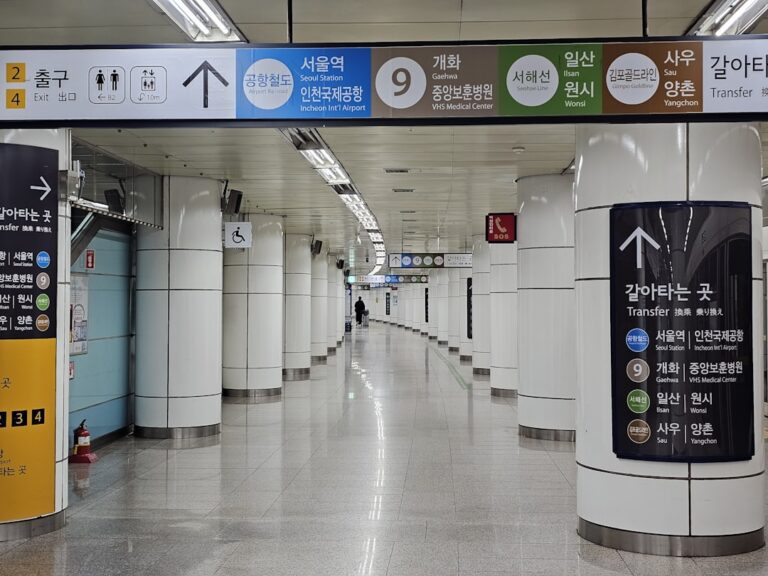
For any city outside Seoul, our KTX booking guide covers how to book the inter-city leg; from there, the last-mile transit column in the table above tells you what to expect once you arrive. Inside Seoul, our subway guide covers Sports Complex and Guil stations directly.
Gocheok Sky Dome Also Hosts K-pop Concerts
Kiwoom Heroes play at Gocheok Sky Dome, the only domed stadium in the KBO. On days without a Kiwoom home game, the same building runs as a concert venue — its seating configuration, gate structure, and access from Guil Station have already been covered in detail in our guide to Seoul’s K-pop concert venues, which goes deeper into seat-block numbering and venue layout than a baseball-focused piece needs to. If you’re deciding between a game and a concert at the same building, that guide is the more useful read for the venue itself.
What You Need to Know
-
If you’re choosing Jamsil, choose it for 2026. This is the stadium’s final season before demolition, and LG and Doosan move to an interim venue from 2027. The Jamsil rows above describe the stadium as it stands for the 2026 season only; the 2027 move changes both the seating and the way you get in, covered in our guide to Jamsil’s final season and where KBO games go next.
-
Three teams don’t use either major vendor. SSG, Lotte, and NC sell exclusively through their own club sites, and two of those (Lotte, NC) go straight to a Korean-only login page with no guest checkout.
- “Global” ticket platforms are built for concerts, not baseball. Ticketlink Global and NOL World both carry K-pop and musical inventory but no sports category — checking the domestic version of the same site is the actual fix, not a workaround.
- Only two clubs keep their prices private. Eight publish a full 2026 chart, though often as an image rather than text; Doosan and NC don’t publish one at all, and this guide leaves those two cells empty rather than filling them with unverified blog numbers.
- OTA coverage stops at Jamsil. I checked Klook’s and Trazy’s Korea listings directly on August 11, 2026: Klook returned no KBO ticket products, and Trazy listed exactly one, for Seoul Sports Complex only. If your team plays anywhere else, there’s no travel-agency shortcut — though these catalogues change often enough to be worth re-checking.
- Kiwoom’s prices move with the calendar. The dome’s official 2026 chart adds a summer surcharge between May 19 and September 6, set individually per seat class rather than as one flat rate — roughly 10% at the low end and up to about a third more on the outfield couple seats.
Practical Tips
- Match your team to your itinerary, not team strength. If you’re only in Seoul, LG, Doosan, and Kiwoom are all reachable without an inter-city trip. Anything else means budgeting a KTX leg.
- Check your team’s vendor before you try to pay. Five teams route through Ticketlink, two through NOL, and three only through their own club site — trying the wrong platform wastes time you won’t get back before first pitch.
- Don’t default to “Global” sites for baseball. If a guide sends you to Ticketlink Global or NOL World for a KBO ticket, check the domestic version of the same platform instead, or plan on a walk-up purchase.
- Carry cash and a passport as a backup for Lotte and NC games. Both clubs’ own booking sites go straight to a Korean-only login screen with no guest checkout option, and our guide to Korean ATMs for foreigners covers which machines reliably accept foreign cards.
- Budget extra transit time for Gwangju and Changwon. Neither puts you within a short walk of a station the way Seoul, Incheon, Busan or Daegu does — plan on a bus or taxi for the last leg.
- Check which pricing system your club uses before you budget. A Samsung, Hanwha or Lotte ticket can cost noticeably more on a high-demand date than the headline figure suggests, and Kiwoom adds a summer surcharge. Only Doosan and NC publish no chart at all — treat any number quoted elsewhere for those two with caution.
- If a guide says an OTA sells your team’s tickets, check it yourself. As of August 2026, Klook and Trazy’s baseball inventory covers Jamsil and nothing else.
Frequently Asked Questions
Which KBO team should I support as a first-time visitor?
There’s no wrong answer competitively, but the practical filter is location. If you’re spending most of your trip in Seoul, LG, Doosan, or Kiwoom require no extra travel. If you’re already planning a Busan trip, Lotte fits naturally into that itinerary. Picking a team primarily by how far you’ll need to travel tends to work better than picking by team record.
Does Busan have a KBO team?
Yes — the Lotte Giants play at Sajik Stadium (사직야구장), reachable via Sajik Station on Busan Metro Line 3, roughly a five-minute walk according to Korean-language sources, which is shorter than the ten minutes some English guides cite. Ticket sales run only through the club’s own site, not through Ticketlink or NOL — our guide to the Lotte Giants at Sajik Stadium covers that club’s booking rules in detail. If you’re building a Busan trip around a game, our guides to where to stay in Busan and Busan’s other attractions cover the rest of the itinerary.
What KBO teams play in Seoul?
Three: LG Twins and Doosan Bears share Jamsil Baseball Stadium, and Kiwoom Heroes play at Gocheok Sky Dome. All three stadiums sit directly on a subway line.
Are Ticketlink Global or NOL World reliable for buying KBO tickets?
Not for baseball specifically. Checked directly in August 2026, neither English-language “Global” platform carries a sports or baseball category — both are built around concerts, musicals, and exhibitions. The domestic Korean-language versions of the same companies do sell KBO tickets, which is why some guides describe these platforms as valid for baseball: the confusion is between the domestic site and its English-facing counterpart.
Why don’t Korean baseball team names include their city?
KBO teams are named after their corporate owners rather than their host cities — a longstanding convention in Korean pro sports sponsorship. The practical consequence for visitors is that the team name alone won’t tell you which city to book travel to, which is also why mapping apps and city names in guides don’t always line up cleanly.
Which KBO stadium is easiest to reach without a car?
Jamsil, Gocheok Sky Dome, Incheon SSG Landers Field, Sajik Stadium and Daegu Samsung Lions Park all sit within a few minutes’ walk of a subway or metro exit. Gwangju-Kia Champions Field is the hardest — no subway line reaches it, and the nearest station on Gwangju’s one operating line is over 30 minutes on foot.
Do Kiwoom Heroes tickets cost more in summer?
Yes. The club’s official 2026 chart runs a summer window from May 19 to September 6 and raises prices seat class by seat class rather than by one flat percentage — around 10% on the cheapest categories, roughly 11% on a standard outfield seat, and up to about a third more on the outfield couple seats. Kiwoom is the only KBO club operating a seasonal chart like this, and it isn’t mentioned in English-language guides, so budget for it if you’re visiting Gocheok Sky Dome between those dates.
Is there a stadium price list that covers all 10 teams?
Not quite, as of this guide’s last check — the table above is as close as it gets. Eight clubs publish a full 2026 single-game chart, and those figures are used directly here. The catch is that several publish it as an image rather than text, which is why it doesn’t show up in search results and why English guides tend to skip it. Doosan and NC publish nothing public, so their prices only appear once you’re inside a booking flow.
Related Questions
- How Do You Get Around Korea Without a Car?
- Is It Better to Pay Cash or Card in Korea?
- Do You Need an eSIM or Korean Phone Number for Bookings in Korea?