Do You Need a Visa for Korea? The 90-Day Rule Most Guides Get Half Right
Quick Answer
Most tourists from visa-waiver countries can enter Korea without a visa for up to 90 days (some nationalities get 30 or 60). The detail guides skip: visa-free entry cannot be extended beyond the original 90 days from your entry date except in narrow circumstances — you cannot simply add more time on arrival. Separately, a K-ETA travel authorisation may or may not be required depending on a temporary exemption, which is a different question from the visa itself.
The Full Answer
“Do I need a visa for Korea?” has a simple headline answer for most travellers — no, not for a short trip — and a more tangled set of details underneath that guides tend to flatten.
Two things get muddled. First, “visa-free for 90 days” is true, but what you can and cannot do with those 90 days is stricter than the phrase implies. Second, the K-ETA travel authorisation is a separate requirement that people confuse with the visa. I checked the immigration guidance and consular notices in July 2026 to separate them cleanly, because conflating the two is the most common mistake in English write-ups.
This is general information, not immigration advice — always confirm your own nationality’s status on the official K-ETA site and your nearest Korean consulate before travelling.
Visa-Free Entry: How Long You Actually Get
The visa-free period depends on your nationality.
| Duration | Typical nationalities |
|---|---|
| 90 days | Most of Europe, US, Canada, Australia, NZ |
| 60 days | Some countries |
| 30 days | Some countries |
Your period is stamped or recorded on entry, and it counts from your arrival date.
Local tip — Visa-free entry cannot be extended past the original 90-day limit just because you want to stay longer. Extensions of stay for visa-free entrants are handled far more restrictively than for long-term visa holders, and “I’ll extend it once I’m there” is not a reliable plan. If you know you need more than 90 days, that is a visa question to sort out before you travel, not on arrival.
The 90 days is also a hard ceiling for the whole stay, not a renewable allowance — leaving and re-entering to reset the clock is a grey area that immigration scrutinises.
The K-ETA Is a Separate Question
This is where most confusion lives.
A K-ETA (Korea Electronic Travel Authorization) is an online pre-approval, distinct from the visa. Being visa-exempt does not automatically tell you whether you need a K-ETA, because Korea has run a temporary K-ETA exemption for many nationalities.
Local tip — As of 2026, a temporary exemption means travellers from many countries can enter without applying for a K-ETA at all — but this is a year-by-year measure that has been extended more than once, sometimes announced close to expiry. Check your nationality’s current status on the official K-ETA site rather than assuming, and treat any guide written more than a few months ago as potentially out of date. The full detail is in the K-ETA guide.
So the two questions stack:
- Do I need a visa? — usually no, for a short tourist trip
- Do I need a K-ETA? — depends on the current exemption for your nationality
They are answered separately, and getting a “no” on the first does not answer the second.
What 90 Days Does Not Cover
Visa-free entry is for tourism and short visits. It does not authorise:
- Working, paid or unpaid, including remote work in some interpretations
- Long-term study — a student visa is separate
- Staying beyond the stamped period — overstaying carries fines and re-entry bans
Local tip — If you are staying longer term — over 90 days — you must complete alien registration within 90 days of entry, which is a different track entirely from tourist entry. For an ordinary holiday this never comes up, but digital nomads and long-stay visitors routinely underestimate how firm the 90-day tourist ceiling is.
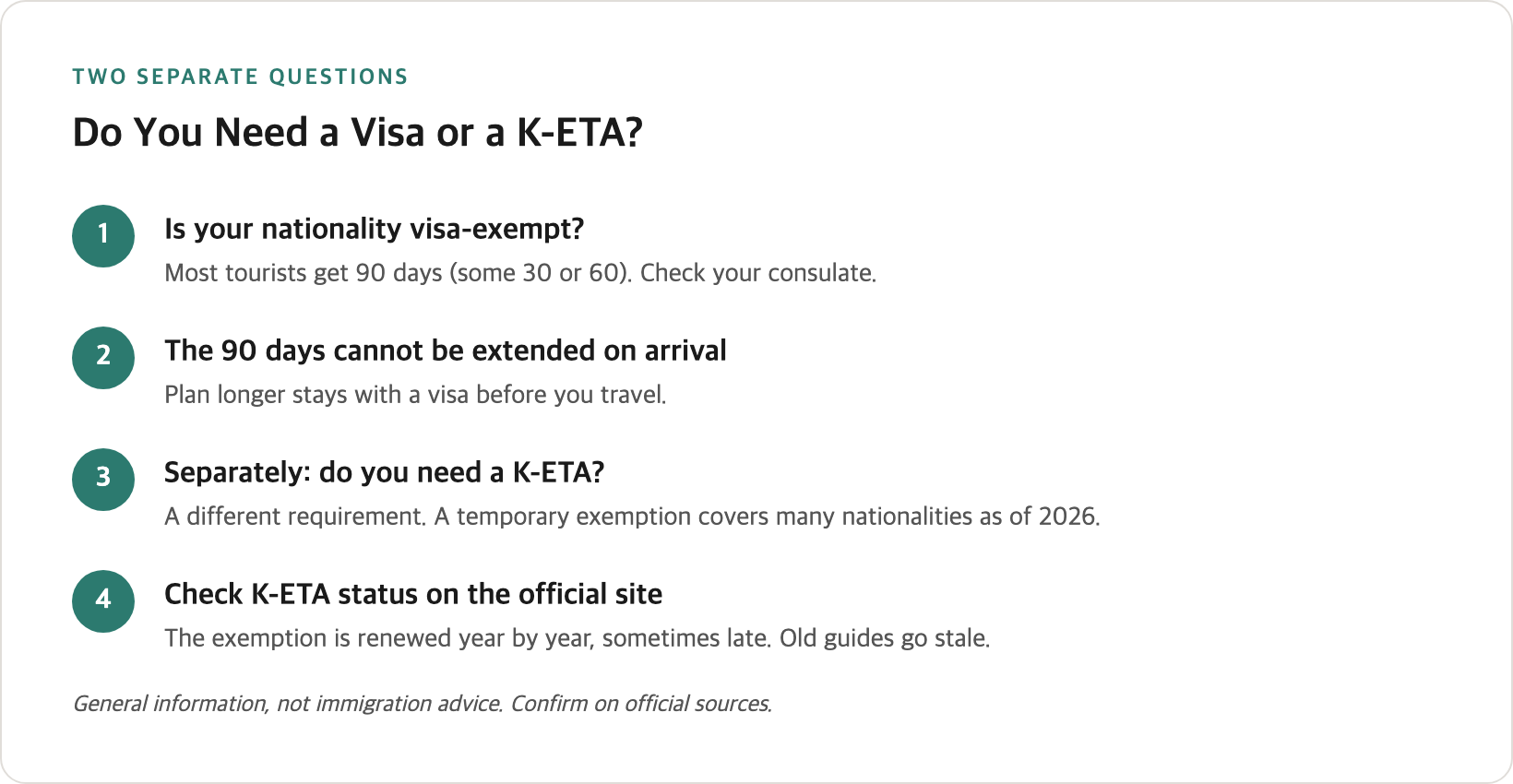
Photo by hannah park on Unsplash
What You Need to Know
-
Most short-trip tourists need no visa — 90, 60 or 30 days by nationality.
-
The 90 days cannot simply be extended on arrival. Plan longer stays before you travel.
-
The K-ETA is a separate requirement from the visa, subject to a temporary exemption.
-
The exemption is renewed year by year, sometimes late — always check current status.
-
Visa-free entry is for tourism, not work or long-term study.
-
This is general information. Confirm your nationality on official sources before booking.
-
Budget and connectivity are separate prep. See the weekly cost breakdown and eSIM options.
Practical Tips
-
Check your nationality’s visa-free period on your nearest Korean consulate’s site.
-
Check the K-ETA exemption separately on the official K-ETA site — it is a different question.
-
Don’t plan to extend a 90-day stay on arrival. Sort a visa first if you need longer.
-
Carry proof of onward travel. Immigration can ask for it on visa-free entry. A booked flight works, and so does a sea crossing such as the Busan–Fukuoka ferry. Sort your arrival transport too, so you’re not stuck at the gate deciding.
-
Don’t work on a tourist entry, including grey-area remote work.
-
Treat old guides with caution — the K-ETA exemption changes yearly.
-
Register within 90 days if you’re staying long-term — a separate process from tourist entry.
Frequently Asked Questions
Do I need a visa to visit South Korea?
Most tourists from visa-waiver countries do not, for stays of up to 90, 60 or 30 days depending on nationality. Check your specific country’s allowance.
Can I extend my stay beyond 90 days?
Not easily. Visa-free entry cannot generally be extended past the original 90-day limit on arrival. Longer stays need a visa arranged in advance.
Is a K-ETA the same as a visa?
No. A K-ETA is a separate online travel authorisation. As of 2026 a temporary exemption means many nationalities do not need one, but this is checked separately from the visa question.
What happens if I overstay?
Overstaying the visa-free period carries fines and can result in a re-entry ban. Leave within your stamped period.
Can I work in Korea visa-free?
No. Visa-free entry is for tourism and short visits, not employment, including in many cases remote work.
How do I know if I need a K-ETA?
Check your nationality on the official K-ETA website, since the temporary exemption is updated year by year. See the K-ETA guide for detail.
How much should I budget once I’m in?
See the weekly cost breakdown. Sorting a transit card and mobile data on arrival covers the essentials.
Related Questions
- Do You Need a K-ETA to Visit Korea?
- Korean Age in 2026: Why the Drinking Age Still Uses the Old System
- How Much Does a Week in Korea Cost?
- Drinking Age in Korea: Who Can Legally Drink, and How It’s Counted
- Korea VAT Refund in 2026: The Instant Route, and the Rule That Just Changed