How to Visit Yangdong Folk Village — What ₩4,000 Doesn’t Open
Last Updated on August 27, 2026
How to Visit Yangdong Folk Village — What ₩4,000 Doesn’t Open
Quick Answer
Yangdong Folk Village (양동마을) costs ₩4,000 for adults (as of 2026), but the ticket doesn’t open doors. General houses aren’t open to visitors at all, and even the nationally designated “treasure” houses only show their outer courtyard — not the main hall (안채). The free, six-times-daily guided tour is the practical way to see more of the village than a self-guided walk allows, and buses stop 1.2km short of the entrance either way.
The Full Answer
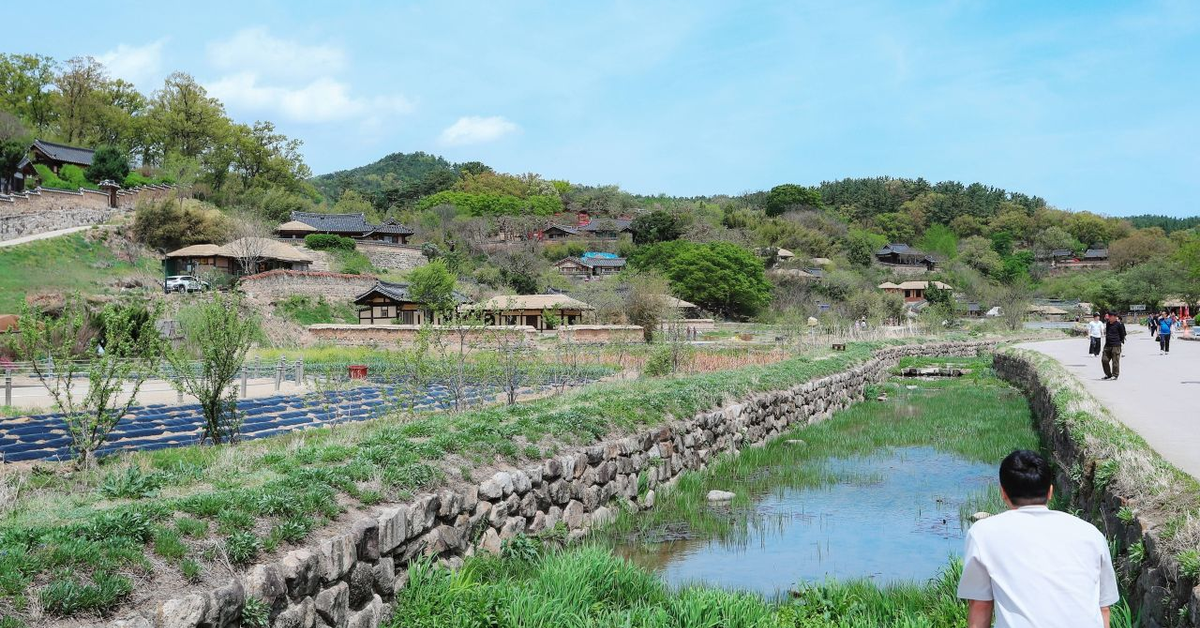
Yangdong is a working village, not a reconstructed one. Families still live inside it, in hanok that date back to the Joseon dynasty — the operator’s own page describes it as Korea’s largest Joseon-era yangban village (반촌). That’s the reason it was inscribed as a UNESCO World Heritage Site in 2010, jointly with Hahoe Village in Andong, under the name “Historic Villages of Korea.” It’s also the reason your ₩4,000 admission fee doesn’t come with the kind of access a museum ticket implies.
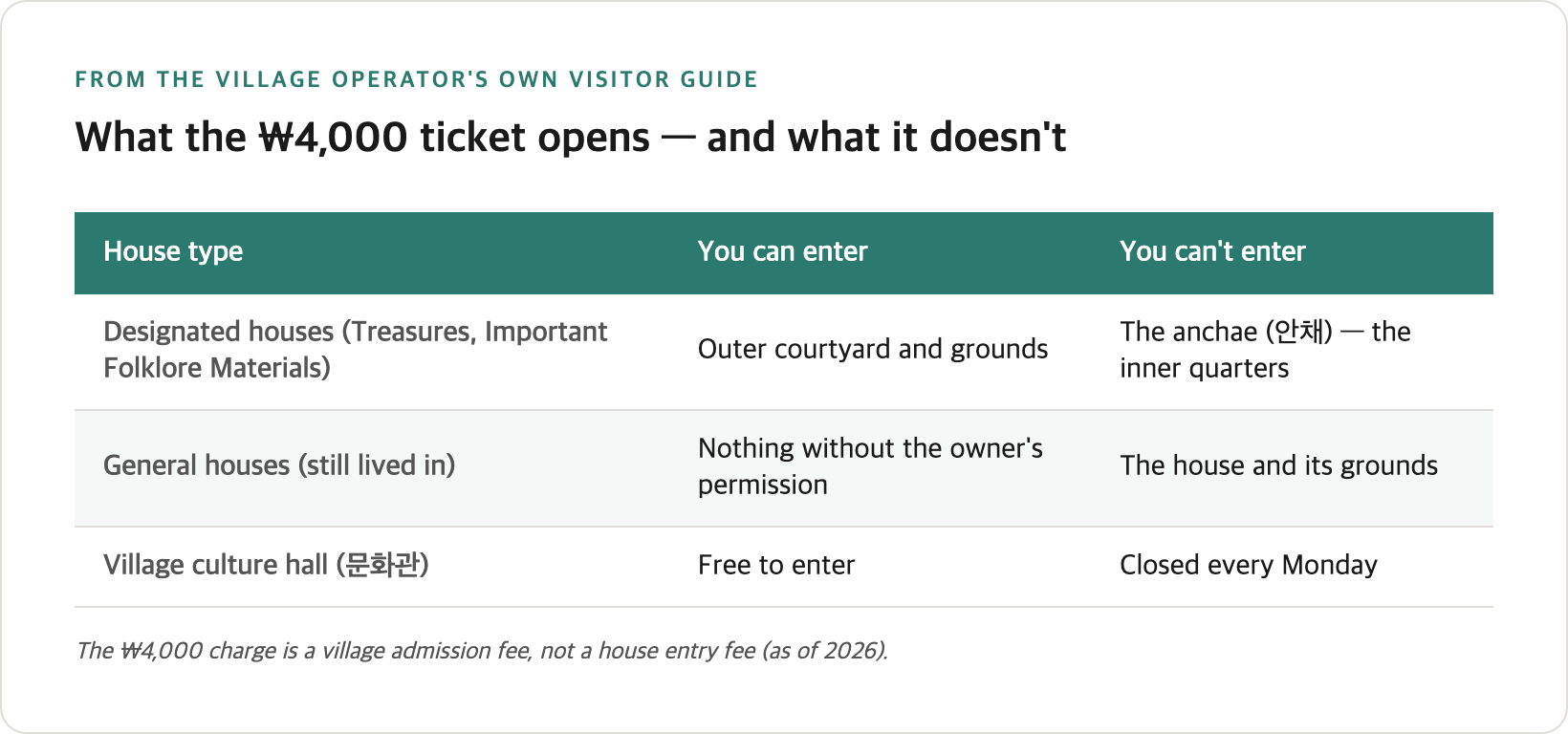
I opened the village operator’s own visitor guide (yangdongvillage.or.kr) directly rather than relying on a summary, because the access rules are the actual spine of a Yangdong visit — most planning guides skip straight to “how pretty it is” without saying what you can and can’t walk into. The Korean original is blunt about it: “일반가옥은 개방하지 않습니다. 주인의 허락없이 가옥 출입은 불가합니다” (“General houses are not open. Entry without the owner’s permission is not allowed”). For the protected houses — the ones with Treasure or National Folklore Cultural Heritage status — the same page says “지정 가옥은 안채를 제외한 외부 공간만 개방 됩니다” (“Designated houses open only their outer space, excluding the main hall”). That single sentence is the whole logic of the village: people still live here, so the public sees courtyards and roofs, not living rooms.
This isn’t a hidden catch. It’s just rarely stated plainly in English-language guides, which tend to describe Yangdong as a place to “step inside centuries-old hanok” without qualifying what “inside” means.
What Your ₩4,000 Ticket Actually Opens
Yangdong has 20 nationally designated cultural properties, including three Treasures — Mucheomdang (무첨당), Hyangdan (향단), and Gwangajeong (관가정) — plus a wider group of houses designated National Folklore Cultural Heritage, among them Songcheom (송첨, also called Seobaekdang), Nakseondang, Sahodang, Sangchunheon, Geunamgotaek, Dugokgotaek, Sujoldang, Ihyangjeong, Suunjeong, Simsujeong, Allakjeong, and Ganghakdang.
These are the houses you can actually approach — walk into the gate, stand in the outer courtyard, look at the roofline and the layout — without needing anyone’s permission. What you’re not getting into, at any of them, is the anchae (안채), the inner women’s quarters that functioned as the private core of a traditional Korean house. General houses, meaning any residence without protected status, aren’t part of the public route at all; the operator’s guide is explicit that entering one requires the owner’s own permission, not a ticket.
Local tip — the “treasure” label doesn’t mean full access. Even Mucheomdang, Hyangdan, and Gwangajeong — all formally Treasures under Korean heritage law — open only their outer courtyards, per the village’s own visitor guide. English-language write-ups of Yangdong routinely describe these three houses as highlights worth photographing, which is accurate, but rarely mention that “worth photographing” is also the ceiling of access. Set expectations before you go rather than after.
Of the ten most recent TripAdvisor reviews for Yangdong Folk Village as of August 2026 — a small sample, not the full 256-review history — three independently raised the same complaint without prompting: that only a handful of houses turned out to be enter-able, and that this wasn’t clear beforehand. One visitor who toured with a guide noted that getting inside a house at all depended on the guide securing the owner’s permission on the spot, which lines up with the operator’s own rule rather than contradicting it. Small sample size aside, it’s a consistent enough pattern to say the access limits genuinely surprise people who show up expecting a hanok museum.
Take the Free Guided Tour to See More
If the exterior-only rule is the ceiling, the village’s own guided tour is the closest thing to a way past it. I checked Gyeongju City’s official tourism page for this schedule first, since it’s the more prominent English-language source, and its table leaves the Yangdong tour-time column blank, deferring to the village’s own site with a note that Korean-language guiding is handled there — so the six-times-daily schedule below comes from the village operator directly, not the city page. According to the operator’s tour page, sessions run six times a day — 10:00, 11:00, 13:00, 14:00, 15:00, and 16:00 — each lasting about two hours, with no lunchtime session at noon. The tour is time-based rather than reservation-based: the page states plainly that it runs “시간제로 운영됩니다” (on a fixed schedule) and that “인원 제한없이 누구나 신청이 가능합니다” (anyone can join, with no headcount limit). Guides are available in Korean, English, Japanese, and Chinese, and sign-up happens on the spot at the “해설사의 집” (Guide’s House) near the village entrance, by Yangdong Elementary School’s front gate — not through an online booking system.
This is worth putting next to what the paid market charges for the same village. On GetYourGuide, the only Yangdong-specific tour listed is a 4.5-hour private tour starting at ₩300,000. I opened that listing directly rather than trusting a summary, since the group size is easy to miss — the fine print caps it at two people, which works out to roughly ₩150,000 per person, not ₩300,000 (as of August 2026). Viator’s closest equivalent bundles Yangdong into a 9-hour private car itinerary at ₩664,563 (as of August 2026), with roughly three hours actually spent in the village. Neither of those is a bad option if you want a private guide and door-to-door transport — but it isn’t the only paid alternative either. GetYourGuide also lists a separate, non-Yangdong-specific “official walking tour” of Gyeongju for about ₩10,000 (roughly $7), running 20–30 minutes — so the real choice isn’t “₩300,000 or nothing.” It’s a spectrum: a short paid city walking tour, a full private Yangdong-only tour in the ₩150,000-per-person range, or the village’s own free, unreserved, six-times-daily option that covers the same ground.
Local tip — the free tour and the ₩300,000 tour see the same houses. Neither one gets you past a general house’s front gate or into a treasure house’s anchae — that limit applies regardless of what you pay. The paid option buys transport, privacy, and scheduling flexibility. It doesn’t buy access the free tour lacks.
Registration is in person only, at the Guide’s House near the entrance; the operator lists a direct contact number, 010-8960-4230, for questions about the day’s schedule.
Getting to Yangdong Folk Village
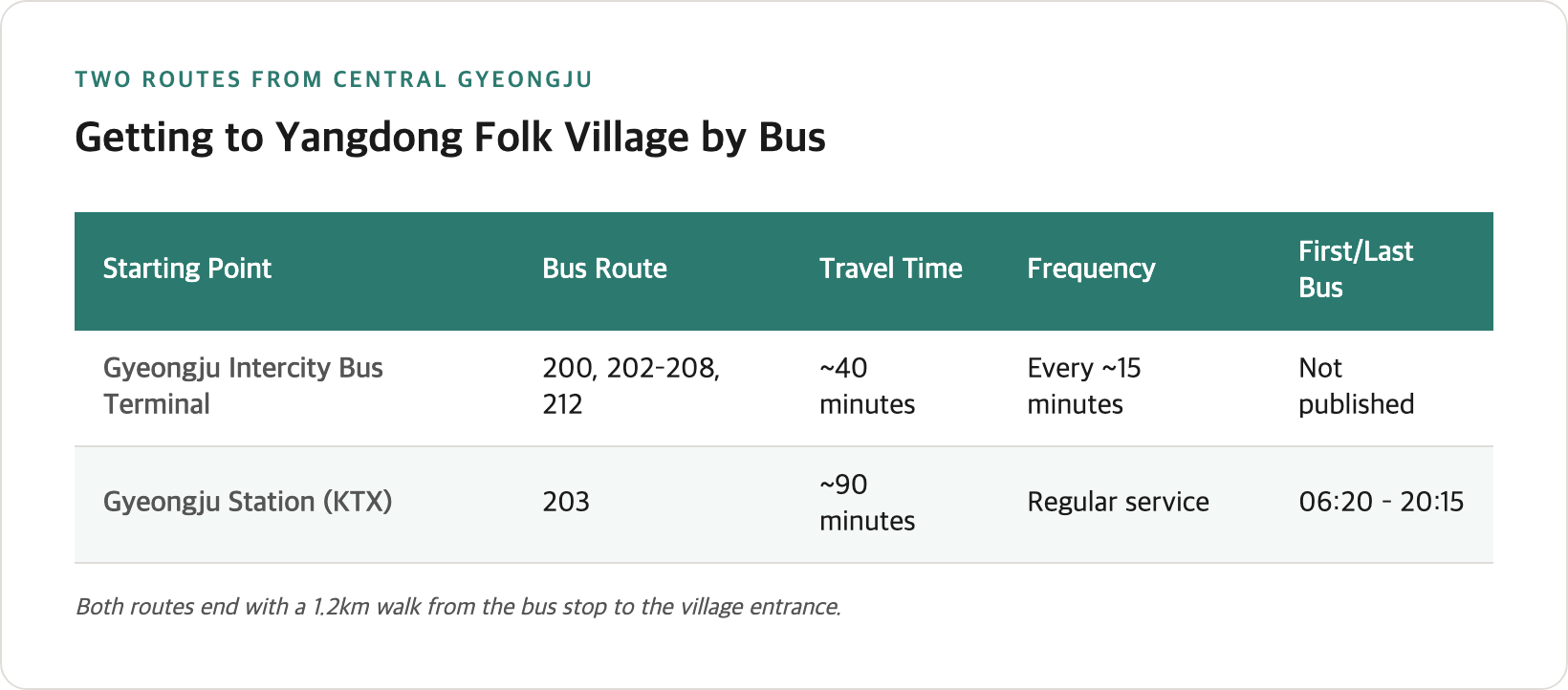
Yangdong sits outside central Gyeongju, and neither of the two public transit options drops you at the gate. According to the village’s own directions page, there are two practical routes:
From Gyeongju Intercity Bus Terminal: buses 200, 202 through 208, and 212 run roughly every 15 minutes and take about 40 minutes to reach the “Yangdong Village entrance” stop.
From Gyeongju Station (the KTX station): a single route, bus 203, makes the trip in about 90 minutes, with a first bus at 06:20 and a last bus at 20:15 (as posted on the operator’s directions page in August 2026).
Neither route ends at the village itself. The operator’s directions page states it directly: “마을입구에서 마을까지 1.2km도보” — from the village entrance stop to the village proper is a 1.2km walk. English-language guides that cover Yangdong’s bus numbers and travel times — and some do get those details right — generally stop there, without flagging the walk or the fact that only the KTX-station route has posted first/last bus times. If you’re coming from Gyeongju Station specifically, the last 203 bus at 20:15 is worth building your day around, not just the outbound schedule.
Local tip — plan around the last bus, not just the first. The 90-minute KTX-station route (bus 203) is the only one with a published last departure: 20:15. The 40-minute terminal route (buses 200/202–208/212) runs more frequently but its schedule page doesn’t list a comparable last-bus time — treat the terminal route as the faster option and the 203 route’s 20:15 cutoff as the one hard deadline to know in advance.
If you’re driving or using a mapping app, note that Google Maps doesn’t fully work for navigation inside Korea — Naver Map or Kakao Map will get you a workable route to the village, including the walk from the bus stop. For the KTX leg itself, it’s worth checking KTX booking and refund rules before you lock in a same-day return, especially if you’re timing your trip around the last 203 bus. And if you’re new to Korea’s transit cards, the buses on both routes take one — no separate ticket is needed for the local bus legs, and Gyeongju’s own fare notice lists a ₩50 discount for paying by card rather than cash (as of 2026).
For the wider question of getting around the region beyond this one village, the general guide to getting around Korea covers how the intercity bus and rail systems connect.
Comparing Yangdong Village, Gyochon Village, and Hahoe Village
Gyeongju has a second, more central historic village — Gyochon (교촌마을) — and visitors researching Yangdong often end up asking whether it’s worth doing both, or whether Hahoe Village in nearby Andong (하회마을, also UNESCO-listed alongside Yangdong) is the better use of a day. Here’s how the three actually compare on the points that matter for planning, based on the operators’ own information where available:
| Yangdong | Gyochon | Hahoe (Andong, reference only) | |
|---|---|---|---|
| Admission | ₩4,000 adult / ₩3,400 group (as of 2026) | Free — the city’s own listing states “관람시간: 정해진 관람시간 없음 / 관람료: 무료” (no fixed hours, no fee), though it also notes that each experience venue sets its own hours and fees | Reported at roughly ₩5,000 for adults in third-party listings; not independently confirmed here — Hahoe sits outside Gyeongju and this guide doesn’t cover its logistics directly |
| Who lives there | A working village — families still live in and around the protected houses | Reorganized around commercial and hands-on spaces — cafés, a performance hall, and experience programs including hanbok, pottery, and traditional tea — with less residential character | Also a living village, by third-party accounts; not independently confirmed here |
| Inside the houses | Exterior-only for designated houses; general houses closed entirely, per the operator’s own guide | Not comparable in the same way — most Gyochon buildings function as businesses open to paying customers rather than private residences | Not independently confirmed here |
| Getting there | Bus + 1.2km walk from either Gyeongju access point | Walkable from central Gyeongju, near Woljeonggyo bridge | Via Andong’s own bus network and a shuttle from the Hahoe ticket office, by third-party accounts |
Gyochon has no fixed visiting hours and no entry fee, and it functions more like a historic commercial district than a residential village — worth treating as a different kind of stop rather than a substitute for Yangdong. Hahoe is genuinely comparable in scale and UNESCO status, but it’s in Andong, outside this guide’s Gyeongju coverage, so treat the figures above as reference points to research further rather than confirmed planning numbers.
Staying Overnight in a Hanok Homestay
Yangdong runs its own traditional homestay program directly through the village operator, separate from any hotel or guesthouse booking platform. According to the operator’s booking guide, check-in runs from 14:00 to 22:00 on the day of your stay, and check-out is by 11:00 the next morning; arriving after 22:00 requires calling ahead. Inside the rooms, open flame is explicitly banned — the page states it as “객실 내에서는 절대 직화(直火) 금지입니다” (open flame is strictly prohibited in the rooms), which matters if you were picturing a traditional wood-fired ondol experience; cooking or heating with open flame isn’t part of it.
Cancellations follow a two-tier schedule, not a flat “no refund” policy:
- Cancel one day or more before your stay date: you get back 50% of the room rate.
- Cancel on the day of your stay: no refund.
That’s a meaningfully different picture from what booking aggregators can tell you. I searched for this village-run homestay program on Trip.com, Hotels.com, and AsiaYo, and all three surface general hotel listings “near Yangdong Folk Village” rather than the village’s own homestay program — and where they mention cancellation at all, it’s a generic “policy varies by property, check before booking” note. The actual step-down structure — 50% back if you cancel a day ahead, nothing back same-day — only exists on the operator’s own page.
Local tip — same-day cancellation loses the whole payment, but a day’s notice gets half back. This isn’t published anywhere the major booking aggregators show. If your Yangdong plans might shift, cancel the night before rather than the morning of — it’s the difference between a 50% refund and none.
Bookings require a deposit paid in advance by bank transfer, in the guest’s own name, confirmed by phone — carrying enough cash or a working card for that kind of transfer is worth sorting out before you arrive in Gyeongju, and knowing where you can withdraw won at a Korean ATM helps if the deposit needs to be arranged in person. Pets aren’t allowed in the rooms, and minors can’t stay without an accompanying guardian.
The Village Culture Hall and Walking Trails
Near the village entrance is a small culture hall (문화관) that’s free to enter and closed every Monday, according to the operator’s own guide. Its posted opening and closing hours are inconsistent on the operator’s site itself — the summer listing shows only a date range with no time, and the winter listing shows a month range and a single time that reads as a closing hour rather than clearly labeled hours. Rather than repeat a garbled time as fact, the practical move is to call ahead: 054-779-6127.
Beyond the culture hall, the village maintains seven marked walking routes of varying length, from a 20-minute loop through the lower village to a two-hour route connecting four of the designated houses — Songcheom, Mucheomdang, Hyangdan, and Gwangajeong — described on the operator’s map as the “representative houses” course. That two-hour figure is the official maximum for a self-guided walking route, which is worth knowing because online estimates for a Yangdong visit vary widely — two recent visitor reports put the total at about two hours 45 minutes including transit (October 2025) and four to five hours (July 2025). That’s two accounts, not a survey. The gap is plausibly explained by how much of that time is travel and waiting versus time inside the village itself, though neither report spells out the breakdown, so treat that as a reasonable read rather than a confirmed cause.
What You Need to Know
- Ticket hours run seasonally. Summer (April–September) ticketing runs 09:00–18:00; winter (October–March) runs 09:00–17:00, per the operator’s admission page as posted in August 2026 — worth re-checking before a late-afternoon arrival, since seasonal timetables shift.
- A long list of visitors get in free. Gyeongju residents with local ID, seniors 65 and older, children 7 and under with a guardian, holders of a disability certificate, national merit recipients and their families, Yangdong descendants attending clan events, and on-duty government officials all enter without charge. Residents of nearby Pohang, Yeongdeok, Uljin, and Ulleung get a 50% discount with ID.
- Bicycles and pets aren’t allowed inside the village grounds. The operator’s rules state this plainly — plan to walk the whole visit.
- Photography restrictions are narrower than some travel sites suggest. The village’s own visitor rules prohibit commercial-purpose photography and the use of specialized equipment; a general courtesy request to ask residents before photographing them, which appears on some third-party tour platforms, is good practice but isn’t part of the operator’s own posted rules.
- Children need a guardian present. The operator’s rules specify that children should be accompanied by a guardian throughout the visit.
- Rowdy or disruptive behavior is explicitly barred, per the same visitor guide, since this is still a residential neighborhood, not a museum campus.
Practical Tips
- Register for the free tour at the Guide’s House, not online. Sign-up happens in person near the village entrance, by Yangdong Elementary School’s front gate — there’s no advance reservation system to use instead.
- Time your visit around a tour slot. With sessions at 10:00, 11:00, 13:00, 14:00, 15:00, and 16:00, arriving 15–20 minutes ahead of one gives you the best shot at joining without a long wait, since it’s first-come, unlimited headcount.
- If you’re arriving via Gyeongju Station, track the last 203 bus (20:15). It’s the only route with a posted last departure — the terminal buses run more frequently but don’t publish a comparable cutoff.
- Budget the 1.2km walk into your schedule either way. Neither bus route reaches the village gate directly.
- Don’t expect to walk inside a house without a guide’s help. Even with the free tour, entry beyond a courtyard depends on the resident owner’s permission on the day — it isn’t guaranteed for either the free or paid tour.
- If you’re weighing a private tour, compare per-person cost, not the listed group price. A ₩300,000 GetYourGuide tour (as of August 2026) caps at two people, so it’s closer to ₩150,000 per person — check the fine print before assuming it’s per traveler. If you’re still mapping out an overall trip budget, a breakdown of what a week in Korea actually costs is a useful sanity check against tour-platform pricing.
- Call ahead for culture hall hours rather than trusting the posted times. The operator’s own site has inconsistent hour listings; 054-779-6127 is the direct line.
Frequently Asked Questions
What can I actually see inside the houses at Yangdong Folk Village?
Only the outer courtyards of the village’s 20 nationally designated houses, including the three Treasure houses — Mucheomdang, Hyangdan, and Gwangajeong. The main hall (anchae) of even these protected houses stays closed to visitors, and general (non-designated) houses aren’t open at all without the resident owner’s individual permission, according to the village operator’s own visitor guide. The operator’s FAQ adds that a designated house can also stay shut entirely when the owner’s circumstances don’t allow visitors. The free guided tour is the closest thing to a way further in — one reviewer among the ten most recent TripAdvisor reviews described a guide obtaining an owner’s permission on the spot — but the tour doesn’t promise it.
Is the guided tour at Yangdong Folk Village free?
Yes. The village runs its own guided tour six times a day — 10:00, 11:00, 13:00, 14:00, 15:00, and 16:00, with no session at noon — at no cost, with no reservation required and no cap on group size. Each session lasts about two hours, and guides are available in Korean, English, Japanese, and Chinese. Sign-up is in person at the Guide’s House (해설사의 집) near the village entrance, by Yangdong Elementary School’s front gate; the operator lists 010-8960-4230 for questions about the day’s schedule. It covers the same houses a paid private tour does, since the access limits apply to both.
How do I get to Yangdong Folk Village from Gyeongju Station or the KTX station?
Take bus 203 from Gyeongju Station; the ride takes about 90 minutes, with the first bus at 06:20 and the last at 20:15 as posted on the operator’s directions page in August 2026. From Gyeongju’s intercity bus terminal, buses 200, 202–208, or 212 take about 40 minutes and run roughly every 15 minutes, though that route’s page lists no comparable first or last departure. Either way, you’ll still walk 1.2km from the bus stop to the village entrance, because neither route reaches the gate itself. Both are ordinary city buses, so a transit card covers the fare and takes ₩50 off it (as of 2026). Check current timetables before you commit to a late return.
Can I stay overnight in a traditional hanok at Yangdong Folk Village?
Yes, through the village’s own homestay program, run by the village operator and separate from third-party hotel bookings. Check-in runs 14:00–22:00 on your arrival day, and arriving later than 22:00 means calling ahead; check-out is by 11:00. Open flame is banned inside the rooms, so a wood-fired ondol night isn’t part of it. A deposit paid in advance by bank transfer, sent in the guest’s own name and confirmed by phone, is required before the booking counts as complete. Pets aren’t allowed in the rooms, and minors can’t stay without an accompanying guardian. Hotel listings that aggregators show “near Yangdong Folk Village” are separate properties, not this program.
What is the cancellation policy for Yangdong Village guesthouses?
It’s a two-tier policy: cancel one day or more ahead of your stay and you get 50% of the room rate back; cancel on the day of your stay and there’s no refund. Refunds are returned by bank transfer with the remittance fee deducted, and the deposit itself has to be paid the same way before the booking is confirmed. Major booking aggregators generally don’t list this program at all — where they mention cancellation, it’s a generic “policy varies by property” note — so the step-down structure isn’t visible outside the operator’s own site. If your plans might shift, cancel the night before rather than the morning of.
Is Yangdong Folk Village worth visiting if I’ve already seen Gyochon Village?
They’re different kinds of stops. Gyochon is free, has no fixed hours, and functions more like a historic commercial district near central Gyeongju — cafés, a performance hall, and hands-on experience programs such as hanbok, pottery, and traditional tea, each with its own hours and fees. Yangdong is a working residential village with an entry fee, a defined house-access rule, and a scheduled guided tour, further outside the city center. Visiting one doesn’t substitute for the other if you’re specifically interested in a lived-in hanok village rather than a restored commercial street.
How much does a private tour to Yangdong Folk Village cost compared to visiting on my own?
As of August 2026, a Yangdong-only private tour on GetYourGuide starts at ₩300,000 for a group of up to two people (roughly ₩150,000 per person), running 4.5 hours. A broader private-car itinerary that includes Yangdong alongside other Gyeongju sites runs closer to ₩664,563 on Viator, with about three hours actually spent in the village. The village’s own guided tour, run six times daily, costs nothing and covers the same access — the paid tours add private transport and scheduling flexibility, not house access you can’t otherwise get.
Is the culture hall (문화관) at Yangdong Folk Village free, and when is it closed?
It’s free, and it’s closed every Monday, according to the operator’s own visitor page. The exact daily opening and closing times aren’t reliably listed there: the summer entry shows only a month range (April–September) with no time attached at all, and the winter entry merges a month range (October–March) with a single time that reads as a closing hour rather than clearly labeled opening and closing hours. Rather than repeat a garbled time as fact, call 054-779-6127 — the number the operator gives for the hall — to confirm same-day hours. If you’re visiting on a Monday, plan the village walk without it.
Related Questions
- Bulguksa and Seokguram in 2026: What’s Actually Free, and What Isn’t
- Gyeongju at Night: Visiting Rules for Wolji Pond, Cheomseongdae, and Daereungwon
- Do You Need a K-ETA for Korea? And Should You Get One Anyway