Anju: Why You Can’t Just Order Drinks in Korea
Quick Answer
Anju (안주) is food eaten specifically with alcohol, and in Korea it’s not optional in the way snacks are elsewhere — at many bars and pojangmacha, ordering at least one anju dish is an unspoken requirement. The word literally means “to press down the drink.” Some places set out free basic anju (기본안주); others expect you to order a paid dish. Knowing the difference — and that ordering something is expected — saves an awkward moment.
The Full Answer
Anju is one of those concepts that English guides translate (“drinking food”) without explaining the social rule attached. And the rule is the useful part: in Korea, drinking is something you do with food, structurally, not a bar culture where you nurse a beer alone.
That has a practical consequence a visitor bumps into fast — try to order only drinks at some establishments and you’ll meet resistance, or a minimum. I checked the Korean-language framing of anju, basic anju and corkage in July 2026, because the etiquette around “do I have to order food” is exactly what gets lost in the one-word translation.
What Anju Actually Means
The word encodes the logic.
Local tip — Anju (按酒) literally means “to press down the alcohol” — food eaten to blunt the effect of drinking. That’s why it’s savoury, salty and often spicy rather than sweet: it’s designed to work with soju and beer, not to be a meal or a dessert. Understanding it as a function, not just “bar snacks,” explains why Koreans always eat while drinking and rarely drink on an empty stomach.
This is also why hangovers are somewhat softened in Korean drinking culture — the food is part of the format, not an afterthought.
Free vs Paid: The Basic Anju Question
This is where visitors get confused about the bill.
Local tip — Some bars set out basic anju (기본안주) for free — a small complimentary dish to get you started — while others expect you to order a paid anju and serve nothing until you do. The two look similar but bill differently, and there’s no universal rule. If a small dish appears without your ordering it, it’s usually the free basic anju; a proper anju dish is one you order and pay for.
Don’t assume the free dish means you needn’t order anything. At most places, the expectation is still that you order at least one paid anju per group — the free dish is a courtesy, not the meal.
The Unspoken One-Dish Rule
The rule that trips up foreigners is rarely stated aloud.
Local tip — At many bars and especially pojangmacha, there’s an unspoken minimum: order at least one anju dish per group, sometimes per person. These venues make their money on food, not drinks, so ordering only soju can read as impolite or get quiet pushback. It’s not a posted rule — it’s an expectation, and meeting it is simply how the transaction works. Budget for food alongside drinks, always.
Practically: sit down, order a drink and an anju. Not one or the other.
Common Anju to Try
The range is wide, from cheap and simple to elaborate.
| Anju | What it is |
|---|---|
| Golbaengi-muchim | Spicy sea snails, often with noodles |
| Nogari | Dried pollock, a classic with beer |
| Gyeran-mari | Rolled omelette |
| Modeum-jeon | Assorted savoury pancakes — the classic with makgeolli |
| Fried chicken | The base of chimaek (chicken + beer) |
Local tip — Match the anju to the drink: jeon (pancakes) with makgeolli, dried fish or fried snacks with beer, spicy and savoury dishes with soju. These pairings aren’t arbitrary — Koreans order along these lines, and following them is a quick way to look like you know what you’re doing rather than ordering at random.
What Is Corkage?
One more concept worth knowing if you bring your own bottle.
Local tip — Corkage (콜키지) is a fee some restaurants charge to open a bottle you brought yourself — usually wine. It’s not universal, and many casual places don’t allow outside alcohol at all, but higher-end restaurants may permit it for a fee. If you’re planning to bring a special bottle, ask about the corkage policy first rather than assuming.
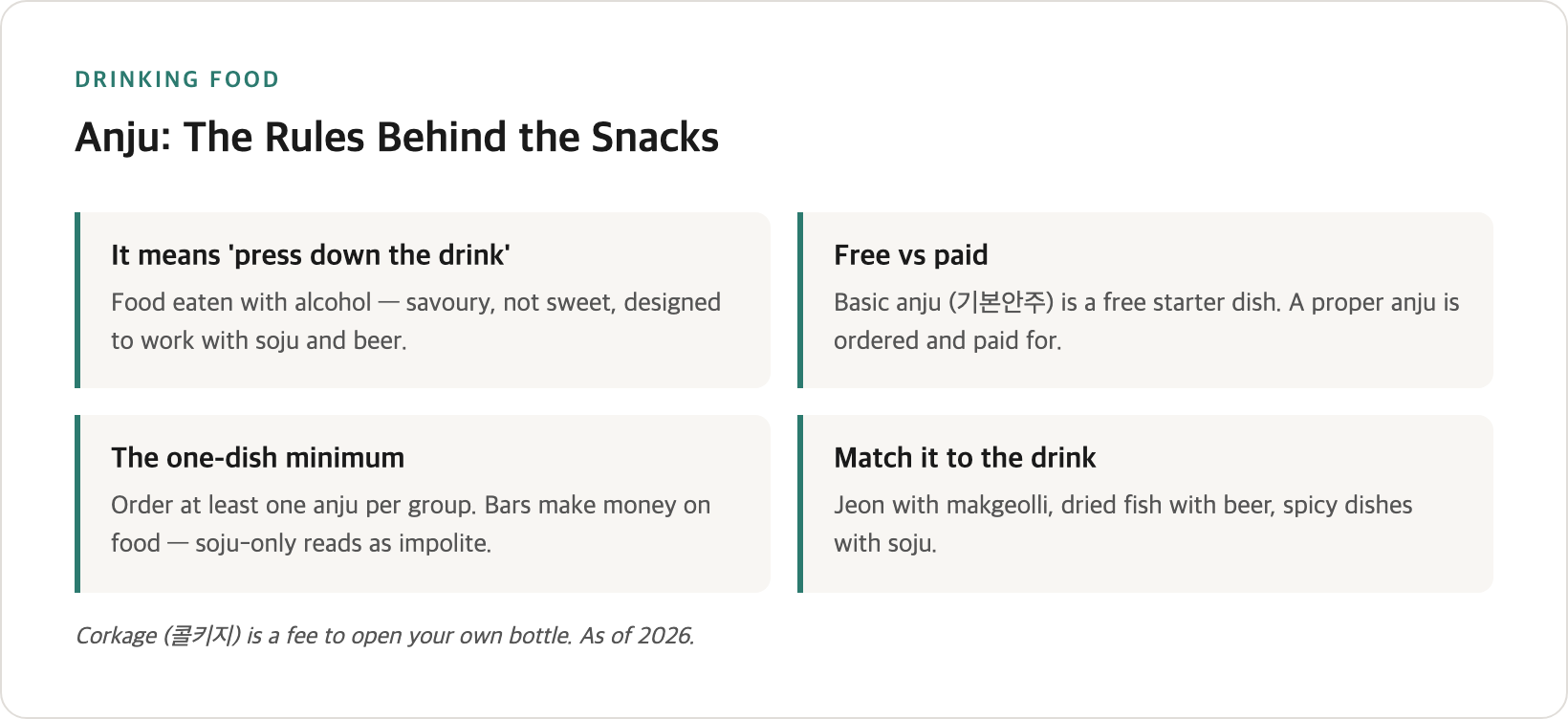
Photo by Jakub Kapusnak on Unsplash
What You Need to Know
-
Anju is food eaten with alcohol — structurally part of drinking, not optional.
-
The word means “press down the drink” — hence savoury, not sweet.
-
Basic anju (기본안주) is free; a proper anju dish is ordered and paid for.
-
There’s an unspoken minimum — order at least one anju per group.
-
Pojangmacha and bars make money on food — soju-only reads as impolite.
-
Corkage exists at some restaurants for your own bottle.
Practical Tips
-
Order a drink and an anju together — not just drinks.
-
Don’t assume the free dish is enough — a paid anju is usually still expected.
-
Match anju to drink — jeon with makgeolli, fried snacks with beer.
-
Budget for food alongside your drinks, always.
-
Bring cash for pojangmacha, which are often cash-only.
-
Ask about corkage before bringing your own bottle.
-
Eat as you drink — it softens the morning after.
Frequently Asked Questions
What is anju?
Food eaten specifically with alcohol in Korea. The word means “to press down the drink,” and it’s a structural part of drinking rather than an optional snack.
Do I have to order food at a Korean bar?
Usually yes. Many bars and pojangmacha expect at least one anju dish per group — they make money on food, not drinks, so ordering only alcohol can read as impolite.
What’s the difference between free and paid anju?
Basic anju (기본안주) is a small complimentary dish some bars set out. A proper anju is one you order and pay for. The free dish doesn’t remove the expectation to order something.
What anju should I order?
Match it to your drink — jeon (pancakes) with makgeolli, dried fish or fried snacks with beer, spicy savoury dishes with soju.
What is corkage in Korea?
A fee some restaurants charge to open a bottle you brought, usually wine. It’s not universal and many casual places don’t allow outside alcohol at all.
Why do Koreans always eat while drinking?
Anju is built into the drinking format — food to blunt the alcohol. It’s also why the morning after is somewhat softer.
Related Questions
- Drinking in Korea: A Practical Guide for Visitors
- Pojangmacha: What to Expect at Korea’s Street-Food Tents
- Soju in 2026: It’s Weaker Than Your Guidebook Says
- Korean Beer: Local Brands, Strengths, and the 4-for-₩10,000 Deal
- Korean Convenience Stores: The Eating Rules and Combos Guides Skip