Cash or Card in Korea? The Apps That Won’t Take Your Foreign Card
Quick Answer
Korea is overwhelmingly a card society — you can tap for almost everything, including cheap items. But “almost” hides real gaps for foreign cards: Kakao Taxi and the food-delivery apps effectively require a Korean card and phone number, some small vendors and markets are cash-only, and public parking machines often reject overseas cards. Carry some cash, and consider a foreigner prepaid card (WOWPASS) that sidesteps most of it.
The Full Answer
The standard English advice — “Korea is cashless, you barely need won” — is true for the visible economy: shops, restaurants, convenience stores, transit. It falls apart in a few specific places that guides don’t map, and those places tend to be the ones you hit when you’re tired or in a hurry.
The gap is not really “cash vs card.” It is that Korea’s payment system is somewhat self-contained, and a foreign card runs into walls that a Korean card never sees. I checked the Korean-language coverage of foreign-card problems in July 2026, because this is exactly the everyday friction locals know about and English guides smooth over.
Where Cards Just Work
To be clear, most of your spending is frictionless:
- Convenience stores, shops, restaurants — card, contactless, almost always fine
- Subway and bus — a T-money card covers it
- Chains and department stores — no issue
- Most taxis — accept T-money or physical cards on the meter
For the bulk of a trip, tapping works. The problem is concentrated in a handful of categories.
Where Foreign Cards Fail
This is the part worth knowing before you’re stuck.
Local tip — Kakao Taxi — the app everyone tells you to use — needs a Korean card and a Korean-number-verified account to register payment. A foreign card and non-Korean phone often can’t complete registration, so you can install the app and still not be able to pay through it. Most street taxis take a T-money card or physical card on the meter, so hailing on the street can be easier for a visitor than the app the guides recommend. Our step-by-step Kakao Taxi guide covers the registration flow and the options left when a foreign card is rejected.
Local tip — Food-delivery apps largely won’t take foreign cards. Yogiyo doesn’t support overseas cards or PayPal at all, and Coupang Eats frequently errors on non-Korean cards. The image of ordering fried chicken to your hotel from your phone runs straight into this — you often need a Korean card or a workaround.
Local tip — Public parking machines and many small independent vendors are cash-only or reject foreign cards. Public parking lots, older market stalls, and some small owner-run shops may not have EMV terminals that accept overseas cards. Markets like Gwangjang and pojangmacha (street stalls) are where cash still rules. Tongin Market’s lunchbox cafe goes further still: neither cash nor card buys you food directly there — you buy brass yeopjeon coins at a counter first, and paying for them in cash is what makes the leftovers refundable on the spot.
The Fix: A Foreigner Prepaid Card
There is a purpose-built solution the affiliate-free guides underplay.
Local tip — WOWPASS is a foreigner prepaid card that combines currency exchange, an IC payment card, and transit-card function in one. You load it with foreign cash at a machine, and it behaves like a Korean card for many of the situations where your home card fails — a genuine fix for the Kakao Taxi and small-vendor gaps, without needing a Korean bank account. It rarely tops English guides because it isn’t a global affiliate product.
Tmoney also offers foreigner-oriented travel cards with similar transit-plus-payment functions. Either sidesteps most of the foreign-card walls.
How Much Cash to Carry
Not much, but not zero.
- Daily: enough for a market meal, a street-taxi ride, and small vendors — perhaps ₩30,000–50,000
- Top up at: ATMs that take foreign cards — look for the “Global” or “Foreign Card” label
- Don’t: carry a week’s budget in cash; the card economy handles most of it
Local tip — The trap is the opposite of what guides warn about. They tell you Korea is cashless, so travellers carry too little and get caught at a market or a parking machine. Keep a modest cash buffer specifically for the cash-only pockets, and rely on cards for everything else.
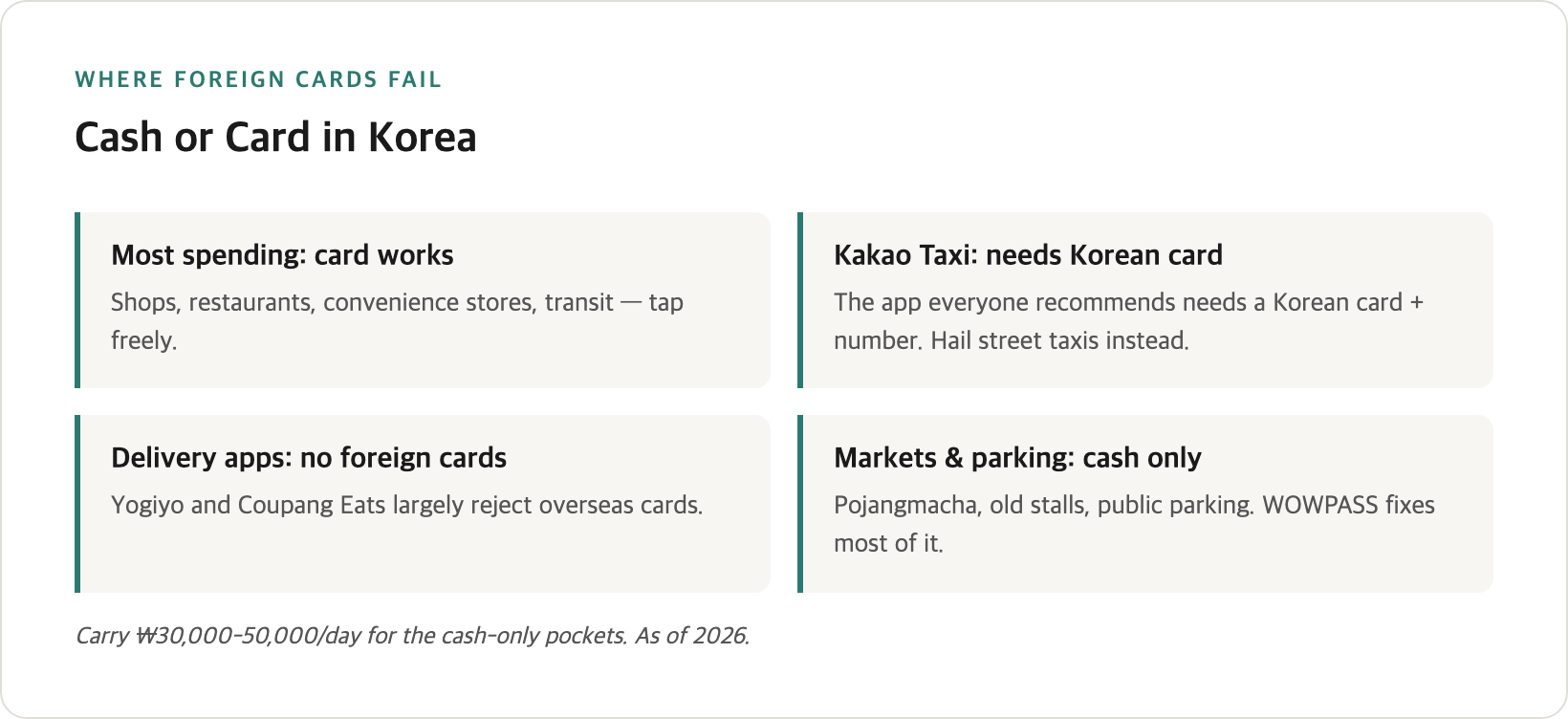
Photo by minho jeong on Unsplash
What You Need to Know
-
Most spending is card-friendly — shops, restaurants, transit, chains.
-
Kakao Taxi needs a Korean card and number — street taxis are easier for visitors.
-
Delivery apps largely reject foreign cards — Yogiyo and Coupang Eats especially.
-
Parking machines and small vendors are often cash-only or foreign-card-hostile.
-
WOWPASS or a Tmoney travel card fixes most of the gaps.
-
Carry a modest cash buffer — ₩30,000–50,000 a day for the cash-only pockets.
Practical Tips
-
Carry ₩30,000–50,000 in cash for markets, street taxis and parking.
-
Hail street taxis rather than fighting Kakao Taxi’s Korean-card requirement.
-
Don’t count on delivery apps with a foreign card.
-
Get a WOWPASS or Tmoney travel card to behave like a local card.
-
Withdraw from foreign-card ATMs — look for the “Global” label.
-
Keep cash for markets and pojangmacha — Gwangjang, street stalls.
-
Don’t over-carry cash — the card economy handles most of the trip.
Frequently Asked Questions
Do I need cash in Korea?
Some. Most spending is card-friendly, but markets, street stalls, public parking and some small vendors are cash-only. Carry ₩30,000–50,000 a day as a buffer.
Why won’t Kakao Taxi take my card?
Registering payment on Kakao Taxi effectively needs a Korean card and a Korean-number-verified account. Foreign cards and non-Korean phones often can’t complete it. Street taxis, which take T-money or cards on the meter, are easier.
Can I use food-delivery apps as a tourist?
Largely no. Yogiyo doesn’t accept foreign cards or PayPal, and Coupang Eats often errors on non-Korean cards. You typically need a Korean card or a workaround.
What’s WOWPASS?
A foreigner prepaid card that combines currency exchange, IC payment and transit functions. You load foreign cash and it behaves like a Korean card for many situations where your home card fails.
Where can I withdraw cash?
At ATMs marked “Global” or “Foreign Card.” See the ATM guide for fees and which machines work.
Is Korea really cashless?
Mostly, for the visible economy. But the cashless narrative leads travellers to carry too little and get caught in the cash-only pockets. Keep a small buffer.
Related Questions
- T-money Card: Buying, Topping Up, and Getting Your Money Back
- Can Foreigners Use Korean ATMs? Fees, Locations, and Tips
- How Much Does a Week in Korea Cost?
- Do You Need a Visa for Korea? The 90-Day Rule Most Guides Get Half Right
- Korean Age in 2026: Why the Drinking Age Still Uses the Old System