Booking KTX: Refund Windows and the Standing-Seat Trade-off
Quick Answer
KTX tickets are refundable, but the terms depend on the day. On weekdays you can cancel free up to three hours before departure; on weekends and public holidays a fee applies even a day ahead. Standing and unreserved seats cost about 5% less than a reserved seat, but cannot be refunded by phone, reissued if lost, or transferred. The foreigner-only KR PASS was overhauled on December 11, 2025: it is now a single “select pass” priced by 2 to 5 travel days with no separate youth rate, and if your reserved seat sells out you can still board standing with the pass and your passport.
The Full Answer
Booking a KTX seat is straightforward. Korail’s app has an English mode, the trains are punctual, and Seoul to Busan takes around two and a half hours — which also makes Busan the practical starting point for the overnight ferry to Fukuoka.
The parts that catch people out are the conditions attached to the cheaper options and the refund rules, which are not symmetrical across the week. English guides tend to give one refund figure and move on. The Korean-language terms are more granular, and the differences are large enough to change which ticket you should buy.
I checked Korail’s published refund and seat-type conditions, plus the current KR PASS structure, against the top English guides in September 2026. The weekday-versus-weekend refund split and the restrictions on unreserved seats are still largely missing from English guides — and the KR PASS section needed a bigger correction than expected, since the pass itself changed in December 2025 and most guides published since then have not caught up.
Refunds: The Day Matters
| When you cancel | Weekday (Mon–Thu) | Weekend / holiday |
|---|---|---|
| More than 1 day ahead | Free | Small fixed fee |
| Up to 3 hours before | Free | Fee applies |
| Under 3 hours | Fee applies | Higher fee |
| After departure | Sharply reduced refund | Sharply reduced refund |
Local tip — The free-cancellation window is weekday-only. English guides often quote a single refund policy without distinguishing weekends, but on a Saturday you pay a fee even cancelling the day before. If your plans are uncertain, a Tuesday booking carries less risk than a Saturday one.
Buying flexibility matters more than usual in Korea because peak-season seats sell out — during Chuseok and Seollal, weeks ahead. If you are pricing a whole trip, the weekly cost breakdown puts intercity travel in context.
Seat Types
| Type | Price | Guaranteed seat? |
|---|---|---|
| Reserved (일반실) | Standard | Yes |
| First class (특실) | Higher | Yes, wider |
| Unreserved / standing (자유석·입석) | ~5% less | No |
Unreserved tickets let you board any train on the route and sit in an unreserved carriage if there is space. On busy departures there will not be.
Local tip — The 5% saving on unreserved seats comes with conditions English guides rarely list: they cannot be refunded by phone, cannot be reissued if lost, and cannot be transferred to someone else. For a ₩59,800 Seoul–Busan fare the saving is roughly ₩3,000 — small enough that the loss of flexibility usually is not worth it.
KR PASS
The foreigner-only rail pass — officially the KORAIL PASS — is sold three ways: directly on korail.com, at station counters including Seoul and Yongsan, and through third-party resellers. It is not available to Korean passport holders.
Buying It Direct
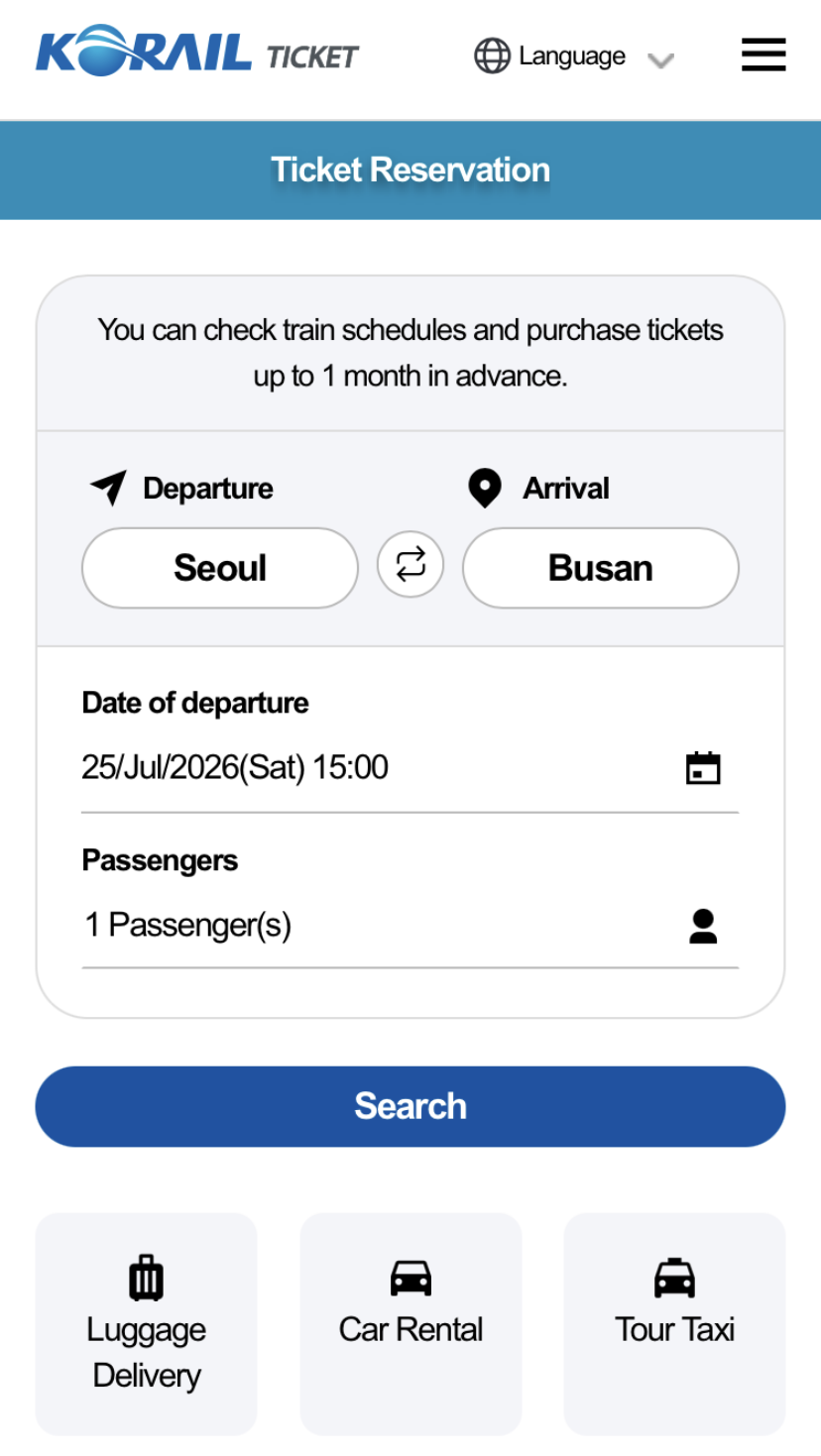
I walked the reservation form on korail.com through to the personal-information step in September 2026. It asks for your name, gender, date of birth, email, nationality, and a five-digit numeric password — no Korean phone number and no local identity verification. A valid passport and a credit card are required to complete the purchase, per Korail’s own pass guide. That’s worth stating plainly, because the assumption that Korean travel sites are hard to use without a Korean SIM does not hold here, at least up to the payment step. Whether a foreign card clears Korail’s payment gateway at the final step is something I could not confirm — I did not submit the form, since that step requires entering real payment details.
Or Through a Reseller
If you would rather buy in English, the same pass is sold on Klook as an e-voucher by email.
Local tip — Refunds are tied to the channel you bought through. Korail’s own FAQ states that online refunds are not available for passes bought at a station counter or through a travel agency — you have to request the refund back through wherever you bought it.
What It Costs Now
The pass structure changed on December 11, 2025, and the version many English guides — including Wikipedia’s own page, checked 2026-09-28 — still describe is no longer sold. There is now one pass type, the select pass: choose 2, 3, 4, or 5 travel days to use within a window from your start date, rather than the old split between a consecutive-day pass and a separate flexible pass.
| Days | Adult (13+) | Child (6–12) |
|---|---|---|
| 2-day | ₩131,000 | ₩66,000 |
| 3-day | ₩186,000 | ₩93,000 |
| 4-day | ₩234,000 | ₩117,000 |
| 5-day | ₩275,000 | ₩138,000 |
(Prices as of the December 2025 change; passes bought before December 11, 2025 keep the pricing they were issued under.)
Age bands changed with it — there is no separate youth category anymore.
Local tip — Older guides describe a youth band running from 13 to 27, priced below the adult fare. That band was discontinued on December 11, 2025. Korail now prices the pass as Adult (13 and up) and Child (6–12) only — checking a “youth rate” before booking no longer does anything.
Seat Reservations Are a Separate Step
Buying the pass gets you boarding rights, not a seat. Seat reservations open separately — per Korail’s pass guide, about a month before departure, though check the current window before you rely on that — and are capped at two seats per person per day.
Local tip — If reserved seats sell out, the pass does not strand you. Korail’s own guide states that pass holders can still board and ride standing with a valid pass and passport when reservations are unavailable. The pass guarantees a place on the train, not a specific seat.
Pass holders can also upgrade to first class for 50% of its normal fare — worth knowing if a reserved seat is unavailable but first class still has room.
Does It Pay Off
Whether the pass is worth it still comes down to how much you travel, though the math shifted with the December 2025 prices. A single Seoul–Busan round trip bought as two ₩59,800 tickets comes to roughly ₩119,600 — still cheaper than the ₩131,000 two-day pass. Three one-way KTX trips at that fare run close to ₩179,400, near the ₩186,000 three-day pass price even before counting the flexibility of unlimited boarding within the window, the first-class discount, or routes priced higher than Seoul–Busan. As a rough rule: one round trip, buy individual tickets; three or more intercity legs, the pass starts to make sense — and that’s the point where the reseller option above becomes a real alternative to filling out Korail’s own form.
KTX Isn’t the Only Train
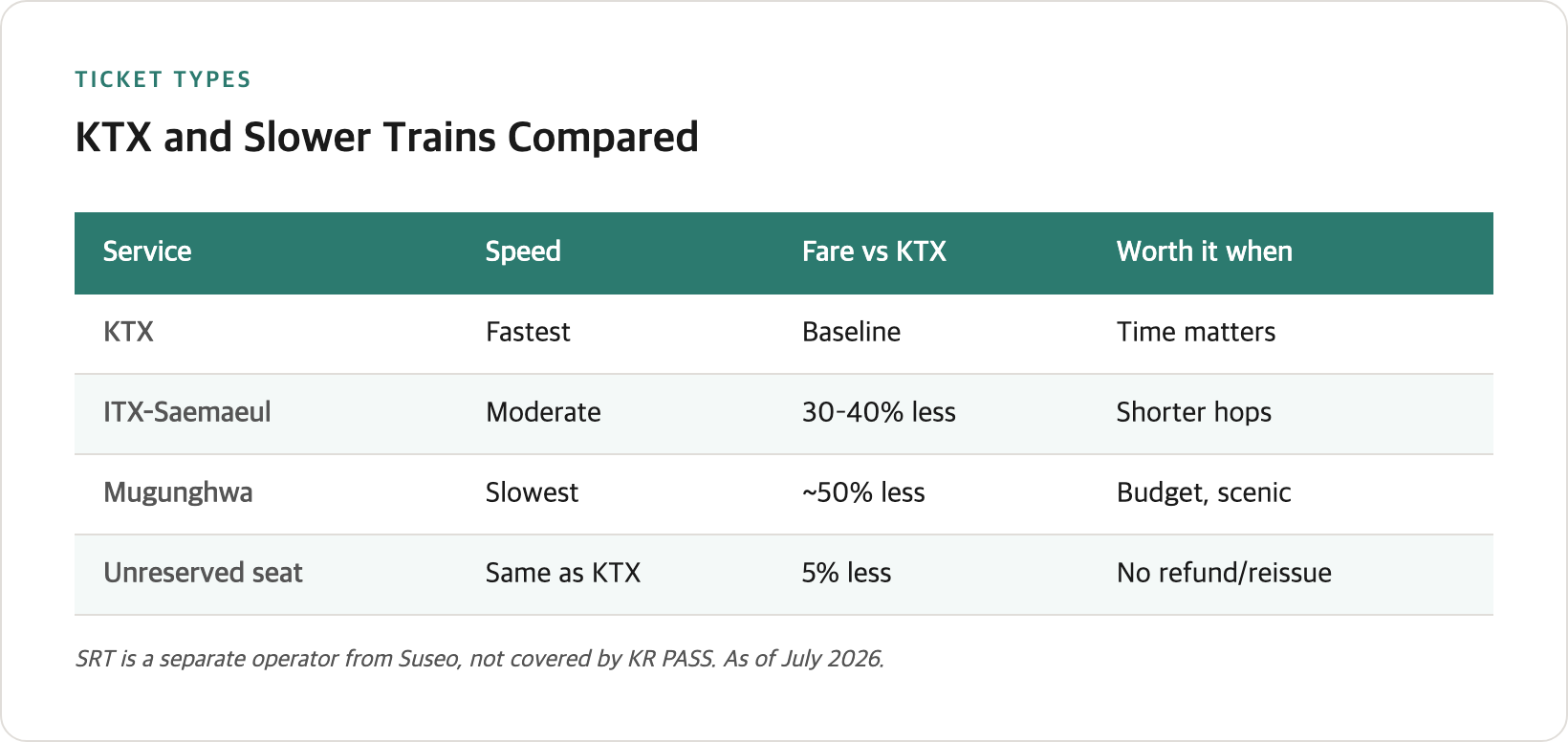
Korail runs slower services on the same routes at meaningfully lower fares, and they are almost invisible in English guides.
| Service | Speed | Fare vs KTX | Worth it when |
|---|---|---|---|
| KTX | Fastest | Baseline | Time matters |
| ITX-Saemaeul | Moderate | Roughly 30–40% less | Shorter hops, relaxed schedule |
| Mugunghwa | Slowest | Roughly half | Budget travel, scenic routes |
On Seoul–Daejeon or Seoul–Jeonju, the time difference between KTX and ITX is often under an hour while the fare gap is substantial. English guides tend to present KTX as the intercity train, which quietly removes the cheaper half of the network from consideration.
Seat availability also differs — when KTX sells out for a holiday weekend, slower services frequently still have space.
Which Station You Depart From
Seoul has more than one intercity station, and they are not interchangeable.
- Seoul Station — Gyeongbu line (Busan, Daegu, Daejeon)
- Yongsan — Honam line (Gwangju, Mokpo) and Jeolla line (Yeosu)
- Suseo — SRT services, a separate operator from Korail
SRT is a different company with its own booking system, and a KR PASS does not cover it — confirmed on Korail’s own pass-exclusion notices. If a booking site shows a cheaper or better-timed departure from Suseo, check which operator it belongs to before assuming your pass applies.
All three connect to the subway network, but allow transfer time — Yongsan and Suseo are both a fair distance from central Seoul. If you are changing cities on a checkout day, you can also send the suitcase ahead separately and travel with a day bag.
What You Need to Know
-
Refund terms differ by day of week. Weekday cancellations are more forgiving than weekend ones.
-
Unreserved tickets trade flexibility for about 5%. No phone refunds, no reissue if lost, no transfers.
-
Peak seasons sell out weeks ahead. Chuseok and Seollal are the two to plan around.
-
KR PASS dropped its youth band in December 2025. It’s now priced Adult (13+) and Child (6–12) only, with no separate youth rate.
-
A sold-out KR PASS seat reservation still lets you board. Standing with a valid pass and passport is allowed when reserved seats are gone.
-
Foreigners can buy the KR PASS directly, without a Korean phone number. The korail.com form only asks for name, nationality, email, and a numeric password.
-
Seoul has two main departure stations. Seoul Station and Yongsan serve different lines — confirm which one your ticket uses.
-
Slower services cost much less. ITX-Saemaeul and Mugunghwa run the same routes at 30–50% lower fares.
-
SRT is a separate operator. It departs from Suseo and is not covered by the KR PASS.
-
Fares and fee schedules change. Confirm on Korail’s site rather than trusting any guide, including this one.
Practical Tips
-
Book through the Korail app in English mode. It handles foreign cards and shows seat maps — worth checking whether your card works in Korea before you rely on it.
-
Prefer a reserved seat unless you are travelling off-peak. The 5% saving is rarely worth standing for two hours.
-
Cancel weekday tickets up to three hours out. That window is free and generous.
-
Book peak-season travel weeks ahead. Chuseok and Seollal seats disappear early.
-
Don’t budget for a KR PASS youth discount. It was discontinued on December 11, 2025 — the pass is priced Adult (13+) and Child (6–12) only now.
-
Use a T-money card for the connecting subway leg rather than buying single tickets at each end.
-
Allow transfer time from Incheon Airport. Seoul Station is the easiest connection; Yongsan and Suseo take longer.
Frequently Asked Questions
How much is a KTX ticket from Seoul to Busan?
Around ₩59,800 for a standard reserved seat, with first class higher and unreserved seats roughly 5% less. Fares vary by departure and class, so confirm on Korail’s site.
Can I get a refund on a KTX ticket?
Yes. On weekdays, cancellations up to three hours before departure are free. On weekends and public holidays a fee applies even when cancelling a day ahead, and fees rise closer to departure.
What is the difference between a reserved seat and a standing ticket?
A reserved seat guarantees a specific seat. Unreserved and standing tickets are about 5% cheaper but do not guarantee a seat and cannot be refunded by phone, reissued if lost, or transferred.
Is the KR PASS worth it?
It depends on volume. A single Seoul–Busan round trip (roughly ₩119,600 as two tickets) is usually cheaper than the ₩131,000 two-day pass. Three or more intercity trips within the pass window generally favour the pass.
How do I buy a KR PASS as a foreigner?
Directly through korail.com — the form asks for name, gender, date of birth, email, nationality, and a numeric password, with no Korean phone number required. It’s also sold at station counters (Seoul, Yongsan, and others) and through resellers such as Klook, which delivers an e-voucher by email instead of a station-counter exchange. It is not available to Korean passport holders.
Does the KR PASS still have a youth discount?
No. The separate youth band (previously 13–27) was discontinued on December 11, 2025. The pass is now priced Adult (13 and up) and Child (6–12) only.
What happens if my KR PASS seat reservation is sold out?
You can still board. Korail’s pass guide states that pass holders may ride standing with a valid pass and passport when reserved seats are unavailable — the pass guarantees boarding rights, not a specific seat.
Is there a cheaper train than KTX?
Yes. ITX-Saemaeul and Mugunghwa run the same routes at roughly 30–50% lower fares. They are slower, but on shorter journeys the time difference is modest.
What is SRT and is it the same as KTX?
SRT is a separate high-speed operator departing from Suseo station. It is not Korail, and the KR PASS does not cover it.
Which station do I leave from, and can I reach Incheon Airport by train?
Seoul Station for Busan and Daegu, Yongsan for Gwangju and Mokpo, Suseo for SRT services — check your ticket rather than assuming Seoul Station. All three connect to the subway network, and the AREX line serves Incheon Airport from Seoul Station; see airport transfer options for how it compares to the limousine buses.
Related Questions
- Seoul Subway: Tap-Out Rules That Changed in 2026
- T-money Card: Buying, Topping Up, and Getting Your Money Back
- Incheon Airport to Seoul: Every Option, Including the Night Bus
- Getting Around Korea: The Transport Guide That Connects the Details
- Why Google Maps Doesn’t Work in Korea — and What to Use Instead
- New Year Sunrise in Korea: Tour vs KTX to Jeongdongjin
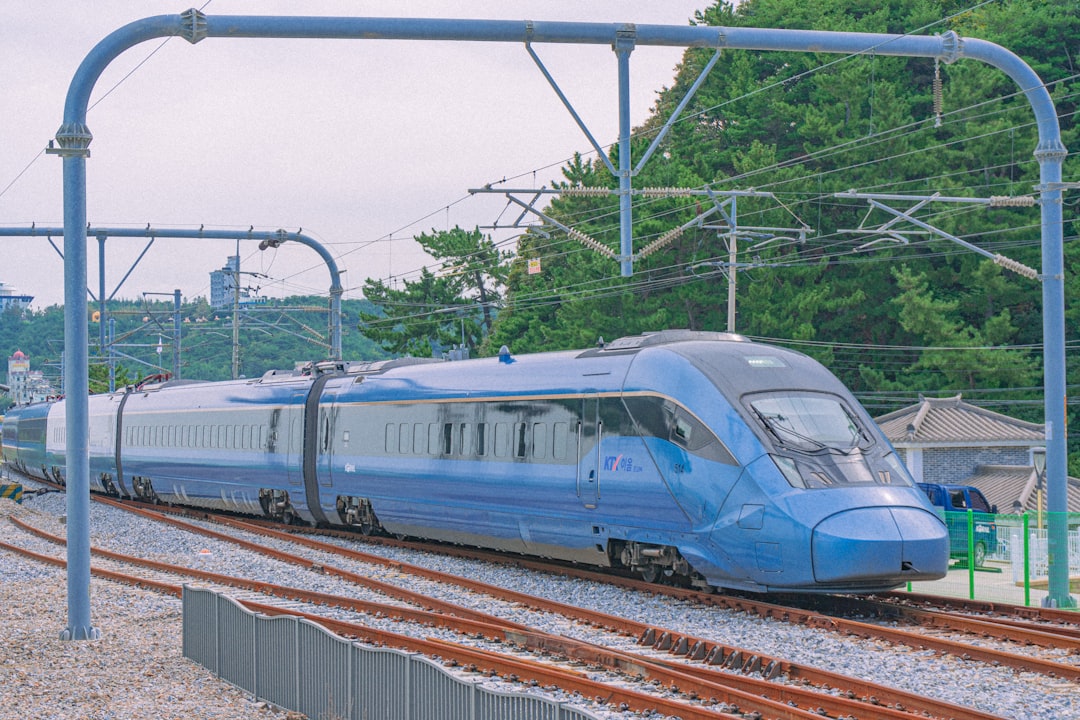
Featured image: Photo by Seungmin Yoon on Unsplash