T-money Card: Buying, Topping Up, and Getting Your Money Back
Last Updated on August 19, 2026
Quick Answer
A standard T-money card costs ₩3,000 and works on subways, buses, taxis and in convenience stores nationwide. The card fee itself is never refundable, but leftover balance is. Convenience stores refund up to ₩20,000 or ₩30,000 depending on the chain, minus a ₩500 fee; bigger balances need a subway T-money service desk. App refunds charge 4% of the whole amount once it passes ₩20,000.
The Full Answer
Almost every guide to Korea tells you to buy a T-money card. Very few explain what happens at the end of the trip, when you are standing at Incheon Airport with ₩13,400 sitting on a plastic card you will never use again.
That end-of-trip moment is where the details matter, and it is where English-language guides thin out. They agree on the basics — buy at a convenience store, tap in and out, ₩500 refund fee — and then stop. The Korean-language sources go further, and some of what they add changes what you should do.
I read the refund rules on T-money’s own Korean customer-service pages in August 2026 and compared them with the top English guides, then checked the regional transfer rules published by each local authority. Three things appear plainly in the Korean sources and in none of the English ones: a percentage fee on app refunds, convenience store limits that differ between chains rather than being a single ₩20,000 figure, and card types that are excluded from ATM and station-desk refunds entirely.
Buying and Loading
- Where: any CU, GS25, 7-Eleven, Emart24 or Ministop, plus subway station machines
- Card price: ₩3,000 for the plain designs T-money currently lists at every chain. Character and licensed designs run to ₩5,000, and the tourist-facing T-money Travel Card is ₩4,000. The card fee is never refundable
- Loading: cash at convenience stores and station machines, in ₩1,000 units, from ₩1,000 to ₩90,000 per top-up depending on the outlet. A card holds a maximum of ₩500,000
- Discount: card fare is cheaper than cash fare. A Seoul subway ride is ₩1,550 on a card against ₩1,650 for a single-journey ticket, and cash fares do not qualify for free transfers
There are several competing cards — T-money, Cashbee, Mybi, Hanpay — and for a traveller they are functionally the same. Take whichever the shop has.
One habit worth forming from day one: keep the balance modest. Convenience store refunds are all-or-nothing — you cannot take part of the balance in cash — and ₩30,000 is the ceiling even at the most generous chains. Top up in small amounts and the end of the trip takes care of itself.
Getting Your Balance Back
This is the part worth reading before your last day.
| Balance | Where | Fee |
|---|---|---|
| Under ₩20,000 | GS25 | ₩500 |
| Up to ₩20,000 | 7-Eleven | ₩500 |
| Up to ₩30,000 | CU, Ministop, Emart24 | ₩500 |
| Up to ₩50,000 | T-money service desk in a subway station | ₩500 |
| Above ₩50,000 | Same desks, but paid out in parts — ₩10,000 to ₩50,000 a day | ₩500 per transaction |
| Any amount | Bank ATM (Shinhan, Woori, Hana, Post Office) — needs a Korean account | — |
| Mobile T-money / Pay balance | In the app, to a Korean bank account | ₩500, or 4% of the total above ₩20,000 |
At a convenience store, hand the card to the cashier and say 환불 (hwan-bul). They will refund the balance in cash minus ₩500 and hand the card back to you. Note that the station desks are not at every station: they cover Seoul lines 1–8, the second and third sections of line 9, and Incheon lines 1–2. There are none on the airport railway.
Local tip — English guides quote a single ₩20,000 convenience store ceiling. T-money’s own Korean pages list three different limits by chain: under ₩20,000 at GS25, up to ₩20,000 at 7-Eleven, up to ₩30,000 at CU, Ministop and Emart24. If a cashier refuses a ₩25,000 refund, that is not an error and the card is not faulty — walk to a CU.
Local tip — App refunds carry a 4% fee once the amount passes ₩20,000, charged on the whole amount rather than on the excess. A ₩50,000 refund costs ₩2,000, not ₩1,200. They also pay out only to a Korean bank account, so for a departing visitor the counter route is better even with the ₩500 charge.
Local tip — Mobile T-money cannot be refunded at a subway service desk or at a bank ATM at all — only in the app, or at a convenience store with the SIM still in the phone. English guides treat every transit card as interchangeable. They are not, and finding out at 05:00 in an airport is a bad time.
Before You Fly Out
The refund windows close earlier than people expect.
- Do it before airport security. Once you are airside, the counters are behind you
- Convenience stores inside the terminal can refund small balances, but queues at departure peaks are long
- If your balance is above the convenience store ceiling, deal with it before you leave the city. A subway T-money service desk will pay out a balance above ₩50,000 in cash, but only ₩10,000 to ₩50,000 per day and only at the lines listed above — and there is no such desk at the airport or on the AREX line that gets you there
- The other option is simply to spend it down — the airport train, a taxi, convenience store snacks, or topping up a travelling companion’s card
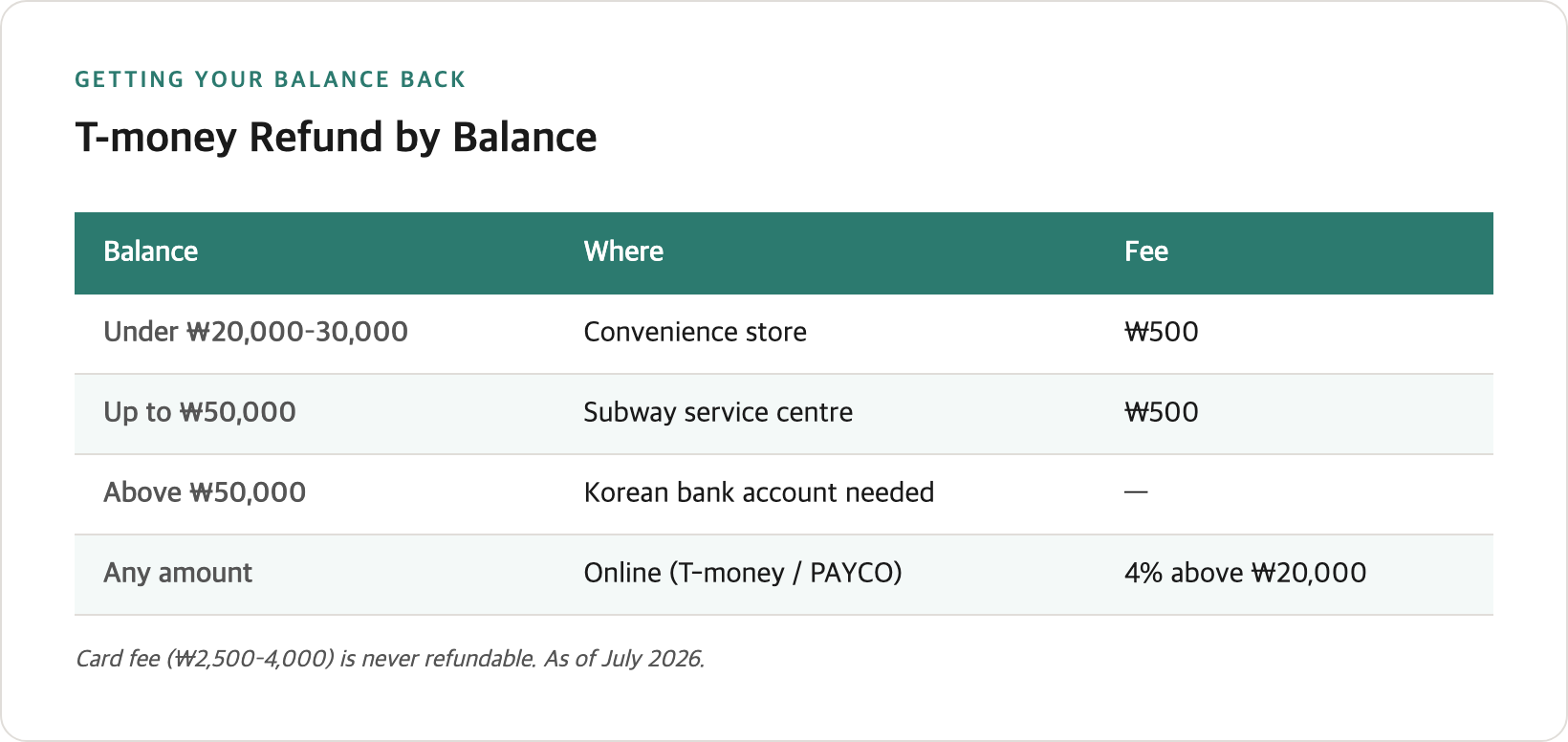
Photo by Theodore Nguyen on Pexels
Regional Differences
T-money works nationwide, but the local rules around it do not.
| Region | Card | Transfer window |
|---|---|---|
| Seoul metro area | T-money / Cashbee | 30 min, extended to 60 min between 21:00 and 07:00 |
| Jeju | Same cards accepted | 40 min, up to two transfers, and the same route number does not qualify |
| Busan | Cashbee is the local issue; T-money works too | Set locally — confirm on arrival rather than assuming Seoul’s 30 minutes |
Local tip — The transfer window is not the same across the country. Jeju’s official bus site allows 40 minutes and two transfers where Seoul allows 30 minutes, but it also refuses the discount when the route number is identical — 111 to 112 counts as a transfer, 111 to 111 in the opposite direction does not, even though it is a different bus going the other way. Guides written about Seoul are routinely applied to the whole country, and that is where the extra fares come from — see the Jeju bus rules.
Passes Worth Knowing About
Seoul’s unlimited-ride pass is the Climate Card (기후동행카드), but the 30-day version is being retired. Prepaid 30-day cards can be topped up for the last time on August 31, 2026 (a card charged that day stays valid through September 29), and the postpaid version stops carrying the discount on September 30. From October 1, 2026 the 30-day Climate Card is gone, replaced for residents by a national scheme called K-패스 (Modu-ui Card).
None of that touches what a short-term visitor actually buys. The short-term passes — 1, 2, 3, 5, and 7 days — continue unchanged, same prices, same rules, confirmed on Seoul’s own English transit page as of August 2026. The physical card costs ₩3,000 on top, and it is sold at station vending machines on lines 1–8 and at convenience stores near subway entrances.
| Pass | Price | Per day |
|---|---|---|
| 1 day | ₩5,000 | ₩5,000 |
| 2 days | ₩8,000 | ₩4,000 |
| 3 days | ₩10,000 | ₩3,333 |
| 5 days | ₩15,000 | ₩3,000 |
| 7 days | ₩20,000 | ₩2,857 |
Against a ₩1,550 subway fare, the three-day pass pays for itself at roughly two and a half rides a day, and the seven-day at under two. The one-day pass is the weak one: at ₩5,000 plus the ₩3,000 card it needs about five rides on that single day.
The Climate Card also stops close to the Seoul city boundary. On the airport railway it works on the all-stop service only, not the express, and the stretch you can both board and exit runs between Gimpo Airport and Seoul Station. Incheon Airport is the one asymmetric exception: since 13 September 2024 you can exit at Terminal 1 or Terminal 2 on a Climate Card, but you cannot board there — so it covers the ride out to the airport and not the ride in from it. The pass is changing again on 1 October 2026, and the Climate Card guide for foreign visitors covers what stays and what drops off. It is equally invalid on the Sinbundang line, on subway lines outside Seoul, on airport and intercity buses, and, unlike ordinary T-money, it buys nothing in a convenience store. Tap out at a station it does not cover and a staff member collects the full fare on the spot.
Local tip — The 30-day Climate Card is being retired — last charge August 31, 2026, gone entirely by October 1 — and replaced by a resident program (K-패스) that requires a Korean or foreigner-registration number, plus 15 or more rides a month before any refund kicks in. None of that applies to a short trip. A short-term card still starts the day you load it — there is no picking a future date — and refunding an unused one means registering the card, stopping it at a station kiosk before it expires, then filing online within 15 days. Seoul’s guidance says the refund normally goes to a Korean bank account, but foreigners without one can collect it in person at T-money’s Seoul headquarters.
What You Need to Know
-
The card fee is gone for good. ₩3,000 buys the card, not credit. Only the loaded balance is refundable.
-
Refund limits vary by chain. Under ₩20,000 at GS25, up to ₩20,000 at 7-Eleven, up to ₩30,000 at CU, Ministop and Emart24. Treat ₩20,000 as the safe assumption and CU as the fallback.
-
App refunds cost 4% of the whole amount once it passes ₩20,000 and need a Korean bank account. Not practical for most visitors.
-
Not all transit cards refund the same way. Mobile T-money is excluded from both ATM and station-desk refunds.
-
You keep the physical card. Refunding the balance at a shop counter does not surrender the card, so you can keep it for a future trip and reload it then.
-
Transfer rules vary by region. Jeju’s 40-minute window, two-transfer cap and same-route exclusion all differ from Seoul’s.
-
Multi-day Climate Cards do pay off. The three-day pass breaks even at about two and a half rides a day; only the one-day version is a poor deal.
Practical Tips
-
Buy the card on arrival, not in advance. They are sold at every convenience store and airport counter, and pre-ordering online adds no benefit.
-
Load ₩10,000 at a time. Top-ups go in ₩1,000 units, so there is no reason to overshoot, and it keeps you under the convenience store refund ceiling.
-
Ask for 환불 (hwan-bul). One word is enough at any convenience store counter.
-
Carry your passport on refund day if your balance is over ₩50,000 — that is the point at which staff start asking for ID.
-
Handle a balance above ₩50,000 before your last day. A station T-money desk will pay it out in cash, but only ₩10,000 to ₩50,000 per day, so a large balance can take more than one visit.
-
Check local transfer rules when you leave Seoul. Jeju and Busan differ.
-
Remember the tap-out penalty. Since March 2026 a missed tap-out adds a base fare to your next subway trip.
Frequently Asked Questions
How much does a T-money card cost?
The plain designs T-money lists at convenience stores are ₩3,000, character designs run to ₩5,000, and the tourist-oriented T-money Travel Card is ₩4,000. That fee is never refundable. Balance loaded onto the card is separate and can be refunded.
Can I get a refund at the airport?
Yes, for small balances at convenience stores inside the terminal, but you must do it before passing through security. There is no T-money service desk at the airport or on the airport railway, so anything above the convenience store ceiling has to be dealt with before you leave the city.
Is there a fee to refund a T-money card?
₩500 at convenience stores and subway service desks. App refunds of a Mobile T-money or Pay balance charge 4% of the whole amount once it passes ₩20,000 — a ₩50,000 refund costs ₩2,000 — and pay out only to a Korean bank account.
Can I use T-money outside Seoul?
Yes. It works on buses and subways nationwide, including Busan and Jeju, though local transfer rules differ by region.
Can I pay for taxis with T-money?
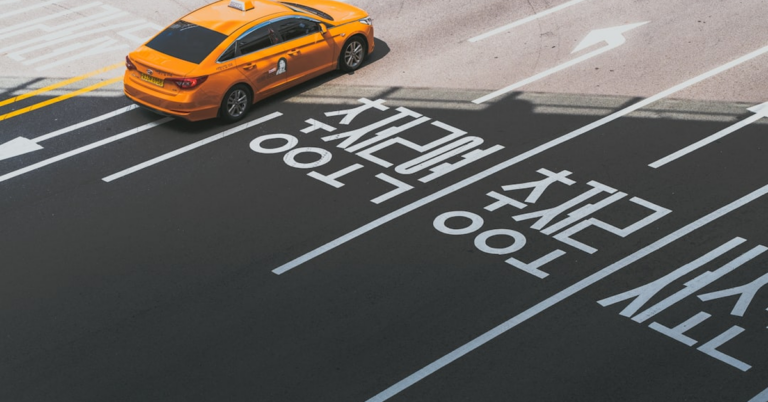
Yes, most taxis accept transit cards, as do convenience stores for ordinary purchases.
What if I forget to refund it?
Nothing expires immediately — the balance stays on the card. If you return to Korea it will still be there, and you can also refund it on a later trip.
Related Questions
- How to Buy and Use the Seoul Climate Card as a Foreigner (2026 Update)
- Seoul Subway: Tap-Out Rules That Changed in 2026
- Incheon Airport to Seoul: Every Option Including the Night Bus
- Cash or Card in Korea? What Actually Works Where
- Getting Around Korea: The Transport Guide That Connects the Details
- Booking KTX: Refund Windows and the Standing-Seat Trade-off