Korea Dropped Its Duty-Free Bottle Limit. Google Still Says 2
Last Updated on August 17, 2026
Quick Answer
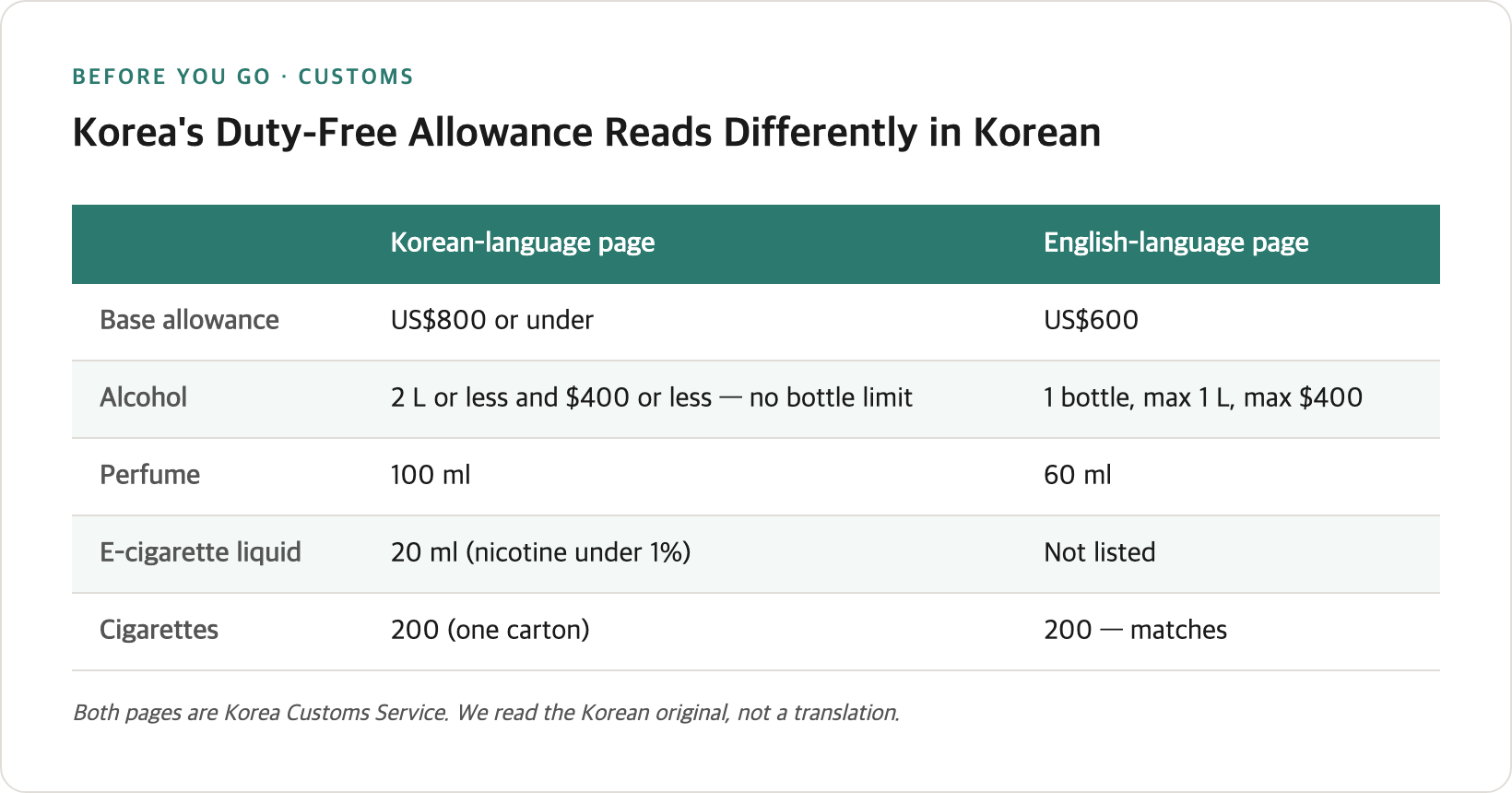
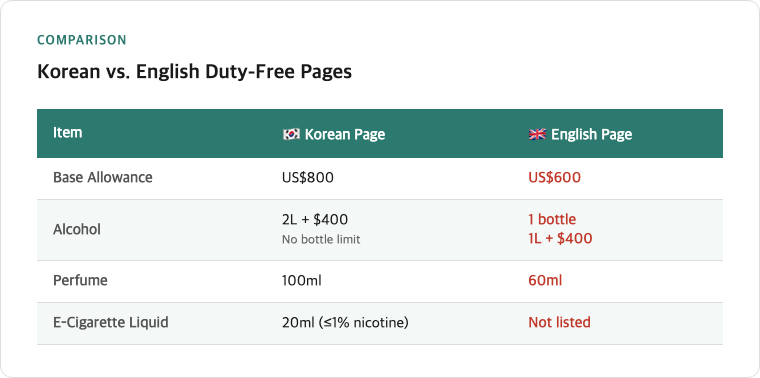
Korea removed the two-bottle cap on duty-free alcohol on March 21, 2025. The rule now has two parts and no bottle count: 2 litres or less and $400 or less, combined. Google’s AI Overview still says “up to 2 bottles,” and Korea Customs Service’s own English-language page still says one bottle. The general allowance is US$800, with 200 cigarettes, 100ml of perfume, and 20ml of e-cigarette liquid — all confirmed on the Korean-language customs page in August 2026.
The Full Answer
This is a case where an official government page carries the outdated information, not just the travel blogs that usually get blamed for it.
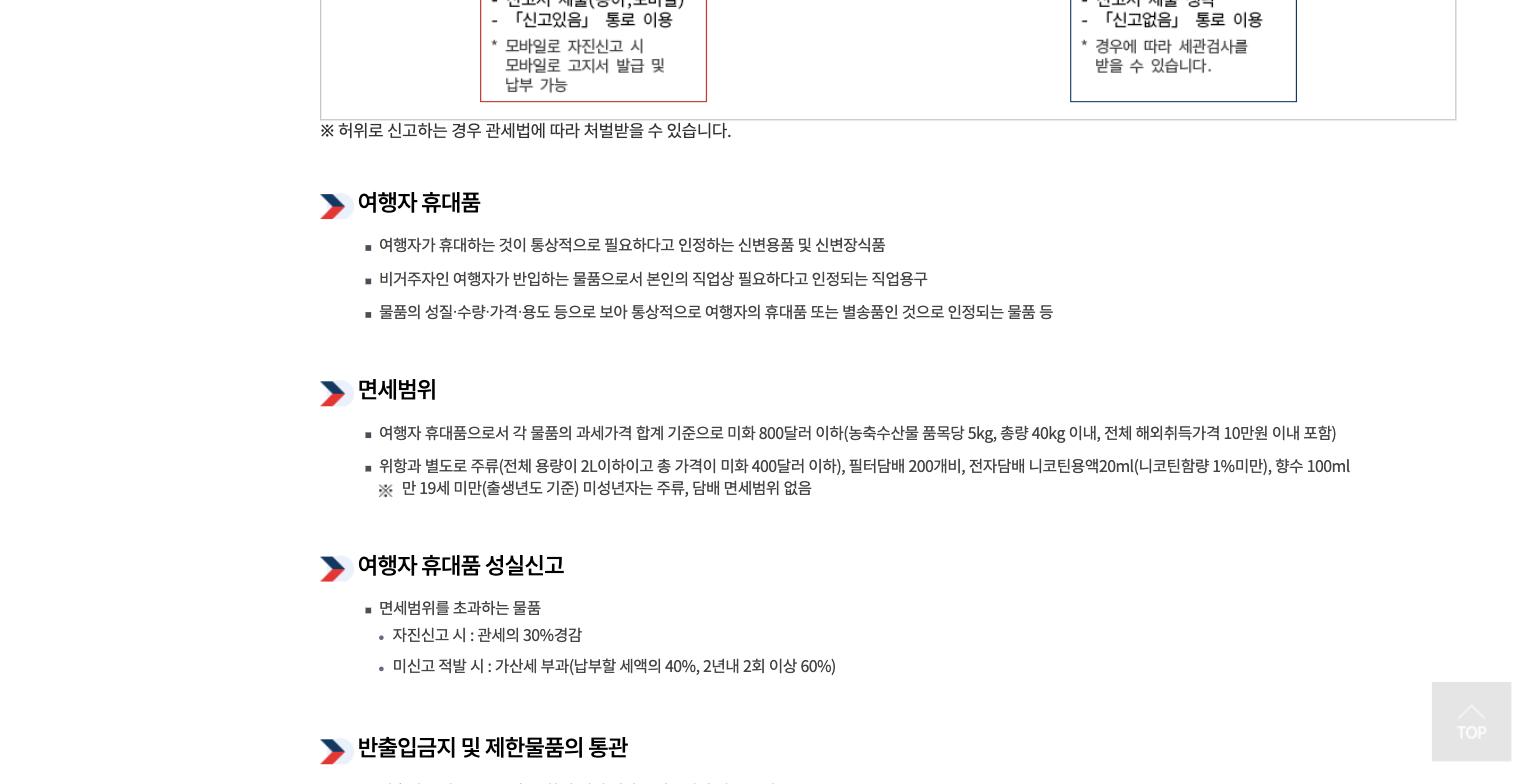
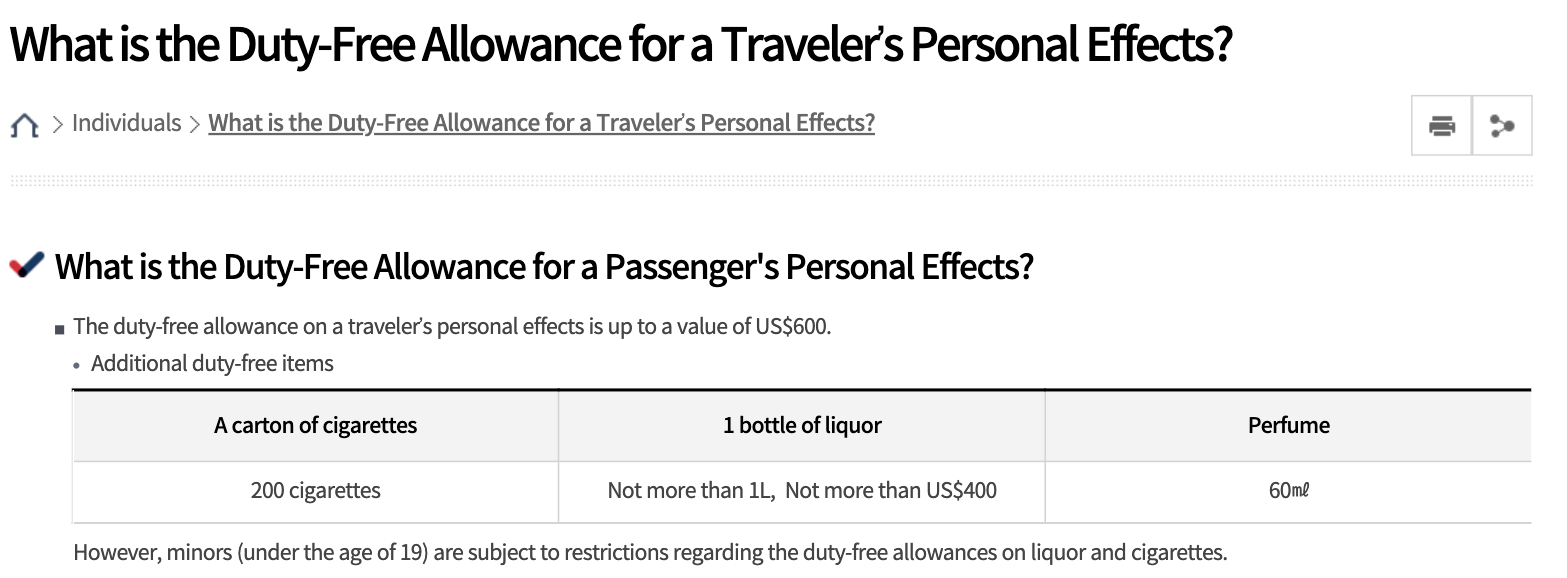
I opened both language versions of Korea Customs Service’s own website (customs.go.kr) on August 14, 2026, and compared the duty-free allowance sections line by line. They don’t match. The Korean-language page states the allowance is “미화 800달러 이하” — US$800 or under. The English-language page, on the same domain, states: “The duty-free allowance on a traveler’s personal effects is up to a value of US$600.” Same institution, same site, two different numbers for the exact figure a first-time visitor most needs to get right.
It isn’t only the headline number. The English page’s table lists “1 bottle of liquor,” “Not more than 1L, Not more than US$400,” and “60㎖” for perfume — all of which are lower than what the Korean-language page currently allows, and none of which reflect two policy changes Korea has made since 2024. There’s no legal advice being offered here — this article covers where to declare what, not how to argue with a customs officer about it — but getting the underlying numbers right matters, because the version most non-Korean-speaking travelers can actually read is the one that’s wrong.
| 🇰🇷 Korean-language page (mi=2837) | 🇬🇧 English-language page (mi=8028) | |
|---|---|---|
| Base duty-free allowance | US$800 or under | US$600 |
| Alcohol | 2 liters or less and $400 or less combined — no bottle-count limit | 1 bottle, not more than 1 liter, not more than $400 |
| Perfume | 100ml | 60ml |
| E-cigarette liquid | 20ml (nicotine under 1%) | Not listed |
| Cigarettes | 200 (one carton) | 200 (one carton) — matches |
| Under-19 travelers | No alcohol or tobacco allowance | No alcohol or tobacco allowance — matches |
Two rows in that table match. The cigarette limit and the under-19 exclusion are the same on both pages, so this isn’t a case of the entire English site being wrong — it’s specific figures that no longer match the Korean-language page. Neither page carries a last-updated date, so there’s no way to tell from the site itself how long the gap has been there.
I checked nine English-language pages that currently rank for Korea customs searches and compared their numbers against the Korean original directly. One of them, World Baggage Network’s Korea customs page, gives the allowance as “USD 600” — the same figure as Customs’ own English page, and $200 below the Korean-language one. It was the only page of the nine using $600, and I can’t demonstrate it took the number from Customs specifically: it links Customs’ homepage rather than the allowance page, and the entries around it (“50 cigars,” “250 grams of other tobacco products”) don’t appear in the Korean source at all, which suggests a general international baggage database rather than a reading of Korea’s page. The narrower claim is the one that matters to you anyway — the figure Korea publishes in English is $600, and $600 is what circulates in English.
Two other sites checked for this article, HaniSeoul and TripKorean, get most of their numbers right but each still carries one stale figure — HaniSeoul’s guide still counts alcohol by the bottle, and TripKorean lists 60ml for perfume while explicitly noting that some sources say 100ml and advising readers to stay with the lower official number. Neither site is uniformly wrong. Each has one specific number that hasn’t caught up, and in TripKorean’s case the writer looked at the official English figure and deferred to it.
What Counts Toward the $800 Allowance
The $800 figure is a combined total, not a per-item limit — the Korean-language page defines it as the sum of the taxable value of everything you’re bringing in as accompanied baggage. Agricultural, livestock, and fishery products have their own sub-limits within that total (5kg per item, 40kg overall, and a combined overseas acquisition value under ₩100,000), but for most travelers — clothing, electronics, souvenirs, gifts — it’s the total value across items that matters, not any single purchase.
If your total goes over $800, you don’t lose the whole allowance — you pay duty on the amount above it. Korea uses a simplified tax rate (간이세율) that varies by item category: clothing is taxed around 25%, bags and sunglasses around 20%, in the worked examples Customs publishes on its arrival-hall duty-free page (linked further down). Exactly which rate applies to a specific item is a customs officer’s call at the point of entry, not something this article can determine for you, and rates change — treat the percentages here as illustrative of the range rather than a fixed schedule.
This limit is separate from anything to do with leaving Korea. If you’re shopping and planning to claim a refund on the way out, that’s a different system covered in our guide to Korea’s VAT refund process — the $800 figure here applies only to what you bring in when you arrive, and the instant in-store refund some shops offer (covered in our K-beauty shopping guide) is a separate outbound-tax mechanism, not part of your duty-free allowance.
Alcohol: There’s No Longer a Bottle Limit
As of March 21, 2025, Korea removed the two-bottle cap on duty-free alcohol. What’s left is a two-part test: total volume must be 2 liters or less, and total value must be $400 or less. Both conditions have to be met — bottle count is no longer part of the calculation at all.
Local tip — some English guides still count bottles; Korea stopped in March 2025. Seoul Shinmun reported the change directly on the day it took effect, under the headline “면세주류 병수 제한 폐지…’2ℓ·400달러 한도만 지키면 돼'” (“Bottle limit on duty-free liquor abolished — only the 2-liter, $400 limit remains”). Customs’ own English page, checked August 14, 2026, still lists “1 bottle of liquor… Not more than 1L” — a figure that doesn’t match the current Korean-language rule. If two bottles together come to 1.5 liters and under $400 combined, they’re within that rule regardless of what the English page implies.
If you’re buying soju, makgeolli, or beer to bring home rather than to drink here, our guides to soju and Korean beer cover typical bottle sizes and ABV, which is useful for estimating whether a purchase fits inside the 2-liter figure before you get to the counter.
Perfume and E-Cigarette Liquid: Two Values Most Guides Still Get Wrong
Perfume’s duty-free limit rose from 60ml to 100ml on January 1, 2024. That’s the value on the Korean-language page today, and it’s been in effect for more than two years — but 60ml is still the number on Customs’ own English page, and it’s the figure that showed up most often across the English-language sites checked for this article.
Local tip — the perfume allowance went from 60ml to 100ml effective January 1, 2024. It has been 100ml for over two years, confirmed on Customs’ Korean-language page as of August 2026. Of the sites checked for this article, TripKorean and World Baggage Network both still list 60ml; only HaniSeoul had the current 100ml figure. TripKorean is the instructive case: it notes that some sources say 100ml, then tells readers to stay with 60ml because that’s what the official guideline states. A careful writer checking the official English page lands on the wrong number precisely by being careful.
E-cigarette liquid is a separate story — not a wrong number, but a missing one. The Korean-language page lists a specific duty-free allowance for e-cigarette liquid: 20ml, provided nicotine content is under 1%. Customs’ English-language page doesn’t mention e-cigarette liquid at all — it isn’t listed as a category, wrong or otherwise.
Local tip — Korea’s own English customs page has no e-cigarette liquid category, but the Korean page does. The allowance is 20ml with nicotine content under 1%, confirmed on the Korean-language page as of August 2026. Two of the English-language sites checked for this article got the unit itself wrong, listing “20 milligrams” rather than milliliters — a mistake that looks like a generic customs template borrowed from another country rather than a reading of Korea’s actual rule.
Buying at the Incheon Arrival-Hall Duty-Free Shop
Incheon and several other airports operate duty-free shops on the arrival side, past immigration but before you collect your bags — separate from the departure-side shops most travelers already expect. Customs’ Korean-language page for this counter (which has no English-language equivalent) explains a deduction order that determines what actually gets taxed when you’ve bought from more than one source.
The rule prioritizes Korean-made goods bought at the arrival-hall counter: their value is deducted from your $800 allowance first, before anything bought abroad or at departure-side duty-free. Customs’ own published examples make the mechanism concrete. In one, a traveler buys an $800 bag at a downtown duty-free shop, $800 of clothing abroad, and $800 of Korean-made cosmetics at the arrival-hall shop — the domestic cosmetics are deducted first, using up the allowance and leaving both the bag and the clothing taxable. In another, comparing an $800 bag against $800 of overseas-bought clothing, Customs deducts whichever item carries the higher simplified tax rate — clothing at roughly 25% versus a bag at roughly 20% — so the deduction goes where it saves the traveler the most.
Two details from the same page are worth knowing before you shop there. The arrival-hall counter has its own purchase ceiling of $800 per traveler, and alcohol and perfume sit outside that ceiling — you can buy them on top of it, within their own allowances. And if you buy Korean-made liquor or perfume at the arrival hall, those get the duty-free treatment ahead of bottles bought abroad.
No English-language page checked for this article describes this priority-deduction mechanism at all — it doesn’t appear to have an English page of its own, on Customs’ site or elsewhere.
Self-Declaring vs. Getting Caught
Nothing in this section is legal advice — it describes the published procedure and rates, not how to interpret them for your situation.
If your total goes over the $800 allowance, you have the option to self-declare rather than wait to see if it’s noticed. Doing so gets you a 30% reduction on the duty owed, capped at ₩200,000. That cap sits in the statute itself, not in a summary of it: I opened Article 96(2) of the Customs Act on the government’s law portal on August 15, 2026. The version in force is dated 11 August 2026, and the clause allows a reduction of 30/100 of the duty for a traveller who self-declares, “within a limit not exceeding 200,000 won.” The clause itself was last amended on 1 October 2025, so the August 2026 amendment to the Act left it untouched. None of the English-language sources checked for this article state the cap at all. The surcharge for undeclared items found on inspection is 40% of the tax owed, rising to 60% if it happens again within two years; that pair of figures comes from Customs’ own Korean-language traveler page linked at the top of this article, not from the statute.
One convenience listed alongside the reduction does not extend to most readers of this article. Deferred payment of the tax, instead of settling on the spot, is described on the Ministry of Government Legislation’s easylaw.go.kr portal as available to Korean-national travelers resident in Korea who self-declare — and not to those with outstanding customs debts, travelers flagged as high-risk, or anyone under 19. If you’re arriving on a passport from elsewhere, plan to pay any duty at the airport.
Declaring Cash and Foreign Currency
Separate from the $800 goods allowance, Korea requires a declaration for cash and equivalent instruments — including Korean-won cashier’s checks — once the combined total exceeds US$10,000 or its equivalent. Below that threshold, no declaration is needed.
If you do need to declare, it happens on the arrival card at the currency-declaration line, submitted to a customs officer along with the cash for verification, in exchange for a foreign-currency declaration receipt. That receipt matters if you plan to take the same cash back out later — and Customs’ Korean-language page is specific that it cannot be issued after you’ve already left the arrival area, so this isn’t something you can go back for once you’ve cleared the hall.
Penalties for not declaring follow a two-tier structure based on the amount involved, not a single flat rate: violations up to $30,000 are handled as an administrative fine (과태료), while violations above $30,000 carry a criminal penalty of up to one year in prison or a fine of up to ₩100 million — or up to three times the item’s value, if that figure is higher.
Local tip — two English guides give two different percentage fines for undeclared cash, and neither percentage is in the rule. One site checked for this article states fines “up to 40% of the undeclared amount”; another states “up to 10%,” with a worked example calculating a specific dollar penalty. Neither percentage appears anywhere in the Korean-language regulation, which instead splits violations into an administrative fine below $30,000 and a criminal penalty — prison or a fine, not a percentage — above it. Both sites also skip the administrative-fine tier entirely, which makes a small overage read as more serious than the rule treats it.
I also compared the Korean and English-language versions of this specific currency-declaration page, and unlike the duty-free allowance pages above, these two match — the $10,000 threshold and the criminal-penalty figures are the same in both. The one gap on the English side is that it doesn’t mention the lower administrative-fine tier for violations under $30,000, so a reader relying on it alone would see only the criminal-penalty language.
If your Korea trip involves carrying more cash than usual because of card acceptance gaps, our guides to cash versus card in Korea and using Korean ATMs as a foreigner cover when carrying cash is actually necessary, and our breakdown of a week’s costs in Korea gives a sense of what a typical trip budget looks like — useful context for judging whether you’re anywhere near the $10,000 threshold at all, which most leisure travelers aren’t.
Who Doesn’t Get Any Duty-Free Allowance
Travelers under 19, counted by birth year under Korea’s age system rather than by the exact date of a birthday, have no duty-free allowance for alcohol or tobacco at all — not a lower limit, but none. This is one figure where the Korean-language and English-language customs pages agree, and it’s also correctly stated on the English-language travel sites checked for this article, so it isn’t part of the contrast this guide is otherwise making. If you’re unfamiliar with why Korea counts age differently in the first place, our guide to the Korean age system explains how the birth-year count works and where it still applies after the 2023 legal-age reform.
What Else Requires Separate Declaration
The $800 allowance and the category limits above cover ordinary purchases and gifts. A separate set of items requires declaration or advance permission regardless of value, based on the Korean-language customs page: firearms, narcotics and controlled medications, CITES-listed endangered species and their products, and agricultural or livestock products, among others. Korea’s arrival card includes a line for declaring these categories, distinct from the general goods-value section.
This article covers only the fact that those categories exist and need to be declared. The quantity limits and procedures for medication are involved enough to need their own guide — how many bottles you can bring, and the three tiers Korea’s schedule actually uses, is covered separately.
What You Need to Know
- Korea Customs Service’s own English-language page understates the duty-free allowance. It lists $600 against the Korean-language page’s $800, along with lower figures for alcohol and perfume, as of the August 2026 check for this article.
- Alcohol has no bottle-count limit as of March 21, 2025. The only conditions are 2 liters or less and $400 or less, combined.
- Perfume’s limit has been 100ml since January 1, 2024 — not the 60ml still listed on several sources, including Customs’ own English page.
- E-cigarette liquid has its own 20ml allowance (nicotine under 1%), a category the English customs page omits entirely.
- Self-declaring an overage gets a 30% duty reduction, capped at ₩200,000 — undeclared items found on inspection are hit with a 40% surcharge instead, rising to 60% on a repeat within two years.
- Cash and cash-equivalent declarations kick in above US$10,000, with a two-tier penalty structure (administrative fine below $30,000 in violations, criminal penalty above it) that two English sources checked for this article both replace with percentage fines found nowhere in the regulation.
- None of this is legal advice. It’s a summary of the published procedure — what gets declared where — not guidance on how a specific case will be handled.
Practical Tips
-
Use the Korean-language customs page’s numbers, not the English one, until Customs updates the English page. As of August 14, 2026, the English page still shows $600, 1 liter of alcohol, and 60ml of perfume — all below the Korean-language figures.
-
Add up the total value of everything you’re bringing in, not just your most expensive item. The $800 allowance is a combined figure across all accompanied baggage, not a per-item ceiling.
-
If you’re buying at Incheon’s arrival-hall duty-free shop, buy Korean-made items there first. They get deducted from your allowance ahead of anything bought abroad, which can change what ends up taxable.
-
Check total alcohol volume and total price together, not bottle count. Two smaller bottles that add up to 2 liters and $400 or less are fine under the current rule, regardless of how many bottles that is.
-
Self-declare rather than hope an overage goes unnoticed. The 30% reduction (capped at ₩200,000) is a better outcome than the 40% surcharge for something found on inspection.
-
If you’re carrying cash near or over $10,000, get your foreign-currency declaration receipt before you leave the arrival area. Customs’ own page states it can’t be issued once you’ve already left, so there’s no going back for it later.
-
Don’t treat a general “customs limits” travel article as Korea-specific. Two English pages checked for this article gave cash-fine percentages that appear nowhere in Korea’s regulation, and two others listed e-cigarette liquid in milligrams — a unit Korea’s rule doesn’t use. Cross-check specific numbers against the Korean-language original when it matters.
Frequently Asked Questions
What is the duty-free allowance for South Korea?
US$800 or under, combined across all items in your accompanied baggage, as of the Korean-language customs page checked in August 2026. Korea Customs Service’s own English-language page currently states $600 instead — a figure this article’s research traced to an outdated English page rather than a genuine policy difference.
How much alcohol can I bring into South Korea duty-free?
Up to 2 liters total volume and up to $400 total value, with both conditions required and no limit on the number of bottles. The bottle-count cap was removed on March 21, 2025; some English-language sources still describe alcohol by bottle count rather than the current volume-and-value test.
How much cash can I bring into Korea before I have to declare it?
US$10,000 or its equivalent, combined across cash and similar instruments including Korean-won cashier’s checks. Below that threshold, no declaration is required. Above it, you declare on the arrival card and should get a foreign-currency declaration receipt before leaving the arrival area — it can’t be issued afterward.
Does duty-free shopping count toward my $800 limit?
Yes, purchases from duty-free shops — whether downtown, at departure, or in the arrival hall — count toward the same $800 combined allowance as anything else you’re bringing in. Buying an item duty-free where you purchased it doesn’t exempt it from Korea’s duty-free allowance calculation on arrival.
What happens if I don’t declare something over the limit?
If it’s found without a self-declaration, a 40% surcharge applies to the tax owed, rising to 60% for a repeat violation within two years. Self-declaring instead gets a 30% reduction on the duty owed, capped at ₩200,000. This article describes the published procedure only — it isn’t legal advice about how a specific situation will be handled.
How much perfume can I bring into Korea duty-free?
100ml, current since January 1, 2024. The previous 60ml limit is still listed on several English-language sources, including Korea Customs Service’s own English-language page, checked as of August 2026.
Can I fill out the Korea customs declaration form online or on an app?
Yes for the mobile route — and often there’s no form to fill out at all. Customs’ Korean-language page describes two paths: travelers with something to declare submit a declaration on paper or by mobile, and those who self-declare by mobile can receive the assessment and pay through the phone as well. Travelers with nothing to declare skip the form entirely and use the “nothing to declare” lane, though they can still be selected for inspection. This is already covered accurately across English-language sources, so it isn’t one of this article’s gaps.
What can’t I bring into South Korea at all?
Korea prohibits importing obscene materials and counterfeit currency or securities, and restricts firearms, narcotics, and CITES-listed endangered species and their products without prior permission. A separate set of items — including agricultural, livestock, and fishery products — must be declared even when they’re within the general value allowance. This article covers customs declaration and duty-free value limits specifically; food and plant quarantine run on entirely separate laws with their own ₩10 million penalty, and medication quantity limits have their own guide.
Related Questions
- Do You Need a Visa for Korea? The 90-Day Rule Most Guides Get Half Right
- Do You Need a K-ETA for Korea? And Should You Get One Anyway?
- Korea VAT Refund in 2026: The Instant Route, and the Rule That Just Changed
- Korea Customs Food Rules — Why Enforcement Got Stricter in 2026