Can Foreigners Use Korean ATMs? Fees, the ‘Global’ Button, and What Fails
Quick Answer
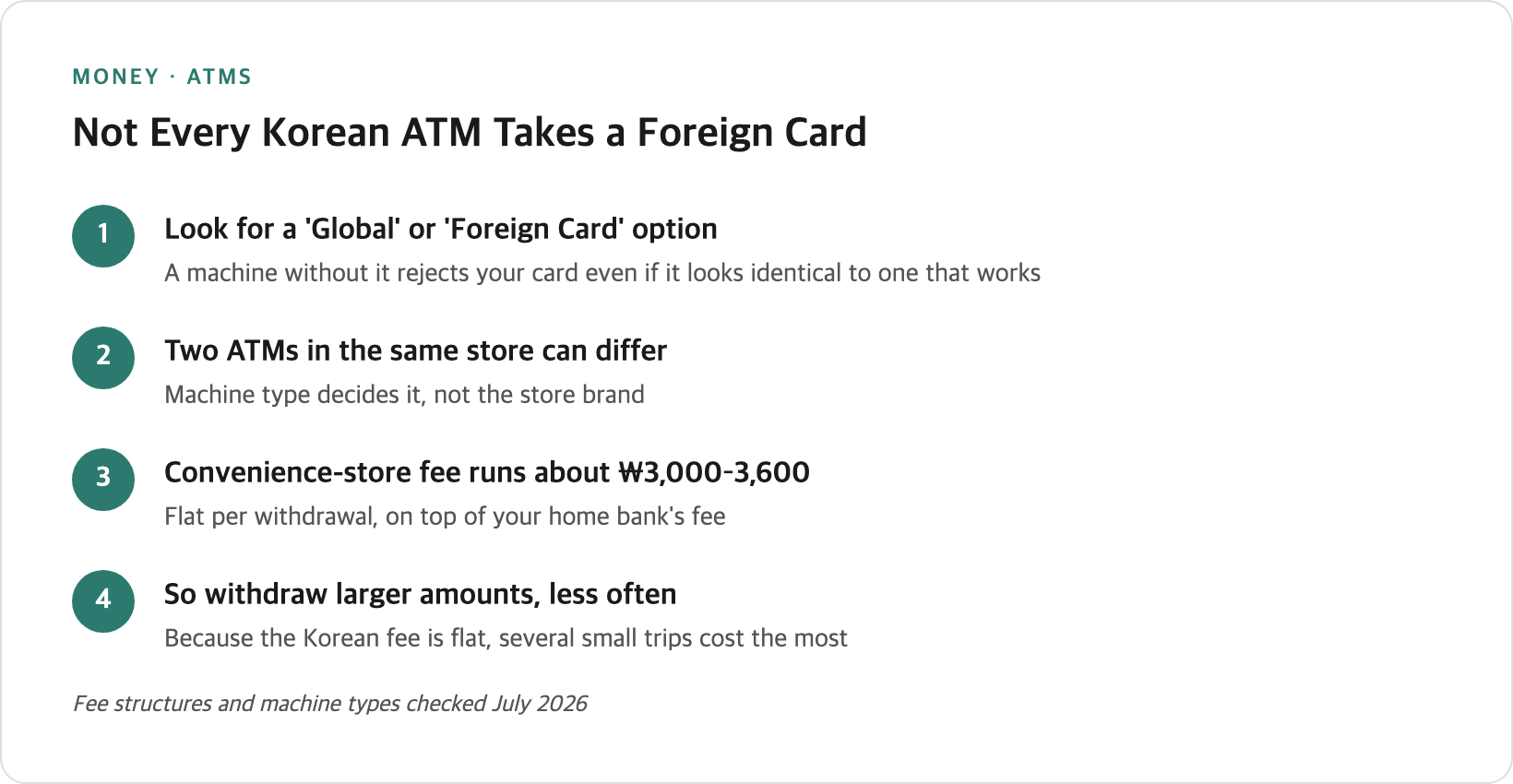
Yes, but not at every machine — and the ones that work aren’t always obvious. Look for an ATM with a “Global” or “Foreign Card” option; a machine without it will reject your card even if it looks identical to one that works. Convenience-store ATM fees run around ₩3,000–3,600 per withdrawal, on top of your home bank’s fee. Because the Korean fee is flat, withdraw larger amounts less often rather than making several small trips.
The Full Answer
“Can I use a foreign card at a Korean ATM?” gets a confident “yes” in most guides, which is true but incomplete. The reality on the ground is that machines vary — even two ATMs in the same convenience store can behave differently — and the fee math rewards a specific withdrawal strategy that guides rarely spell out.
I checked the fee structures and machine-type details in July 2026. The two things that consistently matter — the “Global” capability and the flat-fee logic — are the everyday knowledge that saves money and avoids the “card rejected” moment at the wrong time.
The “Global” Button
This is the single most useful thing to know.
Local tip — Not every ATM accepts foreign cards. Look for one displaying a “Global” or “Foreign Card” option — often GS25, CU, 7-Eleven machines and bank ATMs. A machine without that capability will reject your card, and it can look identical to one that works. Even within the same convenience store, different ATM units run on different operators, so if one rejects your card, try another machine before assuming the card is the problem.
Bank ATMs and the branded convenience-store machines are the safest bets. When in doubt, look for English-language mode and a “Global ATM” label. This matters most for the cash-only pockets where a card simply won’t do.
The Fees
There are two layers, and both apply.
| Layer | Roughly |
|---|---|
| Korean ATM fee | ₩3,000–3,600 (convenience store), sometimes lower at banks |
| Your home bank | Their international withdrawal fee, often 2–3% + flat charge |
Local tip — Because the Korean-side fee is flat per withdrawal, not a percentage, it is far cheaper to take out one larger amount than several small ones. Withdrawing ₩300,000 once costs the same Korean fee as ₩50,000 — so six small trips pay the fee six times. Budget your cash needs and pull a chunk, keeping the cash-only pockets in mind.
Some banks charge less — Woori has tended to be among the lower domestic fees, and Citibank Korea has waived the Korean-side fee, though its branches cluster in central Seoul.
Withdrawal Limits
- Per transaction: often ₩400,000–1,000,000, machine-dependent
- Regulatory cap: foreign-card ATM withdrawals are limited to around USD 5,000/day and USD 10,000/month equivalent
- Practical: the per-transaction limit is what you’ll hit, not the regulatory ceiling
For a normal trip the regulatory caps never come into play; the machine’s own per-withdrawal limit is the real constraint.
When and Where
- Airport: ATMs in arrivals for immediate cash on landing
- Convenience stores: everywhere, 24/7, but check for the Global capability
- Banks: lower fees, but limited to business hours for some functions
- Timing: some machines add a small surcharge outside bank operating hours
- Before a day trip with cash-only stretches: withdraw in the city first — walk-up seats on ski resort shuttles, for example, are sold cash-only, with no card option at the counter
Local tip — A few machines charge a small extra fee outside normal banking hours, so a late-night withdrawal can cost marginally more. If you can, pull cash during the day — and pull enough that you’re not back at the ATM at 1am paying both the flat fee and the after-hours surcharge.
What You Need to Know
-
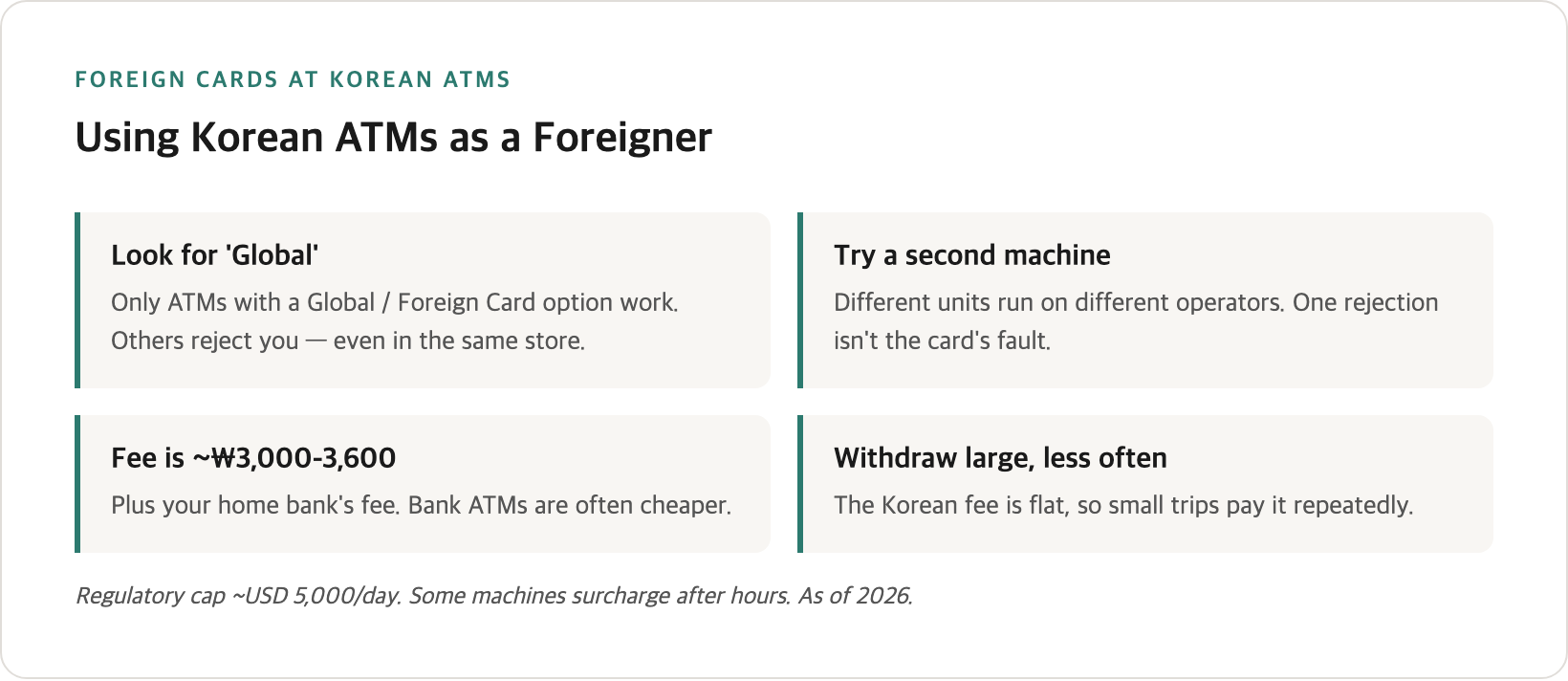
Not every ATM takes foreign cards — look for “Global” or “Foreign Card.”
-
Machines in the same store differ — try another before giving up.
-
Convenience-store fee is ₩3,000–3,600, plus your home bank’s fee.
-
The Korean fee is flat — withdraw larger amounts, less often.
-
Regulatory caps are high (≈USD 5,000/day); the machine limit is what you’ll hit.
-
Some machines surcharge after hours — withdraw during the day.
Practical Tips
-
Look for the “Global” or “Foreign Card” label before inserting your card.
-
Try a second machine if the first rejects you — same store, different operator.
-
Withdraw larger amounts to spread the flat fee.
-
Use bank ATMs for lower fees where convenient.
-
Grab cash at the airport on arrival for immediate needs.
-
Match your withdrawal to the cash-only pockets — markets, street taxis, parking.
-
Factor withdrawal fees into your budget — they add up over a trip.
Frequently Asked Questions
Can I use a foreign card at Korean ATMs?
Yes, at machines with a “Global” or “Foreign Card” option — common at GS25, CU, 7-Eleven and bank ATMs. Machines without that capability will reject your card.
How much are the ATM fees?
Convenience-store ATMs charge around ₩3,000–3,600 per withdrawal, plus your home bank’s international fee (often 2–3% and a flat charge).
Why did one ATM reject my card when another worked?
Different machines run on different operators, even in the same store. Not all support foreign cards. Try another before assuming your card is the issue.
Should I make small or large withdrawals?
Large, less often. The Korean fee is flat per withdrawal, so several small trips pay it several times.
Is there a withdrawal limit?
Machines often cap ₩400,000–1,000,000 per transaction. Regulatory caps (around USD 5,000/day) are far higher than most travellers reach.
Where’s the cheapest place to withdraw?
Bank ATMs tend to be cheaper than convenience-store machines, and some banks waive the Korean-side fee, though their locations are more limited.
Do I even need much cash?
Less than you’d think — most spending is by card. Cash is for the specific pockets where foreign cards fail.
Related Questions
- Cash or Card in Korea? The Apps That Won’t Take Your Foreign Card
- T-money Card: Buying, Topping Up, and Getting Your Money Back
- How Much Does a Week in Korea Cost?
- Do You Need a Visa for Korea? The 90-Day Rule Most Guides Get Half Right
- Korean Age in 2026: Why the Drinking Age Still Uses the Old System