Tongin Market Coin Lunchbox — How Yeopjeon Works and Why the Cafe Shuts Mondays
Last Updated on September 5, 2026
Quick Answer
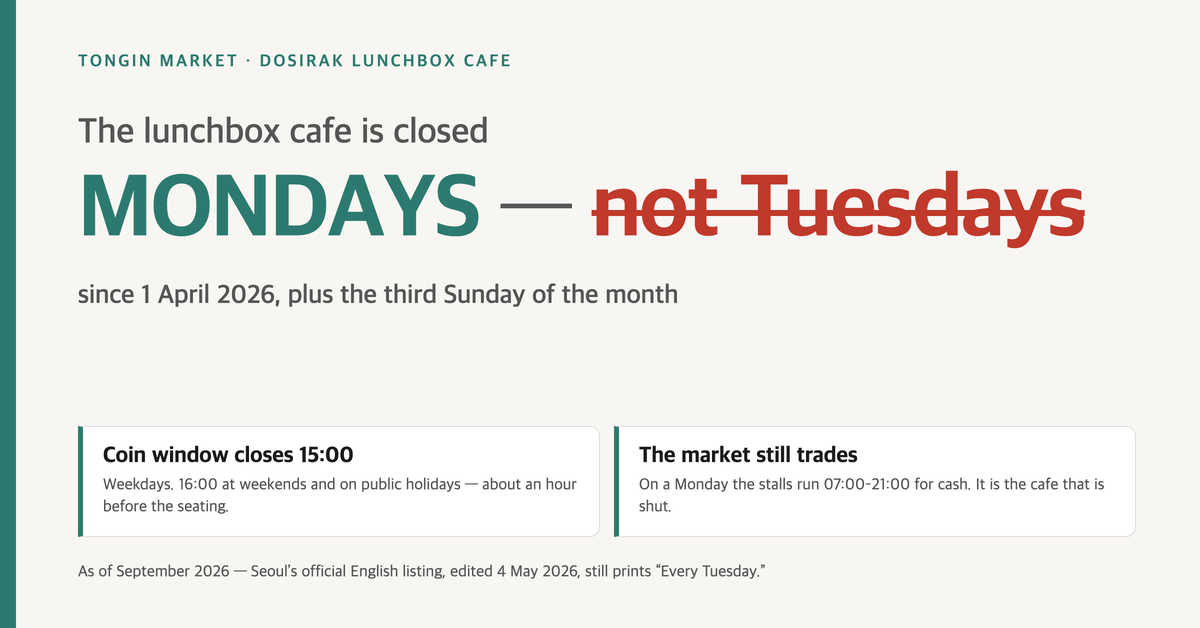
Tongin Market’s lunchbox cafe sells brass yeopjeon (엽전) coins at ₩500 each (as of 2026). You spend them at participating stalls, fill a plastic tray, and eat upstairs. The coin window closes at 15:00 on weekdays and 16:00 on weekends — before the seating does. The cafe is closed Mondays and the third Sunday of the month, not Tuesdays, despite what Seoul’s official English page still says.
The Full Answer
Tongin Market (통인시장) in Seoul’s Seochon neighborhood runs a lunch system you cannot use by walking in and paying — you have to buy a different currency first. The Dosirak Cafe (도시락 카페), literally “lunchbox cafe,” sells replica brass coins called yeopjeon, hands you an empty compartment tray, and sends you back out to spend the coins at stalls that accept them. You carry the tray back upstairs and eat there.
At a market where you pay cash at a stall, arriving unprepared costs you nothing. Here it can cost you lunch: the coin counter shuts an hour before the seating does, it is closed on a weekday that has changed twice in two years, and only signed-up stalls take the coins. None of that is hidden — it is just published on an Instagram account, in Korean.
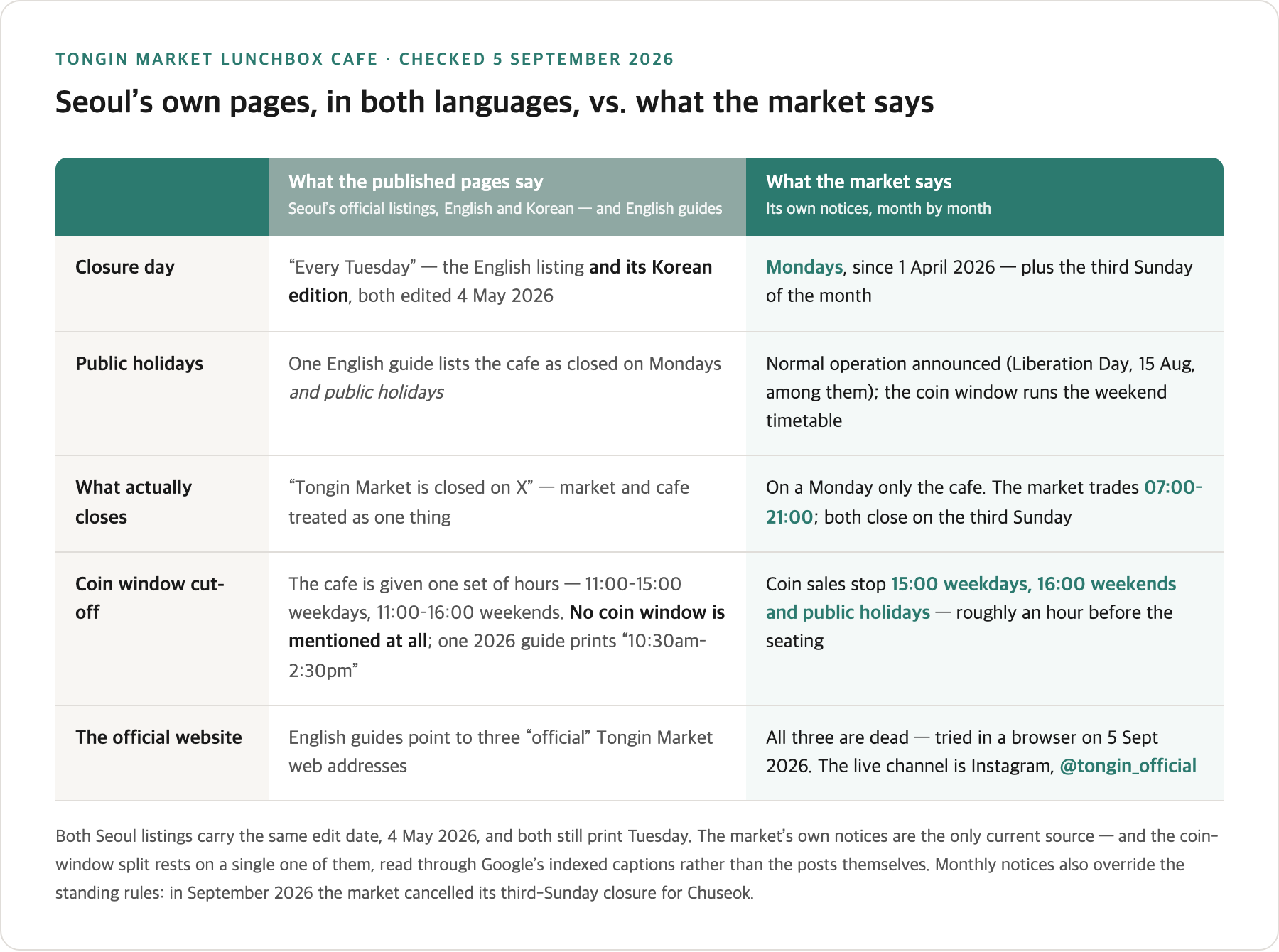
I opened Seoul’s own English listing for Tongin Market on September 5, 2026. It carries an edit date of May 4, 2026, and still says the lunchbox cafe closes “every Tuesday.” The market announced a switch to Mondays effective April 1, 2026, and has posted a Monday-by-Monday closure calendar every month since. The single most consequential fact for planning a visit is currently wrong on Seoul’s official tourism pages in both languages. What follows is the system in the order you will meet it.
The Closure Day Changed in April 2026 — and English Pages Have Not Caught Up
The lunchbox cafe’s regular closing day has moved twice inside two years:
| Period | Cafe closed on |
|---|---|
| Until May 31, 2024 | Mondays |
| June 1, 2024 – March 31, 2026 | Tuesdays |
| From April 1, 2026 | Mondays |
Both changes were announced by the market itself — the 2024 switch on its official KakaoTalk channel, the 2026 switch on Instagram. The cafe also closes the third Sunday of each month.
That is why English guides contradict each other so cleanly: each one froze at a different point in the rules.
Local tip — The lunchbox cafe closes Mondays and the third Sunday of the month, as of September 2026. Seoul’s official English listing, edited May 4, 2026, still prints “Every Tuesday” — and so does its Korean edition, edited the same day. The market’s own account announced the change from April 1, 2026 and has published a monthly closure calendar since. I could not open those posts directly — Instagram puts them behind a login — so I read them through the captions Google has indexed, then checked every listed date against a calendar: May 4, 11, 18 and 25; August 3, 10, 17 and 24; September 7, 14, 21 and 28. All Mondays, across four separate notices.
The other half of the confusion is what closes. Several English pages compress this into “Tongin Market is closed on X” — true of the third Sunday, when the whole market shuts, but not of a Monday, when only the coin system stops.
Local tip — On a Monday the market itself trades normally, 07:00 to 21:00 — it is the cafe that is shut. Seoul’s Korean-language listing is the clearest source for that split: it keeps two separate closure lines, and the market’s own line is just the third Sunday of each month. Take the split from it, not the day — its cafe line is one of the stale ones. The two calendars overlap once a month and diverge every other week: on the third Sunday both are closed, on a Monday only the cafe is. A Monday visit is not wasted — the stalls trade and you can buy the same oil-fried tteokbokki (기름떡볶이) with ordinary money. What you cannot do is buy coins, get a tray, or sit upstairs.
Korean traditional markets each set their own closing rules, with no national pattern — the three big markets in Busan’s Nampo-dong area rotate closures on entirely different schedules. Tongin’s rules apply to Tongin and nowhere else.
Three Different Clocks: The Market, the Cafe, and the Coin Window
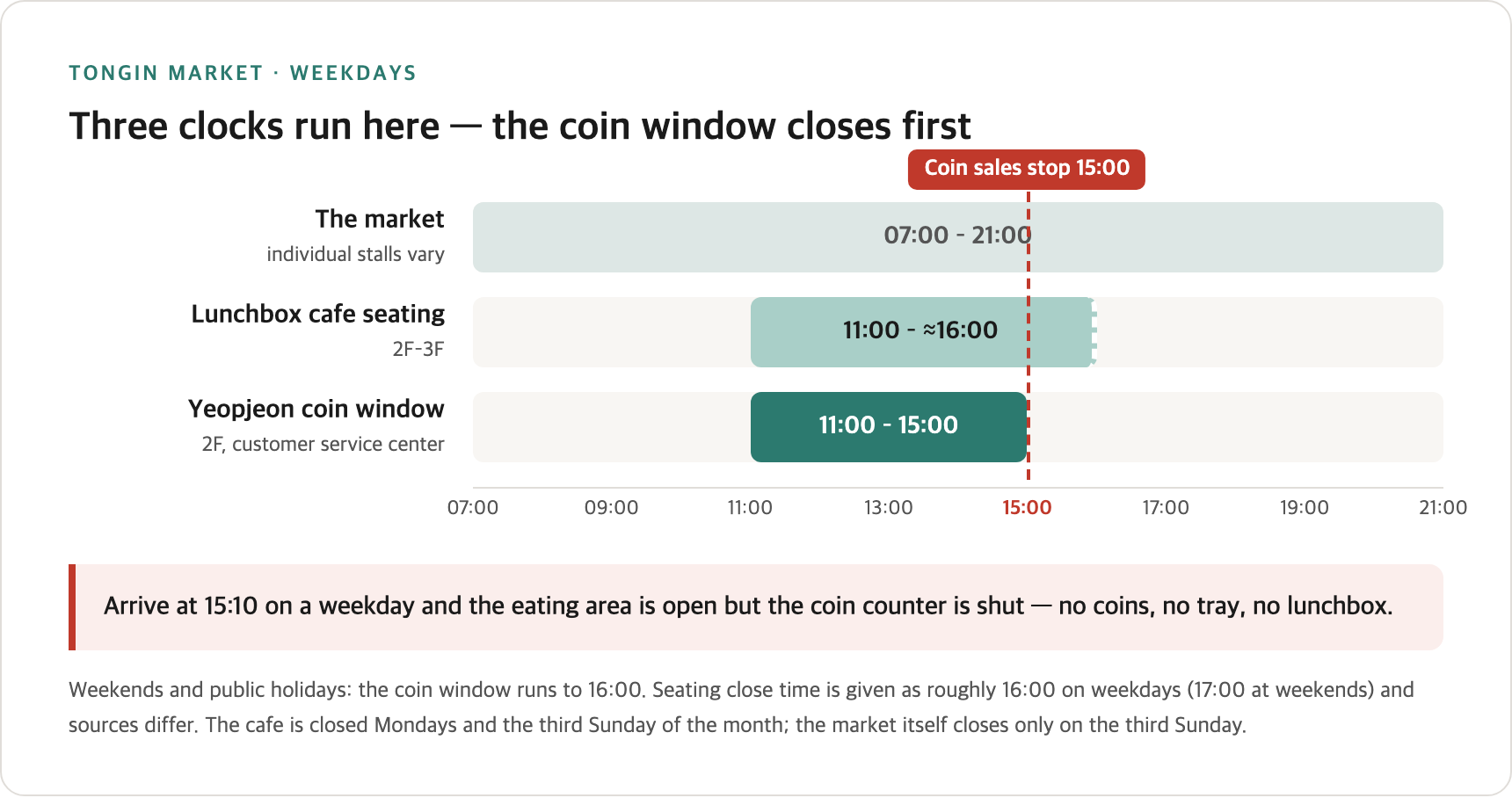
Three separate clocks run here, and most pages print only one of them.
| Hours | Closed | |
|---|---|---|
| The market | 07:00–21:00 (individual stalls vary) | Third Sunday of the month |
| The lunchbox cafe seating (2F–3F) | From 11:00 until roughly 16:00 weekdays, 17:00 weekends — sources differ | Mondays + third Sunday |
| The coin window (2F, customer service center) | 11:00–15:00 weekdays / 11:00–16:00 weekends and public holidays | Mondays + third Sunday |
The coin window is the one that matters: it closes first, and it gates everything else.
Local tip — Coin sales stop at 15:00 on weekdays and 16:00 on weekends and public holidays — roughly an hour before the seating does. Arrive at 15:10 on a Tuesday and the eating area is open and the coin counter shut: no coins, no tray, no lunchbox. One caveat on sourcing: the split rests on a single path. It is the market’s own how-to notice that gives both coin-window times and repeats them as a monthly checklist line, and I read that through Google’s indexed captions, not the posts. Seoul’s official pages give the cafe one set of hours — 11:00–15:00 weekdays, 11:00–16:00 weekends — and do not mention a coin window at all, which is why two clocks look like one; one 2026 guide prints “10:30am–2:30pm,” which matches neither. Treat 15:00 on a weekday as your real deadline.
Public holidays separate out too. One English guide lists the cafe as closed on Mondays and public holidays. The market has announced normal holiday operation — Liberation Day on August 15 among them — and the coin window runs the weekend timetable rather than shutting. A public holiday is a longer coin day, not a closed one.
How the Yeopjeon System Works, Step by Step
1. Find the customer service center, not a stall
Coins are sold at the customer service center in the middle of the market, on the second floor. This is the step people miss: the food is at street level, so it is easy to walk the alley without passing the counter that makes it buyable.
2. Buy coins and take a tray
One yeopjeon is ₩500 (as of 2026). Every Korean and English account gives that figure, though Seoul’s official listings do not quote a price at all. A black plastic tray with six compartments comes with them. Payment can be cash, credit card, or Onnuri gift certificates (온누리상품권), the government vouchers for traditional markets.
3. Learn one word: nyang
Prices at participating stalls are written in nyang (냥), the historical counting unit: one nyang is one coin is ₩500, two nyang is ₩1,000. It trips up Korean visitors too — a Korean review from September 2025 complains outright that the unit is confusing. Fix “1 nyang = 1 coin = ₩500” at the counter and the rest of the market reads normally.
4. Spend the coins at participating stalls only
Seoul’s official Korean listing is blunt about it: the coins work at participating stores only. Spotting them is the next section.
5. Add rice or soup at the center
Rice and soup are bought separately, back on the customer service center’s second floor, at 2 nyang (₩1,000) each (as of 2026) — two Korean sources give that figure; the official listings again give none. Budget for it if you want a meal rather than a tray of side dishes.
6. Eat upstairs, and use the microwave
Seating is on the second and third floors, with utensils, water, a tray return and a microwave. The microwave is there for a reason: by the time six compartments are full, the first thing you bought has gone cold — Korean reviews raise this repeatedly.
7. Return unspent coins
Leftover coins are refundable at the counter, which makes a “buy less, top up later” approach workable — though the procedure is less simple than English pages suggest.
How Many Coins to Buy — a Number the Sources Genuinely Disagree On
The most common question about Tongin Market has no clean answer. Two figures circulate, both from sources that ought to know.
| Figure | Where it comes from | Dates |
|---|---|---|
| ₩5,000 for a bundle of 10 coins | A detailed 2025 Korean walkthrough, a 2017 newspaper feature, most English guides | 2013–2025 |
| ₩10,000 for 20 coins, per person | Two English visitor accounts told this at the counter; a Korean blog post; a bilingual video caption; an online pre-purchase listing | 2023–2026 |
These may not conflict: “a bundle is 10 coins for ₩5,000” is a unit of sale, while “₩10,000 per person” is a minimum the counter asks for — and visitors who report being handed two bundles each fit that reading. But no first-tier source states either as current policy, and one Korean post claiming a ₩10,000 minimum contradicts itself in its own summary box. Both are printed here because neither is settled, not because they are equally likely.
What can and cannot be confirmed — One coin is ₩500 (as of 2026); the minimum is not fixed. Plan for ₩10,000 per person so you are not short, and remember you can buy more mid-meal and return what you do not spend. Korean reviews note that 20 coins does not quite fill all six compartments, since a typical item runs 3–4 coins — oil-fried tteokbokki and Yonggari chicken nuggets (용가리치킨) were both 4 nyang (₩2,000) as of March 2025. Treat ₩10,000 as a tasting budget rather than a full lunch.
For where a ₩10,000 lunch sits in a wider trip, our week-in-Korea cost breakdown has the comparison figures.
How to Tell Which Stalls Take the Coins
Three markers, consistent across Korean sources spanning a decade:
- A “도시락 카페 가맹점” sign — “lunchbox cafe participating store.” Korean articles from 2016, 2017 and 2025 describe the same placard.
- Prices written in nyang. A card reading “엽전 2냥” rather than “1,000원” is the giveaway; Seoul’s own city media calls this the practical way to spot participating shops.
- The coin map. The lunchbox cafe hands out a map of participating stalls — mentioned by Seoul city media, confirmed by one English visitor account. Ask for it when you buy your coins.
How many stalls participate needs care. A 2016 Korean article put it at roughly 20 of the market’s 80-odd shops and that figure is still quoted today — but it is a decade old, and a 2025 Korean walkthrough describes participation as widespread rather than exceptional. Nobody has published a current count. Not every stall, then, and the signs tell you which ones.
Non-participating stalls still sell for cash, and participating stalls take cash when you run out of coins — a traditional market is one of the places where carrying some won still matters, with a convenience-store ATM within reach if you arrive without any. Stalls inside a covered market are also patchy on mapping apps: Naver Map and Kakao Map get you to the entrance, but not to a shop inside.
Refunds: Simpler in English Than in Practice
English pages that mention refunds say some version of “unused coins can be refunded.” True — and it leaves out the part that affects your afternoon: the procedure depends on how you paid.
Cash purchases refund as cash on the spot; card purchases are unwound by cancelling the original transaction and re-charging the amount you actually spent — a void plus a new authorization, which leaves a cancellation receipt. Onnuri gift certificates are more involved again, routing through a card charge, a cancellation and a re-payment on the digital voucher. This comes from one Korean walkthrough published in March 2025, the only description of the procedure I found in either language, so treat the mechanics as indicative rather than posted policy. The direction is still worth acting on: pay cash, and buy modestly. Topping up mid-meal is a two-minute walk. Unwinding a card payment at 14:55, with the coin window about to close, is not.
One caution about a rule you may see quoted: an online pre-purchase listing for digital yeopjeon says refunds are all-or-nothing. That condition belongs to the online product, which is not currently on sale, and whether it applies to walk-up purchases is unconfirmed — another reason to pay cash.
There Is No Working Official Website
Go looking for an authoritative page to check hours against and you hit a dead end.
Local tip — All three “official” Tongin Market web addresses that English guides point to are dead. I tried each in a browser on September 5, 2026: two return error pages, and the third resolves only to a notice that its hosting service shut down on June 26, 2025. Seoul city media leave the official-homepage field blank. The live channel is the market’s Instagram account, @tongin_official, which posts that month’s closure calendar at the start of each month. A KakaoTalk channel exists but its last post is from May 2025. The phone number is 02-722-0911.
This is not trivia. Closure days have changed twice since 2024 and holiday schedules are announced monthly rather than derived from a rule, so the only current answer lives in an Instagram feed — which is both the reason to check before you go and the reason Seoul’s own pages, in both languages, went stale.
Chuseok, and Why “Third Sunday” Is Not a Rule You Can Trust
The third-Sunday closure is real, and it gets overridden.
Local tip — In September 2026 the market cancelled its third-Sunday closure. Its September notice — again read through Google’s indexed caption rather than the post itself — lists Sunday, September 20, the third Sunday, as a special trading day ahead of Chuseok. In exchange, the lunchbox cafe is closed Monday September 21 through Friday September 25 for the holiday, with normal operation on September 26 and 27; Chuseok itself falls on Friday, September 25. No English page I found mentions Tongin’s Chuseok schedule, though “tongin market chuseok” appears in Google’s own autocomplete. The lesson generalizes: the monthly notice overrides the standing rule, so a calendar rule copied from any guide — this one included — is a starting point rather than an answer.
Chuseok reshapes more than one market — our guide to what actually closes in Seoul over Chuseok covers the wider pattern for transport, palaces and restaurants.
What to Expect When You Get There
Tongin is a small market. English reviews from 2025 and 2026 call it smaller than other traditional markets and, in a few cases, over-hyped — fair if you arrive expecting a sprawling food destination. It is a compact covered alley with a lunch system attached, and works best as a 30- to 45-minute lunch stop on a Seochon or palace day. It is not a bargain either: a Korean guide from March 2025 says plainly that Tongin is a tourist market rather than a cheap neighborhood one. A tray of small portions at ₩10,000 plus ₩1,000 for rice is fair for central Seoul, but it is not the cheap-eats experience a “₩5,000 for 10 coins” framing implies.
Two crowd notes. Weekends draw far more visitors — Korean coverage describes crowds in the thousands, and Saturday is the traditional market day — so a weekday around 11:00 is the least pressured window. And some stalls do not open on weekends: a Korean guide from 2025 and an English review from May 2025 both mention closed shutters on a Sunday morning, narrowing your coin options on the busiest days. If the coin window has closed when you arrive, the fallback is cash at whatever stalls are trading, or a convenience store a few minutes away.
Getting There from Gyeongbokgung
Tongin Market sits at 18, Jahamun-ro 15-gil, Jongno-gu (자하문로15길 18). The nearest station is Gyeongbokgung Station (경복궁역) on Line 3, Exit 2, which Seoul’s official listing puts 515m away. Walking estimates range from 5 to 10 minutes; 8 to 10 is the safe planning figure, essentially straight ahead from the exit.
Same station as Gyeongbokgung Palace, different exit: the palace uses Exit 5, 218m away, inside the National Palace Museum concourse. From the palace you do not need the station at all — leave by the west side and walk into Seochon, which makes this a lunch stop rather than a separate trip. On the hanbok rental route, note the narrow alley and the stairwell in it. Changdeokgung is a longer walk east and usually a separate half-day. For the subway leg, the Seoul subway guide covers Line 3 transfers and a T-money card beats single-journey tickets.
The market dates to 1941 and the lunchbox cafe opened in January 2012; Wikipedia’s entry covers the history in more depth than a lunch plan needs.
What You Need to Know
- The coin window closes first — 15:00 weekdays, 16:00 weekends and public holidays, roughly an hour before the seating.
- Monday is a cafe closure, not a market closure. The market trades 07:00–21:00 and you can eat there with cash. The third Sunday is the different one: the market closes too.
- The closure day has moved twice since 2024, so any guide, this one included, is a snapshot.
- The minimum purchase is unsettled. ₩500 per coin is fixed; ₩5,000 for 10 and ₩10,000 for 20 per person are both reported by credible sources.
- Coins only work at participating stalls — the “도시락 카페 가맹점” sign, or prices in nyang.
- Refunds follow your payment method, and there is no working official website: the month’s schedule lives on the market’s Instagram account.
Practical Tips
- Buy coins by 14:00 on a weekday. The cut-off is 15:00 and you still need to walk the alley, queue at two or three stalls, and get back upstairs. Weekends and holidays give you until 16:00.
- Check the market’s Instagram the week before you go. It posts the month’s closure calendar, including the holiday exceptions that override the standing third-Sunday rule.
- Pay cash, and bring ₩10,000 per person but buy at the low end of whatever the counter allows. Cash refunds on the spot, coins are refundable, and the counter is a two-minute walk from the food alley.
- Ask for the coin map at the counter. It marks participating stalls, which saves checking signs shop by shop while your tray gets colder.
- Go on a weekday around 11:00 if you can. Weekends are markedly busier, and some stalls do not open on Sundays.
Frequently Asked Questions
What time does Tongin Market close?
The market trades from 07:00 to 21:00, though individual stalls vary. The lunchbox cafe seating runs from 11:00 until roughly 16:00 on weekdays and 17:00 on weekends — sources differ by about an hour. The number that actually constrains you is the coin window, which closes at 15:00 on weekdays and 16:00 on weekends and public holidays. Treat 15:00 as closing time on a weekday.
When does Tongin Market close — which days?
The market closes on the third Sunday of each month. The lunchbox cafe closes every Monday and the third Sunday, as of September 2026. Those are two different calendars: on a Monday the market trades normally and only the coin system is unavailable. Monthly notices can override both, as happened in September 2026 when the third-Sunday closure was cancelled.
Is Tongin Market closed on Tuesdays or Mondays?
Neither, for the market itself — it trades Mondays and Tuesdays alike and closes only on the third Sunday. The question is really about the lunchbox cafe, and there the answer is Monday. Its closing day was Tuesday between June 1, 2024 and March 31, 2026, then moved to Monday on April 1, 2026. Guides written in that window say Tuesday and were right at the time; Seoul’s official pages, English and Korean, still say Tuesday. Guides from before mid-2024 say Monday and happen to be right again.
How does the Tongin Market coin system work?
You buy yeopjeon coins at ₩500 each (as of 2026) from the customer service center’s second floor and receive a six-compartment plastic tray. You spend the coins at participating stalls — marked with a “도시락 카페 가맹점” sign or prices in nyang — then return to the second or third floor to eat. Rice and soup are bought separately at 2 nyang each. Unspent coins are refundable at the counter.
How many coins should I buy at Tongin Market?
Sources disagree. Korean sources describe a bundle of 10 coins for ₩5,000; several visitor accounts from 2023 onward report being asked for ₩10,000 per person, or 20 coins. Neither is confirmed as official policy. Bring ₩10,000 per person, buy conservatively, and top up — with typical items at 3–4 coins, 20 coins fills most but not all of the tray.
Can I get a refund on unused yeopjeon coins?
Yes, at the same counter that sold them, but the method follows your payment. Cash refunds in cash on the spot; card purchases are unwound by cancelling the original transaction and re-charging what you used, and Onnuri gift certificates are more involved still. An all-or-nothing refund restriction is documented for the online pre-purchase product, but whether it applies to walk-up purchases is unconfirmed.
Is Tongin Market open during Chuseok?
For 2026, the market’s September notice puts the lunchbox cafe closed Monday September 21 through Friday September 25, with normal operation on September 26 and 27. It also lists Sunday September 20 — normally the third-Sunday closure — as a special trading day. The notice does not separate the market’s own hours from the cafe’s, so read those dates as the cafe’s. Chuseok moves each year and the market publishes month by month, so confirm on Instagram rather than assuming the pattern repeats.
How do I get to Tongin Market from Gyeongbokgung?
From the palace, walk out the west side into Seochon rather than back underground. From the subway, take Exit 2 of Gyeongbokgung Station on Line 3 — not Exit 5, the palace’s own exit — and walk approximately 8 to 10 minutes; Seoul’s official listing gives the distance as 515m. The market entrance is on Jahamun-ro 15-gil, and the phone number is 02-722-0911.
Related Questions
- Gyeongbokgung Palace — Tickets, Free Entry, and the Best Time to Arrive
- Cash or Card in Korea — Where You Still Need Won
- Chuseok in Seoul — What Actually Closes
- Namdaemun Market — Real Hours, Sunday Closures and the Car-Free Rule