Jamsil Baseball Stadium Closes in 2026 — Where KBO Games Go Next
Last Updated on September 7, 2026
Quick Answer
Yes — 2026 is Jamsil Baseball Stadium’s (잠실야구장) final season, ending October 7. Korean news reports say demolition begins in December 2026, though Seoul has not published that date itself. LG Twins and Doosan Bears move to a renovated Olympic Stadium next door for 2027–2031, then to a new 30,000-seat dome targeted for completion in 2032. The interim stadium’s working seat count was cut to roughly 13,000 as of July 2026, well below the 18,000 Seoul announced in 2024.
The Full Answer
Jamsil Baseball Stadium’s closure is not a secret. Seoul’s own English-language press office has confirmed it, Korea’s English-language newspapers have covered it, and at least one English-language travel guide already says the same thing. I checked zuzukorea.travel directly: its Korean baseball guide, published in April 2026, states that “Jamsil Stadium is scheduled for demolition at the end of the 2026 season” and frames 2026 as the last chance to see a game there. So the headline — “Jamsil is closing” — is not this article’s contribution.
What none of that coverage does is get specific about what changes for someone actually planning to go. The interim stadium’s seat count has been revised down since Seoul first announced it in 2024, and no English source carries the revised figure — the travel guide above does not give a seat count at all, and the English-language reference pages that do still quote the 2024 plan. The roads fans use to reach the stadium are going to change once the interim venue opens, and nothing in English covers it. And the “farewell season” some Korean outlets describe is still mostly unscheduled, which matters if you’re trying to plan around it.
This article covers the demolition timeline, the interim stadium’s real numbers, the access changes, and what’s actually confirmed for the new dome — with links to the primary sources so you can check them yourself. It does not cover how to buy tickets, which seats are worth having, or what you can bring into the stadium; those are separate topics with their own operating details, and our guide to going to a KBO game is the starting point for them.
For background on the stadium itself — when it opened, its role in Korean baseball history, its various renovations — the Wikipedia entry on Jamsil Baseball Stadium covers that. As of its most recent edit in May 2026, it does not mention the demolition at all, which is itself a useful data point about how far behind the English-language reference layer is running.
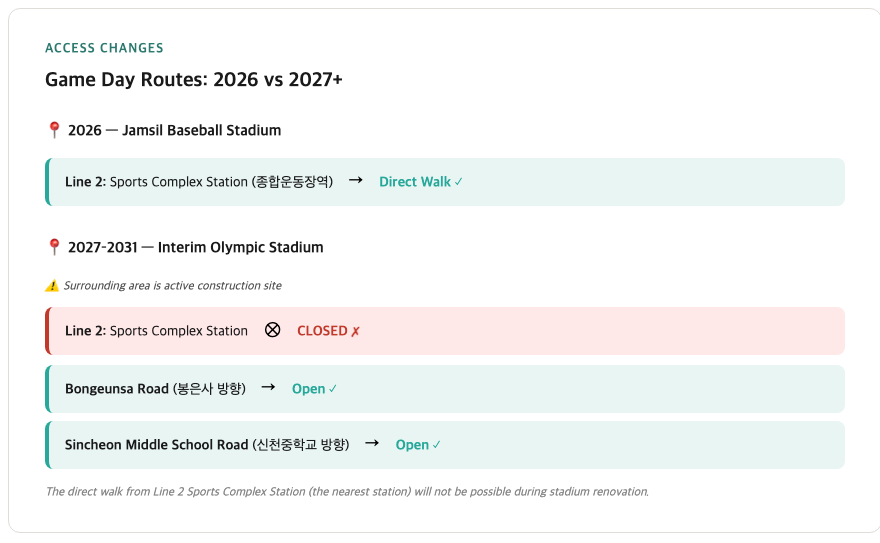
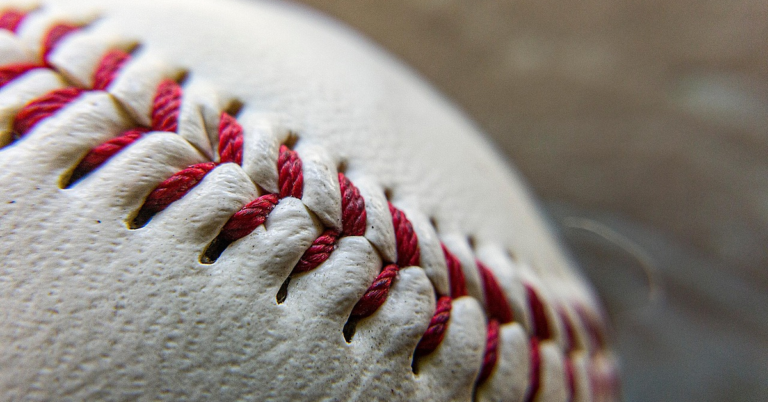
Photo by Connor Scott McManus on Pexels
A Timeline Built From Two Announcements
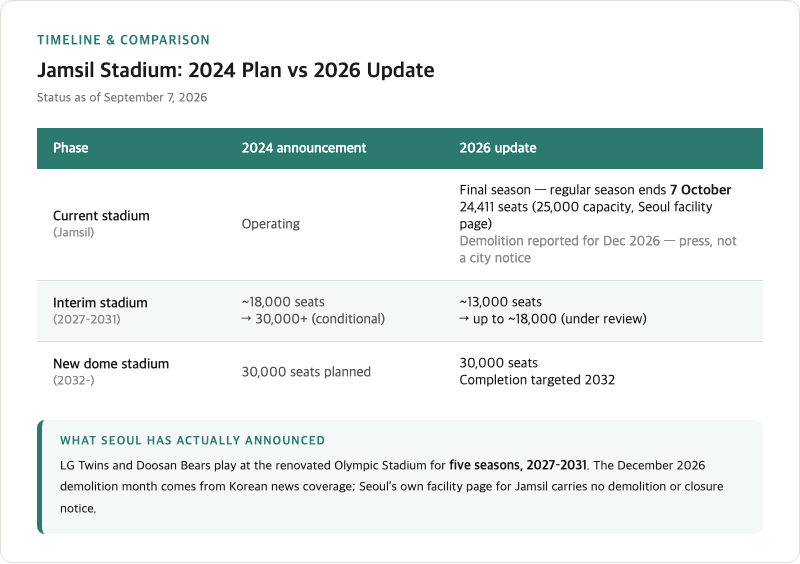
The clearest way to see what’s actually changed is to line up what Seoul said in 2024 against what got reported in July 2026. I compared Seoul’s original 2024 announcement for the interim stadium with the Seoul Sinmun report from July 2026, and the two describe a noticeably smaller ballpark.
| July 2024 announcement | July 2026 reporting | |
|---|---|---|
| Base capacity | “roughly 18,000 seats,” built across the 1st–2nd floors | ~13,000 seats, described as the best fit for safe crowd flow |
| Expanded capacity (major games, postseason) | “30,000 or more,” opening the 3rd floor, conditional on safety monitoring | Up to ~18,000 under review — the 3rd floor and outfield seats are not in the operating plan |
| Source | Seoul Mayor’s office, 9 Jul 2024 | Seoul Sinmun, 15 Jul and 16 Jul 2026 |
Local tip — the interim stadium is smaller than the 2024 plan, and English coverage hasn’t caught up. Seoul Sinmun reported in July 2026 that a pedestrian-flow simulation run for the project found roughly 13,000 seats to be the best fit, with up to 18,000 still workable — against the “roughly 18,000, rising to 30,000 or more” that Seoul announced in 2024. The report also states the 3rd-floor and outfield sections will not be operated at all. Every English source I could find that quotes a seat figure for the interim stadium, including the most detailed English-language wiki entry on the project, still uses the 2024 numbers. Two caveats: this is one Korean newspaper’s reporting rather than a confirmed city figure, and the same report says capacity could be raised if additional walkways open up. Treat 13,000 as the current working plan, not a locked-in number.
The reason for the cut is physical, not budgetary. The renovated venue sits inside the Olympic Stadium (잠실 종합운동장 주경기장), which was not designed as a baseball venue, and the area around it is a live construction site for several more years while the new dome goes up next door. A stadium that can’t safely empty a crowd after a night game is a stadium that gets a smaller number attached to it, regardless of what the original announcement said.
What the Smaller Interim Stadium Actually Looks Like
Beyond the seat count, the renovated stadium differs from Jamsil in ways that matter if you’ve been to a game there before or are comparing it to what other guides describe.
- Field dimensions are tighter. Foul lines shrink from 100m to 95m (Seoul had targeted 96m, but foul-pole positioning forced the extra metre off), and center field goes from 125m to 124m — small changes, intended to preserve the pitcher-friendly character Jamsil is known for.
- Team sides are assigned. The LG Twins take the third-base side; the Doosan Bears take the first-base side.
- Construction was roughly 90% complete on the playing field as of July 2026, with stand and surrounding-area work ramping up from August and a December 2026 completion target. Interior finishing is expected to run into January–February 2027, with provisional-use approval targeted for early January 2027 — tight enough that a delay would push directly into the start of the 2027 season.
Getting to Games Once the Interim Stadium Opens
This is the part that changes the practical experience of going to a game more than anything else, and it’s the one detail I couldn’t find in a single English-language source.
Right now, getting to Jamsil is close to the simplest transit trip in Seoul: Line 2 to Sports Complex Station (종합운동장역), then a short walk. That approach is the one that stops working.
Local tip — the approach from Sports Complex Station gets closed off, and no English guide mentions it. Seoul Sinmun’s July 2026 report states it plainly: once the interim stadium is operating, the whole area around it is an active construction site, and “the current route toward Line 2 Sports Complex Station is also closed off entirely.” Only two access roads will serve the interim stadium — one toward Bongeunsa (봉은사) and one toward Sincheon Middle School (신천중학교). Seoul’s 2024 announcement describes the same pair as a western entrance by Bongeun Bridge (봉은교), where the pavement is to be widened, and an eastern entrance toward Baekjegobun-ro built as a separate pedestrian-only passage away from the construction zone. Every English description of getting to a Jamsil-area game still describes the current, direct walk from Sports Complex Station. None mention that it changes.
Practically, this means the walking route you’d plan from a map app today may not be the one that’s actually open for a 2027–2031 game. Since the interim stadium is a renovated section of an existing complex rather than a brand-new address, it’s also the kind of location where Korean map apps outperform Google Maps for real-time walking directions and entrance changes — worth having installed before your first visit, not after you’re standing outside a closed gate. For the wider transit picture around this part of Seoul, the Seoul subway guide and getting around Korea guide cover the basics of how the city’s transit system works.
Is There a Jamsil Farewell Season in 2026?
Korean coverage describes 2026 as a “farewell season” (고별 시즌) at Jamsil, with plans for photo zones, memory exhibits inside the stadium, and commemorative merchandise. Separately, 일구회 (Ilguhoe), an association of retired KBO players, is reported to be organizing a farewell legend game.
Local tip — the farewell legend game is real, but nothing about it is scheduled yet. Ajunews reported in March 2026 that the farewell legend game is planned for shortly after the Korean Series ends — October or November — organized by the retired players’ association, and that “the player roster and detailed schedule will be announced later, after the organizing committee’s discussions.” As of 11 August 2026 no follow-up announcement has appeared, so the date, lineup, and ticketing are all still open. Western travel guides don’t mention this event at all. A Korean sports outlet’s English edition did cover a related moment — a ceremonial farewell first pitch by LG and Doosan legends at the 2026 All-Star Game, held at Jamsil on 11 July 2026 — but that’s a single ceremony that has already happened, not the farewell legend game itself. If you’re timing a trip specifically around this event, treat it as unconfirmed and check closer to October.
The broader “farewell season” programming (photo zones, merchandise) has similarly thin public detail as of this writing — Korean coverage from January 2026 describes the concept without firm dates. If concrete details are published before the season ends, this section will be updated; until then, don’t build a travel plan around specific farewell-season events that haven’t been scheduled.
When Does the 2026 Season Actually End?
If “last season” means anything practical to you, it’s the date the 2026 regular season actually wraps up — and 2026 has an unusual complication.
The KBO held its first-ever league-wide “heat wave break” in early August 2026, pausing the schedule outright. Sports Khan reported that heat cancellations had pushed back 30 games over the season, out of 55 postponed games in total. The league resumed play on 11 August 2026. That backlog pushes the postseason later too — our KBO postseason guide tracks where the 2026 calendar currently stands.
Local tip — the 2026 regular season ends 7 October, and most English sources still say “through October.” KBO settled this in a Korean-language notice posted on 25 August 2026: the 105 games still outstanding — 45 unscheduled, 60 postponed — are to be played through Wednesday 7 October, three days past 2025’s 4 October finish, with doubleheaders resuming 29 September. Earlier reporting, including Sports Khan’s 10 August 2026 report, had only the league’s projection of “about a week later”; the notice supersedes it. So the window to see a game at the original Jamsil closes in the first week of October, with the postseason — still unscheduled — after it.
The 2026 Asian Games add a further complication. Baseball runs 21–27 September in Nagoya, the national team is due to be called up around 13–14 September, and the KBO is continuing its season straight through with no break — so several clubs will spend close to a fortnight without key players during the closing stretch. That affects the quality of the baseball on offer in late September, not the schedule itself.
The New Dome Stadium: What Seoul Confirms for 2032
Past the interim stadium, Seoul’s plan is a fully enclosed 30,000-seat dome on the Jamsil site, built alongside a large convention center and hotel complex.
I checked Seoul’s official English press release for the dome project directly, and it states a 30,000-seat dome baseball stadium with completion targeted for 2032, corroborated by the Korea Times’ March 2026 coverage of the same figures. Those are the numbers this article uses. Neither source gives a month, so treat 2032 as a target year rather than a date.
It doesn’t match everything published in Korean, though. One Korean business magazine, published in January 2026, reported a 35,000-seat capacity and a 2031 completion target for the same project — different on both counts. Rather than average the two or quietly pick one, the difference is worth stating outright: Seoul’s own English press release is the more recent and more authoritative source for a city-led infrastructure project, so this article uses 30,000 seats and 2032, and treats the 35,000/2031 figure as an earlier or less precise report that the city’s own communications have since superseded.
| Jamsil Baseball Stadium (current) | Interim stadium (2027–2031) | New dome (2032–) | |
|---|---|---|---|
| Seating | 24,411 seats (25,000 capacity, per Seoul’s facility page) | ~13,000 typical, up to ~18,000 under review | 30,000 (Seoul official figure) |
| Location | Current Jamsil site | Renovated Olympic Stadium, next door — but reached via the Bongeunsa or Sincheon Middle School roads, not the current Sports Complex Station approach | Rebuilt Jamsil site |
| Status as of Aug 2026 | Final season in progress | Under construction, ~90% of field work complete | Agreement signed Mar 2026; construction scheduled to start within 2026 |
| Roof | Open-air | Open-air | Fully enclosed dome |
The dome project is being funded entirely through private investment rather than the city budget — a consortium led by Hanwha, operating under the name “Seoul Smart MICE Park,” was selected as preferred bidder and signed the partnership agreement in March 2026. The estimated project cost, as of 2025 figures, is around ₩3.3 trillion, covering the dome along with a convention facility roughly 2.5 times the size of COEX and 841 hotel rooms split across five-star, four-star, and residence-style categories. None of that changes what happens to baseball between now and 2032 — it’s the reason the interim stadium exists at all, since a project this large doesn’t get built around an active ballpark.
Why Gocheok Sky Dome Isn’t a Backup Plan
Gocheok Sky Dome (고척스카이돔) is Seoul’s other ballpark and its only fully enclosed one, so it is the obvious question. Seoul considered it in the original 2024 planning and ruled it out: it lacks the locker and facility space for two more clubs to share alongside the Kiwoom Heroes. For baseball between 2027 and 2031, LG and Doosan fans are at the renovated Olympic Stadium, not Gocheok. If you’d rather look at another city entirely, our comparison of all ten KBO stadiums covers what else is reachable and how each club sells its tickets. Gocheok’s own layout and station access are covered in the guide to Seoul’s K-pop concert venues, since it doubles as a concert hall.
What You Need to Know
- 2026 is the last season at the current Jamsil Baseball Stadium, and the regular season ends 7 October. Korean news reports put demolition at December 2026, but Seoul’s own facility page for the stadium carries no demolition or closure notice — treat the month as press reporting, not a city announcement.
- LG Twins and Doosan Bears move to a renovated Olympic Stadium for 2027–2031 — a five-season interim arrangement, not a permanent new home.
- The interim stadium’s seat count has shrunk since it was first announced. The 2024 plan cited roughly 18,000 seats, expandable to 30,000-plus for big games; July 2026 reporting puts the working number closer to 13,000, with expansion under review up to about 18,000.
- The walking route to and from games changes once the interim stadium opens. The current direct approach toward Line 2 Sports Complex Station is closed off entirely while the surrounding site is under construction; only two access roads serve the interim stadium, toward Bongeunsa and toward Sincheon Middle School.
- A farewell legend game is planned but not yet scheduled — expected October or November 2026, organized by a retired players’ association, with lineup and ticket details unconfirmed as of this writing.
- The 2026 regular season ends 7 October, three days later than 2025, under the schedule KBO published on 25 August after an unprecedented mid-season heat wave break — so “through October” overstates how much of the month is left.
- The new dome stadium is a 30,000-seat project targeted for completion in 2032 — Seoul signed the partnership agreement in March 2026 and said construction was scheduled to begin within the year.
Practical Tips
-
If seeing a game at the original Jamsil Baseball Stadium matters to you, plan for this season. Once 2026 ends, the venue closes for demolition and doesn’t reopen in its current form.
-
Don’t assume the 2025 season-end date applies to 2026. The heat wave break pushed the schedule back, and KBO’s 25 August notice now sets the last day at 7 October rather than 2025’s 4 October. Postseason dates hang off that and were still unpublished as of 7 September — our KBO postseason guide tracks them.
-
If your trip falls in 2027 or later, expect games at the renovated Olympic Stadium, not Jamsil. The stadium itself will not exist during those years; it’s an active demolition and construction site.
-
Don’t build a 2026 trip around the farewell legend game. It’s realistically expected in October or November, but the date, roster, and ticket process are all still unconfirmed.
-
Once the interim stadium opens, check the approach before you go rather than assuming the current walk. The direct path toward Line 2 Sports Complex Station is closed off during the construction years; expect to arrive and leave via the Bongeunsa side or the Sincheon Middle School side instead.
-
Have a Korean map app installed before you go, and make sure your phone actually has data. Especially from 2027 onward, the interim stadium sits inside a renovated, still-under-construction sports complex, which is exactly the kind of location where English map data lags behind — worth checking your eSIM or pocket wifi options before you land, not after you’re standing outside a closed entrance.
-
If you’re flying in specifically to see a game before Jamsil closes, build in flexibility. With the regular season ending 7 October and both the postseason and the farewell events still unscheduled, the dates after that are moving; the guide to getting from Incheon Airport to Seoul covers the arrival side, and the KTX booking guide is worth a look if you’re combining this with a wider Korea itinerary.
Frequently Asked Questions
Is 2026 really the last season to watch a game at Jamsil Baseball Stadium?
Yes. The 2026 season is the final one at the current stadium: Seoul’s 2024 announcement of the interim venue has LG Twins and Doosan Bears playing at a renovated Olympic Stadium for 2027–2031, and the 2026 regular season ends 7 October. Korean and English news reports both put demolition in December 2026, but that month comes from press coverage — Seoul’s own facility page for Jamsil carries no demolition or closure notice, so treat it as reported rather than officially scheduled.
Where will the LG Twins and Doosan Bears play after Jamsil closes?
Both teams move to a renovated version of the Jamsil Olympic Stadium (잠실 종합운동장 주경기장), next to the current baseball stadium and reachable from Sports Complex Station, for the 2027 through 2031 seasons. LG Twins take the third-base side; Doosan Bears take the first-base side.
When exactly does Jamsil Baseball Stadium close?
The stadium closes after the 2026 regular season and postseason conclude. KBO’s 25 August 2026 notice sets the regular season’s last day at 7 October, three days later than 2025 after a mid-season heat wave break; postseason dates had not been published as of 7 September 2026. Demolition is reported to begin in December 2026, though that month comes from news coverage rather than a published Seoul notice.
How many seats will the temporary Olympic Stadium ballpark have?
As of July 2026 reporting, roughly 13,000 seats is the figure identified as workable, with expansion under review up to about 18,000 for larger games. That’s well below the roughly 18,000 base capacity — expandable to 30,000-plus for major games — that Seoul announced in 2024, and most English sources still cite those older figures.
Will it be harder to get to games once the interim stadium opens in 2027?
The walk changes rather than gets categorically harder. According to Seoul Sinmun’s July 2026 reporting, the current direct route toward Line 2 Sports Complex Station is closed off entirely once the interim stadium is operating, because the surrounding area is a construction site. Two access roads serve the venue instead — one toward Bongeunsa, one toward Sincheon Middle School.
Is there a farewell event or ceremony for Jamsil Stadium’s last season?
A farewell legend game organized by a retired players’ association is planned for shortly after the 2026 Korean Series, likely October or November, though the roster, date, and ticket process remain unconfirmed. A separate ceremonial farewell moment already took place at the 2026 All-Star Game in July, featuring former LG and Doosan players.
Should I go to Gocheok Sky Dome instead if I’m visiting Seoul after 2026?
Gocheok Sky Dome is a different team’s home ground (Kiwoom Heroes) and was specifically ruled out as an option for LG and Doosan during the interim years due to insufficient shared facilities. It’s a good venue in its own right — and doubles as a concert venue — but it isn’t a substitute for a Jamsil-area LG or Doosan game between 2027 and 2031.
When will the new Jamsil dome stadium open?
Seoul’s official target, stated in its English-language press release, is completion in 2032, with 30,000 seats. The release does not name a month. Seoul signed the public–private partnership agreement in March 2026 with a Hanwha-led consortium and said construction was scheduled to begin within that year; the interim stadium arrangement covers the years in between.
Related Questions
- Getting Around Seoul: Subway, Buses, and What’s Actually Different in 2026
- Why Google Maps Doesn’t Work for Directions in Korea — and What to Use Instead
- Seoul’s K-pop Concert Venues, Including Gocheok Sky Dome