Seoraksan and Jirisan Shelter Reservations: How Korea’s Lottery System Works
Last Updated on September 10, 2026
Quick Answer
Korea’s national park shelters on Jirisan, Seoraksan, Deogyusan and Sobaeksan are allocated by a year-round lottery rather than a first-come rush. Applications open on the 1st of every even month and close on the 5th, and the draw is random — submitting early changes nothing. Losing the draw isn’t the end: unclaimed and cancelled spots reopen first-come afterward, on a date KNPS publishes for each round at reservation.knps.or.kr.
The Full Answer
A one-night stay at a Jirisan or Seoraksan shelter used to mean what every hiker’s forum described: a booking window that opened at a fixed time, a scramble, and a page that filled within a minute. That is not how it works now — worth knowing before you build a schedule around the old rules, if you’ve already sorted out a K-ETA and flights and are now planning the hiking days. The Korea National Park Service (국립공원공단, KNPS) allocates its shelter nights by a year-round random draw. Korean news coverage in May 2025 put the changeover at July 1, 2025 — counted from the night you stay rather than the day you apply, with the first affected block running July–August and its application window opening on June 1 — and gave the scope as 13 shelters across four parks. The same coverage gave KNPS’s reasoning: the old scramble rewarded whoever could sit at a screen at the right second, which the agency framed as a fairness problem for anyone less comfortable online. The reservation site itself doesn’t publish a start date, but its current Korean-language pages describe the lottery and nothing else.
I opened the live lottery page directly on August 22, 2026, to check what round was active. It showed the fifth 2026 lottery round already closed — application period August 1–5, covering stays from September 1 to October 31 — which matches the “1st to 5th of every even month” rule the agency’s own reservation policy page sets out. The schedule is live and running, not a one-off pilot.
One practical note before the details: the reservation site’s English shelter pages are older than its Korean ones and still carry the pre-lottery text about launch dates on the 1st and 15th. This article follows the Korean policy pages and the live lottery screens.
How the Shelter Lottery Actually Works
The Application Window — Every Even Month, Day 1 to Day 5
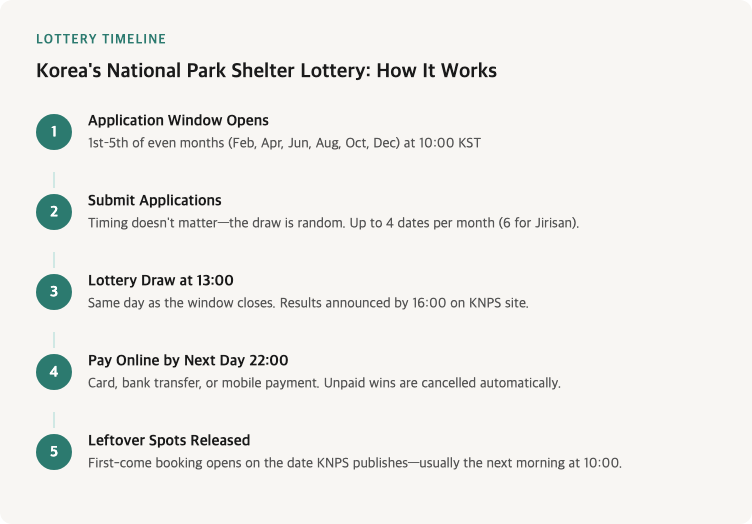
The reservation cycle runs on a fixed rhythm: applications open at 10:00 KST on the 1st of every even-numbered month (February, April, June, August, October, December) and close at 10:00 on the 5th. Each round covers the two-month stay period that follows — the round that opened August 1, 2026 covered stays from September 1 through October 31. You can apply for up to four shelter dates per person per month, with one documented exception: the reservation policy page allows up to six for Jirisan. Applying for the same date more than once is allowed, though only one of those entries can actually win.
Don’t treat that rhythm as a calendar on its own. The policy page notes that a launch or draw date falling on a public holiday shifts to the next weekday, and each round’s exact application, draw and payment times are published on the lottery page. Read the round dates there.
Local tip — The four English-language guides checked for this article all describe the old system: a booking window opening at a fixed clock time on the 1st and 15th of the month, first-come, filling in under a minute. The individual shelter pages on KNPS’s own foreigner reservation portal still carry that 1st-and-15th launch-date text too. The Korean-language lottery page describes something different: regular shelter nights are allocated by random draw in a window that opens on the 1st and closes on the 5th of every even month, and only the leftovers go first-come.
Lottery, Announcement, and Payment — What the Official Timeline Looks Like
KNPS publishes a worked example for how a single round plays out, using an April cycle. The table below follows that example, alongside the live figures from the August 2026 round I checked directly.
| Step | Official example (April cycle) | Live round checked (August 2026) |
|---|---|---|
| Stay period covered | May 1 – June 30 | September 1 – October 31 |
| Application window | April 1, 10:00 – April 5, 10:00 | August 1, 10:00 – August 5, 10:00 |
| Lottery draw | April 5, 13:00–13:30 | August 5, 13:00 |
| Results announced | Same day (no clock time in the example) | August 5, 16:00 |
| Payment deadline | April 6, 22:00 | August 6, 22:00 |
| Leftover spots open first-come | April 8, 10:00 | August 7, 10:00 |
The draw itself is a randomized program that KNPS describes as closed to outside intervention, run with its internal audit office present and streamed on the agency’s social channels with live application counts. Applications close and the draw happens the same day — there’s no overnight wait to find out.
Not First-Come, First-Served — the Official Wording
The live lottery page states its own rule plainly: “선착순이 아니므로 추첨신청 시간과 추첨 당첨 결과는 무관합니다” — since this is not first-come-first-served, the time you submit your application within the window has no bearing on whether you win. Applying at 10:00:01 on day one carries the same odds as applying at 09:59 on day five. That one sentence is the clearest official statement on the point, and it is the opposite of the “book the instant it opens” advice the English guides checked for this article give.
The Shelters Covered by the Lottery
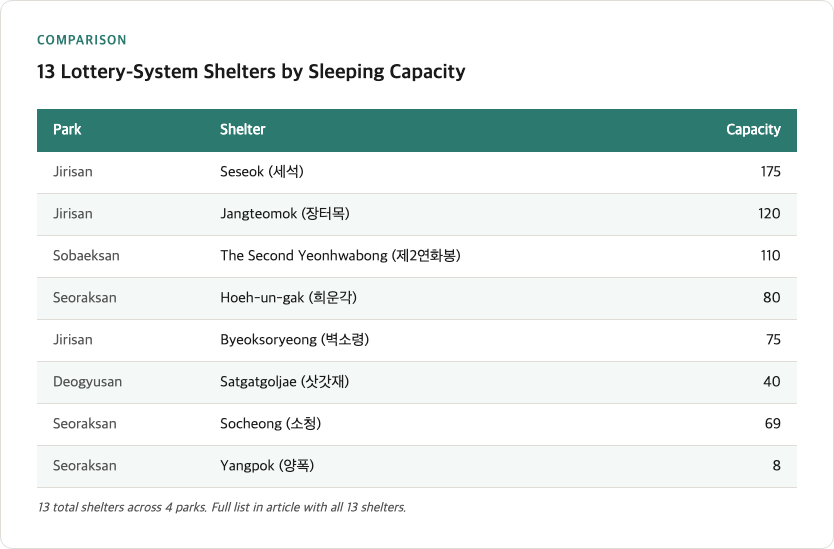
The lottery applies to the bookable overnight shelters across four parks. The rows and capacity figures below are from KNPS’s foreigner-facing shelter list, read on August 22, 2026. Shelter names are given as that page spells them, with the Korean in brackets.
| Park | Shelter (Korean) | Sleeping capacity |
|---|---|---|
| Jirisan | Jangteomok (장터목) | 120 |
| Jirisan | Seseok (세석) | 175 |
| Jirisan | Byeoksoryeong (벽소령) | 75 |
| Jirisan | Rotari (로타리) | not listed on the official page |
| Jirisan | Chibanmok (치밭목) | 45 |
| Jirisan | Nogodan (노고단) | 36 |
| Jirisan | Yeonhacheon (연하천) | 66 |
| Seoraksan | Hoeh-un-gak / Huiungak (희운각) | 80 |
| Seoraksan | Suryeomdong (수렴동) | 16 |
| Seoraksan | Socheong (소청) | 69 |
| Seoraksan | Yangpok (양폭) | 8 |
| Deogyusan | Satgatgoljae (삿갓재) | 40 |
| Sobaeksan | The Second Yeonhwabong (제2연화봉) | 110 |
One oddity if you compare sources: the list shows thirteen rows but heads them “12 Sites”, and Rotari is the row with no capacity printed. Treat the count as approximate and the individual rows as the reliable part.
Jangteomok sits at the end of Jirisan’s main ridge traverse, and Huiungak sits on the shortest route to Seoraksan’s Daecheongbong (대청봉) summit. Those two are where this article’s pricing and inventory figures come from.
What Happens If You Don’t Win the Lottery
Leftover Spots Go to First-Come, First-Served
Losing the draw isn’t a dead end. The official process diagram names three sources of leftover spots — nights nobody applied for, nights a winner failed to pay for by the deadline, and later cancellations — and all of them go back into the system to be booked first-come. Hallasan on Jeju is a separate matter entirely: different operator (Jeju Province), different site, free, and no lottery at all. If a Jeju summit day is also on your list, the Hallasan reservation guide covers that system on its own terms.
When Leftover Spots Open — a Published Date, Not a Fixed Interval
KNPS publishes a specific 빈자리 접수일 (leftover-booking date) for each round on the lottery page — but the interval moves. The worked April example opens leftovers on April 8 at 10:00, two days after the April 6 payment deadline. The live 2026 fifth round, which I read on August 22, 2026, opens them on August 7 at 10:00 — the morning after an August 6 deadline.
Cancellations made after payment work differently again: the diagram marks that category as 수시 접수, accepted on a rolling basis rather than at the announced hour. So there are two things to watch — the published release time for unclaimed and unpaid nights, and the trickle of later cancellations. None of the English guides checked for this article mentions that published date at all, and it is the most useful thing on the screen if the draw doesn’t go your way. Read it on the live reservation page for your own round. Mobile signal is patchy at elevation, so plan to check from somewhere with a reliable connection (eSIM and SIM options for Korea) rather than from the trail.
Signing Up as a Foreigner
What the Foreigner Portal Actually Asks For
I opened the foreigner sign-up page directly on August 22, 2026, to see what it requires. The form asks for first name, last name, email address, password, password confirmation, birthday, and sex — nothing else. There is no field for a Korean phone number, no passport number field, and no button for Korean identity verification services (PASS, Kakao, Naver) anywhere on the page.
That matters because the English guides disagree with each other on this point. One established shelter-booking guide states that the system requires a Korean phone number or ID and is “effectively inaccessible” to visitors just passing through; another says a passport number is enough. Reading the actual sign-up form settles it — an email address and a password are enough to create an account. The confusion has a real source: the separate domestic KNPS membership portal, which is the sign-up link on the Korean-language site, does include an identity-verification step using Kakao, Naver, a Korean phone number, or i-PIN. The /foreigner/ portal is a different, simplified path.
Local tip — One of the English guides checked for this article says the shelter reservation system is effectively closed to visitors because it requires a Korean phone number. The sign-up page on the dedicated foreigner portal asks only for a name, email, password, birthday, and sex — no phone field, no passport-number field, and no Korean identity-verification buttons on the page. The Korean-language membership portal does have that verification step, which is likely where the claim comes from.
Passport Comes Later — At Check-In, Not Sign-Up
None of this means identification is skipped entirely — it’s just moved later in the process. Your passport, or a clear photo or copy of it, gets checked at the shelter itself when you check in, not during account creation or booking. Keep it accessible for the hike, not just the application.
What a Shelter Stay Actually Costs
Weekday/Off-Peak vs Weekend/Peak Season Pricing
Two shelter pages were read for this article — Huiungak (Seoraksan) and Jangteomok (Jirisan) — and both publish the identical structure below. The reservation and refund policy page defines the rate categories (weekday, weekend, peak-demand period) but doesn’t print the amounts, so these figures come from the shelter pages themselves.
| Rate category | Price per person, per night (as of August 2026) |
|---|---|
| Weekday, off-peak season | ₩20,000 |
| Weekend or peak season | ₩30,000 |
Peak season runs July 1–August 31 and October 1–November 15. “Weekend” for pricing purposes means Friday, Saturday, or the day before a public holiday — not simply Saturday and Sunday. On the policy page the weekday band is spelled out as Sunday through Thursday, excluding the eve of a public holiday.
Local tip — The English guides checked for this article that quote a price list a flat ₩12,000 a night; one notes only that the rate varies by season, without giving figures. Both shelter pages read for this article — Huiungak and Jangteomok — show ₩20,000 on a weekday outside peak season and ₩30,000 on a weekend or peak-season night. For an October Friday that is two and a half times the figure those guides quote.
What You Can Buy at the Shelter — Food, Gear, Gas
Unlike Hallasan’s Seongpanak and Gwaneumsa trails, where nothing is sold once you’re past the trailhead, Seoraksan and Jirisan shelters run small on-site counters. Huiungak’s posted inventory (checked August 2026) includes instant rice (₩3,000), energy bars (₩1,500), bottled water (₩1,500 for 500ml, ₩3,000 for 2L), butane and EPI gas canisters (₩2,500–₩4,500), crampons (₩10,000 for the basic type, ₩28,000 for chain-type), a headlamp (₩18,000), and a poncho (₩2,000). It’s a real backup, not a full grocery — plan your main food and water around what you carry in, and treat the counter as an emergency-supplies option rather than a resupply stop. Mountain shelters are exactly the kind of place where an ATM won’t be within reach, so bring enough cash or won already loaded on a transit card for anything you might need at the counter.
Against a full week’s travel budget, a ₩20,000–30,000 shelter night is a small line item — the bigger planning cost is the reservation itself, not the fee.
Cancellations, No-Shows, and Refunds
The Refund Schedule
Cancelling ahead of time gets progressively less back the closer you get to your stay date.
| When you cancel | Refund |
|---|---|
| 3+ days before, or same day as payment | 100% |
| 2 days before | 90% |
| 1 day before | 80% |
| Same day, before 12:00 | 70% |
| No cancellation (no-show) | 0% |
Refunds are processed within 3–7 banking days.
No-Show Penalties — Not a One-Year Ban
I read the “부도자 이용 제한” (no-show restriction) table on the official reservation and refund policy page directly. A first no-show blocks you from booking any KNPS shelter or campsite for one month; a second raises that to three months. If a year passes with no further no-show after a penalty, the record is wiped.
Local tip — One of the English guides checked for this article states that shelter no-shows result in “a one-year ban.” The official policy is milder but still real: a first no-show is a one-month booking block, a second is three months, and the one-year figure is how long your record has to stay clean before it’s wiped — not the length of the ban itself.
Does a Same-Day Cancellation Count as a No-Show? The Site Answers Twice
This is worth flagging rather than smoothing over, because the same official page says both things on two different tabs.
The 결제 및 환불 안내 (payment and refund) tab lists a same-day cancellation made before 12:00 as a 30% deduction with the no-show restriction applied. The 부도자 이용 제한 (no-show restriction) tab says the opposite: if you cancel through the reservation system yourself before 12:00 on the day of use — status recorded as 예약취소(본인) — the no-show is waived, and it adds that a cancellation processed by an administrator instead is not waived.
Neither tab carries a revision date, so there is no way to tell which was written later. The practical reading: cancel yourself, through the system, before 12:00, and expect to lose 30% of the fee. Whether the record also follows is the part the site does not settle — so don’t treat the exemption as something you can rely on when planning.
You Can Reduce a Booking, But Not Change the Date
The system allows you to remove people from a group booking, reduce the number of nights, or swap a companion’s name. It does not allow changing the date of an existing reservation — a date change means cancelling the booking outright and applying again, which puts you back in the lottery or first-come pool for the new date.
Payment for a winning lottery entry is made online, within the payment window the round publishes — card, real-time bank transfer, bank deposit, or simple-payment options including Kakao Pay, Naver Pay, and Samsung Pay are all listed on the policy page, and an unpaid win is cancelled automatically. (The older English shelter pages still say you pay at the shelter on the day; that text belongs to the pre-lottery system.) If a card payment doesn’t go through, having a backup option matters here just as much as it does with apps in Korea that don’t always accept foreign-issued cards.
One Shelter That’s No Longer Bookable
Jungcheong Shelter’s Overnight Function Ended in 2023
Jungcheong Shelter (중청대피소), near Seoraksan’s Daecheongbong summit, stopped offering overnight stays on October 31, 2023, after 40 years of operation. A rebuild has been under way since — coverage at the time of closure gave a 2025 reopening, later reporting says 2026, so treat the year as unsettled — but the point that matters for planning is unchanged: the rebuild is for emergency shelter and climate-monitoring functions, not overnight bunks. I checked the current Seoraksan shelter list directly on August 22, 2026: only four Seoraksan shelters appear — Hoeh-un-gak (Huiungak), Suryeomdong, Socheong, and Yangpok. Jungcheong isn’t on the list.
Local tip — Two of the four English guides checked for this article still list Jungcheong Shelter as a place to book a bed near Daecheongbong’s summit for a dawn start. It closed as an overnight shelter on October 31, 2023, and the rebuild drops the sleeping function. The current official shelter list for Seoraksan carries four shelters and Jungcheong is not among them.
Seasonal Closures to Plan Around
Closures aren’t the only thing the calendar moves. KNPS also runs a designated entry-time system (입산시간지정제) that sets an earliest entry and a turn-back cutoff for every trail gate, in a summer set and a winter set — and the date those two sets swap is not the same in every park. I read the entry-time tables for all 21 KNPS parks on September 10, 2026: nineteen of them, including both Seoraksan and Jirisan, count November as winter, so on November 1 the gates move to their earlier hours — an hour earlier at the gate I checked in detail, where Gayasan’s Cheongnyangdong entrance goes from 04:00–15:00 to 05:00–14:00. Bukhansan and Mudeungsan are the two that don’t: their winter runs December to February, so they hold summer hours through all of November, and the Uiam–Wontongsa gate on Bukhansan stays at 04:00–17:00 rather than dropping to 16:00. That boundary sits in the middle of foliage season — the tourism board’s English forecast puts Bukhansan’s 2026 peak on November 4 and Naejangsan’s on November 11, one on each side of it, and doesn’t mention the switch at all. Read your own gate’s hours on the KNPS entry-time page before planning a late-autumn start.
Seoraksan’s 2026 Spring Wildfire Closure
Seoraksan closes all shelters and high-altitude trails each spring for wildfire prevention. For 2026, the closure runs March 4 through May 15, with trails reopening May 16 — confirmed directly on the park’s official notice board. Lower-elevation trails near Ulsanbawi, Biryong Falls, and Sinheungsa Temple stay open through the closure; it’s the shelters and the high ridgeline that shut down.
Jirisan’s Seasonal Closures
Jirisan also closes sections of its trail network each spring under the same wildfire-prevention program most Korean national parks run, but the exact 2026 dates for Jirisan weren’t independently confirmed for this article — sources found gave conflicting date ranges. Check the current notice on the reservation site’s notice board before planning a spring ridge traverse. Getting to either park’s trailheads is a separate logistics question from the reservation itself — see the general transport guide for how regional buses and trains reach mountain areas outside Seoul.
What You Need to Know
-
This is a lottery, not a race. Submitting your application at the exact moment the window opens gives you no better odds than applying an hour, or four days, later — the system itself says so.
-
Losing the lottery isn’t the end of the road. Unclaimed nights, unpaid wins, and later cancellations all feed a first-come pool. The pool for the first two opens at a date and time the lottery page publishes for each round; later cancellations surface on a rolling basis.
-
The application limit is four shelter dates per person per month, and six for Jirisan. The reservation policy page states both — the general limit and the Jirisan exception — in the same table.
-
Weekend pricing means Friday, Saturday, or the eve of a public holiday — not just the calendar weekend. Peak season (July 1–August 31, October 1–November 15) also triggers the higher rate.
-
You cannot change the date on an existing booking. A date change means cancelling and reapplying from scratch.
-
Payment happens online, inside a published window. Winners pay by the deadline the round announces — in the August 2026 round, 16:00 on the draw day to 22:00 the next evening — and an unpaid win is cancelled automatically.
Practical Tips
-
Apply during the window, but don’t rush the exact opening second. Since the draw is random, applying at any point between the 1st and the 5th gives identical odds — save the adrenaline for something that needs it.
-
Apply for more than one date if your schedule allows it. You can submit up to four shelter applications a month — six if the dates are on Jirisan — and applying for multiple dates spreads your odds across more draws.
-
Note the 빈자리 접수일 for your round before the draw even happens. The lottery page publishes the leftover-booking date and time alongside the application and payment windows. The gap from the payment deadline varies by round, so read it rather than assuming.
-
Bring your passport to the shelter, not just the reservation confirmation. Sign-up doesn’t ask for ID, but check-in does.
-
Carry your own food and water regardless of the on-site counter. The counter at shelters like Huiungak sells emergency supplies — instant rice, water, gas — not a full resupply.
-
Cancel through the system yourself, before 12:00 on the day of your stay, rather than simply not showing up. That recovers 70% of the fee. It may also spare you the no-show record — the site’s no-show tab says a self-service cancellation is exempt while its refund tab says it isn’t, so treat the refund as the certain part.
-
Verify current fire-season closure dates before a spring booking, especially for Jirisan, where this article could not confirm the exact 2026 range.
Frequently Asked Questions
Is Seoraksan or Jirisan shelter booking first-come-first-served or a lottery?
Both, in sequence. Regular shelter nights on Jirisan, Seoraksan, Deogyusan and Sobaeksan are allocated by a random draw: applications open on the 1st of every even month and close on the 5th, with the draw the same day. What’s left over afterward — unclaimed nights, unpaid wins, and later cancellations — is then booked first-come. Korean news coverage put the changeover to a year-round lottery at July 1, 2025; before that, only the peak months ran on a draw. That older first-come system is what the English guides checked for this article still describe.
Can foreigners reserve a Korean national park shelter without a Korean phone number?
Yes. The dedicated foreigner reservation portal’s sign-up form asks only for your name, email address, password, birthday, and sex — there is no phone field, no passport-number field, and no Korean identity-verification button anywhere on the page. That portal sits at reservation.knps.or.kr/foreigner/, and it is a separate path from the Korean-language KNPS membership portal, which does require identity verification through Kakao, Naver, a Korean phone number, or i-PIN. Your passport, or a clear photo or copy of it, is checked in person at the shelter during check-in rather than during account creation.
How much does it cost to stay overnight at a Seoraksan or Jirisan shelter?
₩20,000 per person on a weekday outside peak season, and ₩30,000 on a weekend or during peak season (as of August 2026). “Weekend” here means Friday, Saturday, or the day before a public holiday, not just Saturday and Sunday, and the peak-demand periods are July 1–August 31 and October 1–November 15. Both figures were read directly from the Huiungak (Seoraksan) and Jangteomok (Jirisan) shelter pages, which publish the identical structure. The English guides checked for this article still quote a flat ₩12,000.
What happens if I don’t win the shelter lottery?
Unclaimed spots — nights nobody applied for, wins that went unpaid, and later cancellations — are released back into the system and booked first-come. KNPS publishes a leftover-booking date and time for each round on the lottery page, labelled 빈자리 접수일. The gap from the payment deadline is not fixed: the agency’s worked April example opens leftovers two days after, while the round running in August 2026 opened them the next morning at 10:00. Cancellations made after payment are handled on a rolling basis instead.
What’s the penalty for not showing up to a shelter reservation?
A first no-show blocks new shelter or campsite bookings for one month; a second raises that to three months. The record clears after one full year with no further no-show. Cancelling before 12:00 on the day of your stay recovers 70% of the fee. Whether it also spares you the record is genuinely unclear: the site’s refund tab marks a same-day cancellation as a no-show, while its no-show-restriction tab says a self-service cancellation made before 12:00 is exempt. Plan around the 70%, not the exemption.
Is Jungcheong Shelter on Seoraksan still open for overnight stays?
No. Jungcheong stopped offering overnight stays on October 31, 2023, after roughly 40 years in operation. A rebuild is under way — reported reopening years have moved from 2025 to 2026 — but it is designed for emergency shelter and climate monitoring, not overnight bunks. The current official Seoraksan shelter list carries four shelters — Hoeh-un-gak (Huiungak), Suryeomdong, Socheong, and Yangpok — and Jungcheong is not among them.
Do I need to bring my own food to a Korean national park shelter?
Bring your main food and water regardless. Seoraksan and Jirisan shelters do sell a small range of supplies on-site, and Huiungak’s posted list runs to instant rice at ₩3,000, energy bars at ₩1,500, bottled water at ₩1,500 for 500ml, butane and EPI gas, crampons, a headlamp and a poncho (as of August 2026). It is an emergency-level backup counter, not a resupply stop for a full meal plan — and it is a real difference from Hallasan, where nothing at all is sold past the trailhead.
Related Questions
- How to Hike Hallasan: The Reservation System Nobody Explains
- Jeju Olle Trail: Reading the Signs and Choosing a Course
- Do You Need a Visa for Korea? The 90-Day Rule Most Guides Get Half Right