Going to a KBO Baseball Game — What to Know Before You Go
Last Updated on August 13, 2026
Quick Answer
Korean professional baseball (KBO) games run from late March into the fall, built around an organized, nine-inning cheering section that’s much of the draw. Two things trip up first-timers: rain cancels games often enough that refund rules matter, and the channels most guides recommend — Klook and Trazy — refund less than Korea’s own ticketing system does. Start times also shift by month, not just by weekday.
The Full Answer
A KBO game is closer to an organized fan festival than a quiet afternoon at the ballpark — a caller and cheerleaders lead the whole section through player-specific chants for nine innings, and fried chicken and beer at your seat, chimaek (치맥), is normal rather than a treat. English-language guides cover that experience reasonably well: the atmosphere, roughly what a ticket costs, roughly when gates open.
What they cover less well is the operational layer underneath — the part that becomes obvious only once you’ve bought a ticket, sat through a rain delay, or shown up on the wrong Sunday expecting a 5 p.m. first pitch. I checked KBO’s own English-language site in August 2026: teams, standings and stats, but nothing on tickets or stadium rules. That’s the gap this guide, and the more detailed ones it hands off to, are built to fill.
The 2026 regular season opened on March 28, and each of the ten teams plays 144 games — 720 across the league — with an All-Star break from July 10 to 15. As of this writing the season is running behind its usual pace after heat- and rain-related postponements in August, which affects the postseason section below.
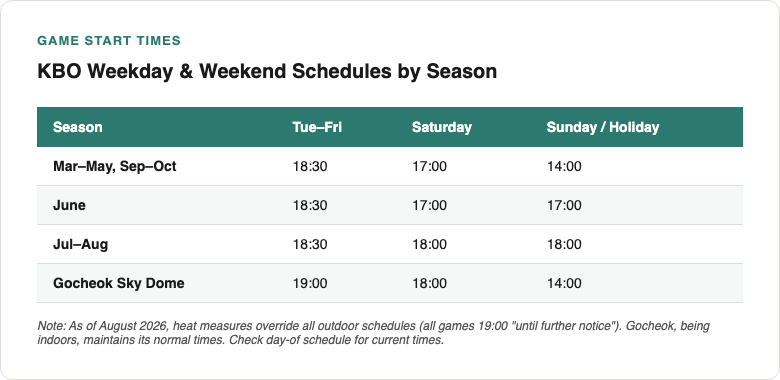
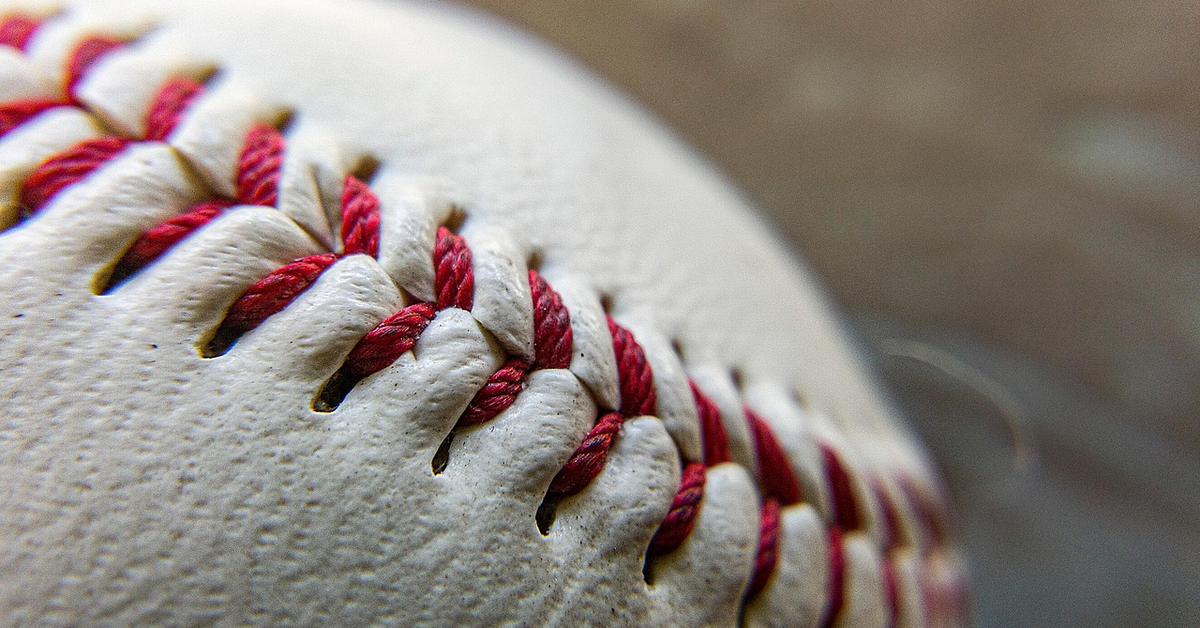
Photo by fernandozhiminaicela on Pixabay
What Time Do Games Start?
Weeknight games (Tuesday through Friday) start at 18:30 year-round — that part is straightforward, and every English guide gets it right. Weekends and holidays are where it gets more specific than most guides let on. The schedule shifts three times across the season rather than settling into one fixed “weekend time”:
| Period | Weekday (Tue–Fri) | Saturday | Sunday / Holiday |
|---|---|---|---|
| March–May, September–October | 18:30 | 17:00 | 14:00 |
| June | 18:30 | 17:00 | 17:00 |
| July–August | 18:30 | 18:00 | 18:00 |
| Gocheok Sky Dome (indoor, rain-unaffected) | 19:00 | 18:00 | 14:00 |
I checked this table against KBO’s own published scoreboard, date by date, in August 2026. Sundays April 12 and May 17 are listed at 14:00; June 13 and 14 at 17:00; July 4 and 5 at 18:00. The pattern holds. Individual dates do deviate — opening Saturday, March 28, started at 14:00 — so treat the table as the pattern and the schedule page as the authority for your date.
Two details most English guides miss. First, June sits between spring and summer — both weekend days start at 17:00, not the 14:00 of the spring column or the 18:00 of peak summer. Second, Sunday didn’t always match Saturday in July and August: until August 2024, Sunday games in the hot months started at 17:00, an hour earlier than Saturday, on the assumption that fans had work the next morning. KBO matched the two starting in August 2024, and guides written before that change — or copying one that was — still show the older Sunday time.
Local tip — Guides that give a single “weekday 6:30 p.m., weekend 5 p.m.” rule are describing spring and autumn only. Check the month before you check the clock, and if it’s June or peak summer, add time to the Sunday start most guides quote.
As of August 2026, the outdoor rows above don’t apply. After a heat-related medical emergency at a game on August 4, KBO cancelled the rest of that week’s games and restarted play on August 11 with every game starting at 19:00. The Korea Herald reported that KBO announced the 19:00 start “until further notice,” and confirmed the two rows the measure overrides: weeknight games normally begin at 18:30, and summer weekend and holiday games at 18:00.
Gocheok Sky Dome — Seoul’s only domed stadium, and also a concert venue, as covered in our guide to Seoul’s K-pop concert venues — is the exception, and KBO’s own scoreboard shows it. On Saturday August 22 the outdoor games were listed at 19:00 while Gocheok kept its usual 18:00; on Sunday August 23, 19:00 outdoors and 14:00 at Gocheok. Being indoors, it never moved onto the heat schedule. Korean-language reporting pointed to early September as a review point, but KBO’s own wording is open-ended, so check the day-of listing on KBO’s schedule page rather than either table while the measure is active.
Buying a Ticket, in Brief
The short version: Korea’s domestic ticket sites require 본인인증 (Korean identity verification) tied to a Korean resident registration number or phone line, which most visitors don’t have. That’s the wall that generates the most first-timer confusion, and it’s also why most English guides steer everyone toward Klook or Trazy by default.
That default isn’t wrong, but it isn’t complete — which channel works, and on what terms, depends on which team you’re seeing, because they don’t all sell through the same platform. Our guide to buying KBO tickets as a foreigner covers that split team by team, including where a Korean phone number opens the domestic sites directly (our guide to eSIMs and Korean phone numbers covers getting one).
Whichever channel you use, bring a card that works internationally — see our guide to paying by cash or card in Korea if you’re unsure which to lead with.
Choosing Your Team and Stadium
Ten teams play across eight cities, and the names don’t include the city the way most foreign leagues do — they’re named after the parent company, which is part of why visitors have trouble working out which stadium is near them. Our guide to choosing a KBO stadium compares all ten by city, ticket channel, and what makes each one distinct.
Two stadium-specific things worth knowing before you pick a date. Jamsil Baseball Stadium (잠실야구장) in Seoul — the one most visitors default to — is shared by two teams, the LG Twins and the Doosan Bears, so which side counts as the “home” cheering section depends on who’s playing. It’s also playing its final season in its current form: Jamsil closes for a rebuild after 2026, with LG and Doosan moving to a temporary stadium from 2027. Our guide to Jamsil’s last season and where KBO games go next covers what that means for a visit next year or later.
If you’re staying in Seoul and the question is less which stadium than which team you can actually get a seat with, our guide to which Seoul KBO team’s tickets you can actually get works through the city’s three teams using KBO’s own published attendance figures.
Outside Seoul, Busan’s Sajik Stadium — home to the Lotte Giants — draws its own visitor traffic and sells tickets through the club’s own site rather than one of the big platforms. If Busan is on your route, our guide to the Lotte Giants at Sajik Stadium covers what’s different about buying in and getting there.
Rain Delays, Cancellations, and Refunds
Rain cancels KBO games often enough in the humid months that the refund rules are worth knowing before you book.
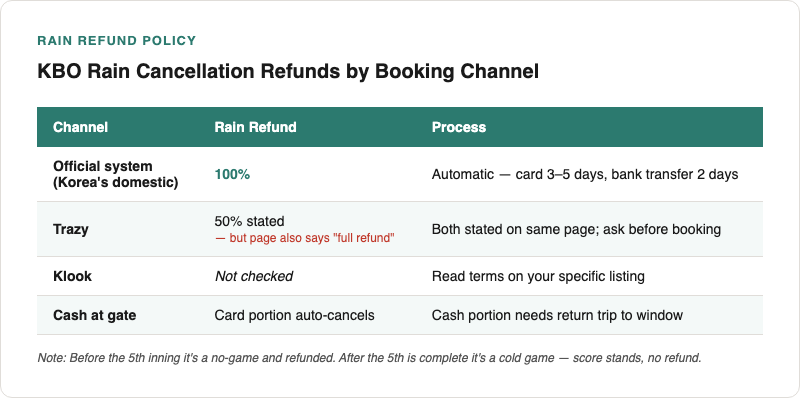
KBO’s decision process is straightforward: before first pitch, the assigned game official decides whether to call the game after checking with the regional weather service; once play has started, that call moves to the umpire. I read KBO’s own game-cancellation notice in August 2026, and it lays out that division of responsibility directly. Worth knowing what that page does and doesn’t cover: it sets alert thresholds for wind, heat, fog, fine dust and yellow dust, but says nothing about refunds, and rain isn’t among its named thresholds at all. What happens to the game depends on the inning: if play stops before the end of the 5th, it’s a 노게임 (no-game) — treated as if it never happened, and tickets are refunded. After the 5th is complete, it’s a 콜드게임 (cold game) — the score stands as the final result, and there’s no refund.
That inning rule is the part most English guides already get right; haniseoul.com and koreaexperience.com both state it correctly. What they don’t cover is what happens to your refund depending on where you bought the ticket:
| Channel | Rain refund | Fee | How |
|---|---|---|---|
| Official system (Korea’s domestic ticketing platforms and club sites) | 100% | None | Automatic — card approximately 3–5 business days, bank transfer approximately 2 business days |
| Trazy | 50% in its stated cancellation policy | — | But a second note on the same page describes a full refund — see below |
| Klook | Not checked for this guide | — | Read the rain terms on the specific listing before booking; don’t assume they match the official system |
| Cash paid at the gate | Card portion auto-cancels; cash portion needs a return trip to the ticket window | — | — |
I opened Trazy’s own KBO listing in August 2026. Its cancellation policy and its FAQ carry the same line, word for word: “If the match is canceled due to rain, a 50% refund will be issued.” That’s half of what the official channel pays out, with no separate fee on either side — the gap is in the refund percentage itself.
One caveat, in fairness to Trazy: a separate note higher up the same page says that if the game is moved to Gocheok Sky Dome or called off, it will notify you in advance and issue a full refund. The two statements sit unreconciled on the same page, and that inconsistency is itself the takeaway — the 50% line is the one in the formal cancellation policy, so ask before booking rather than assuming which applies. We didn’t check Klook’s listings, so treat those terms as unknown until you read the one you’re buying.
Local tip — Every English guide that recommends Klook or Trazy for KBO tickets does so because the domestic sites block foreigners at identity verification — a real and accurate reason. None of them mention that the resale channel’s rain terms are its own, not KBO’s. Trazy’s stated policy is 50%; the official system is 100% and automatic. The better refund terms are there for the taking, but only once you’re past the identity-verification wall — which is exactly what our ticket-buying guide addresses team by team.
If you’re cancelling yourself rather than dealing with rain, that’s a separate and less generous set of terms — fees generally start the day after booking and rise as game day approaches, but the schedule varies by platform, so read the terms wherever you book.
Getting In and What to Bring
Gates and the day-of ticket booth typically open one to two hours before first pitch, and some clubs open earlier for weekend games — it isn’t a single league-wide time, so check your team’s page rather than assuming. Tickets are usually a mobile barcode in a team or ticketing app, which activates a few hours before the game, or a QR code you can print at a kiosk near the gate.
What you can carry in — outside food, drink, how much alcohol, whether you can leave and come back — varies by stadium rather than following one league-wide rule, and stadiums have changed their policy before. Our guide to KBO stadium rules, bags, and food checks the current bag and food policy stadium by stadium, along with how the chicken-delivery-to-the-gate move locals use actually works. Re-entry is another policy we could not confirm across all ten clubs, so ask at the gate rather than assuming.
If You’re in Korea for the Postseason
The regular season normally runs from late March into early October, with the postseason following in October. 2026 won’t follow that pattern: the August heat cancellations, on top of a heavy run of rainouts, pushed a large block of games back, so both the end of the regular season and the postseason are running later than usual.
If you’re planning a trip around the postseason specifically, neither the dates nor the host stadiums are settled far in advance. Our KBO postseason guide covers the current schedule picture, how postseason tickets are sold differently from regular-season ones, and what the 2026 shift means for catching a Korean Series game.
What You Need to Know
-
Rain refunds depend on where you bought the ticket, not just whether the game was called. Official channels pay 100% automatically; Trazy’s own cancellation policy lists 50%.
-
Start times shift three times across the season, not just weekday versus weekend — check the month before you check the clock.
-
As of August 2026, every outdoor game starts at 19:00 “until further notice” because of heat measures. Gocheok Sky Dome, being indoors, keeps its normal times.
-
Jamsil Stadium hosts two teams, and it’s playing its final season in its current form before a rebuild.
-
Domestic ticket sites require Korean identity verification most visitors can’t complete — that’s why Klook and Trazy are the default recommendation, and why the platform you book through, not just the weather, decides your refund.
-
Gate, bag and food policies vary by stadium. What worked at one ballpark doesn’t necessarily apply at another.
-
A KBO night is one of the more affordable big-city outings in Korea; see our week in Korea cost guide for how it fits into a broader trip budget.
Practical Tips
-
Check the month before you check the clock. June and midsummer weekend times differ from spring and autumn, and as of August 2026 the heat measures override all of it for outdoor stadiums, with no fixed end date announced.
-
Book through the official channel if you can get past identity verification. The refund terms are better if rain cancels your game — see our guide to buying tickets as a foreigner for how.
-
If you book through Trazy, budget for a 50% refund rather than a full one if the game is rained out.
-
Arrive at least an hour and a half early if you’re buying same-day — gate times vary by club, so check yours.
-
Bring an international card, and know where to get cash if it doesn’t work. Ticket windows and some concessions may not take every foreign card; our guide to ATMs that accept foreign cards covers the backup.
-
Check the bag and food policy for your specific stadium, not KBO as a whole — it isn’t uniform.
-
Take the subway rather than driving. Stadiums are on the network and parking is limited on game days; our Seoul subway guide covers routes and fares.
Frequently Asked Questions
What time do KBO baseball games start?
Weeknight games start at 18:30 year-round. Weekend and holiday times shift three times across the season — 17:00 Saturday/14:00 Sunday in spring and autumn, 17:00 both days in June, 18:00 both days in July and August (changed in August 2024; Sunday used to start an hour earlier). As of August 2026, heat measures have every outdoor game starting at 19:00 “until further notice,” so check the day-of schedule if you’re visiting then.
Do KBO games get rained out, and can I get a refund?
Yes — rain-outs are common in the humid months. If play stops before the end of the 5th inning it’s a no-game and tickets are refunded; after that the score stands and there’s no refund. How much you get back in the first case depends on where you bought: the official system refunds 100% automatically, third-party platforms may not.
Is the rain-cancellation refund different if I booked through Klook or Trazy?
It can be, and it’s the part most English guides skip. Trazy’s own cancellation policy lists a 50% refund for rain-cancelled games, compared to a fee-free 100% automatic refund through the official ticketing system — though a separate note on the same Trazy page describes a full refund, so the terms are worth asking about directly. Klook’s listings weren’t checked for this guide; confirm the specific product before booking.
What happens if it starts raining in the middle of a game?
The umpire makes the call, checking with the regional weather service. Before the end of the 5th inning it’s a no-game and refunded; after that it’s a cold game — the score stands, and it counts as a completed, non-refundable game.
Do KBO games sell out?
Some do, particularly opening week and games involving the more popular teams. Weeknight regular-season games are generally the easiest to get into for a first visit.
How early should I get to the stadium?
Gates and ticket booths typically open one to two hours before first pitch, though the exact time varies by club and some open earlier for weekend games.
How long does the KBO season run, and when is the postseason?
The regular season typically runs from late March to early October, with the postseason following in October. 2026 is running later than usual: heat- and rain-related postponements pushed a large block of games back, so both the end of the regular season and the postseason are shifted later this year. Our KBO postseason guide has the current picture — check live dates before planning a trip around them.
Can foreigners buy KBO tickets easily?
Not directly through Korea’s domestic ticket sites, which require identity verification tied to a Korean phone number or resident registration. Resale platforms like Klook and Trazy are the usual workaround, and the routes that work vary by club — our guide to buying KBO tickets as a foreigner covers the process team by team.
Related Questions
- What’s the Easiest Way to Get Around Korea as a Visitor?
- What Beers Will You Actually Find in Korea?
- What Should You Order to Go With Your Drink in Korea?