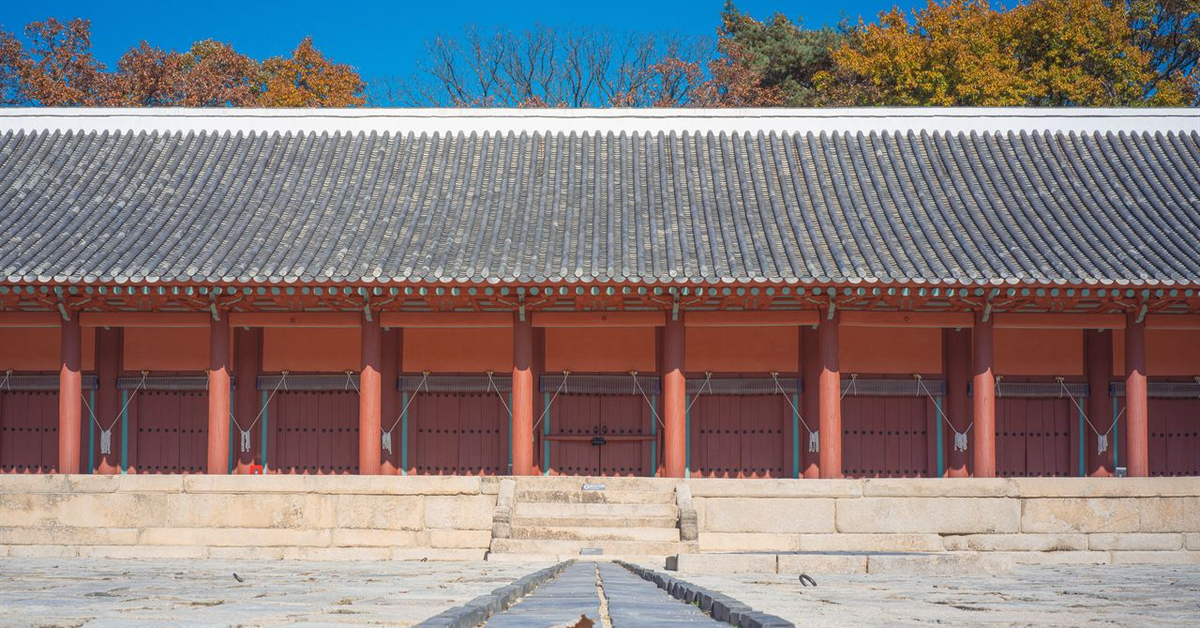
How to Visit Jongmyo Shrine: Entry Rules by Day and Language
Last Updated on October 18, 2026
Quick Answer
Jongmyo Shrine (종묘) can’t be entered freely on an ordinary weekday. Since October 2026, Monday, Thursday and Friday require a scheduled, guide-led entry, capped at 200 visitors per language — half booked online, half sold at the gate. Saturdays, Sundays, public holidays and every Wednesday are free walk-through, no booking needed (Wednesday is also free admission). Tuesday is closed. From July through August 2026 only, every day switched to free entry.
The Full Answer
How you visit Jongmyo Shrine depends entirely on which day you show up — more than at almost any other site in central Seoul’s palace cluster. On three weekdays, you can’t walk in and wander at your own pace; you’re assigned an entry time and a guide, and the shrine’s own rules explicitly rule out self-paced admission on those days. On weekends, public holidays and every Wednesday, that restriction disappears, and you walk in the way you would at Gyeongbokgung.
I put Jongmyo’s Korean-language and English-language official pages side by side on August 29, 2026, expecting them to be close translations of the same rules. They aren’t. The Korean page lists a same-day ticket allocation that the English page doesn’t mention at all, and the English page still describes a renovation that actually finished in April 2025 — a gap of more than a year. A fair amount of what follows exists because of that gap: information that’s on the Korean page and simply didn’t carry over into English, or that changed after the English page was last touched.
None of this makes Jongmyo hard to visit. It’s the shrine where the ancestral tablets of the Joseon dynasty’s kings and queens are kept, and it’s usually paired with Gyeongbokgung and Changdeokgung on a Seoul palace day. If you’re fitting Jongmyo into a day with the other palaces, this palace day itinerary lays out which days the combination works. But its entry system is genuinely different from the other four palaces most guides lump it in with, and getting the day wrong is the easiest way to end up outside a locked gate — or stuck on a guided session when you’d rather have walked in on your own.
The Two Entry Systems: Guided Weekdays vs. Free Walk-Through Weekends
Jongmyo runs on two entirely separate systems, and which one applies to you is fixed by the calendar, not by choice.
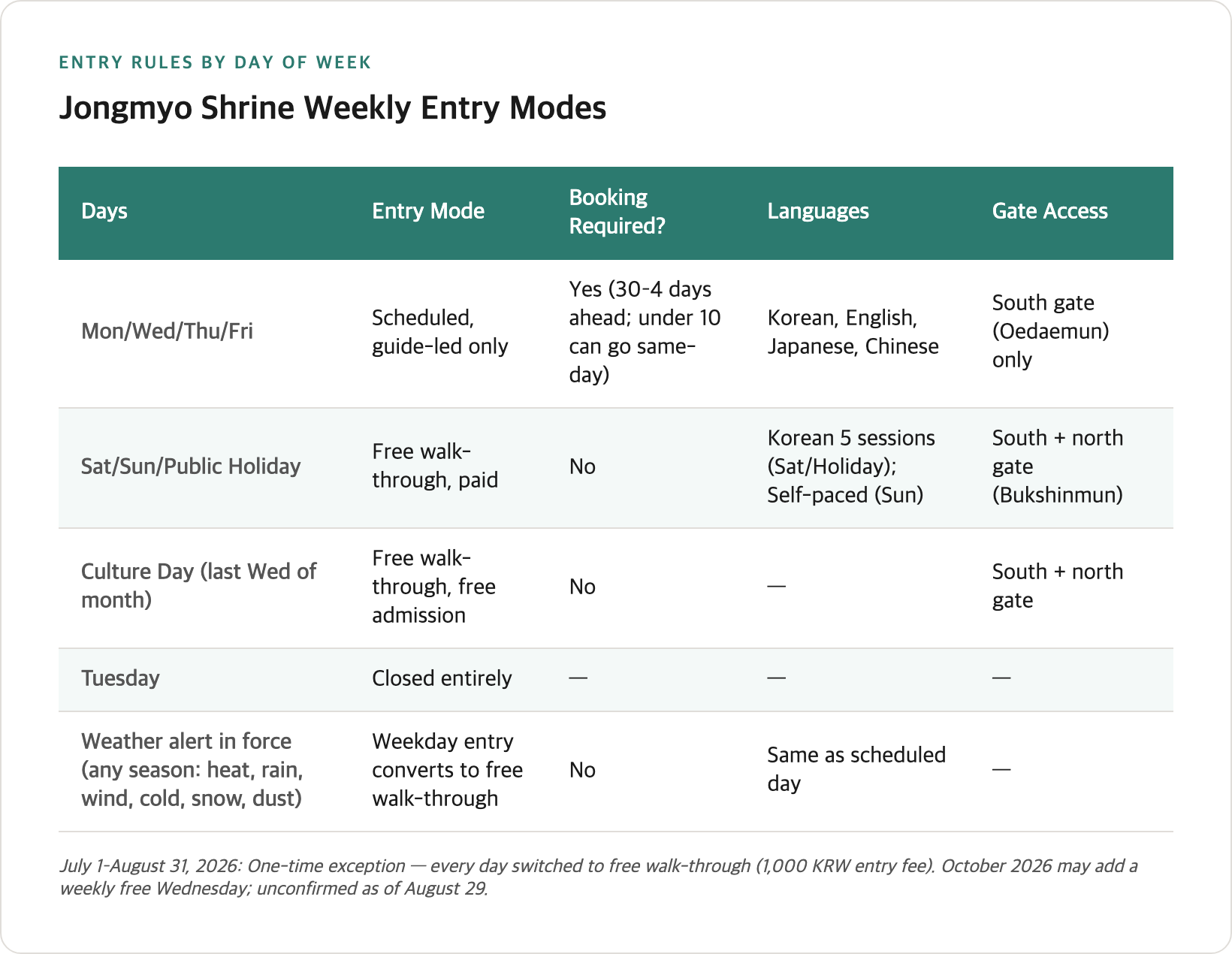
| Day | Entry mode | Booking needed? | Guide language | Gate available |
|---|---|---|---|---|
| Monday | Scheduled, guide-led only | Yes (30–4 days ahead; under 10 people can just show up) | Korean, English, Japanese, Chinese, by time slot | South gate (Oedaemun) only |
| Thursday | Scheduled, guide-led only | Yes | Same as Monday | South gate only |
| Friday | Scheduled, guide-led only | Yes | Same as Monday | South gate only |
| Saturday | Free walk-through, paid | No | Korean only, 5 sessions if you want commentary | South gate + north gate (Bukshinmun) |
| Sunday | Free walk-through, paid | No | Self-paced | South gate + north gate |
| Public holiday | Free walk-through, paid | No | Korean only, 5 sessions | South gate + north gate |
| Wednesday (weekly Culture Day) | Free walk-through, free admission | No | — | South gate + north gate |
| Tuesday | Closed entirely | — | — | — |
The Wednesday row reflects the change that took effect in October 2026 (covered below).
On a scheduled weekday, you show up for your assigned time, enter with a guide, and stay with the group for roughly an hour. On a free-walk-through day, you buy a ticket at the gate and move through the grounds on your own schedule, with a Korean-language guided option available if you want it (and on Sundays, no separate commentary is listed at all — it’s a self-paced day).
One standing exception cuts across this whole table, and it isn’t seasonal: when a weather alert is in force for Seoul, a scheduled weekday converts to walk-in admission on the spot. That rule has its own section below.
Why Mondays, Thursdays and Fridays Are Guided-Only — and the Capacity Figure the English Page Leaves Out
Jongmyo’s own Korean-language rules for the weekday sessions are direct about this: general, self-paced admission “isn’t available” (일반관람 불가) on Monday, Thursday and Friday. You enter at a fixed time with a guide and see the shrine as part of that group, not on your own.
Local tip — Each weekday guided session caps at 200 visitors per language — 100 booked online in advance, 100 sold at the gate the same day. I checked the English-language version of the same page directly and found neither figure: no “200,” no mention of a same-day allocation at all. If a language slot shows as fully booked online, that doesn’t mean the day is closed to you — half the capacity is reserved for people who simply turn up.
The online booking window itself opens 30 days before your visit date and closes 4 days before it, for anyone booking as a group. If you’re fewer than 10 people, you don’t need to book ahead at all — same-day tickets cover it. One rule the Korean reservation page states plainly and worth taking seriously: entry is tied to your assigned time slot, and arriving late forfeits the spot.
The 2026 Summer Exception: Two Months of Free Walk-Through, for the First Time
From July 1 to August 31, 2026, Jongmyo dropped the guided-only weekday system entirely and ran free walk-through admission every day of the week, with entry closing at 16:40 on weekdays and 17:30 on weekends. This is where the day-of-week table above stops applying — but it’s worth being precise about what kind of change this actually was.
I read through all 34 notices posted on Jongmyo’s official bulletin board between January 2024 and August 2026 to check whether this happens every summer. It doesn’t, or at least it hadn’t before 2026. In 2024 and 2025, the shrine switched to free walk-through only in response to individual weather alerts — a heavy-rain advisory here, a heat warning there — each announced separately and lasting only as long as the alert did. The 2026 notice is different: it’s the first time the shrine pre-announced the entire two-month period as free walk-through, rather than reacting day by day. Whether that becomes the new normal for future summers isn’t something the notices answer, so treat 2026 as what’s confirmed and no more than that.
Weather alerts still shaped the guided commentary through that stretch, in three tiers written into the same notice: a heat or heavy-rain/wind advisory cut the guided talk to 30 minutes, a warning cut it to a five-minute safety briefing, and a severe heat warning dropped the commentary altogether. None of that closed the shrine — you could still walk through. But that tiering isn’t a summer invention, and it doesn’t expire with the summer notice, which is the part worth carrying into the rest of the year.
The Rule That Outlasts the Summer: A Weather Alert Can Turn a Guided Weekday into a Walk-In Day
The day-by-day conversions of 2024 and 2025 weren’t improvised. Jongmyo has a standing notice — 기상 특보에 따른 종묘 관람안내, “Visiting Jongmyo under weather alerts,” posted on July 23, 2025 and still on the notice board when we checked it on August 29, 2026 — that sets out exactly what happens. When the Korea Meteorological Administration has an alert in force, measured at the northwestern Seoul zone (서울서북권), the weekday timed-entry system “changes to general admission immediately” (일반관람으로 즉시 바뀝니다). Monday, Thursday and Friday become walk-in days for as long as the alert lasts, with entry closing at 16:40 from March to September and 16:20 from October to February.
What makes this more than a rainy-afternoon footnote is the list of alerts it covers: heat, heavy rain, strong wind, cold wave, heavy snow, and yellow dust or fine dust. Cold-wave and heavy-snow alerts are winter events, so despite where the rule turns up most often in the notice archive, this is not a summer rule — a January visit can fall under it as readily as a July one. Free-walk-through days follow the same notice: Saturdays, Sundays, public holidays and Wednesdays (Culture Day), where entry closes at 17:00 (February–May and September–October), 17:30 (June–August) and 16:30 (November–January).
Local tip — The alert rule runs in three tiers, and only the commentary changes between them: an advisory (주의보) leaves a shortened 30-minute talk, a warning (경보) reduces it to a five-minute safety briefing, and a severe heat warning (폭염중대경보) drops commentary entirely. The shrine stays open, and walk-in, through all three. The reason almost nobody writing in English has this is where it lives — it isn’t on the Korean visiting-hours page that lays out the weekday rules; it’s a separate notice on Jongmyo’s bulletin board, which is not where a trip plan sends you.
Guided-Tour Languages, and How Often They Actually Run
On the three scheduled weekdays, tours run in four languages, but not at the same frequency.
| Language | Sessions per day | Times |
|---|---|---|
| Korean | 8 (Oct–Feb) or 9 (Mar–Sep) | Roughly 09:20–16:20, or 09:20–16:40 in the longer season |
| English | 4 | 10:00, 12:00, 14:00, 16:00, year-round |
| Japanese | 4 | 09:40, 11:40, 13:40, 15:40 |
| Chinese | 2 | 11:00, 15:00 |
Local tip — On Saturdays and public holidays, the schedule flips: only Korean-language tours run, five times a day (10:00, 11:00, 13:00, 14:00, 15:00), and no reservation is needed at all. English, Japanese and Chinese commentary is a weekday-only fixture. If English narration matters to your visit, the weekend — otherwise the easier day to get in — is the one day it isn’t offered. Sunday itself is listed as fully self-paced, without a separate tour schedule.
The Reservation Rule for Foreign-Language Sessions
The English, Japanese and Chinese guided sessions carry one specific restriction, stated on Jongmyo’s own reservation page in all three languages: those sessions can’t be booked by a Korean national traveling alone. A Korean national accompanying a foreign visitor is fine. Jongmyo’s English-language site puts the underlying policy slightly more plainly: guided tours in foreign languages are offered for foreigners and for Koreans accompanying foreigners.
That’s the narrow, literal rule, and it’s worth sticking to it rather than expanding it. I tried to open the actual reservation form to see how — or whether — that restriction gets checked at the booking stage, but the form was disabled during the summer exception, when the whole reservation system was replaced by free walk-through admission. I couldn’t test whether it asks for a passport number, checks nationality some other way, or relies on staff at the gate. That’s a gap in what I could confirm, not a reason to assume foreign visitors face a harder booking process than they do — the stated rule restricts solo Korean-national bookings, nothing broader than that.
The Main Hall’s Renovation Is Finished — the Official English Page Hasn’t Caught Up
This is worth knowing before you go, because it’s the single biggest gap between what Jongmyo’s English page says and what’s actually true.
The Jeongjeon (정전), Jongmyo’s National Treasure main hall, underwent a multi-year restoration that began in 2020. According to a Korean government policy briefing published in 2025, the work finished with a formal ceremony — an hwanahnje (환안제), the rite for returning the royal tablets to their hall — held on April 20, 2025. Korean news coverage of the event described it as the first ceremony of its kind in 155 years, restoring 49 spirit tablets of Joseon’s kings, queens, and the Korean Empire’s emperors and empresses to the Jeongjeon.
I opened Jongmyo’s official English-language page directly on August 29, 2026 and it still reads: “The Main Hall is currently under renovation (until April 2025).” That notice is more than sixteen months out of date. One widely shared English-language guide, updated for 2026 according to its own byline, still describes the Jeongjeon as under renovation between 2020 and 2025 — which lines up with what an outdated official source would tell you, rather than with what’s actually there now.
Local tip — The renovation is finished, and the reason English guides still describe it as ongoing is traceable, not just outdated hearsay — the Korea Heritage Service’s own English-language page for Jongmyo hasn’t been updated since before the completion ceremony. What we couldn’t confirm is exactly how the main hall is being shown to visitors now — whether it’s fully open to view or still has posted access limits — because we found no notice addressing that specifically after May 2024. Don’t take “renovation finished” to mean “no restrictions at all.”
Which Gate to Use: South Entrance vs. the North Gate from Changdeokgung
Jongmyo’s main entrance is the south gate, Oedaemun (외대문) — also called Oesammun (외삼문) — a deliberately plain, low structure compared to a palace’s front gate, with a dismount stele (하마비) and a Seoul-heritage-listed royal well (어정) just outside it. This gate is open every day the shrine is open, on both the scheduled and free-walk-through systems.
The north gate, Bukshinmun (북신문), on the Yulgok-ro side, is different: it only opens on free-walk-through days — Saturdays, Sundays, public holidays and Wednesdays. It connects to a pedestrian route along the palace wall (궁궐담장길) linking Changdeokgung and Changgyeonggung to Jongmyo, so if you’re planning to walk that route rather than backtrack through the south gate, you need a general-admission day. On a scheduled weekday session, Bukshinmun stays closed and you enter and exit through the south gate only.
We couldn’t confirm an official “nearest subway station” for the north-gate approach in Jongmyo’s own materials — treat it as a walk continuing from Changdeokgung and Changgyeonggung rather than a separate subway trip.
What Changed in October 2026: Free Wednesdays, Fewer Guided Days
Per the Korea Heritage Service’s October opening-hours page, Jongmyo’s timed, guide-led days are now Monday, Thursday and Friday only. Wednesday joined the free walk-through days as the weekly Culture Day, with free admission and the Yulgok-ro north gate (Bukshinmun) open. This is the weekly free-admission program that Korean news outlets reported in May 2026; it is now on the official page.
Also, from October 29 to November 15, 2026 (the Korea Grand Festival), Jongmyo switches to general walk-through viewing with free admission, according to a royal.khs.go.kr notice. Closed days are excluded, so Tuesday is still shut.
Cost and Getting There
Adult admission to Jongmyo alone is ₩1,000 (as of 2026); visitors under 19 and those 65 and older enter free. If you’re also seeing Gyeongbokgung and the other royal sites on the same trip, a combined ticket covers Jongmyo alongside the four main palaces — worth checking in our Gyeongbokgung guide rather than repeating the details here. Gyeongbokgung and Changdeokgung both waive admission for visitors in qualifying hanbok; we could not confirm whether Jongmyo runs the same exemption, so budget for the ₩1,000 fee unless you check locally.
Jongmyo is at 157 Jongno, Jongno-gu, Seoul, roughly a five-minute walk from Jongno 3(sam)-ga Station, Exit 11 or Exit 8, served by subway lines 1, 3 and 5. There’s no parking run by the shrine itself; the paid option Jongmyo’s own directions point to is the Jongmyo public car park, operated by the Jongno-gu ward office. A T-money card covers the subway fare, and a multi-day Climate Card pass, if you’re using one during your stay, covers this ride the same way it would any other Seoul subway trip. Google Maps is not the reliable option for walking directions in Korea generally — it’s worth having Naver Map or Kakao Map set up before you go, especially if you’re routing between Jongmyo and the north-gate corridor to Changdeokgung and Changgyeonggung. Carry a passport if you’re booking one of the foreign-language sessions — it’s the simplest way to confirm nationality if it’s asked for.
If you’re heading to Namsan and N Seoul Tower after this, decide how you’re going up before you set off: the cable car, the 01A and 01B buses, the free Myeongdong shuttle, and the walking route run from ₩15,000 round trip down to nothing at all (as of 2026), and the observation deck ticket is charged separately from the cable car fare.
If your visit happens to fall on a Tuesday, when Jongmyo is closed outright, the National Museum of Korea at Ichon is one alternative for that day — a different institution on the other side of the river rather than a substitute experience, and worth checking its own opening days before you commit to it.
What You Need to Know
-
Monday, Thursday and Friday are scheduled and guide-led — there’s no self-paced option, weather permitting. Jongmyo’s own rules state general admission “isn’t available” on those days; you enter at your assigned time and stay with the group for about an hour. The one standing exception is a weather alert, below.
-
Weekends, public holidays and every Wednesday are free walk-through, no booking required (Wednesday is also free admission).
-
July 1–August 31, 2026 is a one-off exception, not an annual pattern. We checked the shrine’s notice board back to January 2024 and found no earlier instance of the whole two-month period switching to free admission — only single-day conversions during heat or storm alerts.
-
A weather alert overrides the weekday rule in any season, and that one is permanent. A standing notice posted in July 2025 converts Monday, Thursday and Friday to walk-in admission for as long as a Seoul alert is in force — heat, heavy rain, strong wind, cold wave, heavy snow, or dust. Only the length of the commentary changes with the alert level.
-
The Jeongjeon’s renovation finished in April 2025, more than a year before this article — but the shrine’s own English-language page still describes it as ongoing.
-
Tuesday is a full closure, same as Gyeongbokgung — no guided sessions, no walk-through.
-
The north gate (Bukshinmun) is not a weekday entrance. It opens only on the same days as free walk-through admission.
-
Since October 2026, Wednesday is a free walk-through day, and from October 29 to November 15 every open day is walk-through with free admission (Tuesday stays closed).
Practical Tips
-
Check the day of the week before anything else. Monday, Thursday and Friday are scheduled, guide-led entry only; Saturday, Sunday, Wednesday and public holidays are free walk-through; Tuesday is closed entirely.
-
Don’t assume a sold-out online slot means you’re locked out. Half of each weekday session’s 200-person cap — 100 spots — is sold at the gate the same day.
-
Arrive at your assigned entry time, not just your assigned day. Jongmyo’s rule states plainly that entry follows the scheduled time slot.
-
Weigh the language trade-off before picking a day. Weekends need no booking, but commentary that day runs in Korean only — English sessions are a weekday-only fixture, four times a day.
-
If you want the north-gate approach from Changdeokgung or Changgyeonggung, go on a free-walk-through day. Bukshinmun stays closed during scheduled weekday sessions.
-
Check the notice board when the forecast turns bad, in any month. A standing rule converts a guided weekday to walk-in admission whenever a Seoul weather alert is in force — heat and rain in summer, cold wave, snow and dust in winter — and in 2026 the whole of July and August ran that way, the first time it was set for a full season rather than alert by alert.
-
Bring a passport if you’re booking an English, Japanese or Chinese session. The rule restricts Korean nationals from reserving those sessions solo; how it’s checked at booking wasn’t something we could confirm.
Frequently Asked Questions
Can I visit Jongmyo Shrine without a guided tour?
Only on free-walk-through days: Saturdays, Sundays, public holidays and every Wednesday (plus October 29–November 15, 2026, during the Korea Grand Festival, and every day from July 1 to August 31, 2026 as a one-off exception). On the other three weekdays — Monday, Thursday and Friday — entry is scheduled and guide-led only, and Jongmyo’s own rules state that general, self-paced admission isn’t available on those days. One standing exception applies year-round: if a Seoul weather alert is in force, those weekdays convert to walk-in admission for as long as the alert lasts.
How much does it cost to visit Jongmyo Shrine?
Adult admission is ₩1,000 (as of 2026), and visitors under 19 or 65 and older enter free. Admission is free for everyone on Wednesdays (weekly Culture Day), which are also free-walk-through days. If you’re seeing Jongmyo alongside Gyeongbokgung and the other royal palaces on the same trip, a combined ticket covers all five sites — see our Gyeongbokgung guide for the current price and what it includes. We could not confirm whether Jongmyo grants the hanbok admission exemption that applies at the palaces, so plan on paying the ₩1,000 unless you check locally.
What day is Jongmyo Shrine closed?
Tuesdays, the same closure day as Gyeongbokgung. The closure is total — no guided sessions, no walk-through admission, and the north gate on Yulgok-ro is shut along with everything else, so the palace-wall route from Changgyeonggung has nowhere to end that day. Changdeokgung, Changgyeonggung, Deoksugung and the Joseon Royal Tombs close on Mondays instead, so there’s usually a nearby palace site open if Jongmyo happens to be shut on the day you’re in the area. If you want the wall route as part of the visit, put Jongmyo on a weekend, Wednesday or holiday rather than simply avoiding Tuesday — that gate opens only on free-walk-through days.
Is Jongmyo Shrine’s Main Hall still under renovation?
No. The Jeongjeon, Jongmyo’s National Treasure main hall, completed a multi-year restoration with a formal ceremony on April 20, 2025. Jongmyo’s official English-language page had not been updated as of August 29, 2026 and still describes the hall as under renovation “until April 2025.” We couldn’t confirm the current viewing arrangements for the hall itself, so it’s worth checking the notice board close to your visit.
Can foreigners book the English-language guided tour alone?
The official restriction is narrower and worded the other way around: Korean nationals can’t book the English, Japanese or Chinese sessions solo — a Korean national accompanying a foreign visitor is fine. The same line appears in the English, Japanese and Chinese sections of Jongmyo’s reservation page (내국인 단독 예약 불가), and the shrine’s English site states the underlying policy directly: foreign-language guided tours are offered for foreigners and for Koreans accompanying foreigners. We weren’t able to test how that’s verified in the booking form itself, since the form was disabled during the July–August 2026 free-admission exception when we checked.
How many people can enter each guided session at Jongmyo?
Each weekday guided session caps at 200 visitors per language, split evenly — 100 booked online in advance and 100 sold at the gate the same day. That same-day allocation isn’t mentioned on Jongmyo’s English-language page, only the Korean one, which is easy to miss if you assume a fully booked online slot means the day is closed to you.
Is Jongmyo Shrine free every Wednesday now?
Yes, since October 2026. According to the Korea Heritage Service’s October opening-hours page, Wednesday is the weekly Culture Day: free admission, free walk-through with no booking, and the Yulgok-ro north gate open. The timed, guide-led days are now Monday, Thursday and Friday only. From October 29 to November 15, 2026 (Korea Grand Festival), Jongmyo is also free walk-through on its open days.
How do I get to Jongmyo Shrine?
Jongmyo is at 157 Jongno, Jongno-gu, Seoul, about a five-minute walk from Jongno 3(sam)-ga Station on subway lines 1, 3 and 5 — take Exit 11 or Exit 8. Both exits lead to the south gate, Oedaemun, which is the only entrance open on scheduled weekdays; the north gate on Yulgok-ro opens only on free-walk-through days, and it’s reached as a walk from Changdeokgung and Changgyeonggung rather than from a station of its own. There’s no parking run by the shrine; the paid option its own directions name is the Jongmyo public car park, operated by the Jongno-gu ward office.
Related Questions
- Gyeongbokgung Tickets: Free Days, Closures, and the Hanbok Rule
- Changdeokgung and the Secret Garden: The Timed Ticket That Sells Out
- Seoul Subway: Getting Between Palaces on Lines 1, 3 and 5
- How to Get to N Seoul Tower — Cable Car, Bus, Free Shuttle, or Walk
Featured image: ⓒ한국관광공사 포토코리아-서문교