How to Buy and Use the Seoul Climate Card as a Foreigner (2026 Update)
Last Updated on August 21, 2026
Quick Answer
Foreigners can buy the Seoul Climate Card (기후동행카드) short-term pass — 1, 2, 3, 5, or 7 days, ₩5,000–₩20,000 plus a ₩3,000 physical card (as of August 2026) — at convenience stores, subway ticket machines, and tourist information centers. The pass itself keeps running. From October 1, 2026 its range is Seoul plus the existing Incheon Airport drop-off exception, so Gimpo, Goyang, Gwacheon, Guri, Seongnam, Hanam, and Namyangju fall outside it. Check that against your dates.
The Full Answer
The Climate Card is Seoul’s unlimited-ride transit pass, and the short-term version aimed at visitors — not the 30-day resident one — is what most travelers mean when they search for it. It buys unlimited rides on Seoul subway lines and city buses for a fixed number of days, no tapping in and out to track a fare balance.
On September 1, 2026, Seoul launches a new resident program, the Climate Pass (기후동행패스) — the national Modu-ui Card (모두의카드, also branded K-패스) with Seoul’s own benefits layered on top. The old 30-day Climate Card winds down alongside it rather than vanishing overnight: the prepaid 30-day version could be topped up until August 31, 2026 and stays usable until September 29, and the postpaid version runs until September 30, becoming an ordinary transit card on October 1. None of that touches what a short-term visitor buys. The 1-, 2-, 3-, 5-, and 7-day passes continue on sale, at the prices listed below, through and beyond September 1.
What does change is the ground the short-term pass covers, from October 1, 2026.
What the English and Korean Sources Each Tell You
Korea’s official English tourism page has the date and the headline restriction: it states that the 30-day and postpaid cards are discontinued effective October 1, 2026, and that from that date the Climate Card is “limited to use within Seoul.” That much is already available in English.
What is not in English is the detail. I read Seoul’s own Q&A page on the change, published August 12, 2026 on the city’s official media hub and updated the next day. Q12 adds two things the English page leaves out: the short-term pass keeps “Seoul and Incheon International Airport (drop-off)” — so the airport exception survives the change — and it names the areas leaving the range, Gimpo, Goyang, Gwacheon, Guri, Seongnam, Hanam, and Namyangju. A Korean news outlet’s 15-question Q&A on the same changeover, published the same day, lists the identical set of cities.
Of the eight English blog and commerce pages ranking for Climate Card searches when this was checked in August 2026, all were published between February and July 2026 — before Seoul’s notice existed — and none named those cities or the airport exception. That is the gap this article fills — not that something changes, but where the line now falls.
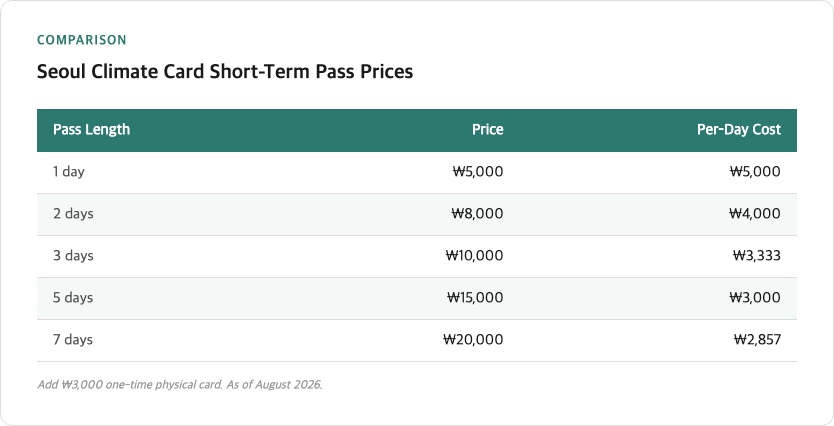
How Much the Short-Term Pass Costs
| Pass length | Price | Per-day cost |
|---|---|---|
| 1 day | ₩5,000 | ₩5,000 |
| 2 days | ₩8,000 | ₩4,000 |
| 3 days | ₩10,000 | ₩3,333 |
| 5 days | ₩15,000 | ₩3,000 |
| 7 days | ₩20,000 | ₩2,857 |
Prices as of August 2026, confirmed on Seoul’s official English transit page and matched against three other official sources — two Seoul city pages and Korea’s national tourism organization.
Add a ₩3,000 physical card, bought once and separate from the pass price. Against a ₩1,550 base subway fare, the math favors the longer passes: the 3-day pass breaks even at a little over two rides a day, the 7-day pass at under two. The 1-day pass is the weak option in the lineup — it needs more than three rides in a single day just to match the cost of paying cash fares, and that’s before the card fee is factored in.
Buying the Physical Card
The pass and the card are two separate line items: you buy the ₩3,000 card once, then load a pass onto it. Seoul’s own guidance lists the physical card as sold at the new-model ticket machines inside Seoul Metro (lines 1–8) stations and at convenience stores near stations — CU, GS25, 7-Eleven and Emart24 are the usual chains — and the tourist information centers in Myeongdong and at the Seoul Travel Plaza also handle it. Reloading is wider than buying: the station top-up machines also cover line 9, the Ui-Sinseol and Sillim lines and the Gimpo Gold Line.
Paying With a Foreign Card
International cards were not an option at the machines until March 20, 2025, when Seoul opened Climate Card purchases and top-ups to overseas-issued credit and debit cards. It expanded again on March 17, 2026: the city installed 440 new ticket machines across 273 stations on lines 1–8, all accepting Visa, Mastercard and mobile payment services such as Kakao Pay and Naver Pay. Seoul’s announcement is specific that this applies to buying the card and loading short-term passes; 30-day passes were left out of the first phase.
One detail the announcement carries and English guides do not: paying with an overseas-issued card adds an average service fee of approximately 3.7%. On a ₩20,000 seven-day pass that is roughly ₩740 — small, but it means cash is marginally cheaper if you already have won in hand. See the broader cash-versus-card breakdown for where foreign cards still fail in Korea, and keep some cash as a backup for machines outside the upgraded set.
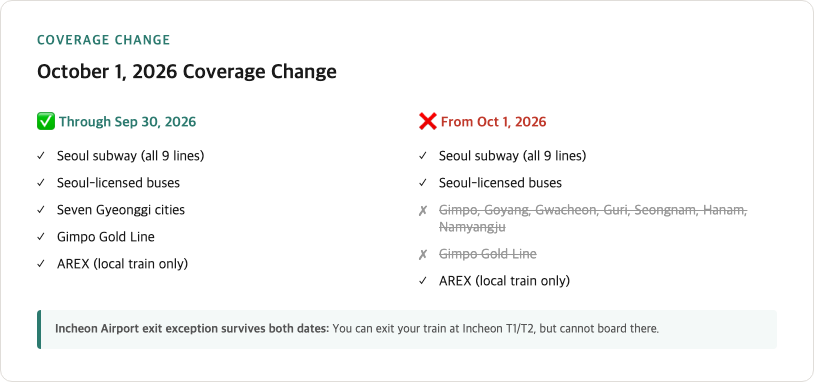
Where the Climate Card Works — Before and After October 1
This is the part where the timing of your trip matters.
| Route or area | Through Sep 30, 2026 | From Oct 1, 2026 |
|---|---|---|
| Subway sections inside Seoul (lines 1–9, Sillim, Ui-Sinseol) | ✅ | ✅ |
| Seoul-licensed city, village and late-night buses | ✅ | ✅ |
| Subway sections running out to Gimpo, Goyang, Gwacheon, Guri, Seongnam, Hanam, Namyangju | ✅ | ❌ |
| Gimpo Gold Line, Seohae line | ✅ | ❌ |
| AREX local train, Gimpo Airport–Seoul Station | ✅ | ✅ |
| Incheon Airport T1/T2 — exiting the train | ✅ | ✅ |
| Incheon Airport T1/T2 — boarding the train | ❌ | ❌ |
| AREX express train | ❌ | ❌ |
| Sinbundang line, GTX, Incheon subway lines 1–2 | ❌ | ❌ |
| Ttareungi bike-share, Han River ferry bus | ❌ | ❌ |
Left column from Seoul’s official coverage page (last revised July 22, 2026); right column from the city’s August 12, 2026 Q&A, which gives the post-change range as Seoul plus alighting at Incheon International Airport. Seoul-licensed buses are a deliberate exception to the city-boundary rule — the city says they stay valid even when you board or alight outside Seoul.
Right Now, Through September 30: Seven Gyeonggi Cities Included
As of this writing, the short-term pass reaches beyond Seoul’s border into parts of Gyeonggi Province. I checked the coverage list on Seoul’s traffic information page directly, and it defines the range by named track segments rather than by city. Lines 2, 3, 5, 6, 8, 9, Sillim and Ui-Sinseol are listed in full; lines 1, 4 and 7 only between stated endpoints (line 4, for instance, runs from Government Complex Gwacheon to Jinjeop). Alongside them sit the Gyeongui-Jungang, Suin-Bundang, Gyeonggang and Gyeongchun lines over defined stretches, the Gimpo Gold Line and the Seohae line, plus city and village buses licensed in Seoul.
Those segments are what let a Climate Card holder ride into Gimpo, Goyang, Gwacheon, Guri, Seongnam, Hanam and Namyangju today without paying a separate fare. The segment-by-segment list is on the Korean page; the seven city names come from the city’s August Q&A. Of the eight English write-ups checked for this article, those that mention Gyeonggi at all describe it as “some Gyeonggi routes” without either level of detail.
One name trips people up: Gimpo Airport is inside Seoul, while Gimpo city is not. The airport stays covered after October 1. The Gimpo Gold Line, which runs through the city of the same name, does not.
Where This Matters on a Map
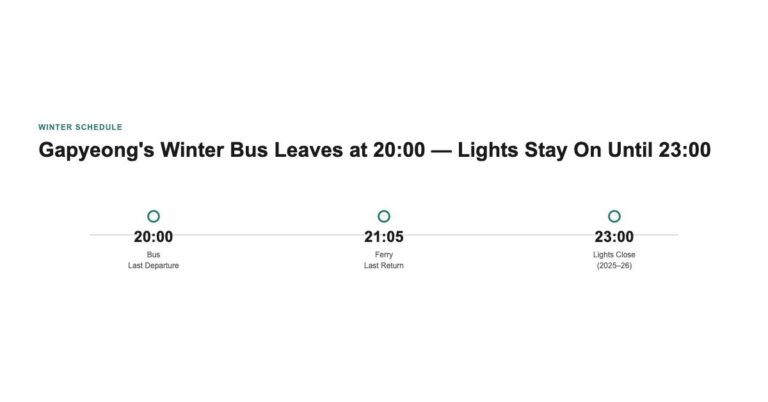
The seven cities are the Gyeonggi suburbs on Seoul’s subway map — the kind of place a visitor adds as a half-day trip rather than an overnight. Ride out to one today and the pass covers it. After October 1, the same trip still runs on the same subway lines — it just needs a separate T-money fare loaded on the same card instead of riding on the pass, so the practical question is whether a suburban day trip lands before or after that date. See the transport guide for how the wider network fits together. That October 1 boundary doesn’t touch trips that stay inside Seoul itself — the ride out to Namsan or to Jamsil for Lotte World sits well within the core Seoul network either side of the date. A day trip further out, to Gapyeong for Nami Island or the Garden of Morning Calm, isn’t a Climate Card question at all — it runs on its own circulator bus schedule, separate from whatever transit card you’re carrying that day.
Local tip — Seoul’s coverage page is worth opening directly if a same-day trip outside Seoul is on the itinerary before October 1, 2026. It gives the exact endpoints of every covered segment, which the English write-ups checked for this article compress into “some Gyeonggi routes.” The distinction matters because the pass fails at the tap-out, not the tap-in: board inside the covered range, alight outside it, and staff collect the full fare at the destination gate. The city’s own example is Jongno 3-ga to Indeogwon.
From October 1, 2026: Seoul Plus the Airport Exception
Starting October 1, 2026, the short-term pass’s range is Seoul itself plus the airport exception it already had: exiting the airport railway at Incheon International Airport. The seven cities above sit outside it.
Neither the city’s Q&A nor the Korean news coverage says what happens to a pass already running when the date arrives — a seven-day pass loaded on September 28, say. Both state the new range without addressing passes in mid-use. Rather than guess, plan around it: put any suburban day trip on a date clearly before October 1, and treat anything after as Seoul-only.
Local tip — Korea’s official English tourism page does carry the October 1 date and the phrase “limited to use within Seoul,” so that much is available in English. What it does not carry is which places that removes, or the fact that alighting at Incheon Airport survives the change. Both are in the city’s own Q&A, Q12, published August 12, 2026. Of the eight English blog and commerce guides checked for this article, all predate that notice and none name Gimpo, Goyang, Gwacheon, Guri, Seongnam, Hanam or Namyangju.
The Airport Railway Rule That Doesn’t Change
On the AREX airport railway, the Climate Card has always worked only on the local (완행), not express, train, between Gimpo Airport and Seoul Station — that part isn’t changing either side of October. On top of that ride range sits an exit-only allowance: you can tap out and exit at Incheon Airport’s T1 or T2 stations, but you cannot tap in and board there. Seoul’s English page dates that allowance to Friday, September 13, 2024 and still lists it as current as of August 2026.
It isn’t the only such allowance: the Korean coverage page grants the same one-way treatment on line 7 between Seokbam and Kkachiul, outside Seoul. The August Q&A names only the airport when describing the post-October range, so whether that one survives isn’t something these documents settle.
What’s Never Covered, Either Way
A short list of things the Climate Card has never included, regardless of the date: the Sinbundang line, GTX, Incheon’s own subway lines 1 and 2, light rail in Yongin and Uijeongbu, intercity and airport buses, and any bus not licensed in Seoul. The short-term pass also doesn’t include Ttareungi (따릉이) bike-share rides or the Han River ferry bus. Seoul’s price table marks every short-term pass “Ttareungi and Han River bus not included” — those rode on the optional add-on tiers of the 30-day pass, which is itself being phased out.
How to Buy and Activate Your Pass
Where to Buy It
Buy it on arrival rather than in advance — there’s no meaningful benefit to pre-ordering, and the pass has to be loaded onto a physical card you’ll be carrying anyway. Ticket machines inside lines 1–8 stations, convenience stores near subway entrances, and the tourist information counters in Myeongdong and at the Seoul Travel Plaza are the usual places to get the card and load the first pass.
One requirement is easy to miss: Seoul’s guidance says physical-card users must register the card on the Tmoney Card & Pay website, one card per person, and that an unregistered card can’t be refunded.
The Card Starts the Day You Load It
There’s no picking a future start date. Seoul’s own price table is explicit about it: the usage period starts on the day you load, advance loading is not possible, and the worked example the city gives is blunt — load a one-day pass on Monday the 1st and it expires with the last train that same Monday. The 30-day pass does allow you to choose a start date within five days of charging; the short-term pass is specifically excluded from that. A pass runs from the first train (04:00) on its start date to the last train on its end date.
So a 3-day pass loaded on your arrival evening burns that evening as day one, even if you only ride to your hotel. Match the loading date to your actual first full travel day, not the day you land, if the two are different.
If Your Trip Crosses the October Cutoff
The city’s documents set out the new range without saying how a pass already in use is treated when the date arrives, so the safe assumption is the cautious one: don’t count on the wider coverage for any day from October 1 onward. If a day trip to one of the seven Gyeonggi cities is on the itinerary, place it before October 1 rather than after, and if your dates straddle the change, plan the out-of-Seoul legs into the earlier half.
Mpass — The Other Foreigner-Only Option
Most English guides to the Climate Card don’t mention that the same T-money operator also sells a foreigner-exclusive alternative called Mpass.
What Mpass Costs and Covers
According to Korea’s official tourism site, Mpass is a foreigner-only pass with a cap of 20 rides per day. T-money’s own English page describes the covered routes slightly more broadly than the tourism page does — metropolitan-area subway rather than Seoul only, plus the airport railway’s regular train, Seoul’s green, blue and yellow buses, village buses and late-night buses. The express train is excluded either way.
Prices run from ₩15,000 for one day to ₩64,500 for seven days (as of August 2026), and the headline figure needs one adjustment English write-ups tend to skip: ₩5,000 of it is a card deposit, refunded at ₩4,500 when you hand the card back, with a ₩500 service fee kept. Net of that, a one-day Mpass costs about ₩10,500 against ₩5,000 for a one-day Climate Card, and a seven-day Mpass about ₩60,000 against ₩20,000 — so the gap is roughly double at the short end and roughly triple at the long end, a spread worth weighing against the rest of a trip’s daily budget.
It’s issued and returned in person at T-money Town near Seoul Station, and paid for in Korean cash only. Buying after 17:00 takes ₩3,000 off every pass length, and the card carries partner discounts including N Seoul Tower and the Seoul Museum of Art.
Local tip — None of the English guides to the Climate Card checked for this article mention Mpass at all, so a traveler who searches only “Climate Card” won’t learn the alternative exists. Two operating details sit on T-money’s own English page rather than in the tourism listings: a multi-day Mpass must be used on consecutive days and cannot be paused or extended once running, and a day runs from your first tap until midnight that same day, not 24 hours from the tap.
Where Mpass Falls Short of the Climate Card
At two to three times the net price and with a single issuing counter, Mpass isn’t a better default for most short trips. Its case is narrower: someone who wants the airport railway inside an unlimited-ride pass and will go to Seoul Station in person for it.
What We Could Not Confirm About Mpass
Neither Korea’s official tourism page nor T-money’s own English Mpass page says whether Mpass allows boarding — not just exiting — the airport railway at Incheon International Airport’s T1 or T2 stations, the same asymmetry that applies to the Climate Card. I opened the T-money page directly while editing this article on August 21, 2026: it lists the routes Mpass covers and the daily ride cap, but says nothing either way about that station restriction. This article treats Mpass’s Incheon Airport boarding access as unconfirmed rather than assuming it either way — don’t plan an airport-to-city trip around Mpass without confirming it at the counter or with T-money’s customer service line first.
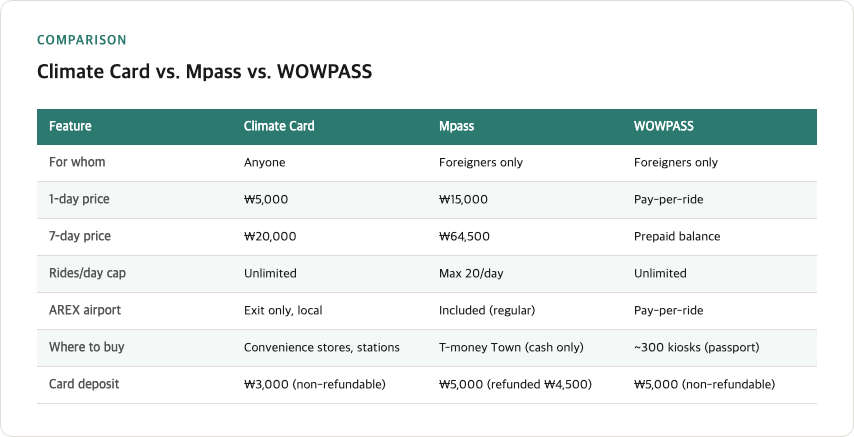
Climate Card vs. Mpass vs. WOWPASS
| Climate Card (short-term) | Mpass | WOWPASS | |
|---|---|---|---|
| Who it’s for | Anyone, foreign or Korean | Foreigners only | Foreigners only |
| 1-day price | ₩5,000 + ₩3,000 card (card not refundable) | ₩15,000, incl. ₩5,000 deposit refunded at ₩4,500 | Card ₩5,000 + pay-per-ride |
| 7-day price | ₩20,000 | ₩64,500 on the same deposit terms | No fixed pass — prepaid balance |
| Subway/bus rides | Unlimited | Up to 20 rides a day | Pay per ride, not unlimited |
| Range | Seoul (Gyeonggi sections until Sep 30, 2026) | Metropolitan-area subway and Seoul buses | Wherever the card is accepted |
| AREX to/from Incheon Airport | Exit only, local train only | Regular train included, express excluded (boarding at Incheon unconfirmed) | Available, pay per ride |
| Where to buy | Convenience stores, station machines, tourist centers | T-money Town near Seoul Station only, cash only | Roughly 300 kiosks, passport required |
Prices as of August 2026.
WOWPASS functions less like a transit pass and more like a prepaid card built for foreign visitors — a different product solving a different problem (currency exchange plus a payment card) rather than a Climate Card substitute. For most short Seoul trips built around subway and bus rides, the short-term Climate Card is the straightforward default; Mpass earns its premium only if airport-railway access outweighs the extra cost and the trip to the counter.
What You Need to Know
-
The September 1 changeover is a resident story, not a visitor one. That date launches the Climate Pass (기후동행패스) for residents, while the 30-day Climate Card winds down — prepaid cards topped up by August 31 run to September 29, postpaid to September 30. The 1-, 2-, 3-, 5-, and 7-day visitor passes keep selling at the prices above.
-
October 1, 2026 is the date that matters for your itinerary. From that date, the short-term pass covers Seoul plus the existing Incheon Airport exit-only exception. Gimpo, Goyang, Gwacheon, Guri, Seongnam, Hanam, and Namyangju sit outside it, so a suburban day trip is a question of dates rather than of a different ticket type.
-
The airport railway rule hasn’t changed and isn’t changing. The Climate Card works on the AREX local train between Gimpo Airport and Seoul Station, and additionally lets you exit at Incheon International Airport, but never lets you board there. The express train is out in both directions, and stations along the line beyond Gimpo Airport aren’t part of the ride range either.
-
The pass activates the moment you load it. There’s no scheduling a future start date — Seoul’s price table says so outright — so load it to match your actual first travel day.
-
Overseas-issued cards work at the 440 machines Seoul upgraded in March 2026, across 273 stations on lines 1–8, with an average service fee of about 3.7%. Cash is still worth carrying for machines outside that set.
-
Mpass costs roughly two to three times as much once its ₩5,000 refundable deposit is netted out, and is issued at one counter near Seoul Station, in cash — worth knowing about, not worth defaulting to for most trips.
Practical Tips
-
Match your pass length to your actual ride count, not your trip length. The 3-day and 5-day passes break even at roughly two rides a day; the 1-day pass needs more than three rides just to match cash fares.
-
If Gimpo, Goyang, Gwacheon, Guri, Seongnam, Hanam, or Namyangju are on your itinerary, go before October 1, 2026. After that date, those routes fall outside the short-term pass and need a separate T-money fare.
-
Load the pass on the day you’ll actually start using it. Activation is immediate and can’t be delayed, and a pass expires with the last train on its final day — so loading it late on arrival night spends a whole day of a short pass on the ride to your hotel.
-
Don’t plan on boarding AREX at Incheon Airport with a Climate Card. It only lets you exit there — for the ride in, see the full Incheon Airport transport breakdown.
-
Either payment method works; pick on convenience, not price. The machines Seoul upgraded in March 2026 take overseas Visa and Mastercard with an average fee of about 3.7%, so cash is marginally cheaper if you already have won, and the card saves you a currency exchange.
-
Skip Mpass unless airport-railway access specifically matters to your trip. Even after netting out its refundable deposit it runs two to three times the Climate Card’s cost, from a single counter — see the comparison table above before deciding.
-
Check Seoul’s official English transit page if your trip lands right around October 1, 2026. The city’s notices set out the new range but not how a pass already in use is handled, and that detail may be spelled out closer to the date.
Frequently Asked Questions
Can foreigners buy the Seoul Climate Card, and where?
Yes. The short-term 1-, 2-, 3-, 5-, and 7-day passes are open to anyone, foreign or Korean, and are sold at convenience stores near subway entrances, ticket machines inside lines 1–8 stations, and tourist information centers including the Seoul Travel Plaza and Myeongdong center. No residency or Korean phone number is required for the short-term pass.
How much does the short-term Climate Card pass cost, and does it include the physical card?
Prices run from ₩5,000 for one day to ₩20,000 for seven days (as of August 2026): ₩8,000 for two days, ₩10,000 for three, ₩15,000 for five. The physical card is a separate, one-time ₩3,000 purchase, not included in the pass price and not refunded on a card in working order. Against a ₩1,550 base subway fare, the three-day pass pays for itself at a little over two rides a day and the seven-day at slightly under two, while the one-day pass needs more than three rides in a single day before it beats paying cash fares.
Can I use the Climate Card to get from Incheon Airport to Seoul?
Only partway, and only in one direction. The Climate Card lets you exit at Incheon International Airport’s T1 or T2 stations on the AREX local train, but it does not let you board the train there — boarding at Incheon Airport still requires a separate ticket.
Does the Climate Card cover the AREX airport train the whole way?
No. The ride range is the local (완행) train between Gimpo Airport and Seoul Station — not the express train, which is excluded in both directions, and not the stations further out along the line. Layered on top of that range is a one-way allowance at Incheon International Airport: you may tap out and leave the system at T1 or T2, but you cannot start a journey there. Seoul’s English page dates that allowance to September 13, 2024 and still lists it as current in August 2026.
Is the Climate Card changing in October 2026 — will my pass still work?
The pass itself keeps working, at the same prices. What changes on October 1, 2026 is where it works: from that date the range is Seoul plus the existing Incheon Airport exit allowance, so Gimpo, Goyang, Gwacheon, Guri, Seongnam, Hanam and Namyangju fall outside it. Korea’s official English tourism page carries the date and the “within Seoul” wording; the seven city names come from Seoul’s own August 12, 2026 Q&A. This is separate from the September 2026 wind-down of the 30-day resident pass, which doesn’t affect the short-term pass’s price or availability.
What’s the difference between the Climate Card, Mpass, and WOWPASS?
Climate Card is the cheapest unlimited-ride option and works for anyone, foreign or Korean. Mpass is foreigner-only and capped at 20 rides a day, covers the airport railway’s regular train, and costs two to three times as much once its ₩5,000 refundable card deposit is netted out — and it is issued at a single counter near Seoul Station, cash only. WOWPASS is a prepaid card with pay-per-ride transit access rather than an unlimited pass, closer to a currency-exchange product than a transit pass.
Can I pay for the Climate Card with a foreign credit card?
Yes. Since March 20, 2025 Seoul has accepted overseas-issued credit and debit cards for Climate Card purchases and top-ups, and on March 17, 2026 it added 440 new ticket machines across 273 stations on lines 1–8 that take Visa, Mastercard and mobile payments such as Kakao Pay and Naver Pay. Seoul’s own announcement notes an average service fee of approximately 3.7% on overseas-issued cards, so cash is slightly cheaper if you have it, and remains useful at machines outside that upgraded set.
Related Questions
- T-money Card: Buying, Topping Up, and Getting Your Money Back
- Incheon Airport to Seoul: Every Option, Including the Night Bus
- Getting Around Korea: The Transport Guide That Connects the Details