What Changes in Seoul During Chuseok — Free Palaces, Closed Museums
Last Updated on September 22, 2026
Quick Answer
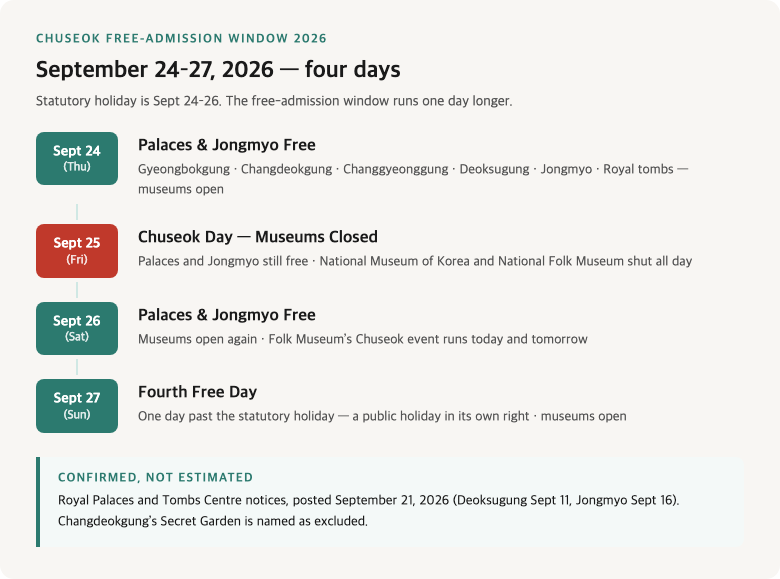
During Chuseok 2026, several of Seoul’s usual visitor rules flip for four days, September 24–27. The four main palaces, Jongmyo Shrine and the Joseon royal tombs go free — confirmed by notices the Royal Palaces and Tombs Centre posted on September 21, 2026. Changdeokgung’s Secret Garden stays excluded. The National Museum of Korea and National Folk Museum do the opposite, closing on Chuseok Day itself (September 25).
The Full Answer
Nearly every English-language guide to Chuseok in Seoul repeats the same line: the palaces are free that week. That’s accurate, as far as it goes, and for most of them that’s where it stops. What actually happens is closer to a temporary swap of the city’s operating rules than a single “free admission” event — for four days a different rule set governs which buildings you can walk into, what they cost, whether anyone will explain them to you, and which are open at all. Then it reverts.
The swap doesn’t move in one direction, and that’s the part that catches people. The palaces and Jongmyo Shrine (종묘) open up; the National Museum of Korea and the National Folk Museum close down, on the same holiday. Someone who read “palaces are free during Chuseok” and planned “palaces one day, a museum the other” can walk up to a locked museum door on Chuseok Day itself and have no idea why.
I checked the Royal Palaces and Tombs Centre’s (궁능유적본부) notice board on September 2, 2026 and found no 2026 Chuseok announcement. I went back on September 22 and read the notices that had gone up since — Deoksugung’s on September 11, Jongmyo’s on September 16, the rest on September 21. Everything below is written against those notices rather than against last year’s pattern, and they corrected something this article originally got wrong: the free window is four days, September 24 through 27, not the three days of the statutory holiday.
The Dates: When Chuseok Falls in Seoul in 2026
Chuseok 2026 runs Thursday, September 24 through Saturday, September 26, with Chuseok Day itself — the actual date on the lunar calendar — falling on Friday, September 25. There’s no substitute holiday (대체공휴일) this year: the rule grants one only when a Chuseok day lands on a Sunday, and none of the three does.
That is the statutory holiday. The palace free-admission window is a separate thing, and confusing the two is where most English coverage goes wrong. The notices posted on September 21, 2026 set the free window at Thursday, September 24 through Sunday, September 27 — four days, one longer than the holiday. Deoksugung’s notice does the arithmetic in the text itself: 「9. 24.(목) ~ 9. 27.(일) / 총 4일」, “four days in total.” Sunday the 27th is a public holiday in its own right under the same regulation, which is why it sits inside the window rather than beside it.
Normal Day vs. Chuseok: What Actually Flips
Seoul during Chuseok isn’t one uniform “holiday mode.” Each site follows its own rule, and several move in opposite directions from each other. The table below is the frame for the rest of this article — every row gets its own section further down.
| What | On an ordinary public holiday | During the free-admission window (Sept 24–27, 2026) |
|---|---|---|
| 4 main palaces (Gyeongbokgung, Changdeokgung, Changgyeonggung, Deoksugung) | Paid admission, hanbok wearers free | Free for everyone, all four days — confirmed by the notices posted Sept 21, 2026 |
| Jongmyo Shrine | Free walk-through, no booking — but a ₩1,000 fee applies | Same walk-through, fee waived; 09:00–18:00, last entry 17:00 |
| Changdeokgung’s Secret Garden (Huwon) | Separate timed ticket, extra fee, booking required | Same as always — the 2026 notice excludes 후원 특별관람 by name |
| Joseon royal tombs | Regular paid admission | Free — named in the same 2026 notice |
| National Museum of Korea / National Folk Museum | Both open — neither closes for ordinary public holidays | Closed completely on Chuseok Day (Sept 25) — open Sept 24, 26 and 27 |
| Regular guided tours at the palaces | Run on a published daily schedule | Suspended at Gyeongbokgung and Changgyeonggung; partial elsewhere (see below) |
| Gyeongbokgung night opening (2026 season: Sept 2–Oct 2) | Ticketed, ₩3,000, closed Mon/Tue | Runs on all four dates — but Sept 23–27 tickets were sold out as of Aug 31, 2026 |
| Large discount marts (E-Mart, Homeplus, Lotte Mart) | Open, except 2 mandated Sundays a month | September’s 2nd mandatory closure day is reported to shift onto Chuseok Day (Sept 25) |
| Weekly closing days (Mon or Tue, by site) | Observed anyway if they fall on a holiday, then pushed to the next non-holiday | Neither a Monday nor a Tuesday falls inside this year’s window — see “The Day After” below |
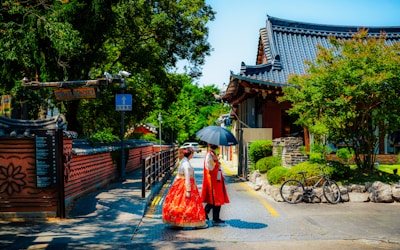
The Palaces and Jongmyo Go Free — and the Window Runs a Day Longer Than the Holiday
Four cycles running now, the scope has been identical: the four main palaces, Jongmyo Shrine, and the Joseon royal tombs open free of charge for the length of the holiday window.
| Cycle | Free-admission dates | Notice posted | Scope |
|---|---|---|---|
| 2024 Chuseok | Sept 14–18, 2024 | By Sept 10, 2024 | 4 palaces + Jongmyo + royal tombs |
| 2025 Chuseok | Oct 3–9, 2025 | Sept 23–24, 2025 | Same, with Changdeokgung’s Secret Garden named as excluded |
| 2026 Seollal | Feb 14–18, 2026 | Reported Feb 2, 2026 | 22 sites total |
| 2026 Chuseok | Sept 24–27, 2026 — four days | Sept 11–21, 2026, site by site | 4 palaces + Jongmyo + royal tombs; Secret Garden excluded |
The first version of this article gave a range rather than a date — roughly September 12 to 20 — and missed at both ends, for a reason worth knowing next year: the notices don’t land together. Deoksugung posted on the 11th, Jongmyo on the 16th, and Gyeongbokgung, Changdeokgung and Changgyeonggung all on the 21st, three days before the window opened. Watch only the Gyeongbokgung page and you are watching the slowest one.
The English-language picture has moved too. The Korea Times ran the announcement on September 18 (“Korea grants free entry to royal palaces, tombs during Chuseok”), and VisitKorea’s English site carries it. The gap this article originally pointed at — nobody in English has confirmed it yet — is closed. What has not closed is the fourth day: guides written before the notices landed are still built around a window ending Saturday the 26th.
Local tip — Check the date range, not just the word “free.” Several English guides still frame Chuseok in Seoul as a three-day window ending Saturday — insideseoul.app’s headline reads “What’s Open Sept 24–26” as of September 22, 2026. The palace notices run free admission through Sunday, September 27, a full fourth free day at all four palaces, Jongmyo and the royal tombs. The Royal Palaces and Tombs Centre’s notice board is where each site posts its own version, and each posts on its own schedule.
Jongmyo’s Free Admission Is a Two-Layer Change, Not One
Competing guides describe Jongmyo Shrine (종묘) as switching from “reservation required” to “walk in free” for Chuseok, as if the holiday unlocks a door that’s normally shut — travel-stained.com calls Jongmyo “normally strictly reservation-only for guided tours,” and insideseoul.app calls Chuseok “the one window in the year to wander it at your own pace.” That’s not quite what happens, and the mechanism only makes sense once you know Jongmyo’s rules for the rest of the year.
Jongmyo already runs a two-track system, confirmed on our own guide to its entry rules: Monday, Wednesday, Thursday and Friday require a scheduled, guide-led entry with no self-paced option — but Saturdays, Sundays, and any public holiday already switch to free, self-paced walk-through, for a ₩1,000 fee (as of 2026). Chuseok Day itself, Friday, September 25, would fall on a normal weekday guided-only slot in an ordinary week. And it isn’t only the middle day that qualifies: Korea’s public holiday regulation lists “the day before Chuseok, Chuseok, and the day after” as three separate statutory holidays (Article 2, item 9), and Sunday is a statutory holiday under the same article. September 24, 25, 26 and 27 are therefore all already in Jongmyo’s free-walk-through category under its standing rules — before Chuseok’s own special notice enters the picture at all.
Jongmyo’s 2026 notice, posted September 16 in Korean and English side by side, confirms exactly that narrow change: 「평소 시간제 관람으로 운영되던 종묘는 추석 연휴 동안 일반 관람으로 전환하여 운영합니다. (무료 입장)」 — timed entry switches to general self-guided entry, free — for September 24 through 27, 09:00 to 18:00 with last entry at 17:00. What it adds is narrower than “you can walk in now.” It waives the ₩1,000 fee that public-holiday visitors already pay every other public holiday of the year. The walk-in access isn’t new for Chuseok; the free part is.
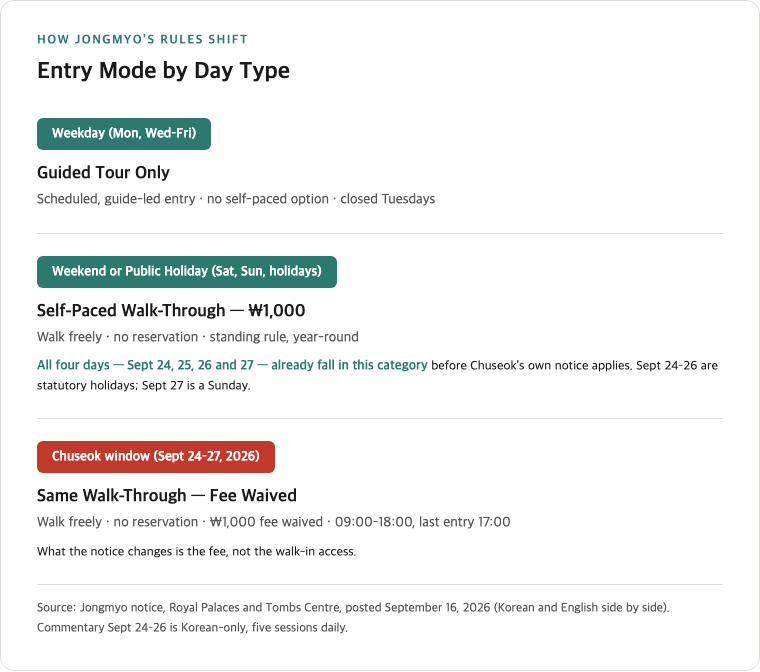
The notice adds one thing the fee argument doesn’t cover, and it cuts the other way: foreign-language commentary is off. From September 24 to 26 Jongmyo runs Korean-language sessions only, five times daily at 10:00, 11:00, 13:00, 14:00 and 15:00, and the English version of the notice says it in one line — “Sep 24 (Thu) ~ Sep 26 (Sat) Only Korean-language tours are available.” For September 27 the notice says commentary returns to 「정상 해설 운영」, normal operation.
Don’t read that as “English is back.” Jongmyo’s standing rules already make Saturdays and public holidays Korean-only year-round, and Sunday is normally listed as fully self-paced with no separate tour schedule at all — English, Japanese and Chinese commentary is a weekday fixture. So “normal” on a Sunday plausibly means no scheduled commentary rather than multilingual commentary, and the notice doesn’t say which. If hearing Jongmyo explained in English is the point, a scheduled weekday session outside the holiday is the reliable route.
Local tip — “Jongmyo requires reservations, except during Chuseok” is roughly how the English guides put it, and it implies the holiday itself unlocks self-paced entry. It doesn’t — any public holiday already does that, for a ₩1,000 fee. The 2026 notice drops the fee to zero. It’s a one-line distinction that only turns up if you’ve read Jongmyo’s day-by-day rules closely enough to see that public holidays were never guided-only to begin with.
The Exception: Changdeokgung’s Secret Garden Stays Out
Free admission has covered the four main palaces, Jongmyo, and the Joseon royal tombs for four cycles running — but Changdeokgung’s Secret Garden (후원, Huwon) has been excluded from it every single time.
The wording has not been consistent from year to year, which is what made this worth reading closely rather than assuming one year’s phrasing carries over:
- The 2024 notice excluded the Secret Garden outright — it simply wasn’t part of the free-admission scope.
- The 2025 Changdeokgung notice never states the admission scope at all. Read directly, it sets the free-opening window (October 3–9, 2025) and then handles guided commentary as a separate item — palace-hall narration suspended, Secret Garden narration running as normal. It says neither that the Secret Garden is included nor that it is excluded.
- The 2026 notice settles it in five words. Changdeokgung’s September 21 posting gives the scope as 「전각 무료개방, 후원 특별관람 제외」 — palace halls open free, Secret Garden special viewing excluded. It is named, and it is out.
Local tip — The English guides that flag this exclusion phrase it as a standing rule, which understates how much the notices move around: in 2025 the Changdeokgung notice didn’t state the Secret Garden’s admission scope at all, and in 2026 it names it as excluded in the scope line itself. What has stayed constant is the practical part — Huwon is a separate paid, timed, pre-booked ticket, and a free-admission window has never changed that.
The Reverse Case: Museums Close Exactly When the Palaces Open
Every free-admission change above moves in the same direction — sites that are normally paid or restricted become more open. The National Museum of Korea and the National Folk Museum move the opposite way, and they do it on the one day some English guides imply is when Seoul’s Chuseok museum activities are busiest.
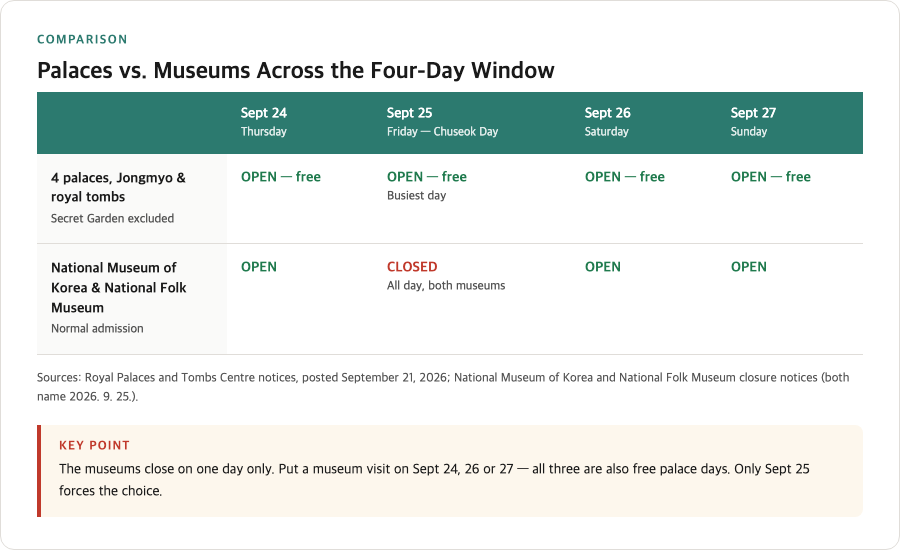
The National Museum of Korea closes completely on January 1, Seollal, and Chuseok Day itself — for 2026, that’s January 1, February 17, and September 25. Not the whole four-day window, just the single calendar day. The National Folk Museum (국립민속박물관) closes on the same dates at its main building, children’s museum, and Paju branch: all three close on September 25, 2026, alongside their standard closures on January 1, Seollal, and one scheduled maintenance closure on July 7.
The four days when the palaces are free bracket a single day — September 25 — when both museums are shut entirely.
The first version of this article couldn’t confirm the National Folk Museum’s Chuseok programming and guessed at the dates. The guess was wrong, so here is the museum’s own notice. The event is 「모두 함께 한가위」, and it runs Saturday and Sunday, September 26–27, 10:00–17:00 — not on the 24th, and not on Chuseok Day itself. It runs at both the Seoul main building in Samcheong-dong and the Paju branch, with roughly twenty programs across seasonal games (ssireum, traditional games, ganggangsullae), folk crafts and harvest activities, plus special performances. Everything is free, and no reservation is taken for any of it — each program is walk-up or open viewing.
One correction matters if you were planning around food: the songpyeon item is 「알록달록 비누송편」, a craft where you make soap shaped like songpyeon, capped at 300 people a day across two sessions (10:00–12:00 and 14:00–16:00). There is nothing to eat at the end of it. The “songpyeon-making” framing English sources use — and that this article repeated — is simply wrong. The original caution about venue confusion does stand, though: Namsangol Hanok Village runs its own seasonal programming, and English write-ups blur the two.
Local tip — Both museums are closed on September 25, 2026 — Chuseok Day itself, the second day of the four-day window when the palaces are free. Put a museum visit on the 24th, 26th or 27th, all three of which are also free palace days. Only the 25th forces the choice, and it’s the day the palaces are busiest.
Local tip — The National Folk Museum’s own English page will not tell you which day it is closed. The Korean page names the date — 「추석 당일(2026. 9. 25.)」 — and so does the Chinese page, 「闭馆日:2026年9月25日(周五)」. The English page says only “Chuseok (Korean Thanksgiving Day),” no date, which is useless to the exact reader it’s written for. It does carry one line the others don’t: “Guided tour in English is not available during the Chuseok Holidays (Harvest Festival). 2026. 9. 24.(THU) ~ 9. 27.(SUN).” So English commentary is off for the whole window — and the one date you need to plan around is on the Korean page instead.
Free Entry, No Explanation: The Guided Tours Mostly Shut Down
The notices carry a second instruction alongside the free admission, and the English coverage we opened doesn’t pick it up. Changgyeonggung’s posting says it in its title: 「9월 공휴일 및 추석 연휴기간 무료관람 및 정규해설 미운영 알림(9.24~9.27)」 — free admission and regular commentary suspended, in the same sentence. The palaces open their gates and turn off the guides. It isn’t uniform, though, and the differences are large enough to reshuffle an itinerary.
| Site | Regular guided tours, Sept 24–27, 2026 |
|---|---|
| Gyeongbokgung | No regular commentary for the whole window |
| Changgyeonggung | No regular commentary for the whole window |
| Changdeokgung | Palace-hall and in-depth tours suspended — but Secret Garden commentary runs normally |
| Deoksugung | Palace-hall tours run on the public-holiday schedule; Seokjojeon English commentary, walk-up, 11:50 and 14:50 |
| Jongmyo | Korean-only sessions, 5 daily, Sept 24–26; the notice says commentary returns to “normal” on Sept 27, but a normal Sunday at Jongmyo has no set tour schedule |
| National Folk Museum | English guided tours unavailable across the whole window |
Read as a group, it inverts the usual advice. Deoksugung is the palace that keeps English commentary running, and Changdeokgung’s Secret Garden — the one thing you still have to pay for — is also the one tour that doesn’t get cancelled. The free days are the walk-in days, not the explained ones.
One caveat on the table: the Centre’s master notice is posted as a scanned image rather than text, so these rows come from the individual site notices. We read the Gyeongbokgung and Jongmyo ones in full; the other three come from those notices’ posted text but not a full read of each attachment. Reconfirm session times on the day.
The Day After: Why 2026 Doesn’t Follow the Usual Pattern
One detail held across the three earlier cycles: the day immediately after the free-admission period ended, the palace sites closed completely — not a return to paid admission, but a full closure. In February 2026 the Seollal window ran the 14th to the 18th, and the 19th was a full closure day. The 2025 Changdeokgung notice gives the reason, citing the palace and royal tomb viewing regulation: the closure falls on the first non-holiday day after a public-holiday opening (공휴일 공개한 다음의 첫 번째 비공휴일).
That rule is narrower than it looks, and 2026 is the year that shows why. Its full wording is 「단, 정기휴일이 공휴일 및 대체공휴일과 겹칠 경우에는 개방하며, 그 다음의 첫 번째 비공휴일이 정기휴일임」 — if a site’s regular closing day collides with a public holiday, the site opens anyway and the closing day moves to the next non-holiday. The trigger is the collision. The palaces’ regular closing days are Monday (Changdeokgung, Deoksugung, Changgyeonggung, the royal tombs, Sungnyemun) and Tuesday (Gyeongbokgung, Jongmyo, Chilgung), and the 2026 window runs Thursday to Sunday. It contains neither. February’s Seollal window contained both, which is exactly why a closure got pushed to the 19th.
We are not putting a date on it ourselves. The four palace notices we read don’t mention closing days at all, and the reasoning above is our reading of the regulation rather than something any 2026 notice states. If your plan runs into the week after Chuseok, check the specific site’s page on royal.khs.go.kr before you go.
What Else Changes (and What’s Still Unclear)
A few more changes are confirmed, at least in part, and worth a shorter mention.
Gyeongbokgung’s night opening runs through the holiday — but its tickets for that window were already gone weeks out. The 2026 second-half night opening (야간관람) runs September 2 through October 2, 19:00–21:30, closed only Mondays and Tuesdays. All four dates in the free-admission window fall outside that weekly closure, so it’s scheduled to run normally through the holiday. According to a report dated August 31, 2026, tickets for the entire September 23–27 window were already sold out, with no additional release planned at that time. Visitors wearing hanbok enter free regardless of nationality, and 300 same-day tickets are set aside daily for foreign visitors. That sold-out figure is a single-source snapshot, not a live count — check Gyeongbokgung’s own ticketing page close to your travel date.
Large discount marts shift their mandatory closure day to land on Chuseok. E-Mart, Homeplus, and Lotte Mart typically close two Sundays a month under local ordinance. In September 2026 the first closure (Sept 9) stays put, but the second is reported to move from the 23rd to Chuseok Day itself, September 25. Costco closes on January 1, Seollal, and Chuseok as a standing company policy, regardless of the ordinance. Those closure days are set by district ordinance, so treat this as the general Seoul pattern rather than a guarantee for every store. Convenience store chains are unaffected by either rule.
Chilgung books differently if you hold a foreign passport. Chilgung (칠궁), the shrine compound attached to Gyeongbokgung, is visit-by-reservation only, and the Gyeongbokgung notice spells out a separate route for foreign visitors: 「칠궁 예약 시 외국인의 경우, 경복궁 안내실 유선전화(02-3700-3900)로 예약」 — no online booking, phone the Gyeongbokgung information office instead, giving passport number, nationality and name. The booking window runs from 10:00 nine days before your date to 17:00 three days before, and you bring the passport itself on the day for identity verification. Read only the English pages and you will find the reservation form, not the phone number.
Department store hours are not something we can confirm for 2026. Branches of Lotte, Shinsegae, and Hyundai have followed different patterns in past years, and there’s no citywide rule. The only branch-specific schedules we found were for 2025, and reusing those dates would be inaccurate. Check the individual store’s own holiday notice.
Getting to the Free-Admission Sites
None of these sites needs special holiday transit. A T-money card or a multi-day Climate Card covers fares exactly as it would on any other day, and the Seoul subway network reaches all four palaces and Jongmyo directly. Google Maps’ walking and transit directions are unreliable in Korea, so set up Naver Map or Kakao Map before you go, and keep Kakao T as a backup. If a meal stop falls through because a smaller restaurant is closed for the holiday, convenience store chains stay open regardless.
What You Need to Know
- Free admission runs four days, September 24–27, 2026 — one day longer than the statutory holiday. The notices were posted September 11–21 depending on the site. Guides that end the window on Saturday the 26th are a day short.
- The scope is the four main palaces, Jongmyo Shrine and the Joseon royal tombs — not Changdeokgung’s Secret Garden. The 2026 Changdeokgung notice names 후원 특별관람 as excluded. Book and pay for it separately.
- Jongmyo’s Chuseok change is a fee waiver, not new access. Public holidays already unlock ₩1,000 self-paced walk-through; the 2026 notice makes it free, 09:00–18:00 with last entry at 17:00.
- Regular guided commentary is suspended at most of the palaces for the whole window. Deoksugung keeps walk-up English commentary at Seokjojeon (11:50, 14:50) and Changdeokgung keeps Secret Garden commentary; Jongmyo runs Korean-only sessions Sept 24–26 and the National Folk Museum drops English tours for all four days.
- The National Museum of Korea and National Folk Museum close completely on Chuseok Day (Sept 25, 2026), not the whole window — both are open on Sept 24, 26 and 27.
- The National Folk Museum’s 「모두 함께 한가위」 runs Sept 26–27 only, 10:00–17:00, free and with no reservation. The songpyeon item is a soap-making craft, not rice-cake making.
- The post-window closure rule only fires when a site’s weekly closing day falls inside the holiday. This year’s window holds no Monday or Tuesday, so don’t assume the February pattern repeats — check the site’s own page.
- Gyeongbokgung’s night opening runs through the holiday, but its Sept 23–27 tickets were sold out as of August 31, 2026, and the large discount marts are reported to move their second September closure day onto Chuseok Day. Costco is closed that day regardless, on its own standing policy.
Practical Tips
- Plan for four free days, not three. September 24, 25, 26 and 27 are all inside the free-admission window at the four palaces, Jongmyo and the royal tombs. Sunday the 27th is the day most English itineraries leave out.
- Don’t put a museum visit on Chuseok Day itself. The National Museum of Korea and National Folk Museum are both closed September 25, 2026 — use the 24th, 26th or 27th instead. It’s those two specifically, not the whole museum category.
- If you want a guided visit, pick your palace accordingly. Deoksugung keeps walk-up English commentary at Seokjojeon (11:50 and 14:50) while Gyeongbokgung and Changgyeonggung run none at all for the whole window.
- Book Changdeokgung’s Secret Garden the normal way, even during free admission. The 2026 notice names it as excluded, and it’s been outside the free scope in every cycle so far.
- If Gyeongbokgung’s night opening matters to your trip, check ticket availability early. The September 23–27 window was already sold out as of late August in 2026; wearing hanbok gets you in free regardless of the timed-ticket situation.
- Don’t assume a full closure the day after the window ends. That rule only fires when a site’s weekly closing day falls inside the holiday, and this year’s window has no Monday or Tuesday in it. Check the individual site’s page before planning the following week.
- If a specific department store’s hours matter to your plan, check that store directly. There’s no single citywide rule, and last year’s dates don’t carry over.
Frequently Asked Questions
How many days are Seoul’s palaces free during Chuseok 2026?
Four: Thursday, September 24 through Sunday, September 27, 2026. That’s one day longer than the statutory holiday, which ends on the 26th, and the mismatch is why several English guides describe a three-day window. Free admission covers the four main palaces, Jongmyo Shrine and the Joseon royal tombs. The notices went up between September 11 and September 21, 2026, site by site, on the Royal Palaces and Tombs Centre’s board.
Is Jongmyo Shrine’s reservation system suspended during Chuseok?
Not exactly, and the more precise answer matters if you want to understand the rule rather than just follow it. Jongmyo already allows self-paced walk-through (for a ₩1,000 fee) on any public holiday, which every day of this window already is — so the reservation system was never really “on” for those days the way it is on an ordinary Monday, Wednesday, Thursday or Friday. What the 2026 notice adds is waiving that ₩1,000 fee, not unlocking access that wasn’t already there. Hours are 09:00–18:00, last entry 17:00.
Is Changdeokgung’s Secret Garden free during Chuseok too?
No. The 2026 Changdeokgung notice states the scope as 「전각 무료개방, 후원 특별관람 제외」 — palace halls free, Secret Garden special viewing excluded — and it has been outside the free scope in every earlier cycle as well. Book and pay for it separately, as a timed ticket, even during the window when the rest of Changdeokgung is free. Its guided commentary is one of the few that keeps running through the holiday.
Is the National Museum of Korea open during Chuseok?
On three of the four days, yes — but it’s closed completely on Chuseok Day itself. For 2026 that’s a closure specifically on September 25; the museum runs normal hours on September 24, 26 and 27. The National Folk Museum follows the same closure pattern. Note that the Folk Museum’s English page doesn’t give the date — only its Korean and Chinese pages name September 25 explicitly.
Are the palace guided tours running during Chuseok 2026?
Mostly not. Gyeongbokgung and Changgyeonggung suspend regular commentary for the whole September 24–27 window, Changdeokgung suspends its palace-hall and in-depth tours, Jongmyo runs Korean-only sessions from the 24th to the 26th, and the National Folk Museum drops English guided tours for all four days. Two exceptions are worth planning around: Changdeokgung’s Secret Garden commentary runs normally, and Deoksugung offers walk-up English commentary at Seokjojeon at 11:50 and 14:50. The free days are the walk-in days, not the explained ones.
Can I still book Gyeongbokgung’s night opening during Chuseok?
The night opening (2026 season: September 2–October 2) is scheduled to run on all four dates in the free-admission window, since none of them fall on the Monday or Tuesday closure days. As of an August 31, 2026 report, however, tickets for the September 23–27 window were already sold out with no additional release announced at that time. Visitors wearing hanbok enter free regardless of the ticket situation, and 300 same-day tickets are set aside daily specifically for foreign visitors.
Are grocery stores and marts closed on Chuseok Day in Seoul?
Large discount chains — E-Mart, Homeplus, Lotte Mart — are reported to shift their second mandatory closure day of September 2026 onto Chuseok Day (Sept 25) itself, under the local ordinance that already requires two closure Sundays a month. Costco closes on Chuseok as a standing company policy, separate from that ordinance. Coverage may vary somewhat by district, since mandatory closure days are set locally. Convenience store chains are unaffected by either rule and remain a reliable fallback.
Related Questions
- How to Visit Jongmyo Shrine: Entry Rules by Day and Language
- Gyeongbokgung Tickets in 2026: Free Days, Closures, and the Hanbok Rule
- National Museum of Korea: Free Entry, New 2026 Hours, and What to See First
- Changdeokgung Secret Garden: The Booking Rules English Guides Missed
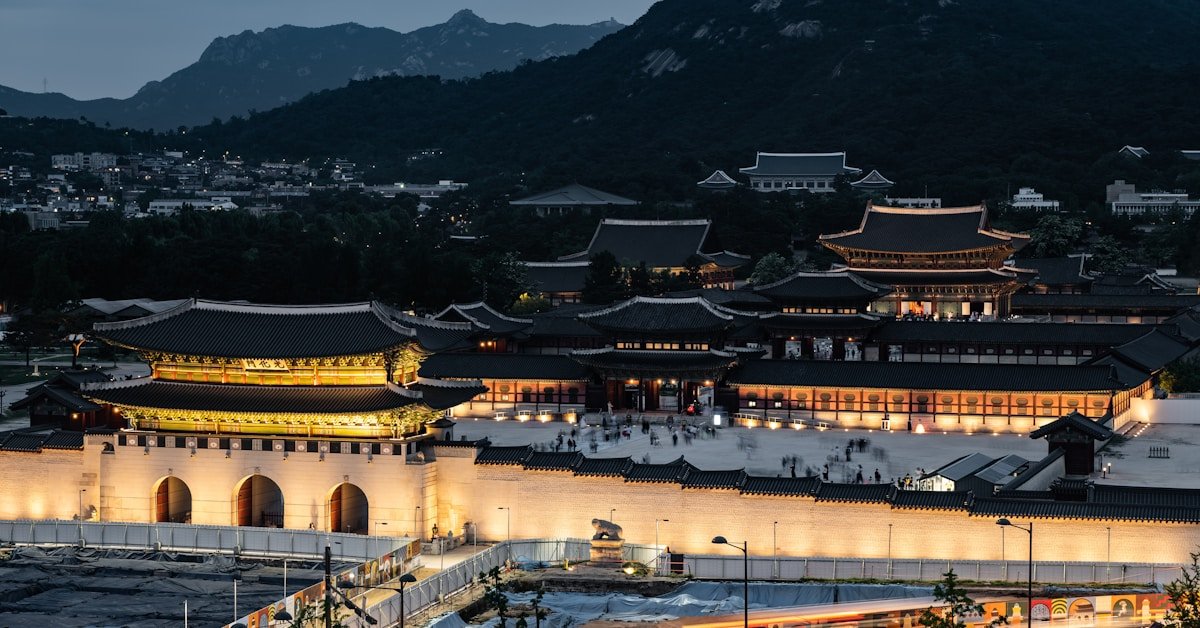
Featured image: Photo by Jin-Woo Lee on unsplash