How to Rent a Hanbok Near Gyeongbokgung — What Isn’t in the Price
Last updated on 21 August 2026
Quick Answer
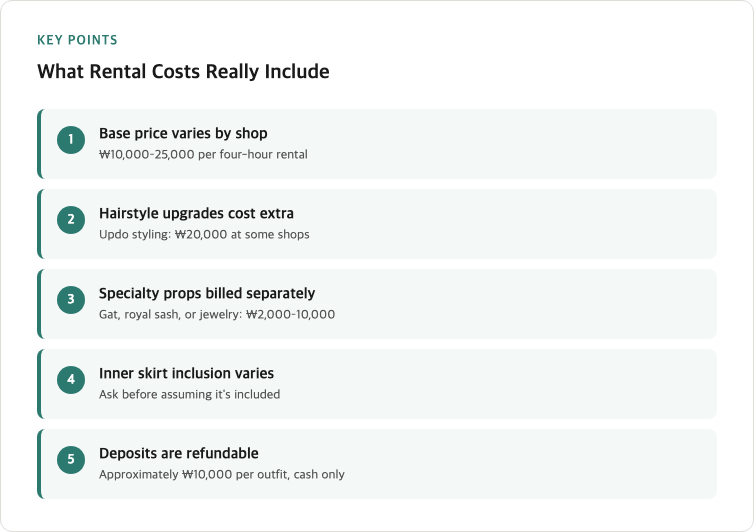
Hanbok rental (한복 대여) near Gyeongbokgung typically starts around ₩10,000–25,000 for a four-hour block (as of August 2026), but that rarely covers what you actually pay. None of five shops checked publishes an all-in price; at the three that itemise extras, an upgraded hairstyle, a specialty prop such as a gat (갓), and a second fitting are each billed on top. Booking through Klook can undercut the base price, but the same add-ons apply at the counter.
The Full Answer
The free-entry rule gets most of the attention: wear hanbok, skip the ₩3,000 Gyeongbokgung admission (as of 2026). That part is well covered, including the written dress-code test that decides whether a given outfit actually qualifies — the Gyeongbokgung ticket guide covers it in full and this article leans on that one rather than repeating it.
What English guides skip is what happens between paying the deposit and walking out the door with a hairstyle and props on top of the base outfit. Every rental shop advertises a base price. Almost none of the English write-ups ranking for hanbok rental searches put a number next to what gets added on top of it — they say “extras cost more” and stop there.
I checked five rental shops’ own price pages directly rather than relying on a summary of them — Seohwa Hanbok (서화한복), Ari Hanbok (아리한복), Gowoonsol Hanbok (고운솔한복), Queens Hanbok (퀸즈한복), and Hanboknam’s (한복남) Gyeongbokgung branch. All five were still listed on Naver Place when this was re-checked on 21 August 2026. All five also sit in the Gyeongbokgung Station cluster — no Bukchon-side shop is in this sample. What follows is what their own pages say, not a composite estimate.
What the Advertised Price Actually Covers
Five Shops Near Gyeongbokgung Station, Compared
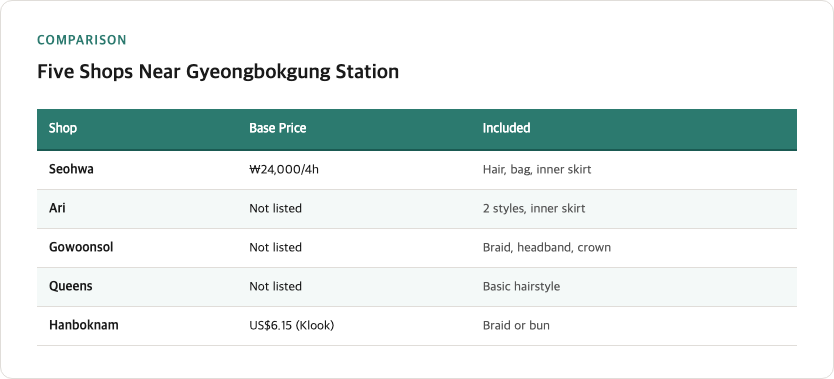
The base price differs shop to shop, and so does what it includes. Reading each shop’s own rate page directly rather than a secondhand list produced this (all figures as published in August 2026):
| Shop | Base price (sample) | Included in base price | Billed separately (confirmed) |
|---|---|---|---|
| Seohwa Hanbok | ₩24,000 / 4h | Hair accessories, bag, inner skirt | Specialty props (gat, royal sash, gisaeng headpiece) ₩4,000; extra fitting ₩5,000 each; late return ₩10,000 |
| Ari Hanbok | — | Two basic hairstyle options, inner skirt | Updo styling ₩20,000; men’s gat ₩2,000; winter vest or traditional shoes ₩5,000; extra sash or layered skirt ₩10,000; extra fitting ₩10,000 |
| Gowoonsol Hanbok | — | Braided hair, headband, flower crown (hwagwan) | Other styling not itemized on the shop’s page — ask in person |
| Queens Hanbok | — | Basic hairstyling | Item-level pricing not published — ask in person |
| Hanboknam (Gyeongbokgung branch) | from US$6.15 (Klook) | Basic hair (braid or bun) | Hair accessories, bag, shoes; upgraded hairstyling; photography or makeup (by reservation) |
The One Pattern That Holds — and What Nobody Publishes
None of the five publish an all-in figure that covers a styled look with props. What the itemised ones agree on, independently, is which categories get billed on top:
Local tip — English guides agree that extras cost more, but none of the ones ranking today put a number next to it. Reading five working rental shops’ own rate pages near Gyeongbokgung Station directly: not one publishes a total for a styled look, and at the three that itemise extras at all — Seohwa, Ari and Hanboknam — an upgraded hairstyle, a specialty prop like a gat or a royal sash, and a second fitting are each billed on top. The other two publish only what the base includes, which says the same thing less usefully: you can’t price a full look from a shop page before you walk in.
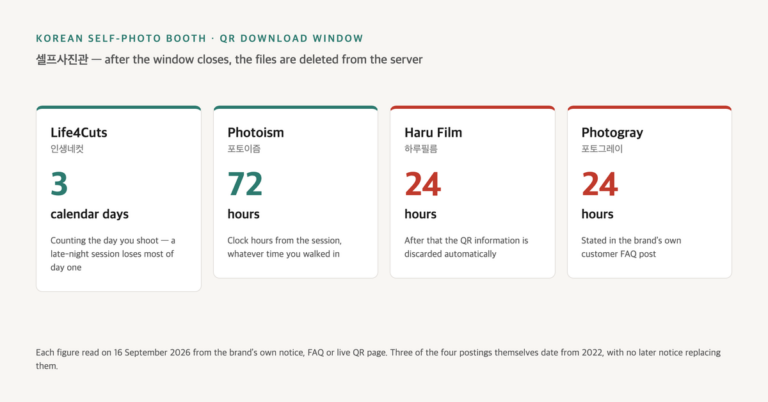
An updo (올림머리) at Ari Hanbok alone costs ₩20,000 — close to the full base rental at some shops. If the plan is a specific hairstyle for photos, price that separately before assuming it’s bundled in. If the photos carry on afterwards at one of the self-photo studios around the station, the strip you walk out with comes with a QR code that expires — how long each Korean photo booth brand keeps your files gives the window brand by brand.
What’s Inconsistent — the Inner Skirt
The one item that doesn’t follow a shared pattern is the inner skirt (속치마). Seohwa and Ari both build it into the base price; the other three shops’ pages don’t say either way. Treat “does the base price include an inner skirt” as a question to ask at the counter, not an assumption either direction.
Deposits: Cash Per Outfit, Refunded at Return
Deposits aren’t new information — English write-ups already mention them — but they’re worth stating plainly since they change what to bring. The common pattern across shop pages is a cash deposit of approximately ₩10,000 per outfit, refunded when the outfit is returned undamaged. Some shops are described as taking a passport alongside that smaller deposit, or roughly ₩50,000 in cash from anyone who would rather not hand over a passport — reported across several shop write-ups rather than confirmed at all five, so treat it as a policy to ask about, not a rule. Either way, whether to leave a travel document at a rental counter is your call rather than the shop’s — see the note on passports as ID in Korea if that gives you pause. Most transactions at these shops run on cash rather than card, so carrying some won either way is worth it.
Is Booking Online (Klook) Actually Cheaper?
What Hanboknam’s Klook Listing Shows
I opened Hanboknam’s Klook listing on 20 August 2026 and confirmed the starting price shown was US$6.15 — roughly ₩8,500 at that day’s rate — for a rental at the same shop’s Gyeongbokgung branch. That sits below the range English write-ups and Korean listings quote for walk-in four-hour rentals nearby, approximately ₩10,000–25,000. That range is compiled from published figures rather than a survey of every shop, and only one of the five shops here publishes a four-hour base rate on its own page (Seohwa, at ₩24,000).
Why “Book Ahead to Avoid Fees” Is the Wrong Conclusion
It would be easy to read that gap and conclude that reserving through a platform like Klook is the way to avoid the extra-fee structure altogether. It isn’t. Hanboknam’s own Klook listing states plainly that hair accessories, bags, and shoes are billed separately, and that upgraded hairstyling is a separate charge — the same categories the other itemised shop pages charge for. The base outfit may cost less through a booking platform. The add-on structure doesn’t change because you booked ahead.
Local tip — No English guide ranking for hanbok pricing searches actually compares a platform listing against a shop’s own walk-in price — they either list on-site prices or promote booking platforms, not both side by side. Doing that comparison directly: the base price can be lower through Klook, but the same extras — hairstyle upgrades, accessories, props — are billed on top either way. “Book ahead to skip the hidden fees” doesn’t hold up; “book ahead if you just want the cheaper base outfit” does.
When Reserving Ahead Still Makes Sense
Reserving ahead is still useful for a different reason than price: it locks in a pickup time on a day when a specific shop might be busy, and it avoids negotiating in a second language at the counter. Just don’t expect it to solve the add-on pricing. Klook listings, like walk-in prices, are subject to seasonal promotions — the US$6.15 figure was what showed on the date checked, not a fixed rate.
A Second Platform, Same Add-On Pattern
Hanboknam’s Klook listing isn’t the only place this shows up. GetYourGuide’s Seoul hanbok listing, run by a different operator — Daehan Hanbok (대한한복), rated 4.6 from 955 reviews as of September 2026 — splits its package the same way: hanbok rental, underskirt, handbag, hairband, and lockers in the base price, while hairstyling, a petticoat, and accessories are add-ons “available for purchase onsite.” I read the option list directly: the two columns are separated only by icon colour — green against orange — with no text label between them, easy to skim past. Same categories, billed separately at the counter regardless of platform.
What the Listing’s Title Doesn’t Match
The listing’s title is “Seoul: Hanbok Rental with Gyeongbokgung Palace Entry,” but palace entry isn’t in the included list — it isn’t a ticket. The description explains why: entry to Gyeongbokgung and several other palaces “is free to visitors wearing a Hanbok.” That “entry” is the wear-it-and-walk-in exemption set out in the Korea Heritage Service guideline — checked directly, and covered in full in the next section — not something the rental adds on top. The platform names five qualifying palaces; only the Gyeongbokgung exemption is confirmed here, so treat the wider count as the seller’s claim, not a checked fact. A listing titled “Palace Entry” doesn’t make an outfit compliant on its own — that still comes down to the two-piece test below.
Local tip — No English write-up on hanbok booking platforms flags that “with Palace Entry” describes a dress-code exemption, not an included ticket. The product page’s own included-versus-excluded split shows the same fee categories — hair, accessories, upgrades — billed on top regardless of platform, wrapped in a title borrowing the free-entry rule to sound like a bundled admission ticket.
Will Your Rental Qualify for Free Palace Entry?
The Two-Piece Test, in Short
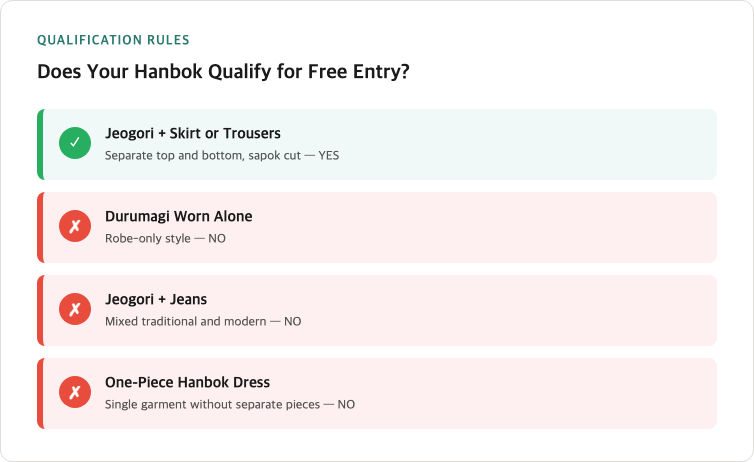
Wearing hanbok gets you into Gyeongbokgung for free instead of paying the ₩3,000 admission (as of 2026) — but only if the outfit passes a written test. The Korea Heritage Service’s hanbok guideline, read directly, requires a separate top and bottom: a jeogori (저고리) with a wrap-over collar, worn with a skirt or trousers cut in the traditional sapok (사폭) style. Both traditional hanbok and modern “living hanbok” (생활한복) styles qualify, and nationality doesn’t matter — the guideline’s own Q&A confirms foreign visitors are treated the same as Korean visitors for this exemption.
| Outfit | Free admission? |
|---|---|
| Jeogori (any tie or knot style) + chima (skirt) or baji (trousers) in sapok cut | Yes |
| Durumagi (두루마기, outer robe) worn on its own | No |
| Jeogori worn over jeans | No |
| Hanbok bottom paired with a T-shirt | No |
Why This Is a Rental Decision, Not a Palace One
The failures above aren’t hypothetical categories — they’re written into the guideline itself as examples of what doesn’t qualify. A rental shop’s cheapest or most photogenic package isn’t automatically compliant, and the decision gets made when you pay for the outfit, not at Heungnyemun Gate where staff check it. If a robe-only style or a one-piece dress cut is what you want, budget for it as a photo outfit rather than a free-entry one.
The complete rulebook — how staff apply it, what counts as acceptable exposure, and how the exemption reads at the evening sessions — is covered in the Gyeongbokgung ticket and hanbok guide, and this article won’t repeat it. The point here is narrower: the shop you rent from decides whether the outfit you walk out in clears the gate for free.
Renting for the 2026 Autumn Night Opening
Key Dates, and the Booking Window That Opens 26 August 2026
I read the Royal Palaces and Tombs Bureau’s notice of 18 August 2026 on the autumn night opening directly. The 2026 second-half night session runs 2 September to 2 October 2026, closed Mondays and Tuesdays, 19:00–21:30 with last admission at 20:30, at ₩3,000 per ticket (as of 2026). Online booking runs from 10:00 on 26 August 2026 to 23:59 on 1 October 2026. This is one dated session rather than a standing feature — after 2 October 2026 the next run is announced separately on the bureau’s notice board, so check there rather than assuming these dates repeat.
Daily attendance is capped at 3,300: 3,000 tickets sold online, up to four per person, plus 300 held back for foreign visitors and sold on the day at the palace, two per person, on production of a passport or other proof of foreign nationality. The notice sets the number but does not name a window, so ask at the ticket office on arrival. The two pools are separate, and how they work is covered in the Gyeongbokgung ticket guide.
Hanbok Wearers Skip the Ticket Pool Entirely
Free admission at the night opening has no attendance cap at all, and hanbok wearers are on that free list alongside children six and under and adults 65 and over. No reservation is needed for the free category — staff check eligibility at Heungnyemun Gate the same way they do during the day. If you’re already renting a compliant outfit for the daytime exemption, the same outfit gets you into an evening session without booking anything. The catch is the two-piece guideline above, and the notice states it in the same breath: an outfit that fails the hanbok guideline is refused entry, whatever the time of day.
Local tip — The rental-focused English write-ups that rank for hanbok searches — Klook’s own product page, Creatrip, the established English blogs — describe the night opening as a ticket you buy, and none of them mention that a qualifying hanbok bypasses the ticket altogether. The bureau’s 18 August 2026 notice puts it in one line: free admission has no entry limit, free categories don’t pre-book, and hanbok that doesn’t meet the guideline is turned away at the gate. For anyone renting an outfit anyway, an evening session costs nothing and needs no booking — and the pages selling the rental don’t say so.
Gyeongbokgung Station or Bukchon — Does Where You Rent Change the Price?
Walking Distance, as Best as It Can Be Measured
I tried Google Maps for a walking route between Gyeongbokgung Station and the palace gate and it returned a message that walking directions aren’t available for that search in Korea — the service only offers transit routing there, which is one of several reasons Naver Map or Kakao Map work better once you’re actually navigating on the ground. Six shops (Ari, Byeolgungteo, Haewaldal, Queens, Seohwa, and Hanboknam) each state on their own pages that they’re a one- to two-minute walk from Gyeongbokgung Station’s Exit 3, 3-1, or 4, reached via the Seoul subway. Straight-line distance calculations put the Gyeongbokgung Station shop cluster at roughly 465 metres from Heungnyemun Gate, against roughly 782 metres from Anguk Station, the stop closer to the Bukchon Hanok Village cluster — roughly 1.7 times further in a straight line. These are approximations, not routed walking times, since no walking-directions tool for the area was accessible during this check.
Does the Bukchon Side Cost More? This Check Can’t Say
The five shops priced above are all in the Gyeongbokgung Station cluster, and no Bukchon or Anguk-side rate page was read for this comparison — so which cluster is cheaper is a question this article can’t answer, and putting a number on it would mean inventing one. What the five do show is that price and location come apart inside a single block: all five are one to two minutes from the same station exits, and their advertised starting points still range from a US$6.15 Klook listing to ₩24,000 for four hours on a shop’s own page. Within that cluster, distance to the palace isn’t what sets the price.
What You Need to Know
-
The advertised base price is a starting point, not the total. None of the five shops checked publishes an all-in figure, and at the three that itemise extras, upgraded hairstyles, specialty props, and extra fittings are each billed on top.
-
The inner skirt is the one inconsistent item. Two of five shops build it into the base price; the rest don’t specify either way — ask before you assume.
-
Booking through Klook can lower the base price, but not the add-on structure. Hanboknam’s own listing states hair accessories, bags, shoes, and hairstyle upgrades are billed separately, same as walk-in shops.
-
Not every hanbok qualifies for free palace entry. The outfit needs a separate top and bottom that meets the written guideline — see the full guideline breakdown before you assume any rental gets you in free.
-
The 2026 autumn night opening runs 2 September–2 October 2026, with online booking opening at 10:00 on 26 August 2026. A same-day foreign-visitor quota of 300 tickets exists even if online sells out; the notice doesn’t name a window, so ask at the ticket office.
-
Deposits are typically cash, around ₩10,000 per outfit, refunded on return — bring cash rather than assuming a card works at the counter.
-
None of this moves the needle much on a trip budget. A rental and its extras are small change against the rest of a week in Korea — see the full cost breakdown for where the money actually goes.
Practical Tips
-
Ask what’s included before you choose a package, not after you’ve paid. Whether the inner skirt is bundled in varies by shop, and it wasn’t listed consistently on any comparison found in English.
-
Price any hairstyle upgrade separately if it matters to you. An updo alone ran ₩20,000 at one shop checked — close to a full base rental elsewhere.
-
Bring cash for the deposit. The common pattern across shop pages is approximately ₩10,000 per outfit in cash, refunded when you return the outfit.
-
Check your outfit against the free-admission test before you pay for it. A jeogori with a separate skirt or trousers passes; a robe worn alone or a one-piece hanbok dress does not. Ask the shop to show you the top and bottom separately before you commit.
-
Compare a shop’s own price page against its Klook listing before assuming walk-in is cheaper. The gap can run in either direction, and it changes with season and promotion.
-
If you want the autumn night opening, book online before 23:59 on 1 October 2026, or bring a passport and ask about the same-day foreign-visitor allocation on arrival. The online pool and the foreign on-site pool are separate — one selling out doesn’t affect the other.
-
Don’t assume the shop nearest the gate is the cheapest, or the priciest. The five shops checked are all one to two minutes from the same station exits and their advertised starting prices still differ widely. Bukchon-side pricing wasn’t part of this check.
Frequently Asked Questions
How much does it cost to rent hanbok at Gyeongbokgung Palace?
Approximately ₩10,000–25,000 for a four-hour rental at shops near the palace (as of August 2026), a range compiled from published shop and platform listings rather than a survey of every shop. That range covers only the base outfit — at the three shops that publish item-level pricing, hairstyle upgrades, specialty props, and extra fittings are billed on top; the other two don’t itemise them either way. Klook’s listing for one shop’s Gyeongbokgung branch showed a starting price of US$6.15 on the date checked, below the general on-site range.
Is Gyeongbokgung Palace free with hanbok?
Yes, but only if the outfit meets a written guideline: a separate top and bottom, with a jeogori that has a wrap-over collar and a skirt or trousers cut in the sapok style. A robe worn alone, a one-piece hanbok dress, or a hanbok bottom paired with regular clothing doesn’t qualify. The full guideline covers the exceptions in more detail.
What’s included in the hanbok rental price, and what costs extra?
It varies by shop, and the honest answer is that none of the five checked publishes a total for a finished look. At the three that itemise their extras, an upgraded hairstyle (such as an updo), a specialty prop (a gat or a royal sash, for example), and an extra fitting are each billed on top; the other two publish only what the base includes. Whether the base price includes an inner skirt differs too — two of five build it in, the rest don’t specify.
Is booking a hanbok rental online (Klook, etc.) cheaper than walking in?
It can be for the base outfit — one shop’s Klook listing showed a lower starting price than the general walk-in range at comparable shops. It doesn’t remove the extra-fee structure, though. The same platform listing states that accessories, bags, shoes, and hairstyle upgrades are billed separately, matching what walk-in shops charge for the same items.
Do I need to leave my passport as a deposit?
Not necessarily. The common pattern across shop pages is a cash deposit of approximately ₩10,000 per outfit, refunded when you return the outfit undamaged. Some shops are reported to take a passport alongside that smaller deposit, or roughly ₩50,000 in cash from anyone who would rather not leave a passport — that was described in several write-ups rather than confirmed at every shop checked, so ask before you choose a shop. Whether to leave a travel document at a rental counter is your call, and bringing enough cash removes the question.
Can I wear hanbok into the Gyeongbokgung night opening without a ticket?
Yes, if the outfit meets the same two-piece guideline as daytime entry. Free-admission categories, hanbok wearers included, have no attendance cap at the night opening and don’t need a reservation — eligibility is checked at Heungnyemun Gate. The 2026 autumn session runs 2 September to 2 October, with online booking for paid tickets opening 26 August 2026.
Is it cheaper to rent hanbok near Gyeongbokgung Station or in Bukchon?
This check can’t settle it. The five shops whose prices were read directly are all in the Gyeongbokgung Station cluster, and no Bukchon-side rate page was included, so any claim either way would be guesswork. What the station cluster does show is that advertised prices vary widely between shops standing one to two minutes from the same exits, so proximity alone doesn’t predict cost. On distance: straight-line measurements put the station cluster roughly 465 metres from Heungnyemun Gate against roughly 782 metres from Anguk Station, the stop nearer Bukchon — approximations rather than routed walking times.
Related Questions
- Gyeongbokgung Tickets in 2026: Free Days, Closures, and the Hanbok Rule
- Changdeokgung Secret Garden: The Booking Rules English Guides Missed
- Cash or Card in Korea? The Apps That Won’t Take Your Foreign Card
- Korean Folk Village Tickets for Foreigners: Rate, Discounts, and Getting There
Featured image: Photo by Daniel Bernard on Unsplash