Busan Markets: Which Days Jagalchi, Gukje and Bupyeong Are Closed
Updated for August 2026
Quick Answer
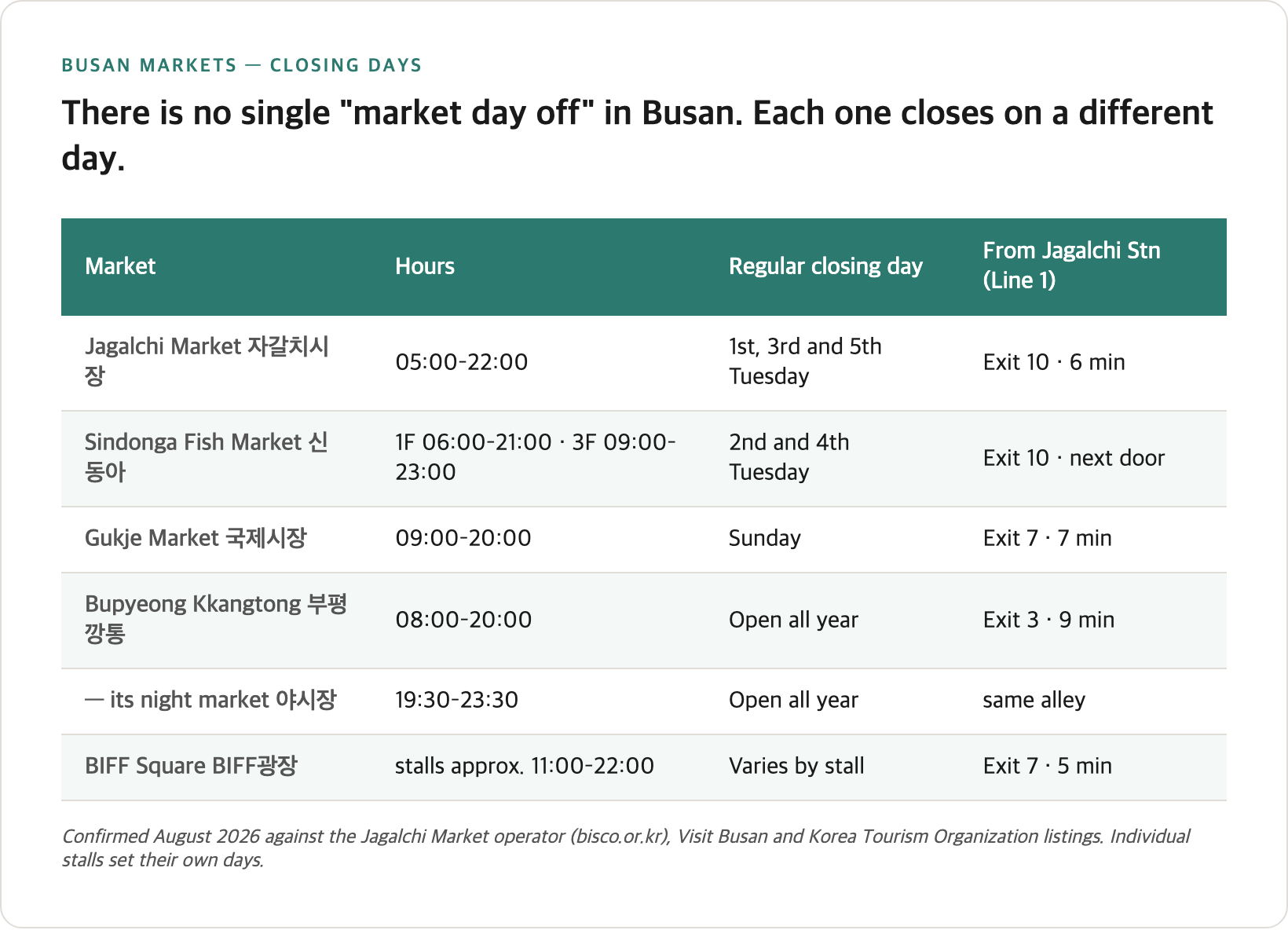
Busan’s three big markets sit within a ten-minute walk of each other in Nampo-dong, and none of them closes on the same day. Jagalchi Market shuts on the 1st, 3rd and 5th Tuesdays and otherwise runs 05:00–22:00. Gukje Market’s listed closing day is Sunday, 09:00–20:00. Bupyeong Kkangtong stays open all year, with its night market from 19:30.
The Full Answer
English-language guides are, to their credit, good about Jagalchi’s closing days. Six of the seven Jagalchi guides I read state them outright. What none of them does is tell you the one thing that makes those closing days actionable: Jagalchi is not the only fish market on that street, and the market next door closes on the opposite Tuesdays.
I checked the Jagalchi market operator’s own site in August 2026 rather than relying on secondary listings. Its floor guide gives the closing days for the ground-floor seafood market as the 1st, 3rd and 5th Tuesdays — a slightly longer list than the “1st and 3rd” that circulates in English, which matters in months with five Tuesdays. I then pulled the Korea Tourism Organization’s listing for Sindonga Fish Market, the separate fish market a few doors along the same street, and its closing days are the 2nd and 4th Tuesdays. The two buildings alternate. Nobody arranged that for tourists, but the effect is that there is no Tuesday when the whole Jagalchi waterfront is shut — only ever one of the two, and knowing which one turns a wasted trip into a five-minute walk.
The other scheduling trap is a different day entirely. Almost every guide tells you to do the Nampo-dong markets as one outing, which is sound advice — they genuinely are minutes apart — but it quietly assumes they keep the same calendar. They do not. Turn up on a Sunday and Jagalchi is fine while Gukje is the one with a closing day.
The rest of this guide is the operating layer: hours, closing days, the two-part structure of the Bupyeong alley, and the three separate charges that make up a meal at Jagalchi. If you are still working out where to base yourself, where to stay in Busan covers the neighbourhood trade-offs, and Busan’s main attractions covers what else is within reach of the same subway line.
| Market | Hours | Closed |
|---|---|---|
| Jagalchi (indoor, ground floor) | 05:00–22:00 | 1st, 3rd and 5th Tuesday |
| Sindonga (ground floor) | 06:00–21:00 | 2nd and 4th Tuesday |
| Sindonga (raw-fish floor, level 3) | 09:00–23:00 | 2nd and 4th Tuesday |
| Gukje | 09:00–20:00 | Sunday (see the reconciliation below) |
| Bupyeong Kkangtong (day market) | roughly 08:00–20:00 | Open all year |
| Bupyeong Kkangtong (night market) | 19:30–23:30 | — |
Verified against each operator’s own Korean-language listing in August 2026. Outdoor stalls at Jagalchi are individual traders who set their own days.
The Tuesday Problem: Two Fish Markets, Alternating Days
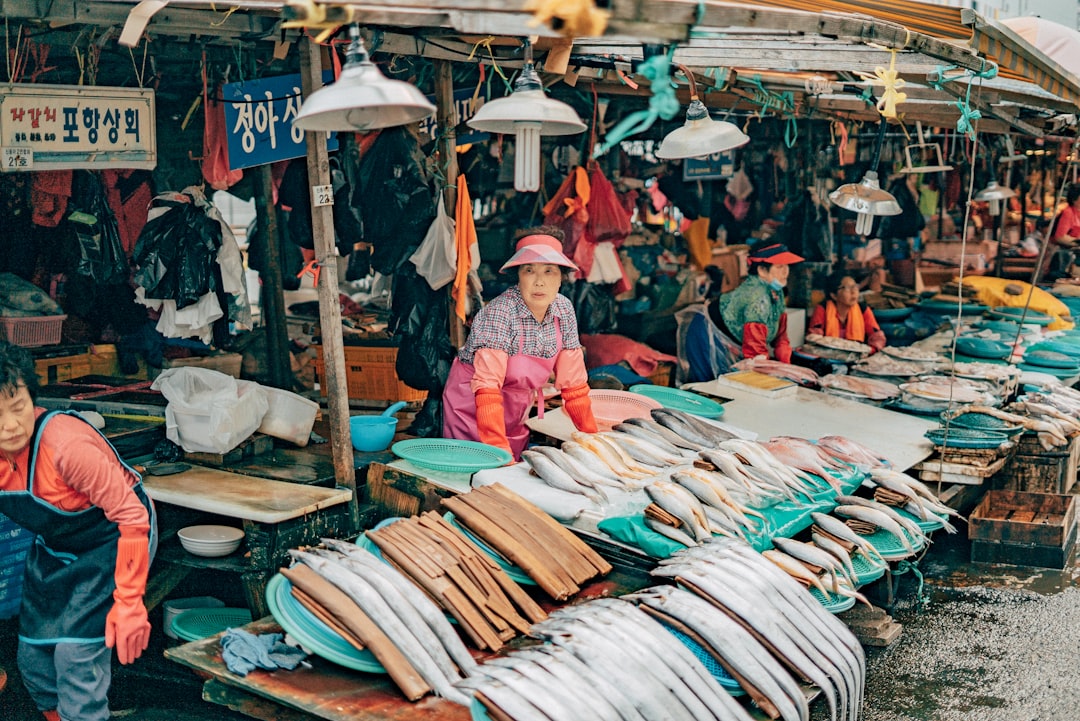
What people call “Jagalchi” is not one building. It is an outdoor market along the waterfront, a modern indoor market run by the city facilities corporation, and a separate fish market called Sindonga a short walk along the same street. They keep different schedules.
Jagalchi Market (자갈치시장) is the indoor building at 52 Jagalchi-haean-ro, opened in August 2006 after a two-year-eight-month rebuild. It runs from basement level two up to the seventh floor, and only the lower floors are a market at all — the ground floor is the seafood market, the second floor is the raw-fish restaurant centre and dried seafood, and the floors above that are a youth centre and a small-business support office. Hours are 05:00–22:00, and the ground floor closes the 1st, 3rd and 5th Tuesdays.
Sindonga Fish Market (신동아수산물종합시장) is at 42 Jagalchi-ro. Its floors are stacked the same way and its hours differ by level: the ground floor of live fish and shellfish runs 06:00–21:00, the dried-seafood floor above it 09:00–21:00, and the raw-fish restaurant floor on level three runs latest at 09:00–23:00, with a food court in the basement. It closes the 2nd and 4th Tuesdays.
Local tip — on any Tuesday, one of the two fish markets is open. Not one of the seventeen English-language pages I read distinguishes the two buildings at all; they treat “Jagalchi” as a single market, which is why the closing days they correctly publish still leave you stuck. Jagalchi’s ground floor closes the 1st, 3rd and 5th Tuesdays (the operator’s own listing, slightly longer than the “1st and 3rd” usually repeated). Sindonga closes the 2nd and 4th. So: 1st, 3rd or 5th Tuesday, walk to Sindonga. 2nd or 4th, walk to Jagalchi. The doors are a few minutes apart on the same waterfront.
The outdoor stalls along the water are a different matter again. They are individual traders rather than a managed building, they set their own days, and they are the part of Jagalchi that most photographs are actually of. On an indoor closing day the outdoor rows are usually still trading, just thinner.
Local tip — the market runs on two clocks, and the early one is not for you. You will see both 02:00 and 05:00 quoted as Jagalchi’s opening time, and the discrepancy is not an error in either. The retail hall you can walk into opens at 05:00 — that is the figure the operator and Busan’s tourism listings both give. The much earlier hours belong to the wholesale side of the fish trade, which is a separate operation from the retail market with its own buyers, its own building and its own schedule. Every English guide I read gives 05:00 without explaining that a second, earlier market exists at all, which is why “Jagalchi opens at 2am, go before dawn” keeps circulating as advice. Turning up at 03:00 expecting a market experience gets you a closed retail hall and a trade floor you have no business on.
Gukje Closes on Sunday — the Opposite Day
Gukje Market (국제시장) is the sprawling general-goods market a seven-minute walk inland, at 32 Junggu-ro. It is not a food market in the way the other two are; it is hardware alleys, hanbok alleys, bedding alleys, toys, tools and imported oddities, connected by the covered footbridges that link the buildings above the lanes. Listed hours are 09:00–20:00.
Its closing day is where the sources part company, and it is worth being straight about that rather than picking one. Busan’s own English tourism listing gives the closing day as “Sunday”, flat, and the Korea Tourism Organization’s Korean listing says the same. Korean secondary sources — including the Korean Wikipedia entry, last edited in January 2026 — instead give 09:30–19:30, closed the 1st and 3rd Sundays. Both cite the same merchants’ association contact number.
Local tip — Gukje’s closing day is Sunday, and the two versions you will see are not in conflict about that. Of the English pages I read, exactly one mentions a Gukje closure, and it manages to publish both versions without reconciling them — “closed Sunday” in the body, and “closed the 1st and 3rd Sundays” for the food alley, with nothing to tell you which applies to you. Here is the reconciliation. The merchants’ association calendar is the source of both, and the difference is whether you read it as every Sunday or the two designated ones. Either way the planning rule is identical: Sunday is Gukje’s bad day and a perfectly good day for Jagalchi, and Tuesday is the reverse. If Gukje is the reason you are going, do not make it a Sunday. If you have no choice, expect a thinned-out market rather than a locked one — individual traders set their own days.
The practical consequence for a one-day Nampo-dong plan is simple. Wednesday to Saturday gets you everything. Sunday gets you Jagalchi, BIFF Square and Bupyeong at full strength and Gukje at reduced strength. Tuesday gets you one of the two fish markets plus everything else.
Bupyeong Kkangtong Is Two Markets in the Same Alley
Bupyeong Kkangtong Market (부평깡통시장) sits between the other two, nine minutes from Jagalchi Station, and it is the one people get the timing wrong on most often — because it is genuinely two different markets sharing one alley.
By day it is a covered food market running roughly 08:00–20:00: fish cake stalls, side dishes, dried goods, imported groceries, the tteokbokki and fried-tofu shops it is known for. It is open all year.
In the evening the daytime market winds down and the alley changes function. Cart stalls are wheeled in and set up along about 110 metres of the lane, and the night market runs 19:30–23:30. Korea’s first permanent night market opened here in October 2013, and the mix is unusual for Korea — alongside the Korean-food carts there are stalls run by vendors selling Turkish, Vietnamese, Japanese and Filipino food, plus clothing and accessory sellers.
Local tip — the carts arrive at 19:30, and that start time moved. Korean-language sources note that the night market used to begin around 18:00 and now starts at 19:30. Turn up at six expecting the night market and you will find a daytime food market packing up. Turn up at eight and it is the thing you came for. Busan’s own English listing compounds the confusion by publishing “Every day 19:30–24:00” as the market’s hours outright, which reads as though the market does not exist during the day — it does, from 08:00, it is just a different market.
BIFF Square (BIFF광장) is the pedestrian block between Gukje and the waterfront, five minutes from Jagalchi Station Exit 7. Its street-food stalls run roughly 11:00–22:00 and vary stall by stall, which is a way of saying that arriving before late morning gets you an empty square. The seed-filled hotteok the square is known for runs around ₩2,000 (as of 2026).
How Eating at Jagalchi Actually Bills You
The system everyone describes is real: you buy live seafood from a ground-floor stall, and the stallholder walks you up to a restaurant on the floor above, where it is prepared and served. What English guides get wrong is not the system. It is the money.
Search for the cost and you get numbers that contradict each other by a factor of two to four — ₩5,000 on one page, ₩10,000 on another, ₩25,000 on a third. A couple of pages do split the charge into two lines. But none of them names the components, and none says whether the figure is per person, per table or per kilo, which is the information you would need to check the bill against it. The reason the numbers disagree is that each page is quoting a different part of a bill that has three.
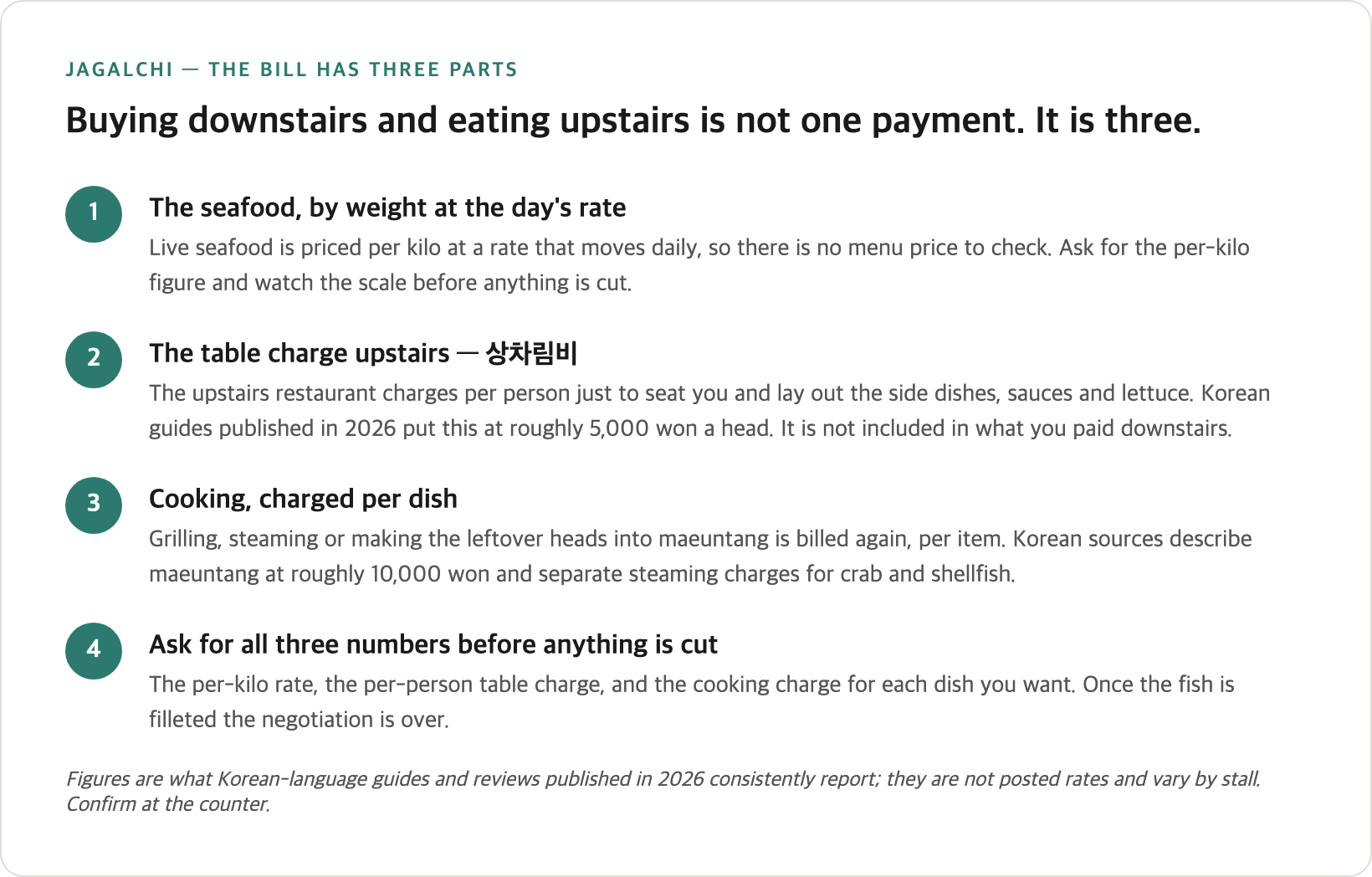
I read the Korean-language guides published in 2026 that break it down, and the structure they describe consistently is this. First, the seafood itself, priced by weight at the day’s rate — there is no fixed menu price, which is exactly why it is the part you have to pin down before anything is cut. Second, a table charge (상차림비) billed per person upstairs, just for seating you and laying out the sauces, side dishes and lettuce; Korean sources put this at roughly ₩5,000 a head (as of 2026). Third, cooking billed per dish — turning the leftover heads and bones into maeuntang runs around ₩10,000, and steaming crab or shellfish is charged separately again.
Local tip — the upstairs bill is a per-person charge plus a per-item charge, and no English page names either one. The figures published in English are not wrong so much as unattributed: none of the pages I read uses the Korean terms, and none states the unit. That is what makes them impossible to check on the spot. The two charges have names — 상차림비 (sangcharimbi), the per-person table charge, and the 조리비 (jori-bi) or 찜비 charged per dish cooked — and asking for them by name is the difference between a quote and a guess. Ask for three numbers before anything is filleted: the price per kilo, the per-person 상차림비, and the cooking charge for each dish you want. None of these are posted rates and all vary by stall. Korean guides add a useful filter for choosing a stall in the first place: pick the ones with the day’s rates written up on a whiteboard or LED board (“광어 1kg ○○○원”) over the ones that quote a number only after you ask.
Two smaller practicalities. Stalls will generally work to a budget if you name one first — telling them what you want to spend and letting them assemble it is normal practice, not a faux pas. And if you would rather not deal with any of this, the raw-fish restaurant floors at both buildings sell set plates at posted prices.
If you would rather have a local guide do the ordering, a guided Gukje-to-Jagalchi food tour ends with a sit-down seafood meal at Jagalchi, with one drink included.
Money, Cards and What Things Cost
Market stalls in Korea skew heavily toward cash, and Busan’s traditional markets are no exception — the fixed shops and restaurant floors take cards routinely, the outdoor traders and cart stalls often prefer not to. Bring notes. If you need to withdraw, which Korean ATMs actually take foreign cards is worth reading before you rely on the nearest machine, and cash or card in Korea covers where each one works.
You will also see 온누리상품권 (Onnuri gift certificate) signage everywhere in these markets, along with QR payment stickers. These are a domestic subsidy scheme — vouchers sold at a discount to encourage spending in traditional markets — and the digital versions require Korean identity verification to load. They are not something a short-term visitor needs to solve. Cash and a card cover everything.
For rough budgeting, market street food sits at the cheap end of a Korea trip: hotteok and fish cake are in the low thousands of won, a night-market plate is usually under ₩10,000, and a shared seafood meal at Jagalchi is the one line item that can run away from you if you skip the three questions above. What a week in Korea actually costs puts those numbers in context.
If you buy something substantial in the Gukje shopping alleys, note that market stalls are generally not tax-refund affiliated — the VAT refund system works at registered stores, not traditional-market traders.
Overcharging complaints in Busan are handled through the Korea Tourism Organization’s 1330 helpline, which operates in English and routes complaints to the relevant local authority. Busan has also been running a QR-code reporting system for overcharging, though that scheme has been aimed at accommodation rather than markets.
Getting There
All of the Nampo-dong markets are on Busan Metro Line 1, and one of the stations is named after the market.
- Jagalchi Market — Jagalchi Station Exit 10, about 6 minutes on foot. Nampo Station Exit 2 works too.
- Gukje Market — Jagalchi Station Exit 7, about 7 minutes.
- Bupyeong Kkangtong Market — Jagalchi Station Exit 3, about 9 minutes.
- BIFF Square — Jagalchi Station Exit 7, about 5 minutes.
I checked these exits against the Busan Metro Line 1 station listings in August 2026. You do not need a taxi to reach any of them, and you do not need one to move between them either — the walk from Jagalchi to Bupyeong takes about the same time as waiting for a bus. Your T-money card works on Busan Metro exactly as it does in Seoul, and getting around Korea covers the intercity side if you are arriving from elsewhere. Coming from Seoul, booking KTX puts you at Busan Station, three stops from Jagalchi on the same line.
Driving is the one bad option. The Jagalchi building’s car park holds 121 spaces, runs 24 hours, and charges ₩700 per 10 minutes for a small car with a ₩21,000 day pass (as of 2026) — which is both expensive and, on a weekend, full.
One navigation note: Google Maps is unreliable for walking directions in Korea, and market alleys are exactly where it fails worst. Korean map apps will route you through the arcades correctly.
The Markets Beyond Nampo-dong
Two more Busan markets are worth knowing about, and neither is in the old-town cluster.
Gupo Market (구포시장) in the north of the city is a hybrid — a permanent market that also hosts a periodic country market on dates ending in 3 and 8 (the 3rd, 8th, 13th, 18th, 23rd and 28th). On those days it roughly doubles in size and turns into the kind of open-air produce market that has largely disappeared from Korean cities. General hours are 08:00–20:00; closing days are set by individual traders. It is at Deokcheon Station, Exits 1 and 3 — a transfer point between Lines 2 and 3, not a detour if you are already heading that way.
Gijang Market (기장시장) is out east near the coast, in Gijang-eup. It began as a five-day periodic market in 1944 and became permanent in the 1960s, so unlike Gupo there is no date cycle to work around — the Korea Tourism Organization lists it as open year-round, 07:00–22:00. Some Korean listings give it a closing day on the last Tuesday of the month and an earlier 20:00 finish; I could not settle which is current, so treat a last-Tuesday visit as the one worth phoning ahead about (051-721-3963). What makes it worth the trip is seasonal rather than daily: it is a seaweed and anchovy market in spring and a hairtail market in autumn, and it is close enough to the coastal attractions that it pairs naturally with a beach day.
If you are combining Busan with a trip across the strait, the ferry terminal is a short ride from Nampo-dong — see the Busan to Fukuoka ferry for schedules and check-in cut-offs.
What You Need to Know
-
Jagalchi closes the 1st, 3rd and 5th Tuesdays. Not just the 1st and 3rd. Hours are 05:00–22:00.
-
Sindonga Fish Market next door closes the 2nd and 4th Tuesdays. The two alternate, so one is always open.
-
The retail hall opens at 05:00, not 02:00. The earlier figure belongs to the wholesale trade, which is a different operation.
-
Gukje’s closing day is Sunday. Some Korean sources narrow this to the 1st and 3rd Sundays; either way Sunday is the risk day.
-
Bupyeong Kkangtong is open all year — daytime market 08:00–20:00, night market 19:30–23:30 in the same alley.
-
The Jagalchi upstairs bill has three parts — seafood by weight, a per-person table charge, and per-dish cooking charges.
-
All four sites are on Busan Metro Line 1, within a 5–9 minute walk of Jagalchi Station. You do not need a taxi.
-
Carry cash. Fixed shops take cards; outdoor traders and cart stalls frequently do not.
Practical Tips
-
Check which Tuesday it is before you go. 1st, 3rd or 5th, walk to Sindonga. 2nd or 4th, walk to Jagalchi.
-
Do not put Gukje on a Sunday. It is the one market in the cluster with a Sunday closing day.
-
Ask for three prices at Jagalchi — per kilo, per-person table charge, and cooking charge per dish — before anything is cut.
-
Choose the stalls with rates posted on a board. Korean guides use this as the basic filter, and it removes the negotiation entirely.
-
Arrive at Bupyeong after 19:30 for the night market, or between 08:00 and 20:00 for the daytime one. They are not the same market.
-
Come to BIFF Square after late morning. The stalls run roughly 11:00–22:00 and the square is empty before that.
-
Walk between the markets. Jagalchi to Gukje to Bupyeong is under fifteen minutes end to end, and driving means a full car park.
Frequently Asked Questions
When is Jagalchi Market closed?
The ground-floor seafood market closes on the 1st, 3rd and 5th Tuesdays of each month, according to the market operator’s own listing. The version usually repeated in English is “the 1st and 3rd,” which leaves out the extra closed Tuesday in months that have five. Outside those days it runs 05:00–22:00. The outdoor stalls along the waterfront are individual traders who set their own days and often trade through the indoor closures.
Does Jagalchi really open at 2am?
The retail market opens at 05:00 — that is the figure the operator and Busan’s tourism listings both publish. The 02:00 that circulates describes the wholesale side of the fish trade, which runs on a separate schedule in a separate operation and is not somewhere a visitor can browse. If you want the market at its most active, early morning after 05:00 is the answer, not the middle of the night.
Is anything open at Jagalchi on a closing Tuesday?
Yes. Sindonga Fish Market, a few minutes along the same street at 42 Jagalchi-ro, closes on the 2nd and 4th Tuesdays instead — the opposite pattern. So on any given Tuesday one of the two indoor fish markets is trading. Sindonga’s ground floor runs 06:00–21:00 and its raw-fish restaurant floor on level three runs until 23:00.
Is Gukje Market open on Sunday?
Sunday is Gukje’s closing day. Busan’s official tourism listing and the Korea Tourism Organization both give it flatly as “Sunday,” while some Korean sources narrow it to the 1st and 3rd Sundays. Both readings come from the same merchants’ association calendar, and both point to the same planning rule: avoid Sunday if Gukje is what you came for. If you cannot avoid it, expect a thinned-out market rather than a locked one, since individual traders set their own schedules.
What time does the Bupyeong Kkangtong night market start?
19:30, running to about 23:30. Korean sources note the start time used to be around 18:00 and moved later, which is why some guides still say six o’clock. The daytime market in the same alley is a separate thing and runs roughly 08:00–20:00.
How much does it cost to eat the seafood you buy at Jagalchi?
There are three charges, not one. The seafood is priced by weight at the day’s rate, the upstairs restaurant adds a per-person table charge that Korean sources put at roughly ₩5,000 (as of 2026), and cooking is billed per dish on top — maeuntang around ₩10,000, with steaming charged separately. None of these are posted rates, so ask for all three figures before anything is prepared.
Do I need cash at Busan’s markets?
Bring some. The fixed shops and the restaurant floors take cards routinely, but outdoor traders and night-market cart stalls frequently prefer cash. The Onnuri gift certificates advertised throughout these markets are a domestic subsidy scheme requiring Korean identity verification and are not practical for short-term visitors.
Are the Nampo-dong markets on the subway?
Yes. All of them are within a 5–9 minute walk of Jagalchi Station on Busan Metro Line 1 — Jagalchi Market from Exit 10, Gukje and BIFF Square from Exit 7, Bupyeong Kkangtong from Exit 3. Nampo Station on the same line is an alternative for Jagalchi. No taxi is needed to reach them or to move between them.
Related Questions
- Where to Stay in Busan: The Subway Access Nobody Warns You About
- Busan Attractions: What Is Actually Open Right Now
- Busan Beaches: Opening Dates and Swimming Hours
Featured image: Photo by Daniel Bernard on Unsplash