KBO Stadium Rules: Bags, Alcohol, and Food Explained by Stadium
Last Updated on August 13, 2026
Quick Answer
Outside food is allowed at every KBO (한국야구위원회) stadium checked for this guide, but the details are set club by club, not league-wide. The league’s own safety policy caps bags at 45cm×45cm×20cm plus one 30×50×12cm shopping bag — yet Gwangju’s Champions Field posts smaller numbers on its own site. It sets no alcohol strength limit at all, while Gocheok Sky Dome allows up to 6% ABV and KT Wiz Park up to 8%. Check your stadium before you pack.
The Full Answer
Most English-language guides to KBO stadiums describe one set of rules and apply it to every ballpark — outside food is fine, no glass, no hard liquor, done. The Korea Times came closer than most in a March 2026 piece, noting in passing that stadium rules vary, but stopped short of saying how. That gap is what this guide is for. It assumes the basics are already covered — our guide to going to a KBO game handles start times, tickets and rain refunds, while this one is only about what gets through the gate. Broader expectations around drinking in Korea don’t automatically carry over once you’re past a stadium gate; the stadium sets its own line.
The KBO’s national policy document, published as part of its “SAFE Campaign” safety guidelines, sets the league-wide baseline: bag sizes, sealed-container allowances, and a long list of restricted items that has nothing to do with food or drink at all. On top of that, individual stadiums — and in some cases the clubs that play in them — layer their own rules, and the league document says so itself. Three stadiums (Gocheok Sky Dome, KT Wiz Park, and Champions Field) publish those extra rules on their own official sites, and this guide checked each one directly rather than relying on someone else’s summary. If you’re still deciding which ballpark to go to, our comparison of all ten KBO stadiums covers city, ticket vendor, price range and transit access for each.
Four stadiums remain unconfirmed here — SSG Landers Field (Incheon), NC Park (Changwon), Hanwha Eagles Park (Daejeon), and Sajik Stadium (Busan). That is not for lack of trying: SSG’s rules pages returned 404s and its ticketing subdomain blocked access, NC’s information page redirected to a ticket login, Hanwha’s facilities tab showed only a seating diagram, and Lotte’s site refused access on every attempt. Rather than guess, this guide marks them unconfirmed and points you to where the answer lives.
The Rules That Apply Everywhere
Before getting into what differs by stadium, here’s what the KBO’s central “SAFE Campaign” safety policy sets as the floor for all nine stadiums (as of August 2026):
- Bags. One personal bag up to 45cm×45cm×20cm, plus one shopping-style bag up to 30cm×50cm×12cm (handles included). Oversized bags may be refused at the gate.
- Drink containers. Glass bottles of any kind, PET over 1 liter in total, and canned drinks are restricted — with an exception for unopened containers, up to one PET bottle plus two cans per person. Note that this is a rule about containers, not about alcohol content: the league text sets no ABV limit anywhere.
- Concession alcohol. Drinks sold inside the stadium are capped at 2 liters per person per game, and the policy states that sales may be suspended after the bottom of the eighth inning.
- Food. Anything not on the banned-items list is generally fine — but the policy adds that food judged likely to disturb others, specifically hot broth-type dishes and strong-smelling food, may be refused at the gate. That caveat is league-wide, not a Champions Field invention.
- Restricted: knives and scissors, cooking equipment, noise-making cheering gear, anything that could be thrown, laser pointers, pets, frozen water bottles, mats, folding chairs, portable tables, and boxes or coolers. The league notes that some clubs allow mats or chairs in specific areas such as lawn seating, so this list is a default rather than an absolute.
Almost none of this — beyond the bag dimensions, which one English blog (Extra Innings Travel) gets right — shows up in existing English-language guides. Cooking equipment, frozen water bottles, and folding chairs are restricted at every KBO stadium, and no tourist-facing summary mentions any of the three.
Local tip — The clearest statement that KBO rules are not uniform comes from the KBO itself. Its SAFE Campaign FAQ asks “Do the same rules apply at every stadium?” and answers that club-by-club exceptions exist — the league calls its document a minimum standard, says individual stadiums may operate flexibly around it, and asks fans to check the relevant club’s homepage before visiting. Every English guide checked for this article presents KBO entry rules as one fixed list. The league’s own text says the opposite.
Where the Official Numbers Diverge: Alcohol Strength
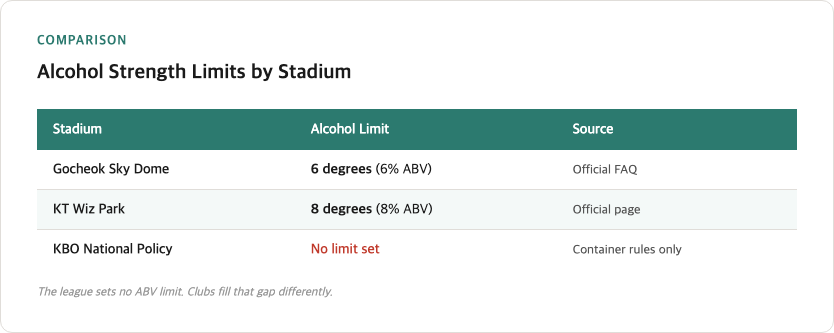
This is the strongest evidence that “KBO stadium rules” isn’t one rulebook. The KBO’s national safety policy regulates containers — no glass, no PET over a litre, cans only if sealed and within the one-PET-plus-two-cans allowance. It never sets a strength limit. Individual clubs fill that gap, and they don’t fill it with the same number.
Local tip — I opened Gocheok Sky Dome’s official FAQ on the Seoul Facilities Corporation site directly (sisul.or.kr) — for baseball games it permits outside food, drinks in PET containers of 1 litre or less, and alcohol up to 6 degrees (6% ABV), while banning anything in glass. I then checked KT Wiz Park’s official entry page (ktwiz.co.kr), where the same category of information is rendered as an image rather than selectable text, and it gives a different number under the same “KBO SAFE Campaign” heading: sealed 500mL cans or PET containing drinks up to 8 degrees, with anything over 8 degrees and all glass bottles refused. Most English guides quote one percentage as if it applied everywhere, and several state flatly that outside alcohol is banned. Neither is right: the league sets no strength number, and the two stadiums that publish one publish different ones.
One line in the KBO document is worth flagging, because it is the likely source of the “no alcohol at KBO games” claim in some English guides: the policy does state that Major League Baseball bans all outside alcohol — but that sentence sits in a section comparing overseas leagues, not in the rules for Korean stadiums.
Champions Field’s own FAQ, by contrast, doesn’t set an independent alcohol number at all — it repeats the KBO’s national wording almost word for word, with no ABV figure mentioned. So of the three stadiums with confirmed official rules, one sets a 6-degree cap, one sets 8, and one simply mirrors the league text. As of August 2026, nothing found for this guide reconciles them, and the honest answer for the remaining six stadiums is that their alcohol policy has not been independently confirmed — several Korean blogs from 2025 claim “5% or under” is the nationwide norm, but that figure traces back to no official source for any specific stadium.
One caveat worth stating plainly: the Gocheok FAQ entry carrying the 6-degree figure is dated December 2016. It is still what the stadium operator publishes today and nothing more recent contradicts it, but it is an old posting rather than a fresh notice — one more reason to confirm if you’re carrying something borderline.
If you’re bringing a can of Korean beer or makgeolli from a nearby convenience store, check the label’s ABV against the specific stadium you’re headed to rather than assuming a blanket rule. If you’re also picking up anju (안주, drinking snacks) to go with it, note that concession alcohol sales may be cut off after the bottom of the eighth inning under the league policy — and buying at the counter still requires meeting Korea’s legal drinking age, which is based on Korean age rather than your passport age.
Bag Size Isn’t National Either: Champions Field Runs Smaller
The bag dimensions above are the ones the KBO publishes centrally, and KT Wiz Park’s own page repeats them exactly. Champions Field in Gwangju does not.
Local tip — KIA Tigers’ official FAQ page (tigers.co.kr, under “경기장 이용”) sets its own, smaller numbers: one bag up to 40cm×35cm(height)×20cm, and one shopping bag up to 30cm×35cm(height, handles included)×12cm. Both run smaller than the national standard of 45×45×20 and 30×50×12 — 10cm shorter in the case of the shopping bag, which is the dimension most likely to catch out a tote. Champions Field also publishes a separate cooler allowance: up to 40×35×30cm, one per person.
The cooler rule needs care, because the club’s own answer says two things that don’t quite line up. The main sentence caps you at two items total across bag, shopping bag and cooler. The parenthetical immediately after it is stricter: if you bring a cooler, no other bag or shopping bag may be brought in at all. Both sentences sit in the same answer. Until the club clarifies it, the safe reading is the stricter one — if you’re bringing a cooler to Champions Field, plan on the cooler being the only thing you carry through the gate.
None of this shows up in the English-language sources checked for this guide. A bag that clears security at Jamsil is not guaranteed to clear it at Champions Field, and the gap is large enough to matter when a gate staffer is holding a tape measure.
What Champions Field Specifically Bans
Outside food is allowed at Champions Field in principle, the same as everywhere else. The league’s own policy already warns that strong-smelling and broth-heavy food can be turned away anywhere. What makes Champions Field different is that it stops describing a category and starts naming dishes.
Local tip — I opened KIA Tigers’ official FAQ and expanded the accordion items under “경기장 이용” by hand rather than trusting a cached summary. The banned-food answer names makgeolli (막걸리), hongeo (홍어, skate — raw or seasoned), mala tang (마라탕), and mala xiang guo (마라샹궈) specifically, describing them as strong-smelling enough to bother the people around you. Packet and cup ramyeon and canned foods — anything carrying broth — are also restricted, as are oily stir-fried noodle dishes. Fruit is allowed only if it’s already sliced before you arrive. The same answer lists what is allowed and no English guide mentions: baby bottles, milk and juice in paper cartons, and medication all pass, regardless of the drink-container rules.
“Outside food is allowed” is the sentence every tourist-facing summary uses, and at Champions Field it’s technically true but incomplete.
Gocheok’s Re-Entry Catch
Gocheok Sky Dome’s food policy has one more layer that doesn’t show up anywhere in English.
Local tip — Gocheok’s own FAQ states that for professional baseball games, food, drinks in PET containers of 1 litre or less, and alcohol up to 6 degrees are permitted, and anything in glass is not — then adds, in the same answer, that under Kiwoom Heroes’ own club rule food cannot be brought in on re-entry. If you step out of the dome mid-game and come back later, the food-allowed rule that applied when you first walked in no longer applies the second time.
This has been a point of confusion for years: a 2016 fan-board thread refers to a news report that Gocheok was then considering banning outside food entirely. That proposal never became the rule — the present FAQ clearly allows outside food on first entry. The re-entry restriction is the piece that survived, and the piece no English source mentions.
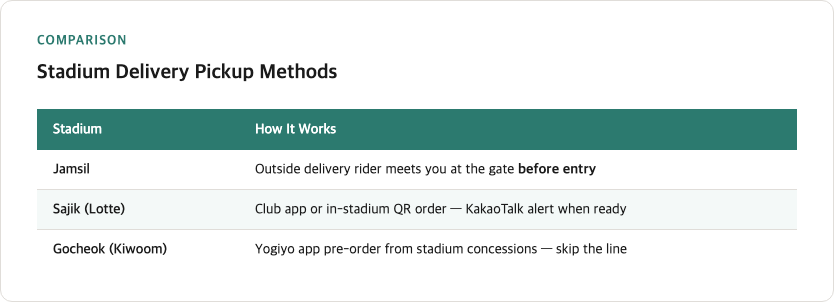
Getting Delivery Food to Your Seat — Three Different Systems
“You can get food delivered to a KBO stadium” is technically one sentence that covers three different systems, and treating them as interchangeable will send you to the wrong place at the wrong time.
- Jamsil (LG Twins, Doosan Bears): An outside delivery rider — from an app like Baedal Minjok or Coupang Eats — brings your order to a designated spot outside the stadium, not inside it. You have to step out to meet the rider before entering, since riders cannot bring food through the gates. Korean sources disagree on the exact gate (some say the main entrance, others the parking-lot entrance), so treat “somewhere outside the gates” as the honest answer rather than a specific number. Most visitors arrive at Jamsil by subway rather than by car, so plan to meet your rider on foot near whichever gate you entered through, not at a car park.
- Sajik (Lotte Giants): This isn’t an outside delivery order at all. You order stadium concession food through the Lotte Giants’ own app or an in-stadium QR code, then get a KakaoTalk notification when it’s ready for pickup near your seat.
- Gocheok (Kiwoom Heroes): Food is ordered in advance through the Yogiyo app for pickup from the stadium’s own concession stands, letting you skip the line rather than wait to order in person. This came out of a Kiwoom–Yogiyo partnership announced for the 2026 season, reported by Star News in March 2026 — worth confirming it’s still running if you’re reading this in a later season.
English guides that mention delivery at all describe one uniform “food delivered to a pickup area near the gate” process. It isn’t that. Jamsil involves meeting someone from outside the stadium; Sajik and Gocheok both involve ordering from the stadium’s own kitchen through an app and picking it up once you’re already inside. And none of it covers what happens after the final out — concession alcohol can be cut off after the eighth inning, so if the plan is to keep drinking, a nearby pojangmacha (포장마차, street tent bar) is the separate scene to know about.
If you would rather not sort out food and drink rules on your own at Jamsil, a Jamsil game ticket with a pre-game K-BBQ or fried chicken dinner bundles the match ticket, the meal and one beer or soft drink.
Lockers, Storage, and Reusable Cups
Storage options are inconsistent enough that “check for lockers” isn’t a safe assumption at every park.
At Samsung Lions Park in Daegu, storage is paid, not free — the club’s official “GO! Rapark” page lists four-hour rates of ₩2,000, ₩3,000, and ₩5,000 by locker size (as of August 2026), plus ₩1,000 per hour past four hours. Lockers sit beside the central ticket office (A and B) and at the Legend Road parking entrance (C), and the club recommends keeping valuables on you. Gocheok has no stadium-run equivalent; Korean fan posts point to a private smart-locker service nearby, which is community sourcing rather than an official page — treat it as a lead to check.
Local tip — Reusable-cup adoption is one more thing that varies by a lot more than most guides suggest. A survey by the Korea Federation for Environmental Movements (환경운동연합), reported by Kyunghyang Shinmun on June 15, 2026, covered 350 concession stands across all nine KBO stadiums. Reusable-container adoption ranged from 50.0% of stands at Incheon’s SSG Landers Field down to 2.4% at Daegu’s Samsung Lions Park — better than a twentyfold gap by our own arithmetic. Across all nine stadiums, exactly one stand had stopped handing out single-use containers entirely, leaving 99.7% still using them. Sajik and Samsung Lions Park had no stadium-level container return system at all.
Jamsil’s own numbers illustrate why the gap matters. A Hankook Ilbo investigation published May 30, 2026, working from KBO waste figures obtained through a National Assembly member’s office, found Jamsil’s general waste rose from 214 tonnes in 2023 to 498 tonnes in 2025 — a 132% jump — while regular-season attendance rose about 37% over the same period. A companion piece in the same series recorded return bins sitting closed during a game while fans wandered looking for one. None of this appears in the English sources checked for this guide.
Separately, a July 2026 regulatory change matters if you’re planning what to eat. The Korea Herald reported that the Ministry of Food and Drug Safety and the government’s regulatory-reform body would let roaming vendors sell prepared food — hot dogs, churros, fried chicken — directly to spectators in the stands, previously a gray zone for anything beyond beer. Rather than rewriting the law, they reinterpreted the existing Food Sanitation Act. Korea JoongAng Daily reported the same day that items with uncooked ingredients — gimbap, boxed meals, sandwiches — are excluded as spoilage risks in summer heat. Both pieces describe the change as coming rather than already in force, so don’t count on vendors in the aisles yet.
Stadium-by-Stadium Comparison
The table below separates what’s confirmed from official sources against what remains unverified. Where a cell says “unconfirmed,” that reflects a real gap in this research, not an assumption that nothing applies — the national KBO baseline above still applies as a default at every park.
| Stadium | Outside Food | Alcohol | Bag Size | Storage | Delivery Pickup | Reusable Cups |
|---|---|---|---|---|---|---|
| Jamsil (Seoul, LG/Doosan) | Allowed | Blogs report roughly 5% ABV cans/PET; not confirmed on an official page | National standard | Reported to exist, exact location unconfirmed | Outside rider meets you before entry | 34.7% |
| Gocheok Sky Dome (Seoul, Kiwoom) | Allowed, blocked on re-entry | 6 degrees confirmed (operator FAQ, posted 2016) | National standard | Private lockers nearby (community sources, unofficial) | Yogiyo app pre-order pickup | 29.3% |
| Champions Field (Gwangju, KIA) | Allowed, specific foods banned by name (makgeolli, hongeo, mala tang, mala xiang guo) | Follows national wording, no separate ABV set | Smaller than national standard (40×35×20cm bag) | Unconfirmed | Unconfirmed | 9.7% |
| KT Wiz Park (Suwon, KT) | Unconfirmed in detail | 8 degrees confirmed (official page) | Matches national standard | Unconfirmed | Unconfirmed | 38.2% |
| Samsung Lions Park (Daegu) | Unconfirmed in detail | Unconfirmed | National standard assumed | Paid, ₩2,000–5,000/4hr | Unconfirmed | 2.4% (lowest of 9) |
| Sajik Stadium (Busan, Lotte) | Reported allowed (multiple sources, no official page confirmed) | Unconfirmed | National standard assumed | Unconfirmed | Club app/QR order, KakaoTalk pickup alert | 13.0% |
| SSG Landers Field (Incheon) | Unconfirmed | Unconfirmed | National standard assumed | Unconfirmed | Unconfirmed | 50.0% (highest of 9) |
| NC Park (Changwon) | Unconfirmed | Unconfirmed | National standard assumed | Unconfirmed | Unconfirmed | Included in national survey, individual figure not published |
| Hanwha Eagles Park (Daejeon) | Unconfirmed | Unconfirmed | National standard assumed | Unconfirmed | Unconfirmed | Included in national survey, individual figure not published |
For any stadium marked “unconfirmed” above, the practical move is the one the league itself recommends: assume the KBO national baseline applies, then confirm specifics — especially alcohol strength — on the club’s own site or app before you pack anything borderline. The four clubs whose rules we could not confirm publish at ssglanders.com, ncdinos.com, hanwhaeagles.co.kr and giantsclub.com; their notice boards and mobile apps are the fastest route to a current answer. For Sajik specifically, our guide to the Lotte Giants at Sajik Stadium covers what that club does publish. Be aware that several of these sites route entry information through their own ticketing systems, which is precisely why we could not read them without an account — expect to do some clicking.
What You Need to Know
- Rules are set per club, not per league. That isn’t our inference — the KBO’s own FAQ says club-level exceptions exist and tells fans to check the specific club before visiting. Everything below follows from that one fact.
- “Outside food is allowed” is true but incomplete. Every confirmed stadium permits it in principle, but the league policy already allows gates to refuse broth-heavy and strong-smelling food anywhere, Gocheok blocks food on re-entry, and Champions Field names specific banned dishes.
- Alcohol strength is the least standardized rule in the league. The league document sets container rules and no ABV number at all; Gocheok posts 6 degrees and KT Wiz Park posts 8. Don’t assume a percentage that worked at one stadium works at another, and don’t trust English guides that say outside alcohol is simply banned.
- Bag dimensions look uniform but aren’t guaranteed to be. Champions Field’s numbers run smaller than the national standard, and its cooler answer is restrictive enough that a cooler is best treated as your only carried item there.
- Storage isn’t always free or always available. Samsung Lions Park charges for lockers; Gocheok has no stadium-run facility, only private options nearby.
- “Delivery” means three different processes. Confirm which system your stadium uses before assuming a rider can walk right up to your seat.
- Four stadiums remain genuinely unconfirmed for specifics in this guide — SSG Landers Field, NC Park, Hanwha Eagles Park, and Sajik’s alcohol and bag rules specifically. Their official pages either returned errors or routed us into ticketing logins. The national baseline is the safest default until you check the club’s own channel.
Practical Tips
- Check your target stadium’s alcohol rule before buying, not after. If you’re headed to Gocheok or KT Wiz Park, note the 6-degree and 8-degree caps respectively; for any other stadium, don’t assume a specific number is confirmed. Nowhere accepts glass.
- Slice fruit before you leave if you’re going to Champions Field. Whole fruit is not accepted there — only pre-cut fruit is.
- Skip the makgeolli and mara-style takeout if Champions Field is your stop. Both are named explicitly on the club’s own banned list, along with hongeo, broth-based instant noodles, and oily fried noodle dishes.
- Don’t count on re-entry at Gocheok if you’re carrying food. If you plan to step out mid-game, finish what you’re carrying before you leave, since it won’t come back in with you.
- Bring smaller bags to Champions Field than you would to Jamsil or Suwon. The national 45×45×20cm standard does not apply there — the club’s own limit is 40×35×20cm, and its shopping-bag limit is 10cm shorter than the league figure.
- Budget cash for Samsung Lions Park’s lockers if you need one. Storage there runs ₩2,000 to ₩5,000 for four hours depending on size, plus ₩1,000 per additional hour — it is not free.
- Confirm your delivery pickup method by stadium, not by habit. At Jamsil, plan to step outside to meet a rider. At Sajik and Gocheok, order through the club’s own app or QR system instead and wait for an in-app or KakaoTalk alert.
Frequently Asked Questions
Can I bring outside food into a KBO stadium?
Yes, at every stadium checked for this guide — Jamsil, Gocheok Sky Dome, and Champions Field all allow outside food in principle. The exceptions are specific: the league policy lets any gate refuse hot broth-type or strong-smelling food, Gocheok blocks food on re-entry, and Champions Field bans certain dishes (makgeolli, hongeo, mala tang, mala xiang guo) by name along with broth-based instant noodles.
Is alcohol allowed inside Korean baseball stadiums?
At the stadiums we could confirm, yes, within limits. The KBO’s league-wide policy restricts containers — no glass, no PET over a litre, cans only if sealed and within a one-PET-plus-two-cans allowance — but it sets no strength limit at all. Gocheok Sky Dome’s operator FAQ permits alcohol up to 6 degrees, and KT Wiz Park’s official page permits up to 8. Champions Field’s FAQ follows the national wording without setting a separate figure. For the other stadiums, no official ABV limit has been confirmed as of August 2026.
What’s the bag size limit at KBO stadiums?
The national standard is one personal bag up to 45cm×45cm×20cm plus one shopping bag up to 30cm×50cm(handles included)×12cm. KT Wiz Park matches this exactly. Champions Field in Gwangju sets smaller limits on its own FAQ — 40cm×35cm×20cm for the bag and 30cm×35cm×12cm for the shopping bag. Its cooler answer caps you at two items total in one sentence and says no other bags at all alongside a cooler in the next, so treat a cooler as your only item there.
Can I get food delivered to a KBO stadium?
Yes, but the process differs by stadium. At Jamsil, an outside delivery rider meets you at a spot outside the gates before you enter. At Sajik, you order stadium concession food through the Lotte Giants’ app or an in-stadium QR code and get a KakaoTalk alert when it’s ready. At Gocheok, you pre-order through the Yogiyo app to skip the concession line.
Are the rules the same at every KBO stadium?
No, and the KBO says so itself — its SAFE Campaign FAQ states that club-level exceptions exist and asks fans to check the relevant club’s homepage before visiting. Bag dimensions, alcohol strength limits, named food restrictions, and delivery pickup methods all vary by stadium in ways official sources confirm directly. The Korea Times has noted in passing that rules vary, but no English-language source checked for this guide breaks down how, stadium by stadium.
Does Gocheok Sky Dome allow outside food?
Yes, on your first entry. The dome’s official FAQ separately notes that under Kiwoom Heroes’ club rule, food cannot be brought back in if you leave and re-enter during the game.
Is there luggage storage or lockers at Korean baseball stadiums?
It varies. Samsung Lions Park in Daegu has paid lockers (₩2,000 to ₩5,000 for four hours, plus ₩1,000 per hour after that) at three locations beside the central ticket office and at the Legend Road parking entrance. Gocheok Sky Dome has no stadium-run equivalent; Korean fans point to private smart-locker services nearby instead. Locker availability at the other stadiums was not confirmed for this guide.
What items are banned from KBO stadiums?
League-wide, the restricted list covers knives and scissors, cooking equipment, loud non-standard cheering gear, throwable objects, laser pointers, pets, frozen water bottles, mats, folding chairs, portable tables, and boxes or coolers. The KBO notes that some clubs allow mats or chairs in designated areas such as lawn seating, so it is a default rather than an absolute. Individual stadiums can also add to it — Champions Field’s named food bans are the clearest example confirmed for this guide.
Related Questions
- What Should You Know Before Drinking in Korea?
- What’s the Legal Drinking Age in Korea?
- How Do You Get Around Korea Without a Car?
Featured image: Photo by Geraldo Gáspere on Pexels