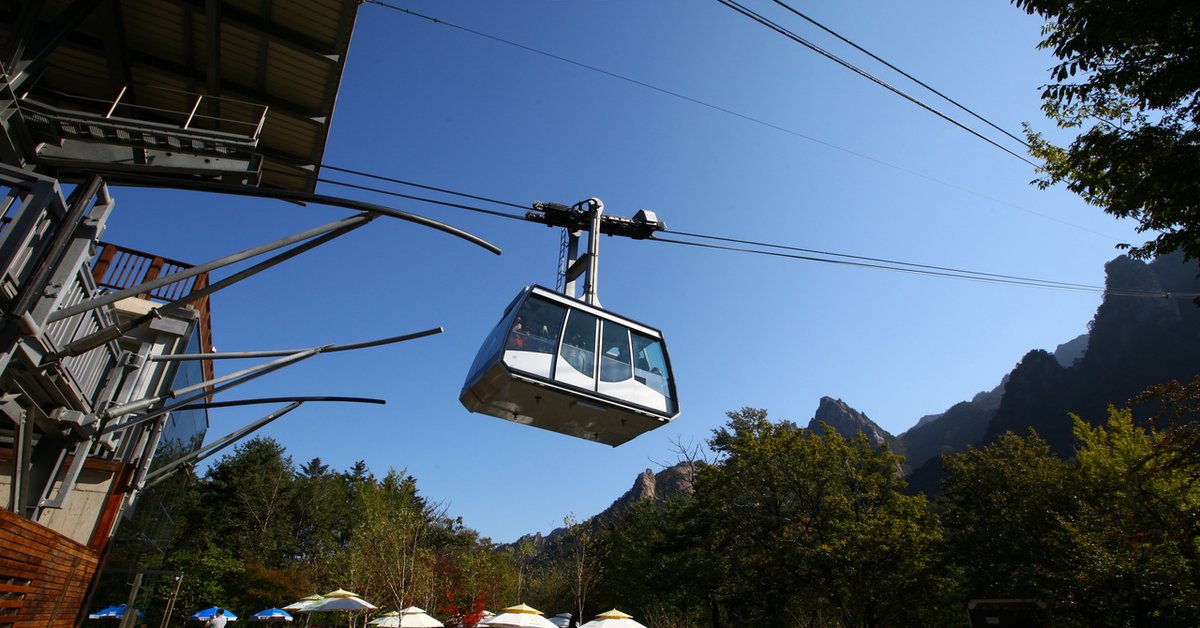
Seoraksan Cable Car Tickets: No Advance Booking, and What Time to Arrive
Last Updated on September 22, 2026
Quick Answer
Seoraksan cable car tickets cannot be booked in advance. The operator sells them only at the counter on the day, and what you receive is a ticket with a boarding time printed on it — arrive later, and you get a later slot rather than nothing. An adult ticket is ₩16,000 (as of September 2026), round trip only, with no one-way fare. Park and temple admission are both free.
The Full Answer
The Gwongeumseong (권금성) cable car at Seoraksan (설악산) is the rare Korean attraction where the usual foreigner problem — a booking site that demands a Korean phone number — does not exist, because the booking site does not exist either. The cable car takes no reservation of any kind and sells no online ticket — a rule specific to this privately run lift rather than to the mountain, since the park’s own overnight shelters elsewhere on Seoraksan are allocated by a national lottery. The operator’s Korean-language guide states the cable car rule twice, in two separate places: no advance reservations, on-site purchase on the day only.
That sounds like it removes a problem. In autumn it creates a different one, and it is a problem of timing rather than of access. Because nothing is allocated in advance, everything is allocated in a queue, and the queue starts before the machine does. The useful question is not how to book, but what time you need to be standing in front of the counter — and what it costs you if you are not.
Korea’s two big autumn ticket problems are exact opposites, which is worth holding in mind if you are doing both. At Hwadamsup, timed entry is booked online in advance and the whole difficulty is getting through the booking wall. Here there is no wall and no booking. The difficulty is the clock on the day.
The clock is also where the most repeated piece of English advice about Seoraksan turns out to be shaped wrong. The story goes that the day’s tickets sell out around eight in the morning. The operator publishes no daily quota and no cut-off time anywhere, and 08:00 is when sales start on busy days.
What the Fare Actually Covers
Every ticket is a round trip. The operator sells no one-way fare at all, and that is not a pricing decision — there is no hiking trail down from the Gwongeumseong station, so the ride back is the only way back. Korea’s other famous cable car works the opposite way: Seoul’s Namsan line sells a cheaper one-way ticket precisely because walking down is normal there, as our guide to the four routes up N Seoul Tower sets out. At Gwongeumseong you buy both legs whether you want to or not.
Fares as published by the operator (as of September 2026, VAT included):
| Ticket | Who it covers | Round trip |
|---|---|---|
| Adult | Middle school age and above | ₩16,000 |
| Child | 36 months to elementary school | ₩12,000 |
| Infant | Under 36 months | Free |
| Adult (reduced) | National merit recipients, severe or grade 1–2 disability | ₩13,000 |
| Child (reduced) | Severe or grade 1–2 disability | ₩9,500 |
| Senior | 65 and over, excluding peak periods | ₩14,000 |
| Sokcho resident | Proof of residence, one ticket per person | ₩8,000 adult / ₩6,000 child |
Two details in that table matter more to a foreign visitor than the numbers do. None of the reduced fares are available to you — the operator’s Korean fare policy restricts the discounts to Korean nationals in person, non-combinable, with no group rate. Budget ₩16,000 a head. And the senior discount is suspended during peak periods, with the 2026 exclusion window running September 19 to November 15, the whole foliage season. That affects Korean visitors rather than you, but it tells you how the operator classifies these eight weeks.
Refunds are straightforward: full refund up to ten minutes before your printed boarding time, 20% deducted after that, and a full refund on unused tickets if the line stops for weather. Lost tickets are not reissued.
What you do not pay for is entry. The national park admission fee was abolished in 2007, and the cultural property fee that Sinheungsa (신흥사) temple collected at the Seoraksan entrance — the ₩3,500 that still appears in older guides — was waived on May 4, 2023, when 65 temples nationwide stopped charging it. The operator’s own directions page says it plainly: there is no admission fee. The cable car ticket and your parking are the only things you pay.
How Ticketing Really Works: a Boarding Time, Not a Daily Quota
Here is the mechanic English coverage keeps skipping, and it changes what “arriving early” is for.
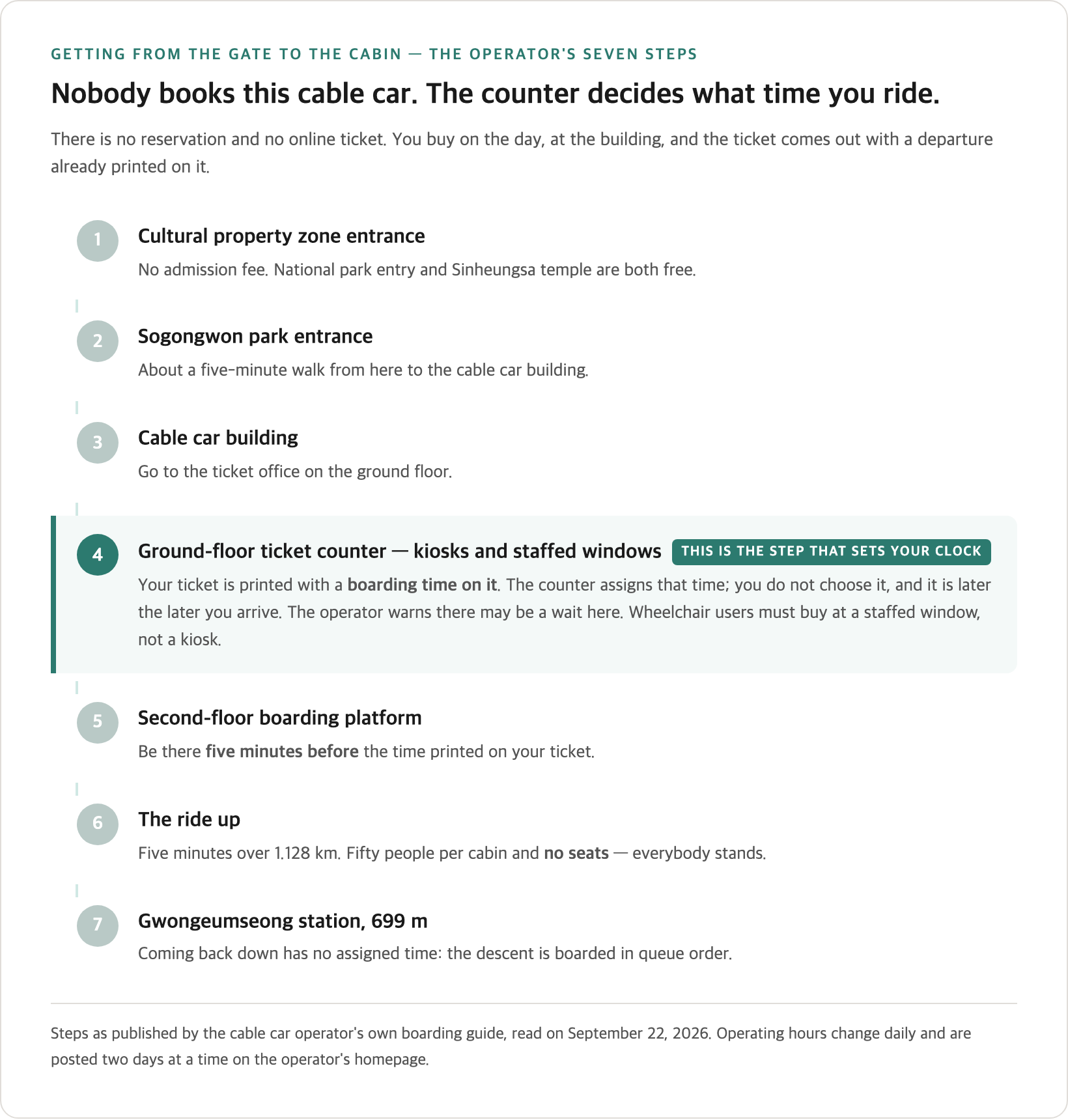
When you buy at the counter — kiosks and staffed windows both operate on the ground floor — the ticket is issued with a boarding time on it. You are not buying a place in a general queue or an open-ended pass. You are being assigned a departure, and the operator’s walkthrough tells you to be at the second-floor platform five minutes before it. Each cabin carries 50 people, two cabins run in opposition, and headways are 10 to 15 minutes when it’s quiet and about 5 minutes when it’s busy.
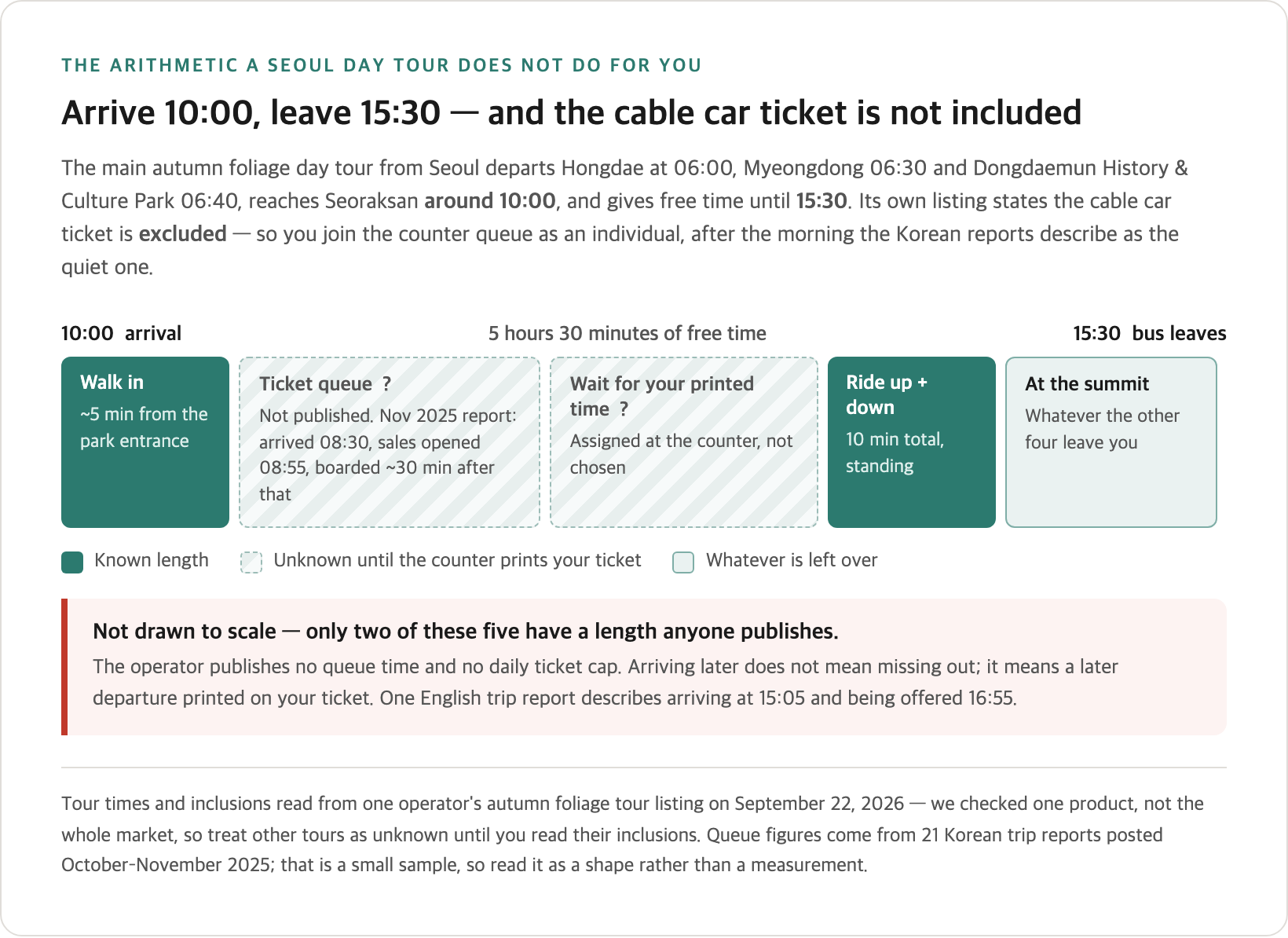
So the failure mode in autumn is not “sold out.” It is buying a ticket in the afternoon and being handed a departure hours later — one English trip report describes arriving at 15:05 and being offered 16:55 as the next slot. You are still going up. You are simply doing nothing else with your day. The live status feed does include a sold-out state, so running out of slots is possible on the heaviest days — but that means the day’s departures have all been allocated, not that a morning quota emptied at a fixed hour.
I read the operator’s Korean-language guide content directly on September 22, 2026 — the fare policy, the seven-step boarding walkthrough and all 27 FAQ entries — rather than working from a search summary, because this operator runs a JavaScript site where the on-screen text and the underlying content are easy to conflate.
What Korean visitors actually report about the wait
We collected 21 distinct Korean-language blog posts about queuing for this cable car, posted between October 1 and November 30, 2025, and counted what they mention rather than translating them:
| Mentioned in the post | Count (of 21) |
|---|---|
| Going early in the morning | 6 |
| A wait of over an hour | 4 |
| A wait of two to three hours | 1 |
| Selling out or an opening rush | 2 |
| Parking queue separate from the ticket queue | 2 |
Twenty-one posts is a small sample, and Korean blog platforms carry a high proportion of sponsored and duplicated content, so read that table as a shape rather than a measurement. The two posts that recorded clock times are more useful than the counts. One, from November 15, 2025, arrived at 08:30, saw sales begin around 08:55 and boarded roughly 30 minutes later. The other, from peak season on October 11, 2025, reported that sales normally start at 08:30 but move to 08:00 on holidays and in peak season, and that the first cabin that day ran at 08:05. Both describe an opening, not a closing.
Local tip — the “sells out by 8am” advice has the clock running backwards. The operator publishes no daily ticket cap and no sales cut-off; what it publishes is a timed-boarding system. On busy autumn days, sales and the first cabin move earlier — to 08:30, sometimes 08:00 — rather than ending then. What degrades as the morning goes on is not availability but the departure time printed on your ticket. Source: the operator’s Korean fare and FAQ pages, read in full on September 22, 2026, plus 21 Korean trip reports from the 2025 season.
What Time to Arrive — and Why a Packaged Day Tour Lands at the Wrong Hour
If you are coming from Seoul on a bus tour, do this arithmetic before you book, because none of the English pages we read do it for you. The same arithmetic applies to a winter day trip to Gapyeong: the circulator bus’s last departure from the arboretum leaves at 20:00, earlier than both Nami Island’s last ferry (21:05) and the winter light display’s closing time (23:00 on Saturdays, as of the 2025–26 season).
The main autumn day tour from Seoul departs Hongdae at 06:00, Myeongdong at 06:30 and Dongdaemun History & Culture Park at 06:40, arrives at Seoraksan around 10:00, gives you free time until 15:30, and returns to Seoul between 18:30 and 19:20. That is the product as listed on Trazy’s autumn foliage tour page on September 22, 2026, with Seoraksan dates running October 12–31. And the listing states, in its own words, that the cable car ticket is not included in this tour.
Put those two facts next to each other. You arrive at 10:00 — after the window the Korean reports describe as quiet — and you then join the counter queue as an individual, with no group booking behind you, for a ticket whose printed departure is whatever is left. Into five and a half hours of free time you have to fit the approach from the car park, the five-minute walk in from the park entrance, the ticket queue, a 10-minute round-trip ride, and whatever time you wanted at the top. It is doable. It is not the same thing as “the tour takes you up the cable car,” which is what a lot of people assume they have bought. We are describing that product rather than recommending it, and we earn nothing from the Trazy listing. The point is the arithmetic.
And this is where the useful finding is, because it is not one operator’s quirk. Put two GetYourGuide products side by side. From Seoul: Seoraksan Mountain with Cable Car Shuttle Bus sells from ₩86,511, and From Seoul: Sokcho Beach, Market and Seorak Cable Car Tour from ₩110,816 (both as of September 2026). Both put the cable car in the title. Only the second one buys you the ride: its inclusions carry “Admission to: Seorak Cable Car”, while the first names “Admission to: Seoraksan Cable car” among its exclusions. The cable car is in the product name and in the excluded list at the same time — and the near-identically named product beside it includes it.
Of the four products we opened on that page, no two treat the ride the same way. One excludes it. One includes it. A third, Seoul: Mt.Seorak(+CableCar Option)+Sokcho Fish Market&Beach at ₩93,377, makes it a paid extra — its itinerary marks the cable car ride “Optional, Extra fee,” and the ticket appears in the inclusions and the exclusions at once, separated only by the words “only if you added this option” and “if you did not add this option.” The fourth, Seoul: Mt.Seorak, Nami Island & Garden of Morning Calm at ₩119,083, excludes the ticket and adds something no title would tell you: “During autumn foliage season(Oct. 21~Nov. 03) we visit Seoraksan Osaek course not Cable Car course.” Four products, four different answers, three of them with “cable car” in the name.
So the rule is to stop reading titles and read the inclusions list, looking for a line that starts “Admission to:” with the cable car in it. If it is not there, what you have bought is transport to the queue. One practical warning about reading those pages: the inclusions and exclusions run together as continuous text, and the boundary on this operator’s template is the line “KRW 100 million passenger liability insurance per vehicle.” Everything above it is included; everything from “Meals & Beverages” downward is not. We opened four of the six listings on GetYourGuide’s Seoraksan Cable Car page on September 22, 2026 — four products, not the whole market.
Booking links on this page are affiliate links — we may earn a commission, and the price you pay is unchanged.
Local tip — a Seoul day tour’s name does not tell you whether the cable car is included. Two products with almost the same title gave opposite answers. Of the four GetYourGuide Seoraksan products we opened on September 22, 2026, one excludes the ticket, one includes it, one sells it as a paid add-on, and one excludes it and reroutes: its own notice says that from October 21 to November 3 it visits Seoraksan’s Osaek course rather than the cable car course — which is the exact stretch either side of this year’s forecast peak. Trazy’s Seoraksan package excludes the ticket too. Do not read the title. Read the inclusions list for a line beginning “Admission to:” naming the cable car, using the boundary described above to tell inclusions from exclusions. Four products out of the six on that page, and one Trazy listing — not the whole market. If your tour does not include the ticket, you queue at the counter exactly as an independent traveller does, so getting there before the buses still decides your day. If the ride up is the reason you are going, an independent trip that puts you at the counter before the tour buses arrive is the version of the day that works. Verified against both operators’ own itineraries and inclusion lists on September 22, 2026.
The Live Operating Board
The operator’s homepage carries a live status panel that updates through the day. Four English guides tell readers to “check the official website” and none says what is on it — which is a shame, because it answers the questions that actually matter that morning: is it running, and how long is the queue.
Here is what the board reported at 13:31 KST on September 22, 2026, when I read it:
| Board field (Korean) | What it means | Value that day |
|---|---|---|
| 운행정보 | Service status | Running normally |
| 운행구분 | Boarding mode | Free boarding (자유탑승) |
| 시작 ~ 마감 | Start and last ticket sales | 09:00 – 17:30 |
| 대기시간 | Current wait | None |
| 잔류인원 | People still up at the top | 200 |
| 갱신시각 | Last updated | 09-22 13:31 |
The status values it can show include normal service, service suspended, ticket sales suspended, closed for the day, tickets sold out, trail closed, and under inspection. The hours panel covers today and tomorrow — two days, not a season-long timetable. Treat any English page that prints fixed hours as wrong by construction; one guide we checked publishes “9:00 AM–6:00 PM” as a flat fact, and the board did not say that on the day we looked.
The board is also the reason to sort your data before leaving Seoul. A bus in Gangwon is not where you want to discover your eSIM or pocket WiFi setup is not working.
Local tip — the operator’s English FAQ drops the question about seats, and it is the one that matters in October. The Korean FAQ carries the entry 「케이블카 안에 의자가 있나요?」 — is there a seat in the cable car — and answers it plainly: there are none, you ride standing. The English version of the same page answers most of the other questions, but that entry is not in it: the words seat, seated and standing do not appear on the English page at all. So an English-only reader can arrive having read the operator’s own guide end to end and still not know that the ride is a standing one. I opened the operator’s Korean and English guide pages side by side on September 22, 2026 and compared them entry by entry to find that gap.
Getting There, and the 2026 Parking Plan
The cable car is at 1085 Seoraksan-ro, Sokcho, Gangwon Province (강원도 속초시 설악산로 1085). From the park entrance it is approximately a five-minute walk to the building.
By bus from Seoul. Express buses reach Sokcho from Seoul Express Bus Terminal in approximately two and a half hours, with intercity services from Dong-Seoul Terminal taking around two hours ten minutes, at roughly 30-minute intervals. English-language sources reported fares of ₩16,400 standard and ₩27,600 premium as of August 2026 — secondary rather than official, so check prices when you book.
From Sokcho to the park. The operator’s directions name city bus routes 7 and 7-1 from the intercity bus terminal, running via the express bus terminal and the national park visitor centre to the Seoraksan parking lot terminus. We could not verify headways, fares or first and last departures from a primary source, so we are not going to print times. Check them live in Naver Map or Kakao Map — Google Maps does not do driving directions in Korea and carries only thin transit data, which is the most common way visitors lose an hour here. For the last leg by road, our walkthrough of the Kakao T app covers the foreign-card problem, and our overview of how Korean transport connects is where to start if you are assembling the trip yourself.
By car, this autumn specifically. The Sogongwon (소공원) lot at the park entrance is the one everyone aims for, and the one that fills. On September 18, 2026, five organisations signed a joint traffic plan for this foliage season: Sokcho City, Sokcho Police, the Seoraksan National Park Office, the Sokcho model drivers’ association, and Sinheungsa temple. Under it, a congested Sogongwon lot means vehicles are directed to the B and C district lots with a shuttle connection from there, run by the park office in step with staged traffic control. Sokcho City is also running a traffic control room and posting conditions on electronic signboards.
On parking charges the sources disagree, and we did not resolve it: VisitKorea’s English page lists ₩6,000 and ₩9,000 by vehicle size, one English guide gives ₩4,000–5,000 for small and mid-size cars, and Korean trip reports mention ₩6,000 for a small car. The cable car operator states that park parking fees have nothing to do with it and points enquiries to 033-636-4050. Carry more than you expect to need and confirm at the gate.
Local tip — “just drive and park at the entrance” is the plan that breaks this autumn. Under the September 18, 2026 agreement, a full Sogongwon lot means being turned toward the B and C district lots with a shuttle link rather than waiting in place. No English page we checked mentions this arrangement. Its limits, stated plainly: the shuttle’s operating dates, times, frequency, fare and stop locations have not been published in any of the four Korean reports covering the signing, and we could not find a primary release either. Watch the electronic signboards on the day rather than planning around a timetable that does not exist yet. Sources: Kangwon Ilbo and Kangwon Domin Ilbo, September 21, 2026.
Autumn 2026: What the Forecast Says, and What It Doesn’t
The Korea Forest Service and the National Institute of Forest Science released their 2026 foliage peak map in a press release dated September 22, 2026. It puts Seoraksan’s peak at October 20, with Songnisan on October 28, Naejangsan on November 4 and Hallasan on November 6 — approximately 0.8 days later than the five-year average.
Two cautions before you plan a week around that date.
“Peak” is defined differently by different agencies. The Forest Service defines it as 50% of foliage turned. The figures circulating in English guides — a long-term average of October 17, an observed October 29 in 2024, an observed October 24 in 2025 — come from a different standard that uses 80%. Those numbers are not comparable.
A mountain-wide peak date is not a cable car peak date. Seoraksan’s peak is judged across the whole massif, including Daecheongbong at 1,708m, while the cable car’s upper station sits at 699m. Colour arrives later at lower elevations, and we have no sourced figure for how much later — so we are not going to invent one. A mountain-wide peak date tells you the mountain is turning. It does not tell you the view from Gwongeumseong is at its best that morning.
Inside the Cabin: No Seat, and the Ten-Minute Trap
The cabins are built for 70 and loaded with 50, and there are no seats — everybody stands. It is a five-minute ride over 1.128km, so that reads as trivial until you are doing it at 08:30 in late October with an hour of queue already in your legs, and it is the detail the operator’s own English page leaves out.
The two most-confused facts about time at the top sit in separate FAQ entries, and they are both true:
- On a normal ride, there is no limit on how long you can stay at Gwongeumseong. You simply need to be at the boarding area five minutes before the last downward cabin departs, and the descent is boarded in queue order with no assigned time.
- If you take the last cable car up, you get about ten minutes up there. That is the operator’s own warning, in its own FAQ.
Local tip — the last car up buys you ten minutes at the summit, not twenty. Some English guides give a longer figure for the last ascent, and at least one attributes it to the operator’s FAQ. The Korean FAQ says ten minutes (십 분). The same FAQ separately says there is no time limit on an ordinary visit — so the correct reading is “unlimited normally, ten minutes on the last car up,” not one number for both. If the plan is to ride the final cabin and watch the light go, you have ten minutes, and the descent queue forms inside them. I read all 27 FAQ entries on the operator’s Korean guide page on September 22, 2026 to separate the two.
One more detail English coverage misses: the toilets at the top are foam-flush rather than plumbed. Use the ones at Sogongwon or on the second floor before you ride.
Who Can and Cannot Board
- Wheelchairs: yes, but not through the kiosk. Buy at the staffed counter and state the type (manual or powered) and the number of chairs. Staff route you via the lift to the second floor and a dedicated boarding gate, with one companion.
- Strollers: no. There is a free storage point outside, on the right-hand side of the building.
- Pets: no, in every form. Carriers and bags included, and animals are not allowed inside the building at all. Guide dogs for the visually impaired are the sole exception.
- Smoking: banned throughout Seoraksan National Park.
What You Need to Know
- No reservation and no online ticket — for the cable car. Do not generalise it to the mountain. Seoraksan’s overnight shelters run on a park-service lottery with applications open from the 1st to the 5th of every even month, which our guide to Korea’s shelter lottery covers.
- The ticket carries a boarding time. Arriving late costs you the hour rather than the ride.
- Round trip only, because there is no way down on foot, and the line ends at Gwongeumseong at 699m rather than at Daecheongbong.
- Weather stops it, and weather is why there is no booking system. Wind, poor conditions or a safety inspection shut the line down; unused tickets are refunded in full when that happens.
- Carry cash, with a caveat we want to be honest about. English guides and Korean trip reports both advise cash for the ticket window and the restaurants at the entrance, but the operator publishes nothing about which payment methods it accepts — treat that as unconfirmed rather than as a warning that your card will fail. Our notes on where foreign cards do and don’t work and on which ATMs dispense to foreign cards are worth reading before you leave the city.
- Peak-season operations shift earlier, holidays included — the same pattern that runs across Korean attractions during holiday weeks such as Chuseok.
Practical Tips
- Get to the counter before the tour buses do. The packaged day tours from Seoul land around 10:00. Everything about your day improves if your ticket is printed before that.
- Check the operator’s live board the night before and again that morning. We read it in Korean, and the six fields sit in a fixed order — use the table above as your key if the labels come up in Korean for you.
- Read the boarding time on your ticket immediately, and plan backwards from it. If the slot is unworkable, the counter will change or refund it within that day’s operating hours, with a 20% fee.
- Do not build the trip around one forecast date. October 20 is a 50%-threshold, mountain-wide figure, and the cable car sits at 699m. Give yourself a window rather than a day.
- Dress for standing — in the queue and in the cabin. No seats, 50 people, five minutes each way, and an exposed summit at the other end.
- If you are driving, decide in advance what you do when Sogongwon is full. This year that means the B or C district lots and a shuttle across, not waiting for a space that is being actively managed away from you.
- Do not plan on the last car up. Ten minutes at the top, a queue to get down, and no trail if you misjudge it.
Frequently Asked Questions
Can you book Seoraksan cable car tickets in advance?
No. The operator’s Korean-language guide states in two separate places that there are no advance reservations and that tickets are sold only at the counter on the day. Its stated reason is weather — the line stops for wind often enough that pre-selling creates more problems than it solves. That operator statement is the strongest evidence. On the resale side we checked two platforms rather than the market: GetYourGuide’s own Seoraksan Cable Car page lists six products and all six are tours, not tickets, and Trazy’s Seoraksan package excludes the cable car outright. Some tours do bundle the admission — one of the four we opened lists it among its inclusions — but that is a tour buying the ticket on your behalf, not a ticket you can book yourself. Where a tour does not include it, you queue at the counter on the same terms as an independent traveller.
How much is the Seoraksan cable car in 2026?
₩16,000 for an adult round trip and ₩12,000 for a child aged 36 months through elementary school, with under-36-months free (as of September 2026, VAT included). There is no one-way fare. The reduced fares the operator lists apply to Korean nationals in person and cannot be combined, so no discount is available to foreign visitors. Some English pages still quote ₩15,000, ₩11,000 or ₩10,000. Those are out of date.
What time should I arrive at Seoraksan for the cable car in autumn?
Earlier than a Seoul day tour arrives, which is around 10:00. The reason is not that tickets run out at a fixed hour — the operator publishes no daily cap — but that your ticket is issued with a boarding time on it, and the slots left get later as the morning goes on. In peak season, sales and the first cabin can start earlier than the standard 09:00, so arriving before 09:00 is not wasted.
Is there an entrance fee for Seoraksan National Park or Sinheungsa Temple?
No, on both counts. National park admission was abolished in 2007, and the cultural property fee collected by Sinheungsa — the ₩3,500 that still appears in older guides — was waived on May 4, 2023, when 65 temples nationwide stopped charging it. The operator’s directions state there is no admission fee. Parking is charged separately and is not run by the cable car operator.
Can I hike down from Gwongeumseong instead of taking the cable car back?
No. There is no descending trail from the Gwongeumseong station, which is why only round-trip tickets are sold. On a normal ride there is no limit on how long you stay at the top; you need to be at the boarding area five minutes before the last downward cabin leaves. The descent is boarded in queue order, with no assigned time.
Does the Seoraksan cable car go to Daecheongbong summit?
No. It ends at Gwongeumseong, 699m above sea level, over a run of 1.128km. Daecheongbong is 1,708m and a multi-hour ascent on foot, generally with a shelter night attached. The two are not substitutes.
What happens to my ticket if the cable car stops for wind?
Unused tickets are refunded in full when service is suspended for high wind or bad weather. Otherwise the ordinary rule applies: full refund up to ten minutes before your printed boarding time, 20% deducted after that, whether you are refunding or moving to a later slot. Changes are only possible within that day’s operating hours, and lost tickets are not reissued.
Can I bring a stroller, a wheelchair, or a dog on the Seoraksan cable car?
Strollers cannot go in the cabin, but there is a free storage point outside the building on the right-hand side. Wheelchairs can, provided you buy at the staffed counter rather than the kiosk and declare the type and number; staff then take you up by lift to a dedicated boarding gate with one companion. Pets are not permitted in any form, carriers and bags included, and cannot enter the building. Guide dogs are the only exception.
Related Questions
- Seoraksan and Jirisan Shelter Reservations: How Korea’s Lottery System Works — the same mountain, the opposite booking system.
- Hwadamsup Autumn Tickets 2026: Buying in English, and Getting There — Korea’s other big autumn ticket, where the problem is that you must book online.
- How to Hike Hallasan: The Reservation System Nobody Explains — Korea’s other major mountain, and a third set of rules again.
Featured image: ⓒ한국관광공사 포토코리아-이범수