How to Attend Music Bank and K-pop Shows: The Routes That Still Work
Quick Answer
Seven K-pop music shows air weekly, six of them in or near Seoul. As a visitor you realistically have two routes: apply directly through a broadcaster — KBS for Music Bank, the SBS app for Inkigayo — or buy a paid tour package. The fandom-seat route that most fans use requires proof of album purchase and streaming, and is effectively closed to travellers.
The Full Answer
A music show recording is not a concert, and the difference is not cosmetic. Ten to fifteen acts perform two or three songs each for a live television broadcast that runs roughly an hour. You watch whoever is on that week’s running order, in the order the production team sets it, from a standing floor or a fixed seat in a television studio. There is no interval, no reserved view of your own group, and — in almost every case — no leaving once the doors close.
What makes attending hard is not the ticket price. Broadcaster entry is free; money only enters if you buy a package. The difficulty is that the entry systems were built for a domestic fan audience, and the instructions live in Korean-language notices posted by record labels two days before each broadcast. The English-language guides describe the outline correctly. What they leave out is the operational layer: what time the roll call actually happens, how long the application window stays open, what counts as proof that you bought the album, and what happens if you do not turn up.
I worked from four Korean-language audience notices posted by record labels for specific 2026 recordings — two for Show! Music Core, one for Inkigayo, one for M Countdown — and four Korean audience guides published in May 2026 for Music Bank, Inkigayo and M Countdown. The times and requirements below come from those, not from other English guides. Where I could not confirm something, I have said so rather than repeating it.
One thing to settle before you read further: this is about attending in person in Seoul. Voting for your group and streaming the broadcast from home are different problems with different answers, and neither requires a flight.
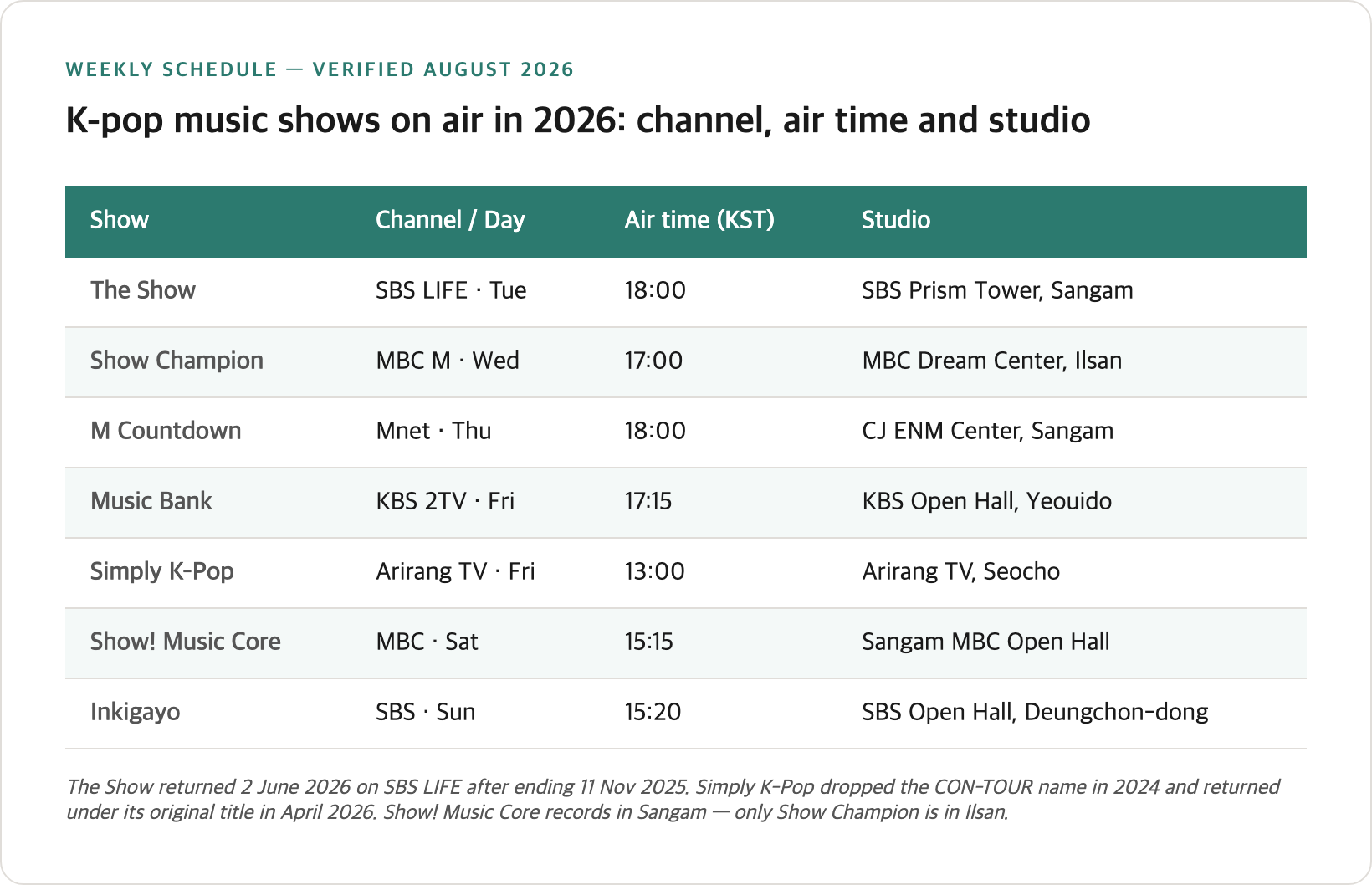
Which Shows Are Actually On Air
The weekly lineup changed twice in the last eighteen months, and several English round-up pages have not caught up.
| Show | Channel | Day | Air time (KST) | Where it is recorded |
|---|---|---|---|---|
| The Show | SBS LIFE | Tuesday | 18:00 | SBS Prism Tower, Sangam, Seoul |
| Show Champion | MBC M / MBC every1 | Wednesday | 17:00 | MBC Dream Center, Ilsan, Goyang |
| M Countdown | Mnet | Thursday | 18:00 | CJ ENM Center, Sangam, Seoul |
| Music Bank | KBS 2TV | Friday | 17:15 | KBS Open Hall, Yeouido, Seoul |
| Simply K-Pop | Arirang TV | Friday | 13:00 | Arirang TV, Seocho, Seoul |
| Show! Music Core | MBC | Saturday | 15:15 | Sangam MBC Media Center Open Hall, Seoul |
| Inkigayo | SBS | Sunday | 15:20 | SBS Open Hall, Deungchon-dong, Seoul |
Two corrections worth carrying with you.
The Show was off the air for almost seven months. Its eighth season ended on 11 November 2025, and Korean entertainment press reported at the time that the broadcaster had not decided whether the programme would return at all. It came back on 2 June 2026 as season nine — on SBS LIFE, not the SBS MTV or SBS funE channel that older listings name, produced in partnership with an outside company. It still records at SBS Prism Tower in Sangam on Tuesdays. If you booked a “SBS MTV The Show” package during the hiatus, the channel name on that listing was already out of date.
Simply K-Pop is no longer called CON-TOUR. The CON-TOUR format ended on 6 December 2024, and the programme returned under its original name on 10 April 2026. It is worth knowing about for a different reason: Arirang TV is Korea’s English-language international broadcaster, so it is the one weekly music programme built for a non-Korean-speaking audience from the start.
Air times drift, and several widely-shared English schedules are carrying old ones — listing Show! Music Core at 15:45, Inkigayo at 15:30, and Show Champion at 18:00. The times in the table above match the broadcast times printed on 2026 agency notices and the current broadcaster listings. Treat any of them as approximate until you see the notice for your specific date.
The Three Ways In — and Which One You Can Actually Use
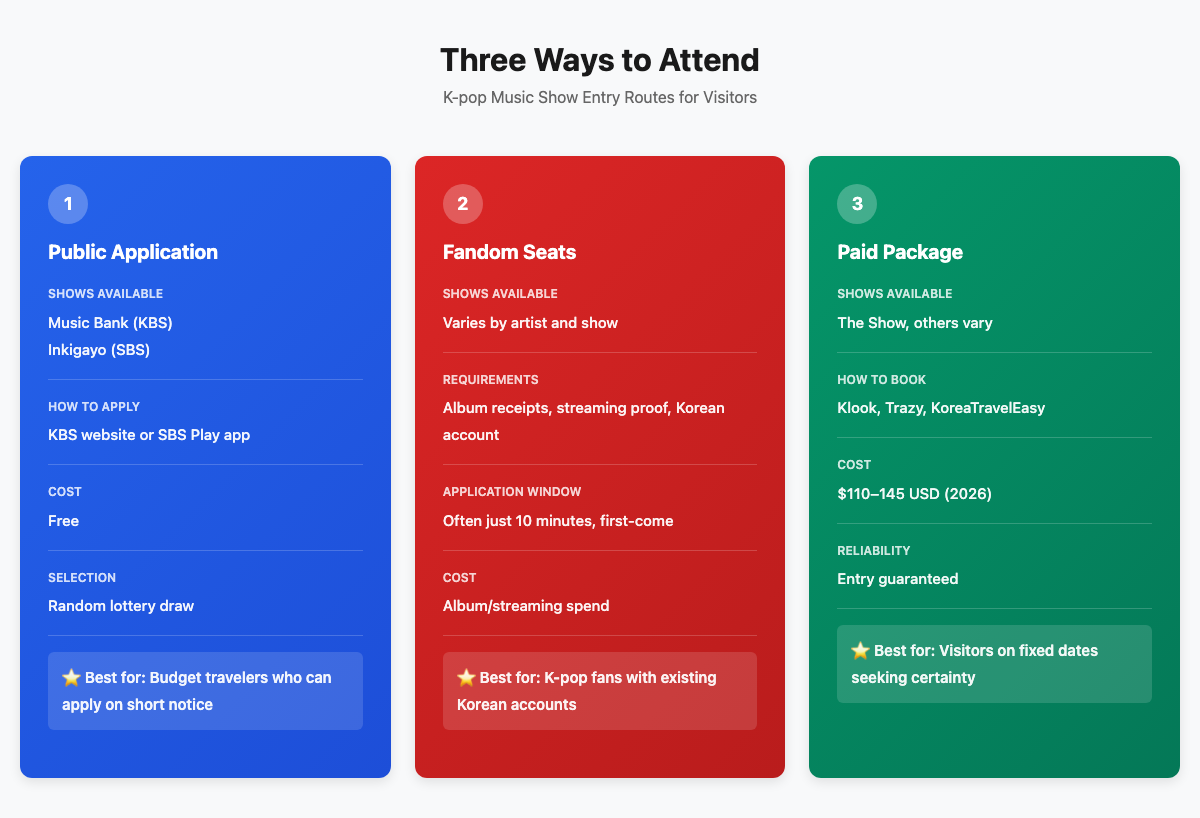
Every seat in a music show studio is filled through one of three systems. They are not tiers of the same process. They have different application windows, different arrival times, and different requirements, and confusing them is where most of the wasted trips come from.
Route 1 — The broadcaster’s own public application
Two shows run an application that is open to the general public rather than to a specific artist’s fandom.
Music Bank (KBS). Applications run on the KBS website under 시청자 참여 → 방청 신청 (Viewer Participation → Audience Application). The window opens Thursday at 09:00 KST and closes at midnight for the following week’s broadcast, up to two seats per person. Winners are drawn by lottery and posted on the KBS site from 18:00 the following Monday, with a text message going out after 14:00 the same day. Entry is free. On the day you bring a physical photo ID and nothing else — no album, no lightstick.
Inkigayo (SBS). Applications go through the SBS Play app, which has an English language setting. Entry is free, seat assignment is by draw, and a physical ID is required at the door — a passport or an alien registration card both count.
If you have no Korean phone number, the account creation step is where this route can stall. English guides describe a KBS sign-up path for overseas nationals using a passport scan. I could not confirm that option on KBS’s own registration page in August 2026, and I am not going to assert it on the strength of other English blogs repeating each other. Assume account creation may take several days and may fail, start it well before you fly, and keep Route 3 as a fallback.
Verified tip — lottery winners do not queue at dawn.
Korean audience guides published in May 2026 give the Music Bank general-admission timeline as tickets distributed at 14:00 and entry at 16:00 for a broadcast just after 17:00. The 05:00 roll call that English guides describe belongs to the fandom seats, which are a separate allocation with separate requirements. If you win the KBS draw, arriving at dawn buys you nothing — the seat is already assigned.
Route 2 — The fandom seat, via a label’s notice
This is how most of the studio actually fills, and it is worth understanding even though you probably cannot use it. A record label posts a notice — on Weverse, on the artist’s own site, or through the Mnet Plus platform — announcing an application form for one specific broadcast. You fill in the form, and if you are inside the cut-off you are in.
The requirements are the part English guides compress into “album purchase receipts can improve your tier.”
Verified tip — the proof of purchase is more specific than “buy the album.”
A notice for the 1 August 2026 Show! Music Core recording required the physical album, plus a printed 전곡 구매 내역서 — a full-track purchase statement including the instrumental track. A notice for the 26 July 2026 Inkigayo recording required a digital membership card, an official lightstick, more than 500 Melon streams of a specific song, and a paid messaging subscription held for at least 30 days. A Music Bank fandom notice from April 2026 required three album versions and a printed full-track download statement. None of that is discoverable through a Korean music service without a Korean payment method.Verified tip — these are first-come windows, not lotteries.
The window for the 11 April 2026 Show! Music Core broadcast ran from 19:00 to 19:10 on the Thursday two days earlier — ten minutes, first come, first served. A second Music Core notice opened its form at 20:50 for a 21:00–22:00 window. The Inkigayo notice for 26 July opened Friday 19:00–20:00. A Music Bank fandom window in April took the first 300 applicants in ten minutes. English guides describe the fandom route as a “priority lottery,” which sets exactly the wrong strategy: the deciding factor is being on the form at the second it opens, not luck.
There is a further filter that rules travellers out quietly. Several notices state that fans of other artists may not apply, and enforcement runs through membership cards and streaming records tied to a Korean account.
Route 3 — A paid package
Travel agencies sell foreigner-facing music show entry — Trazy, KoreaTravelEasy, Klook, and several Seoul-based tour operators. You book in advance with your passport name, you are given a meeting point and time, and entry is guaranteed. The Show is the one most consistently listed, at around US$110–145 per person depending on the operator and the week (as of 2026); others appear and disappear with the recording calendar.
I opened one such listing directly — the [KPOP] THE SHOW + MVP Seoul Tour Package on Klook — in September 2026 to check the price range above against a real booking page, and its price sat inside that range. The listing puts the meeting point at SBS Prism Tower, the same building named above, and shows a 4.6/5 rating across 59 reviews. That does not change the trade-off: it is still the paid route around the barriers, not a way past them.
The trade-off is money and position. You are placed in general standing or seating rather than the fandom block, so you are further from the stage than the fans who spent a month streaming to get there. For a visitor with a fixed week in Seoul, that is usually the right trade. Reliability is what you are buying.
The Timing That Actually Decides Whether You Get In
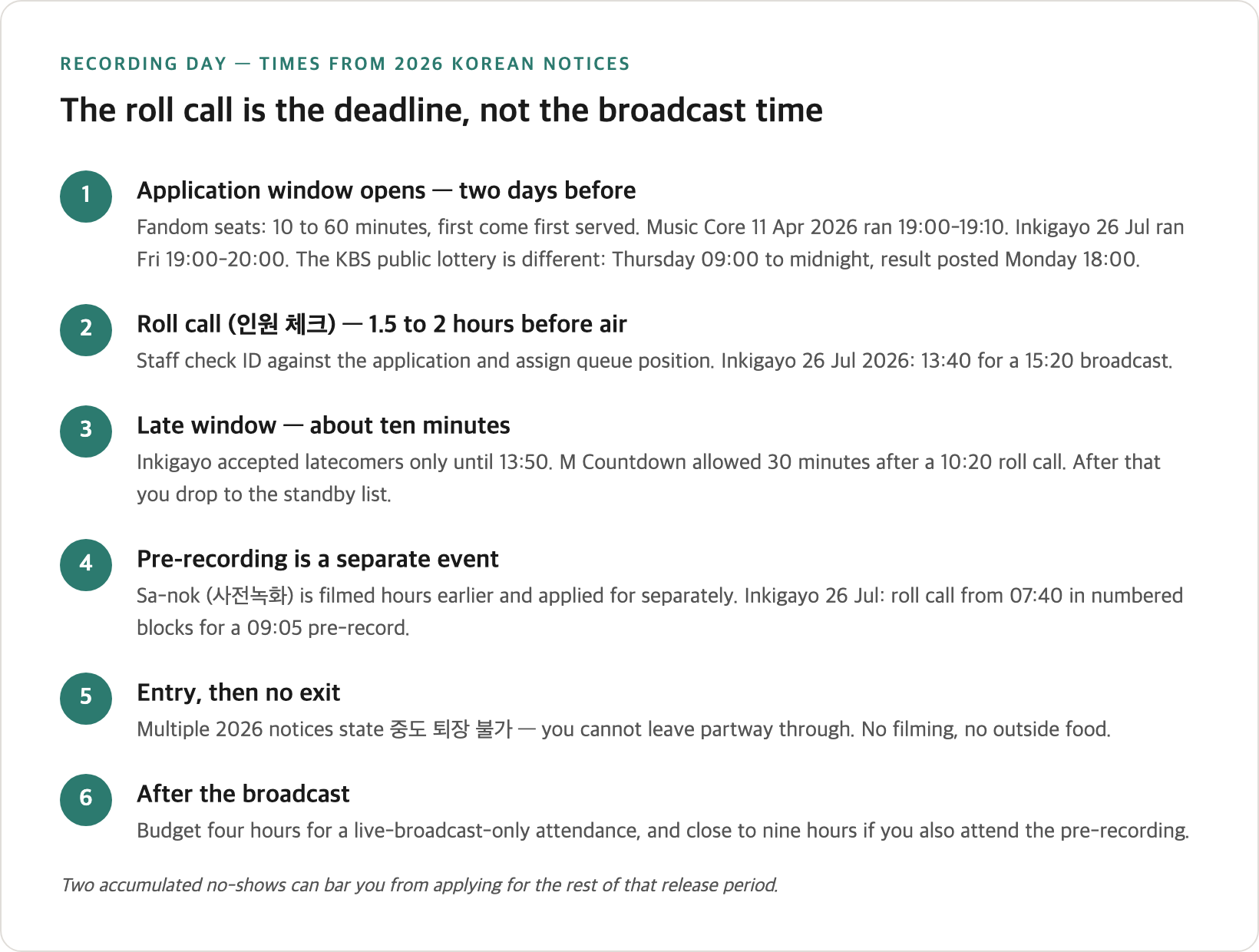
The broadcast time is not your deadline. The 인원 체크 — the roll call where staff verify names against IDs and assign queue positions — is. Miss it and the seat goes to the standby list, regardless of what your confirmation says.
Verified tip — the late window is about ten minutes, and it is enforced.
The Inkigayo notice for 26 July 2026 set roll call at 13:40 for a 15:20 broadcast, with latecomers accepted only until 13:50. For that day’s pre-recording at 09:05, roll call ran in numbered blocks: positions 1–100 from 07:40 to 08:10, latecomers 08:10–08:20, standby 08:20–08:30. The M Countdown notice for 28 May 2026 set roll call at 10:20 for a 12:20 pre-recording — eight hours before the 18:00 broadcast — with a 30-minute late allowance. Show! Music Core ran roll call at 13:00 for a 15:15 broadcast, and at 08:00 for a 09:20 pre-recording. English guides give a single vague instruction to arrive early. The Korean notices give a number, a block, and a cut-off.
Two consequences follow from those figures.
A pre-recording is a separate event. 사전녹화 (sa-nok) is a filmed performance by one artist, shot hours before the live show, and it is applied for separately. Getting into the pre-recording does not put you in the live broadcast, and vice versa. Several notices cover both and ask you to choose.
Budget the whole day, not the broadcast slot. If you are attending a pre-recording and the live show, the roll call at 07:40 and the exit after 16:30 bracket almost nine hours. Even a live-broadcast-only attendance runs from roughly two hours before air to thirty minutes after.
Verified tip — two no-shows can lock you out of the whole promotion cycle.
Korean audience guides published in May 2026 describe the M Countdown rule plainly: applications are one per person with no edits after submission, and two accumulated no-shows bar you from applying for the rest of that release period. Multiple 2026 notices also state 중도 퇴장 불가 — you cannot leave partway through. If you are not certain you can commit the full day, the notices ask you not to apply, and the system remembers.
Getting to the Studios
Six of the seven venues are on the Seoul subway. One is not in Seoul at all.
| Venue | Address | Nearest station |
|---|---|---|
| KBS Open Hall (Music Bank) | Yeouido, Yeongdeungpo-gu, Seoul | Gukhoeuisadang (국회의사당), Line 9 |
| SBS Open Hall (Inkigayo) | 442 Yangcheon-ro, Gangseo-gu, Seoul | Gayang (가양), Line 9 |
| CJ ENM Center (M Countdown) | 66 Sangamsan-ro, Mapo-gu, Seoul | Digital Media City, Line 6 / AREX |
| Sangam MBC Open Hall (Music Core) | 267 Seongam-ro, Mapo-gu, Seoul | Digital Media City, Line 6 / AREX |
| SBS Prism Tower (The Show) | Sangam-dong, Mapo-gu, Seoul | Digital Media City, Line 6 / AREX |
| MBC Dream Center (Show Champion) | 596 Hosu-ro, Ilsandong-gu, Goyang | Jeongbalsan (정발산), Line 3, Exit 1 |
Two of those deserve a flag, because the widely-copied version of this list gets them wrong.
Show! Music Core is in Sangam, not Ilsan. It has recorded at the Sangam MBC Media Center Open Hall since September 2014. The Ilsan MBC Dream Center is Show Champion’s venue, and only Show Champion’s.
The Dream Center is a 650-metre walk from Jeongbalsan Station on Line 3, exit 1 — straight for 150 m then toward the lake park. Guides that route you to Baekseok Station are sending you to the wrong stop. From central Seoul the whole trip runs roughly 50 to 70 minutes, which is the single biggest argument against choosing Show Champion on a short trip. If you are still working out how the network fits together, the Seoul subway guide and the broader guide to getting around Korea cover the transfer and fare rules, and you will want a T-money card rather than buying single-journey tickets for a day with this much travel in it.
Two practical notes on navigation. Google Maps does not do transit directions properly in Korea, so put the Korean address into Naver Map or Kakao Map before you set out. And if you have come straight from the airport, the Incheon Airport to Seoul routes put you at Digital Media City on the same AREX line that serves three of these six venues.
What You Need to Know
-
The minimum age is 15, counted from your actual birthday. Every 2026 notice examined states 만 15세 이상 and spells it out as “born in 2011 with the birthday already passed.” Under-15s are refused even with a parent present. Korea’s age rules are counted differently from what most visitors expect — the Korean age system explains why the number on the notice may not match the number you would give.
-
Your ID must be physical, and the name must match exactly. Passports and alien registration cards are both accepted. Photocopies and phone photos are not. Notices state that foreign applicants must enter the Roman-alphabet name exactly as printed on the document — a missing middle name is a mismatch.
-
A Korean phone number is not formally required, but it smooths every step. The KBS result notification goes out by SMS, app logins ask for verification, and payment inside Korean music services needs a domestic method. Sorting out an eSIM or SIM before you land removes several small obstacles at once.
-
The Inkigayo standing pen has a height cutoff, measured at the door. Anyone above it is moved to a seat. The number is genuinely unstable: English coverage in 2025 reported a change from 165 cm to 160 cm, while Korean audience guides published in 2026 state 165 cm. Do not plan around either figure — check the notice for your date, and wear flat shoes.
-
No filming, no recording, no professional cameras. Phones stay down during performances. Notices list removal from the venue as the penalty. A handful of artists designate specific songs where fan filming is allowed, announced on the day.
-
The lineup is not published far in advance. It goes out on the show’s own social accounts a few days before the broadcast. There is no way to guarantee a specific group when you book weeks ahead.
-
Entry is free on the broadcaster routes. Music Bank and Inkigayo public applications cost nothing. Money only enters through Route 3, or through the album and streaming spend that the fandom route assumes.
-
You are standing for most of it, indoors, without food. Outside food and drink are not permitted inside. Eat first — there is a convenience store within a few minutes’ walk of every one of these venues.
Practical Tips
-
Decide your route before you book flights, not after. The KBS window opens Thursday 09:00 for the following Friday, so a trip that lands on a Wednesday leaves you one shot. A package can be booked months ahead.
-
Register your broadcaster account from home and allow a week. If verification fails you want to find out while you can still fall back on a paid package, not on the Tuesday of your show week.
-
Set an alarm for the application window, not the day. Ten-minute first-come windows for the fandom seats are announced roughly two days out, usually in the evening. Being an hour late is the same as not applying.
-
Work backwards from the roll call, not the broadcast. Add up: roll call time, minus travel from your accommodation, minus a buffer for finding the right entrance. That is your alarm. The ten-minute late window is not a grace period you should be planning to use.
-
Check which venue before you check the time. Music Core and Show Champion are both MBC, and they are 25 km apart. Confirm the address on the notice for your date.
-
Carry the passport you registered with, not a copy. This is the single most common reason people are turned away at the door, and there is no appeal at the desk.
-
Have a plan for the rest of the day. You will be near Sangam or Yeouido with several hours either side. The K-pop company buildings in Seoul piece covers what is actually open to visitors near these studios and what closed years ago.
Frequently Asked Questions
Can foreigners attend a K-pop music show?
Yes. Neither the KBS Music Bank application nor the SBS Inkigayo application restricts entry by nationality, and 2026 agency notices explicitly list passports and alien registration cards as valid ID. The practical barriers are account creation without a Korean phone number, and the fandom-seat requirements built around Korean music services. Paid tour packages exist precisely to route around both.
Which music show is easiest for a visitor to get into?
The Show, if you are willing to pay — it is the one most consistently sold as a packaged ticket to international visitors, at roughly US$110–145 per person (as of 2026). If you would rather not pay, Music Bank has the clearest public application: a defined window on the KBS site, a published result date, and free entry.
Do I need a Korean phone number?
Not as a formal requirement. But the KBS result notification is sent by SMS, several app sign-ups lean on Korean verification, and buying music inside a Korean service needs a domestic payment method. A tourist eSIM handles the phone number; it does not handle the payment method.
How long does the whole thing take?
Roll call for a live broadcast runs roughly 90 minutes to two hours before air, and the broadcast itself is about an hour, so budget four hours minimum. If you are also attending the pre-recording, the 2026 notices put roll call around 07:40 to 08:00 for a broadcast that ends after 16:00 — close to nine hours.
Can I choose which group I see?
No. You watch that week’s full running order in the sequence the production team sets. The lineup is announced on the show’s social accounts a few days before broadcast, which is generally after the application window has closed.
What happens if I do not turn up after being accepted?
It is recorded. Korean audience guides describe the M Countdown rule as two accumulated no-shows barring you from applying for the rest of that release period, and several notices state that leaving partway through the recording is not permitted. If your schedule is uncertain, do not apply.
Is there an age limit?
Yes — 15 and over on every 2026 notice examined, counted from the actual birthday rather than the calendar year, and not waived by a parent being present.
Can I take photos inside?
No. Filming, photography and audio recording are prohibited during recordings, with removal from the venue as the stated penalty. Occasional exceptions are announced on the day for specific songs.
Related Questions
- K-pop Company Buildings in Seoul: What You Can Actually Enter
- Do You Need a Visa for Korea? The 90-Day Rule Most Guides Get Half Right
- How Much Does a Week in Korea Cost? A Real Breakdown by Category
- Noraebang in Korea: The Rules Korean Guides Spell Out and English Ones Don’t
- Korea’s Year-End Music Festivals: Can You Actually Get In?
- Gocheok and KSPO Dome: Reading Korean Seat Maps and Getting Home After