National Museum of Korea: Free Entry, New 2026 Hours, and What to See First
Updated for August 2026
Quick Answer
The permanent galleries are free and need no ticket or reservation. Since 16 March 2026 the museum opens at 09:30 and closes at 17:30, with late opening to 21:00 on Wednesdays and Saturdays. Several English travel sites still list the old 10:00–18:00 hours. Only special exhibitions charge, and the Children’s Museum runs on booked sessions.
The Full Answer
The National Museum of Korea (국립중앙박물관) is the country’s largest museum, and the part almost everyone comes for costs nothing. That much is in every English guide. What those guides mostly have not caught up with is that the museum changed its opening hours in March 2026, changed them again for three weeks this summer, and is openly preparing to stop being free.
I read the museum’s Korean visitor-information page and its English equivalent side by side in August 2026, along with the Korean pages for the current special exhibitions, the docent schedule, the Children’s Museum reservation rules and the directions page. The two language versions do not say the same things. The Korean page carries three entry rules the English page omits entirely, and the two pages give different opening hours for the Ichon Station underpass. I also checked what Seoul’s own English tourism site says about the museum, and it is wrong on two counts.
None of this affects whether the collection is worth your morning. It is. It affects whether you arrive at a useful hour, get in with the bag you are carrying, and pay the right amount.
Hours: What Changed in March 2026
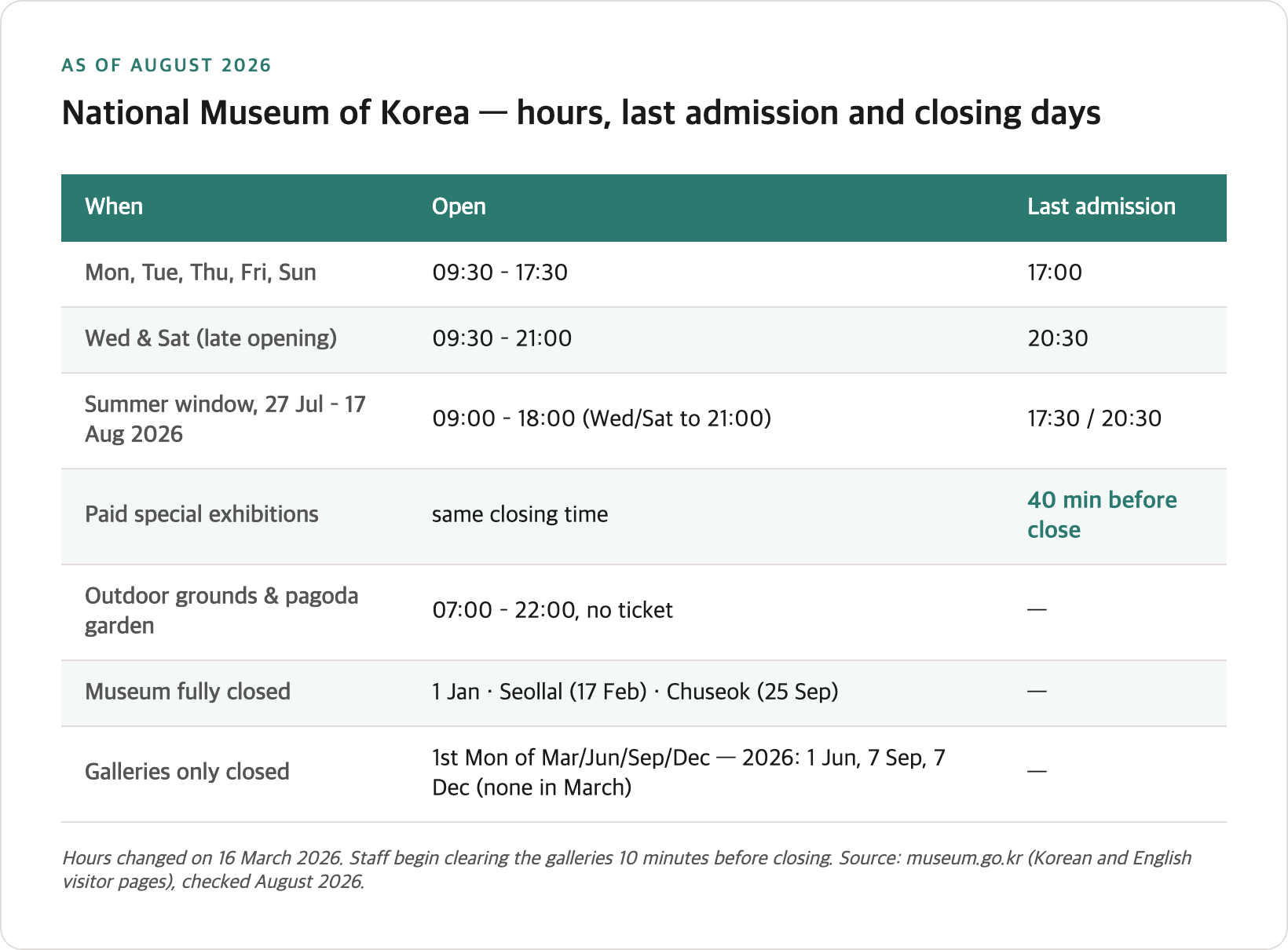
Until March 2026 the museum ran 10:00–18:00, with Wednesday and Saturday extended to 21:00. From 16 March 2026 the whole schedule shifted half an hour earlier at both ends:
- Monday, Tuesday, Thursday, Friday, Sunday: 09:30–17:30, last admission 17:00
- Wednesday and Saturday: 09:30–21:00, last admission 20:30
There is then a summer exception. For the school-holiday window of 27 July to 17 August 2026 the museum opened half an hour earlier again and closed half an hour later: 09:00–18:00 on ordinary days, last admission 17:30, with Wednesday and Saturday unchanged at 21:00. From 18 August the regular 09:30–17:30 pattern returns.
Two details sit underneath those numbers. Admission closes 30 minutes before the posted closing time, and the museum states that staff begin moving visitors toward the exits 10 minutes before closing. So walking in at the 17:00 cut-off on an ordinary day buys you roughly twenty usable minutes, not thirty — enough for one room, and only if you know which one.
The reason is not a secret. The museum reported 3,754,000 visitors in the first half of 2026, up 39.7% year on year, with foreign visitors up 68.8% to 165,404, against a building designed for roughly 18,000 people a day. Both the earlier opening and the summer extension were responses to queues forming before the doors opened.
That is also why the museum’s own crowd advice, issued in Korean, runs against instinct: use public transport, and start on the second and third floors. Almost everyone turns into the Prehistoric and Ancient gallery on the ground floor and works upward, which is exactly why the ground floor is the congested one.
The palaces run on completely different schedules, so plan them separately — Gyeongbokgung has its own closing day and free-entry rules, Changdeokgung’s Secret Garden is timed-entry and cannot be walked into at all, and Jongmyo Shrine restricts most weekdays to a guide-led entry rather than free walk-through.
Where the English-language listings are wrong
Seoul’s official English tourism site currently lists the museum as 10:00–18:00 and states that the Permanent Exhibition Hall closes “the first Monday of April and November.”
Both are wrong, and the second one is wrong in a traceable way. The first Monday of April and November is a real date in the museum’s Korean listings — but it is the closing day for two of the museum shops, Shop 2 in the Permanent Exhibition Hall and the MU:DS brand showroom on the third floor. The galleries close on a different, quarterly cycle entirely. A shop schedule appears to have been read as a gallery schedule, and the error has since propagated. Other English travel pages still carry the pre-March 10:00 opening.
Closed Days Are Two Different Things
Korean museum notices distinguish between 휴관일 (the museum is shut) and 휴실일 (the galleries are shut but the site is not). English listings tend to flatten the two, which produces wasted trips in both directions.
The museum closes completely on 1 January, Seollal and Chuseok. In 2026 those fall on 1 January, 17 February and 25 September.
Only the Permanent Gallery and Special Exhibition Galleries 1 and 2 close on the first Monday of March, June, September and December. In 2026 that means 1 June, 7 September and 7 December — and the museum has stated there is no March closure in 2026, so the rule already has an exception in its first year of being quoted.
On those gallery-closure Mondays the grounds stay open. The outdoor exhibition area and pagoda garden run 07:00–22:00 with no ticket, every day, which is a far longer window than the galleries and the reason the garden is a reasonable stop on an evening when the building itself is shut.
What “Free” Covers, and What It Doesn’t
Free, with no ticket and no reservation: the permanent galleries, the Children’s Museum (which still requires a booking — see below), and any special exhibition the museum designates as free.
Charged: the paid special exhibitions in Special Exhibition Galleries 1 and 2. As of August 2026 there are two running. Amazing Thailand: Masterpieces of Thai Art is in Gallery 1 until 6 September 2026. The Korean Table: Food, Nature, and Life (우리들의 밥상) is in Gallery 2 until 25 October 2026, priced at ₩5,000 for adults aged 25–64 and ₩3,000 for ages 7–24, free under 7 and over 65 (as of 2026). Special exhibitions turn over every few months, so check the current listing rather than any figure in a guide, including this one.
Local tip — a paid special exhibition stops admitting 40 minutes before closing, not 30. The permanent galleries cut off entry 30 minutes before the doors close, and that is the number every guide quotes. The Korean page for the current Gallery 2 exhibition sets its own, stricter cut-off: last admission and last ticket sale at 16:50 against a 17:30 close, and 20:20 against a 21:00 close on Wednesdays and Saturdays. That is a full 40 minutes. If your plan is to see the free collection first and buy into the special exhibition afterwards, you have less runway than you think, and the ticket desk is a walk away — it sits in front of Special Exhibition Gallery 1, though Gallery 2 also sells at its own entrance.
The ticketing mechanics are worth knowing before you queue. On site you can only buy a same-day ticket; advance online sales through TicketLink and Naver close the day before. Full-price online buyers are sent a mobile barcode and walk straight to the gallery entrance, skipping the desk — but concession and free categories get no barcode and must show documents in person, so the discount costs you the queue. Korean ticketing platforms frequently reject foreign-issued cards and demand a verified Korean phone number, the same wall covered in why Korean apps refuse foreign cards and what a tourist SIM can and cannot register. If online booking fails, buying at the desk on the day is a normal outcome.
Local tip — the Korean ticketing page lists a 50% Culture Day discount for Wednesday evening buyers, and no English page mentions it at all. The admission block on the current Gallery 2 exhibition page grants 50% off to anyone buying a ticket from 18:00 on a Wednesday, valid that day only. Wednesday is also one of the two nights the museum stays open to 21:00, so the discount lands squarely inside three hours of late opening. The English exhibition listing gives dates and a location and no pricing whatsoever. One caution: the museum’s pages have described this discount both as “every Wednesday” and, elsewhere, as the last Wednesday of the month, which is the standard nationwide Culture Day rule. Check the specific exhibition’s Korean admission block before you plan around it.
Getting In: Bags, Shoes, and the Security Line
This is the section where the two language versions diverge most sharply, and it is the one most likely to cost you time at the door.
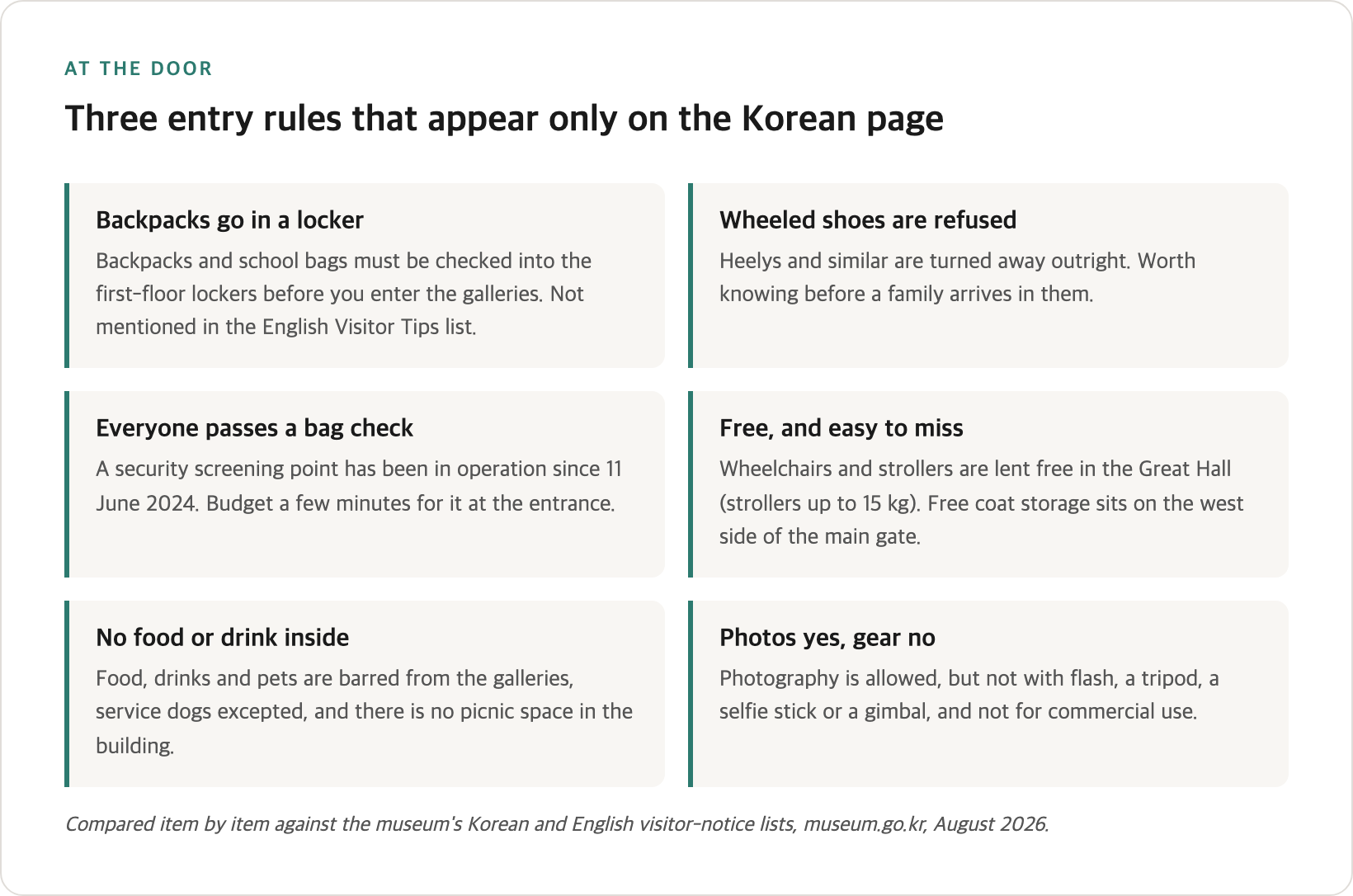
Local tip — three entry rules appear only on the Korean page. I compared the museum’s Korean 유의사항 (visitor notices) list against the English “Visitor Tips” list item by item. Both cover smoking, food, phones, noise, touching exhibits, and the ban on flash, tripods, selfie sticks and gimbals. The Korean list carries three more that the English list does not mention at all. Backpacks and school bags must be checked into the first-floor lockers before you enter the galleries. Wheeled shoes are refused entry outright — relevant if you are travelling with children in Heelys. And since 11 June 2024 all visitors pass a security screening point where bags are checked, which is a queue nobody arriving from an English guide is expecting. The Korean list also asks visitors to avoid slippers and similar dress. If you are carrying a day pack, plan on a locker stop and a bag check before you see a single object.
The storage itself is generous and free. Wheelchairs and strollers are lent free of charge in the Great Hall, with strollers rated for children up to 15 kg. There is free coat storage on the west side of the main gate, and lockers sit in front of the museum shop and outside the Children’s Museum. A lactation room is on the first floor of the Great Hall, opposite the shop.
Food and drink cannot go into the galleries at all, and there is no picnic space inside. Eat before you arrive — a convenience store run near Ichon Station is the cheap version — and factor it into the daily budget alongside everything else that a free museum quietly saves you.
The Route the Museum Itself Recommends
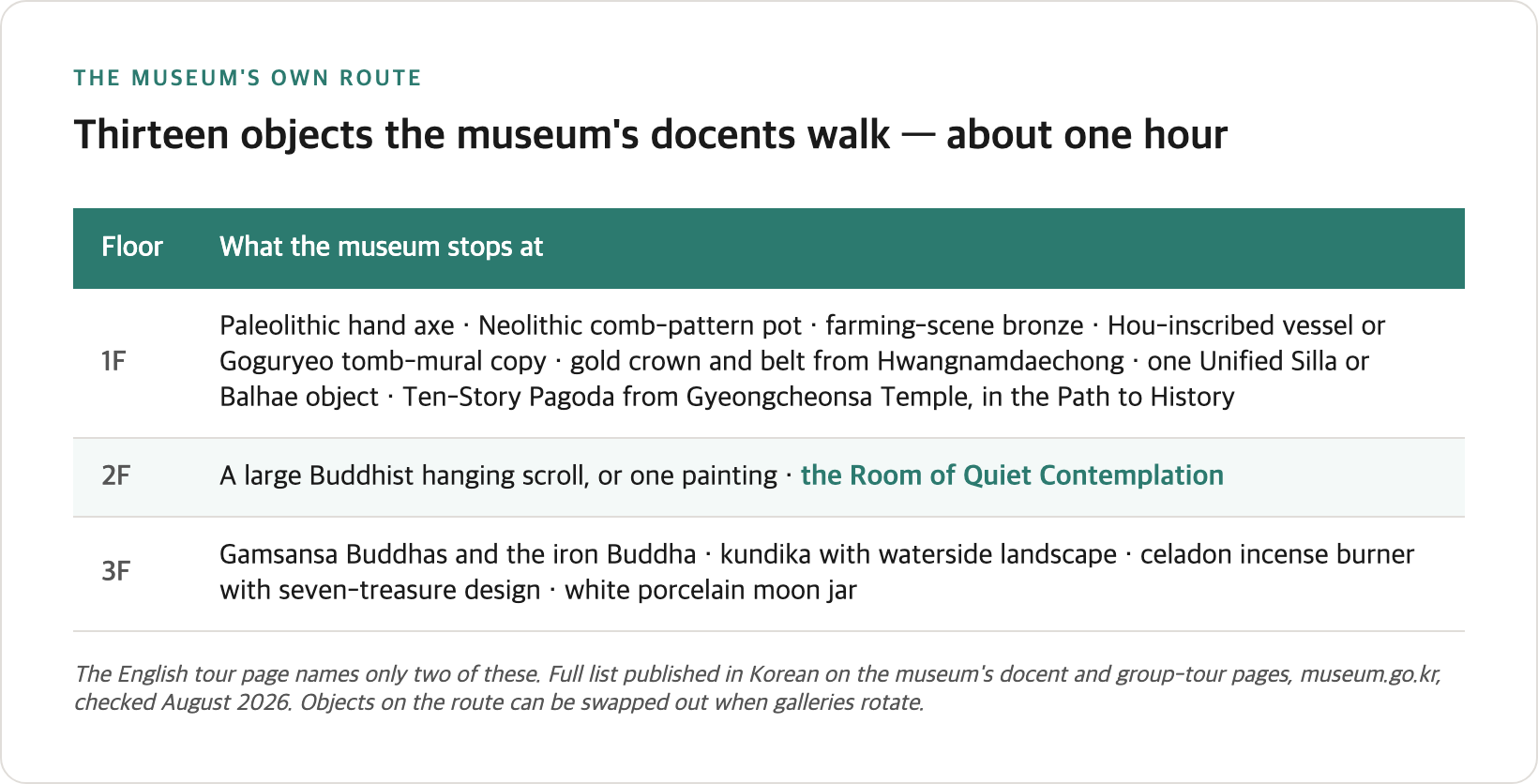
The building is genuinely large, and “allow two to three hours” is the least useful sentence in every English guide about it. The practical question is which objects to walk to if you have one hour, and the museum answers it in Korean without anyone quoting it.
Local tip — the museum publishes the exact object list its own docents walk, and the English page names only two of them. The Korean pages for both the walk-up docent talk and the bookable group tour set out an identical thirteen-object route across three floors, covering it in about an hour. The English tour page describes the same tour as “highlights including the Pensive Bodhisattva and the Ten-Story Pagoda from Gyeongcheonsa Temple” and stops there. The full list is: on the first floor, the Paleolithic hand axe, the Neolithic comb-pattern pot, the farming-scene bronze, the Hou-inscribed vessel or the Goguryeo tomb-mural copy, the gold crown and gold belt from Hwangnamdaechong, one Unified Silla or Balhae object, and the Ten-Story Pagoda from Gyeongcheonsa Temple standing in the Path to History; on the second floor, a large Buddhist hanging scroll or one painting, and the Room of Quiet Contemplation; on the third floor, the Gamsansa Buddhas and the iron Buddha, the kundika with waterside landscape, the celadon incense burner with seven-treasure design, and the white porcelain moon jar. Walk that and you have seen the museum’s own definition of itself.
The Room of Quiet Contemplation (사유의 방) sits on the second floor and holds two gilt-bronze Pensive Bodhisattva statues, both National Treasures, in a purpose-built low-lit room. It is the single space most visitors come for, and the one place where the advice to start upstairs pays off twice: you reach it before the ground-floor crowd works its way up.
The layout is worth carrying in your head. First floor: Prehistory and Ancient History, Medieval and Early Modern History, and the Path to History running through the middle. Second floor: Calligraphy and Painting, the Donation galleries, and the Room of Quiet Contemplation. Third floor: Sculpture and Crafts, and the World Art galleries.
Free Guided Tours in English
The museum runs a free Museum Highlights Tour for international visitors, roughly an hour long, and individuals do not need to book.
- Weekdays: 10:30 and 13:00
- Saturday and Sunday: English and Japanese at 10:30 and 13:00; Chinese at 13:00 only
- Meeting point: in front of the Korean Empire section, first floor of the Permanent Exhibition Hall
- Groups of 15 or more must telephone at least a day ahead: +82-2-2077-9683 for English
The schedule is reset monthly, so check on the day if the tour is why you are going.
Two conditions appear only in Korean. The foreign-language tours are restricted to foreign visitors — a Korean resident cannot simply join one, though a Korean accompanying a foreign visitor may. And commercial guiding operations are barred from using the free programme, while groups bringing their own guide must reserve in advance. If you have paid a private guide, they are not the museum’s guide, and they cannot fold your group into a free session.
The free exhibition guide app is the fallback if you miss a slot. Bluetooth beacons trigger commentary in Korean, English, Chinese, Japanese and Vietnamese, and it adds indoor navigation, gallery maps and recommended routes. Bring your own earphones and download the content over Wi-Fi first.
The Children’s Museum Is a Separate, Booked Museum
This trips up families who assume “free” means “walk in.”
The Children’s Museum is free but runs on online-booked sessions with no on-site ticketing at all. Sessions are about 80 minutes with a cleaning break between them, and each takes 320 online reservations. In the summer window of 28 July to 17 August 2026 it ran six sessions from 09:10 to 18:00; from 18 August it returns to five between 09:30 and 17:20.
The booking rules are strict enough to read before you rely on them:
- Individual bookings open at 00:00, 14 days before your visit, and close 50 minutes after each session starts
- Maximum five people per booking, one booking per person per day
- Children under 36 months still need their own reservation
- If you have not entered within 30 minutes of your session start, the booking is cancelled automatically — and a no-show carries a 60-day ban from the Children’s Museum
- Adults without a child, and children without an adult, are refused entry
- The galleries are pitched at ages 5–9
One inconsistency to be aware of: the museum’s English hours page carries a note reading “Children’s Museum: temporarily closed until December 14th” directly above a full list of operating sessions. The Korean pages carry no such closure, list the same sessions, and the Korean reservation system is taking bookings. If a closure notice on the English side is about to change your family’s plans, check the Korean reservation page before you cancel anything.
Getting There from Ichon Station
The museum is in Yongsan, at 137 Seobinggo-ro. Ichon Station serves it on Line 4 and the Gyeongui–Jungang Line, one transfer from most of central Seoul — change at Yongsan from Line 1, Samgakji from Line 6, Dongjak from Line 9. Ordinary fares apply, so a T-money card covers it and the tap-out rules that changed in 2026 apply as anywhere. Broader planning is in getting around Korea, and if your mapping app misbehaves, Korean map apps rather than Google Maps is the fix.
From Exit 2 it is about 150 m on the surface toward Yongsan Family Park. There is also the Museum Nadeulgil (박물관 나들길), a 255 m underground passage to the museum’s west gate, 160 m of it moving walkway, with lifts toward Exits 1 and 2.
Local tip — the museum’s own two language versions give different closing times for the Ichon underpass. The Korean directions page states the Nadeulgil is open 07:00–23:00, and adds that it does not open on days the museum is closed. The English directions page opens with the same 07:00–23:00 line, then gives a day-by-day table underneath it ending at 19:00 on Mondays, Tuesdays, Thursdays, Fridays, Sundays and holidays, with only Wednesday and Saturday running to 22:00. I could not reconcile the two from published sources, so treat the shorter figure as the planning assumption: if you leave after 19:00 on a night that is not Wednesday or Saturday, expect to walk the 150 m surface route from Exit 2 rather than the covered one. In January or in a downpour that is a difference worth knowing in advance. On a full closure day — 1 January, Seollal, Chuseok — the passage is shut outright.
Yongsan Family Park is immediately next door, and the grounds run 07:00–22:00 without a ticket — a reasonable early-morning or after-dark walk independent of the galleries.
Free Now, Possibly Not in 2027
The permanent galleries have been free since May 2008. That is now under active review.
Director Yoo Hong-jun said in an October 2025 press briefing, and again in February 2026, that the museum is working with the Ministry of Culture, Sports and Tourism toward charging for the permanent exhibition. The published sequence is: build the ticketing infrastructure through 2026, run a pilot in the first half of 2027 covering online reservation, on-site ticketing, contactless electronic ticket checks and mobile QR tickets, then decide after public hearings and inter-ministry consultation.
Nothing is settled. No price has been set — figures floated in the Korean press have ranged from ₩2,000 to ₩10,000 for adults with no official confirmation — and the government has publicly stated that no decision has been made on paid admission at national cultural sites. Unlike most of what is on this page, this story has been covered in English by the Korea Times, the Korea Herald and the Korea JoongAng Daily, so it is not obscure. What is worth carrying is the shape of it: a reservation system arrives before a fee does, and a museum that currently needs nothing but your presence may within a couple of years need a booking.
What You Need to Know
-
The permanent galleries are free and need no booking. Only paid special exhibitions and the session-booked Children’s Museum work differently.
-
The hours moved on 16 March 2026. 09:30–17:30 ordinarily, 09:30–21:00 on Wednesdays and Saturdays. Several English listings, including Seoul’s official English tourism site, still show 10:00–18:00.
-
“Closed” means two different things. Full closures are 1 January, Seollal and Chuseok. The first Monday of March, June, September and December closes the galleries only — and there was no March closure in 2026.
-
The grounds run 07:00–22:00 with no ticket, far longer than the galleries, and stay open on gallery-closure days.
-
A backpack means a locker stop, and everyone passes a security check. Neither rule appears on the museum’s English page.
-
Start on the second and third floors. That is the museum’s own crowd advice, and the Room of Quiet Contemplation is upstairs anyway.
-
Free admission is under review. A ticketing pilot is planned for the first half of 2027, with no price and no decision yet.
Practical Tips
-
Check the day before you go, not the week before. Hours and the docent schedule are both reset monthly, and 2026 has already produced one permanent change and one summer exception.
-
Aim for a Wednesday or Saturday if your day is tight. The 21:00 close gives you the two longest days of the week, the evening galleries are quieter, and Wednesday evening is when the special-exhibition discount applies.
-
Travel light, or budget ten minutes at the door. Backpacks go into first-floor lockers and every visitor passes a bag check. Coat storage and lockers are free.
-
Go up before you go along. Take the escalator to the third floor and work down, rather than turning into the Prehistoric gallery with everyone else.
-
Treat the last hour as half an hour. Admission stops 30 minutes before closing for the permanent galleries and 40 minutes before for paid special exhibitions, and staff start clearing the rooms 10 minutes out.
-
Book the Children’s Museum 14 days ahead at midnight if you need a specific session, and arrive within 30 minutes of your slot or lose it — plus a 60-day ban.
-
If it rains or the galleries are shut, the grounds still work. The pagoda garden runs to 22:00 with no ticket, and a jjimjilbang is the other all-weather option in the same price bracket. For a full day out of the city, a DMZ tour has to be booked well ahead.
Frequently Asked Questions
Is the National Museum of Korea free?
Yes. The permanent galleries are free with no ticket and no reservation, as they have been since May 2008, and the Children’s Museum is free but needs an online session booking. Only designated paid special exhibitions charge — currently ₩5,000 for adults in Gallery 2 (as of 2026). The museum is preparing a ticketing pilot for the first half of 2027 that could eventually lead to a charge, but no price has been set and no decision announced.
What are the opening hours of the National Museum of Korea?
Since 16 March 2026 it opens at 09:30 and closes at 17:30 on Mondays, Tuesdays, Thursdays, Fridays and Sundays, with last admission at 17:00. On Wednesdays and Saturdays it stays open to 21:00, last admission 20:30. During the summer window of 27 July to 17 August 2026 it ran 09:00–18:00 instead. Several English travel listings still show the pre-March hours of 10:00–18:00.
When is the National Museum of Korea closed?
It closes completely on 1 January, Seollal and Chuseok — in 2026, 1 January, 17 February and 25 September. Separately, the Permanent Gallery and both Special Exhibition Galleries close on the first Monday of March, June, September and December, which in 2026 means 1 June, 7 September and 7 December, with no March closure. On those days the outdoor grounds and pagoda garden stay open.
Do I need to book the National Museum of Korea?
Not for the permanent galleries — you walk in. The Children’s Museum requires an online reservation with no on-site ticketing, opening 14 days ahead at midnight, 320 places per session, and children under 36 months need their own booking. Paid special exhibitions can be booked through TicketLink or Naver until the day before, or bought at the desk on the day.
Is there a free English tour at the National Museum of Korea?
Yes. The Museum Highlights Tour for international visitors runs about an hour, at 10:30 and 13:00 on weekdays, and at 10:30 and 13:00 in English and Japanese at weekends, with Chinese at 13:00 only. It meets in front of the Korean Empire section on the first floor, and individuals do not need to book. Groups of 15 or more must call a day ahead, and the schedule changes monthly.
How long do you need at the National Museum of Korea?
The museum’s own docent route covers thirteen objects across three floors in roughly an hour, which is the efficient answer if time is short. Two to three hours lets you add a gallery you care about. Because entry is free you can come back another day without paying twice, so there is no reason to force the whole building into one visit.
What can’t you bring into the National Museum of Korea?
Food, drinks and pets are prohibited, with certified service dogs permitted. Backpacks and school bags must be left in the first-floor lockers, and wheeled shoes are refused entry — two rules that appear only on the Korean-language page. All visitors pass a security screening point in place since 11 June 2024. Photography is allowed, but not with flash, a tripod, a selfie stick or a gimbal, and not for commercial use.
Related Questions
- Gyeongbokgung: Free Entry Days and When It’s Closed
- Changdeokgung Secret Garden: Why You Can’t Just Walk In
- Jjimjilbang: What First-Timers Get Wrong About Time Limits