Jjimjilbang Rules in Korea: The Two Clocks, the Curfew, and Who Gets Turned Away
Updated for August 2026
Quick Answer
A jjimjilbang (찜질방) is a Korean bath house and sauna complex, licensed as a bath-house business under the Public Health Control Act. Entry runs roughly ₩12,000–17,000 (as of 2026). Two separate clocks matter: the night rate usually starts at 20:00, and a statutory curfew keeps under-19s out from 22:00 to 05:00 unless a guardian comes along or signs a consent form.
The Full Answer
There is no shortage of English-language jjimjilbang guides. They cover the wristband, the gender-separated baths, the sauna rooms, the shared sleeping halls, and the etiquette of washing before you get in the water. All of that is accurate and all of it is visible in your first ten minutes inside.
What none of them cover is the regulation underneath. A jjimjilbang is not an informal cultural institution — it is a 목욕장업 (mogyokjangeop), a licensed bath-house business, and the enforcement rule attached to the Public Health Control Act (공중위생관리법) spells out what the operator must and must not do: who may be turned away, what hours minors may enter, what the venue may put on the floor for you to sleep on, and what has to be posted on the wall.
I read the current text of that enforcement rule — 공중위생관리법 시행규칙 [별표 4], as amended on 22 June 2022 — in August 2026, along with the definition of 목욕장업 in Article 2 of the Act itself. I then checked the published price boards of three Seoul-area venues against what the English guides say about pricing, and traced the status of two well-known bath houses that English guides still recommend. I also read the English-language jjimjilbang guides currently ranking for the obvious searches. Two of them state pricing rules that the Korean price boards contradict, and the highest-ranking one opens its venue list with a place that was demolished six years ago.
None of this is about whether you will enjoy a jjimjilbang. You probably will. It is about the handful of points where the building does not behave the way an English guide said it would.
The Two Clocks: 20:00 and 22:00
Almost every English guide mentions “10 PM” somewhere, and almost all of them attach it to the wrong thing.
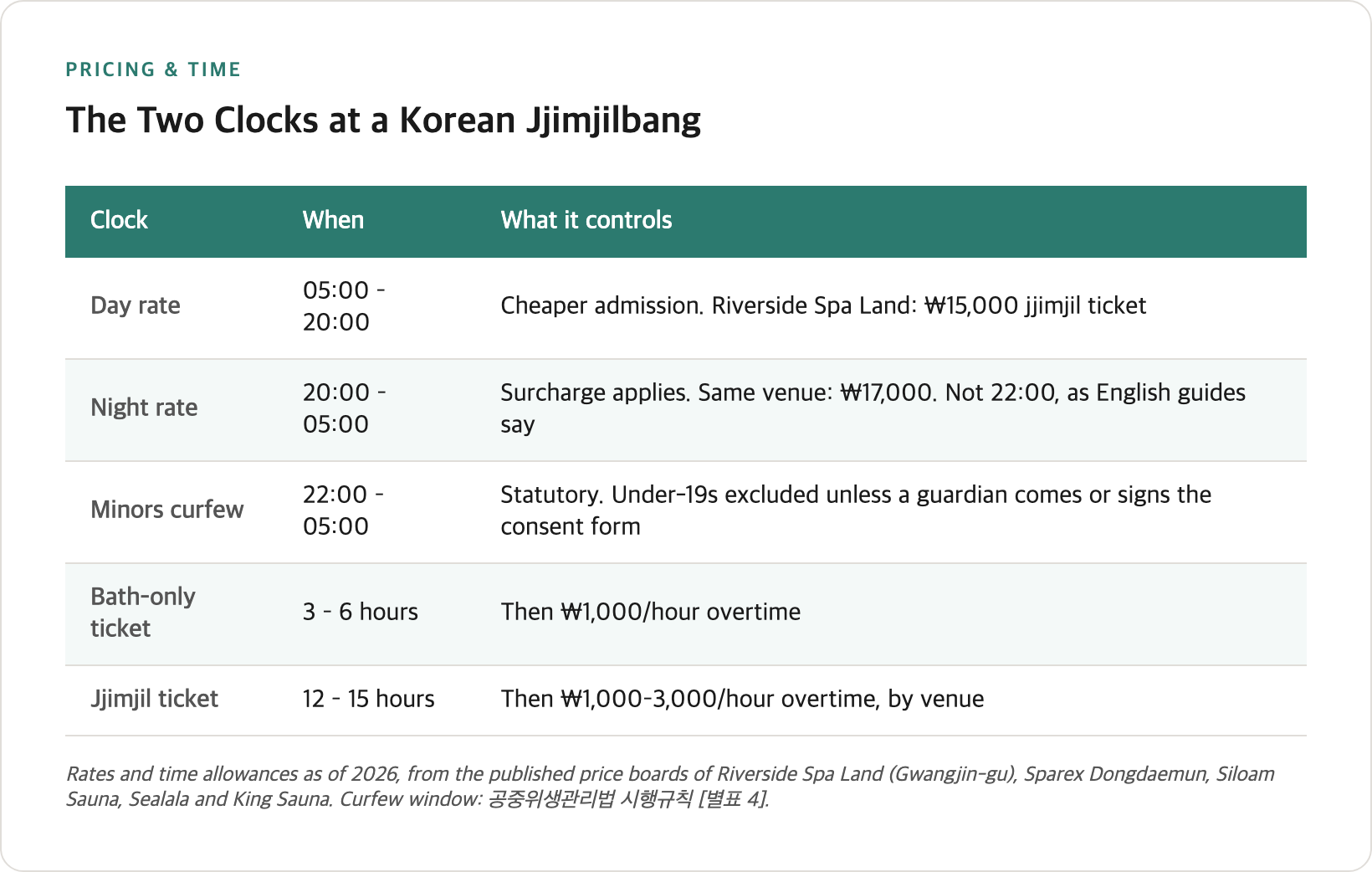
Local tip — the night surcharge starts at 20:00, not 22:00. Korean price boards split the day at 8 PM, not 10. Riverside Spa Land in Gwangjin-gu, Seoul publishes its day rate as 05:00–20:00 and its night rate as 20:00–05:00 (₩15,000 day / ₩17,000 night for the jjimjil ticket, as of 2026). Sparex at Dongdaemun runs the same 05:00–20:00 day window, and Siloam Sauna near Seoul Station lists its night admission as 20:00–05:00. One currently ranking English guide, updated in March 2026, tells readers that “some places charge extra after 10 PM.” The 22:00 line is real, but it is a different rule entirely — the statutory curfew for under-19s, which has nothing to do with what you pay.
The practical consequence is small in money and large in planning. If you arrive at 19:45 rather than 20:15 you buy the day rate, and at most venues the difference is ₩2,000. If you are budgeting a trip against what a week in Korea actually costs, the swing is trivial. What is not trivial is the assumption that you have until 10 PM to walk in cheap.
What Your Ticket Actually Buys
Entry is not open-ended, and — more usefully — the two tickets sold at the same counter run on very different clocks.
Most venues sell a 목욕 (mogyok) ticket for the wet baths only and a 찜질 (jjimjil) ticket that adds the clothed sauna floor. English guides treat these as a price difference. On Korean price boards they are also a time difference, and a large one.
Local tip — the bath-only ticket runs on a much shorter clock than the jjimjil ticket, and overtime is billed by the hour. Riverside Spa Land charges overtime after 6 hours on the sauna ticket but only after 15 hours on the jjimjil ticket, at ₩1,000 per hour in both cases (as of 2026). King Sauna in Gyeongsangnam-do publishes 3 hours for the bath and 12 for the jjimjil floor, also ₩1,000 per hour after that. Sealala’s jjimjilbang runs 12 hours with a steeper ₩3,000 per hour overtime. English guides that mention a limit describe it as “12 or 24 hours” without distinguishing the two tickets — so a visitor who buys the cheaper bath-only ticket to save ₩2,000 can be into overtime in an afternoon.
Two things follow. Note your entry time, because the wristband is timing you from the moment you tap in. And if there is any chance you will stay past dinner, buy the jjimjil ticket even if you never intend to use the sauna floor — the extra hours cost less than the overtime.
The wristband is also your tab. Lockers, food, drinks and any overtime charge to it, and you settle everything at the desk on the way out. That part every guide gets right. If you would rather not carry cash for it, note that the front desk is one of the places where a foreign card sometimes fails — the same wall described in which Korean apps and counters won’t take your card.
How a Visit Works
The flow is the same almost everywhere.
- Pay at the desk and get a wristband, cotton clothes and a towel
- Shoe locker first, then the gender-separated changing area
- Bathe naked in the same-sex wet area — wash at a station before entering the pools
- Change into the provided clothes and enter the mixed-gender sauna floor
- Roam the themed sweat rooms, snack bars, sleeping halls and lounges
- Settle any overtime at the desk on your way out — the wristband tracks it
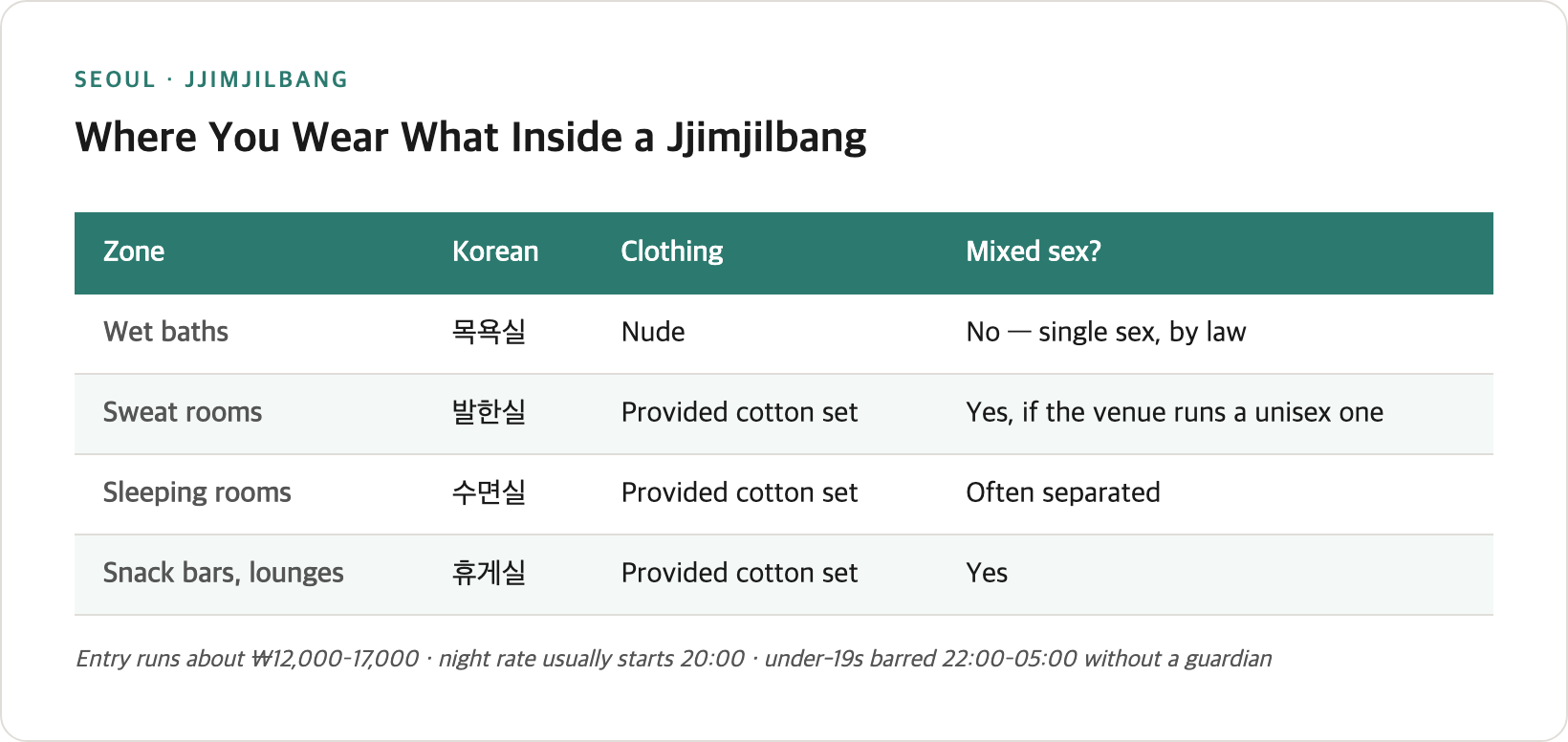
| Zone | Korean | Clothing | Mixed sex? |
|---|---|---|---|
| Wet baths | 목욕실 | Nude | No — single sex, by law |
| Sweat rooms | 발한실 | Provided cotton set | Yes, if the venue runs a unisex one |
| Sleeping rooms | 수면실 | Provided cotton set | Often separated |
| Snack bars / lounges | 휴게실 | Provided cotton set | Yes |
The clothed floor is not a convention — it is written into the rule. Where a bath house operates a unisex sweat room, the enforcement rule requires that people wear the issued sweat clothes (발한복) to enter or use it. That is why the cotton set is handed over at the desk rather than sold as an option, and why nobody is walking that floor in a towel.
The wet baths run the other way: single sex, no swimwear, and the enforcement rule also requires that staff working in the bath area, changing room and sweat rooms be the same sex as the customers, except outside business hours for cleaning and repair. If you have used a Japanese onsen the format will feel familiar; the staffing rule is stricter here.
Why You Are Sleeping on a Mat
Every English guide sells the jjimjilbang as budget accommodation. Almost none explains why the sleeping hall looks the way it does.
Local tip — a jjimjilbang is legally forbidden from stocking bedding for lodging. The enforcement rule states that a bath-house operator “shall not keep bedding used for lodging,” with an explicit proviso that large towels and pillows for a user’s temporary sleep or rest are permitted. That single clause explains the entire sleeping floor: heated wood, a mat, a folded towel, a block pillow, and no mattresses or duvets anywhere. It is not cost-cutting and it is not tradition. A bath house that furnished the room properly would be operating as accommodation, which is a different licence. English guides describe the mat as charmingly spartan; it is a licensing boundary.
Read that way, the overnight stay is better understood as a long rest inside a bath house than as a night in a hostel. It works, it is cheap, and it is one of the few places open when the subway has stopped — but you should not arrive expecting a bed, and you should keep enough on your transit card for the first train out.
Minors, the 22:00 Curfew, and the Consent Form
If you are travelling with anyone under 19, this is the section that matters, and it is missing from every English jjimjilbang guide I read.
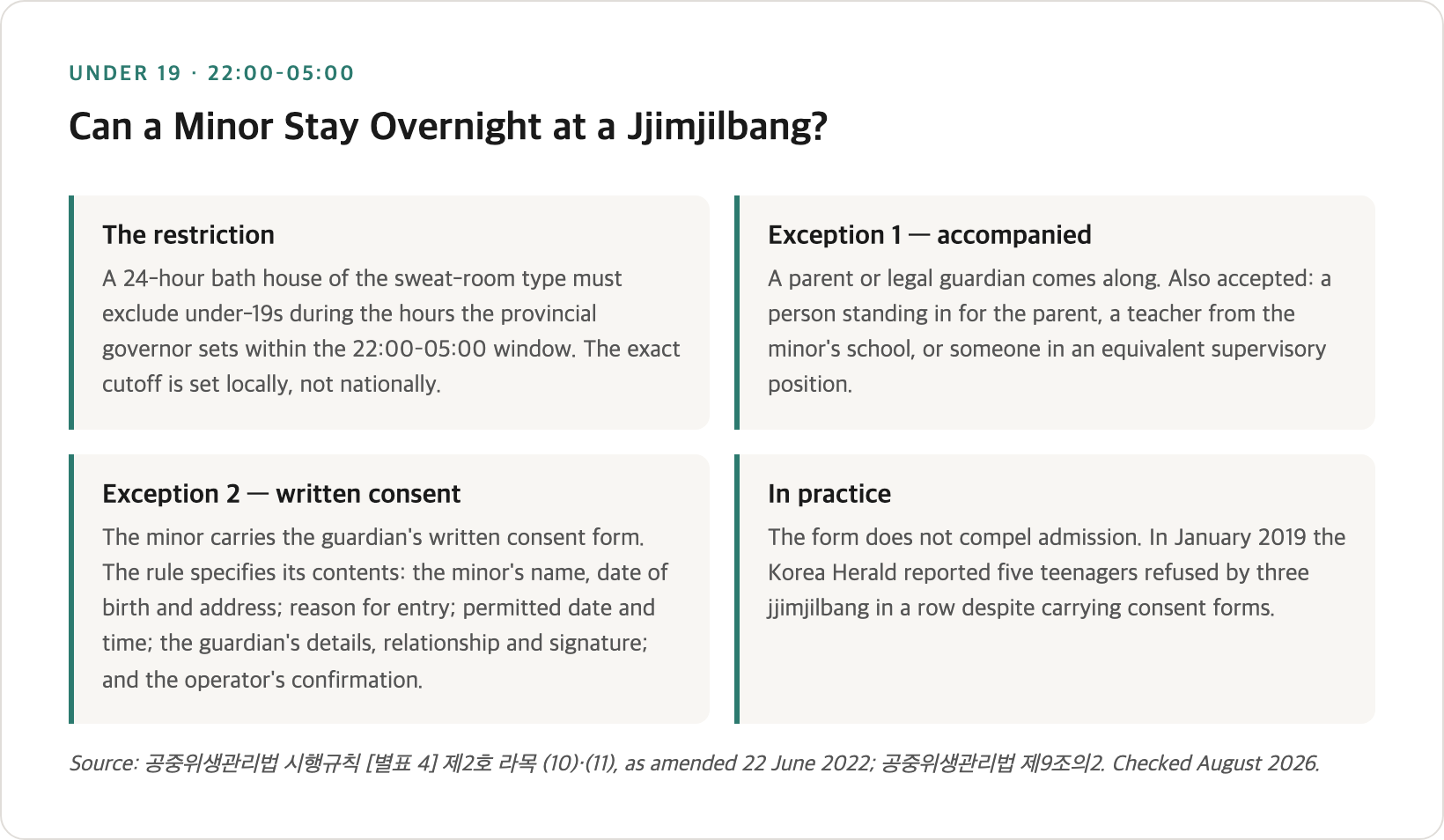
Local tip — under-19s are barred from a 24-hour jjimjilbang between 22:00 and 05:00, and the exception is a written consent form the law specifies line by line. The enforcement rule requires 24-hour bath houses of the sweat-room type to exclude minors during hours set by the provincial governor within the 22:00–05:00 window — so the exact cutoff is set locally rather than nationally, and venues publish their own. The proviso: the restriction does not apply if a parent or legal guardian comes along, if the minor carries that guardian’s written consent form, or if they are accompanied by someone standing in for the parent, a teacher from the minor’s school, or a person in an equivalent supervisory position. The rule then dictates what the form must contain — the minor’s name, date of birth and address; the reason for entry and the permitted date and time; the guardian’s name, date of birth, address, phone number, relationship to the minor and signature; and the operator’s confirmation.
Two caveats keep this honest. First, having the form does not guarantee entry. In January 2019 the Korea Herald reported that five teenagers travelling to Gangwon Province for the New Year sunrise were refused by three jjimjilbang in a row despite carrying consent forms, in the aftermath of the Gangneung carbon-monoxide accident. Venues that would rather not take the risk decline, and the rule obliges them to restrict entry, not to admit anyone.
Second, “under 19” here follows the Youth Protection Act’s counting, which is the same one behind the drinking age and is not the same arithmetic as Korean age. Bring passports; staffed front desks do check.
Children and the 48-Month Rule
The rule that surprises families most has nothing to do with teenagers.
The enforcement rule prohibits an operator from admitting males and females aged 48 months or older together into the bath area or the changing room. In plain terms: from a child’s fourth birthday, a mother cannot take a son into the women’s baths, and a father cannot take a daughter into the men’s. The threshold was lowered from five years old to four, effective 22 June 2022, in the same amendment that removed people with mental illness from the list of customers an operator must exclude.
Two things worth knowing. The obligation sits on the operator, not on you, which is why front desks enforce it firmly regardless of how the family feels about it. And several municipal health-office pages still publish the old “만 5세” figure — I found one Seoul district office page carrying it in August 2026 — so a Korean-language source you find online may be a year-count behind the statute. The mixed sauna floor is unaffected: everyone is clothed there, and children go wherever their family goes.
Who a Jjimjilbang Can Legally Turn Away
This is where English guides and Korean regulation diverge most sharply, and the divergence runs in the opposite direction to what most visitors expect.
The enforcement rule gives a short, closed list of people a bath-house operator must not admit:
| Must be refused | Detail |
|---|---|
| A person deemed to have an infectious disease | Exception for therapeutic bathing at hot-spring or seawater facilities |
| A person unable to use the bath house normally due to intoxication or similar | No exception |
That is the list. Tattoos are not on it.
Local tip — there is no statutory basis for refusing you over tattoos, but there is one for refusing you if you have been drinking. The bath-house operator standards name infectious disease and intoxication, and nothing else. Tattoo restrictions are venue policy rather than law — Korean reporting in 2024 documented “no tattoo zone” rules spreading through hotels, gyms and pools, with thresholds set by each operator (one Seoul hotel pool drew its line at 15cm), and a 2007 police attempt to treat visible tattoos in bath houses as a minor offence was criticised at the time as having no legal footing. Meanwhile English guides routinely suggest a jjimjilbang as the place to sleep off a night out. The operator standards point the other way, and so does the wall: the enforcement rule requires every sweat room to carry a posted warning listing people who should not enter, and one of the six categories is anyone within two hours of drinking alcohol.
So the honest reading is the reverse of the usual advice. Tattoos are usually fine, and Korean bath houses are considerably more relaxed about them than Japanese onsen — but arriving visibly drunk is the thing the rule actually addresses. If the evening has already gone that way, Korean hangover remedies and the norms in drinking in Korea are the more useful reading, and a convenience store is open at the same hour with fewer conditions attached.
Hygiene Rules You Can Actually Check
The same enforcement rule sets out obligations that are visible to a customer who knows to look, which makes it a better cleanliness test than reviews.
- Towels, gowns and rental clothes must be laundered before being handed to a customer. Not “should be” — must be.
- Bath water gets a water-quality test at least once a year. Venues that filter and recirculate their tub water carry two extra duties: a weekly measurement of temperature and free residual chlorine, recorded, and an annual Legionella test through an accredited laboratory.
- The tub-water management notice must be posted somewhere easy to see. This is the one to look for. If you cannot find a posted notice about tub-water management near the baths, the venue is out of compliance with a rule that costs nothing to follow.
- Combs, if provided, must be stored used and unused separately, and used ones disinfected. Seat baths and steam devices must be disinfected after every single customer.
- A thermometer must be present inside every sweat room, with the warning notice posted inside and outside.
None of this makes a bath house good. It does give you three things to glance at — the posted water notice, the thermometer, the comb bins — that a venue cutting corners tends to skip first.
Venues English Guides Still Recommend That Are Gone
This is where an out-of-date guide costs you an evening rather than ₩2,000.
| Venue | What English guides say | Actual status |
|---|---|---|
| Itaewon Land | Listed first by a Seoul tourism guide updated 29 July 2026 as “the most foreign-friendly… 24-hour service” | Stopped trading in early 2020; the building was demolished and the site run as a car park pending redevelopment, per Korean property reporting in 2022 |
| Dragon Hill Spa (Yongsan) | Still named in current travel articles; some now note it closed | Suspended in 2021, never reopened after distancing ended, delisted from Naver Place in 2025 |
| Sparex (Dongdaemun / Dongmyo) | Rarely featured | Reopened after its pandemic suspension and operating, 24 hours, with a renovated Dongmyo branch |
The Itaewon Land case is worth dwelling on, because it shows how the failure happens. The venue was genuinely the most foreigner-friendly bath house in Seoul for years, so it is embedded in a decade of English writing, and each new guide inherits it from the last. Korean sources closed the question in 2022. English guides updated in 2026 have not caught up.
The general lesson is more useful than the specific one: check the venue on a Korean map before you build an evening around it. A place with no recent reviews and no listing is usually gone, and that check takes thirty seconds — the mechanics are in why Google Maps doesn’t work in Korea. It is the same discipline that saves you a wasted trip to a palace on its closing day.
What You Need to Know
-
Two clocks, not one. The night rate starts at 20:00. The 22:00 line is the minors’ curfew and does not affect your bill.
-
The bath-only ticket has a shorter time limit than the jjimjil ticket — as little as three to six hours at some venues, against twelve to fifteen. Overtime runs roughly ₩1,000–3,000 per hour (as of 2026).
-
Under-19s are excluded from 22:00 to 05:00 unless a guardian comes along or has signed the consent form the rule specifies. Venues can still decline.
-
From 48 months old, children use the bath matching their own sex. The operator is legally obliged to enforce it.
-
Tattoos are venue policy; intoxication is regulation. Only infectious disease and intoxication appear on the statutory refusal list.
-
There is no bedding because bedding is not allowed. Mats, large towels and pillows are the legal maximum.
-
Prices and hours vary widely by venue. The price board must be posted at the front desk, but it does not have to be posted outside — so you often cannot see the rate until you are already at the counter.
Practical Tips
-
Arrive before 20:00 if you want the day rate. The boundary is 8 PM at every Seoul price board checked for this article, not 10 PM.
-
Buy the jjimjil ticket rather than the bath-only ticket if you might stay more than a few hours. The time allowance is the real difference, not the sauna floor.
-
Note your entry time. The wristband starts counting on the way in, and overtime is settled on the way out.
-
Bring a passport for anyone who looks under 19 — and, if they are, the guardian’s written consent form if a guardian is not coming.
-
Look for the posted tub-water management notice near the baths. It is a required posting and a fast read on whether the venue follows the rules it can be inspected against.
-
Check the venue on a Korean map app before travelling to it. Two famous names in English guides no longer exist.
-
Assume no re-entry. Leaving generally ends the session, so buy snacks and toiletries at a convenience store on the way in rather than stepping out later. A noraebang is the usual second stop after, not before.
Frequently Asked Questions
How much does a jjimjilbang cost in Korea?
Roughly ₩12,000–17,000 for the jjimjil ticket at a Seoul venue (as of 2026), with the bath-only ticket a few thousand won cheaper. Riverside Spa Land in Gwangjin-gu publishes ₩15,000 for the day jjimjil ticket and ₩17,000 at night; Sparex at Dongdaemun lists ₩12,000 for its day session. The night rate typically begins at 20:00, and overtime beyond your ticket’s time allowance runs about ₩1,000–3,000 per hour depending on the venue.
Is there a time limit at a jjimjilbang?
Yes, and it differs by ticket. Korean price boards commonly allow 12 to 15 hours on the jjimjil ticket but only 3 to 6 hours on the bath-only ticket, with hourly overtime after that. English guides that mention a limit usually give “12 or 24 hours” without separating the two tickets, which is how visitors on the cheaper ticket end up paying overtime by mid-afternoon.
Can you sleep overnight at a jjimjilbang?
Yes, and it is a long-standing budget option, but it is not accommodation in the licensing sense. The enforcement rule under the Public Health Control Act bars a bath house from keeping bedding used for lodging, permitting only large towels and pillows for temporary sleep or rest. That is why the sleeping hall is a heated floor with mats rather than beds. Check your ticket’s time allowance before assuming a late arrival covers you to morning.
Can under-19s go to a jjimjilbang in Korea?
During the day, generally yes. Overnight is restricted: 24-hour bath houses of the sweat-room type must exclude minors during hours the provincial governor sets within the 22:00–05:00 window. The rule carries an explicit exception for a minor accompanied by a parent or guardian, carrying that guardian’s written consent form, or accompanied by a teacher from their school or an equivalent supervisor. The form’s required contents are specified in the rule. In practice some venues refuse even with the form.
Can a mother take her son into the women’s baths?
Only until he is 48 months old. The enforcement rule prohibits admitting males and females aged 48 months or over together into the bath area or changing room, and the obligation is on the operator. The threshold was lowered from five years to four with effect from 22 June 2022, so older Korean-language pages — including some municipal health-office pages still online in 2026 — may still show the previous figure.
Will tattoos stop you entering a Korean jjimjilbang?
Usually not, and Korean bath houses are considerably more relaxed about tattoos than Japanese onsen. There is no provision in the bath-house operator standards allowing refusal on that basis: the list of people an operator must exclude covers infectious disease and inability to use the facility normally due to intoxication. Restrictions that do exist are individual venue policies, and Korean reporting in 2024 documented such policies spreading through hotels, gyms and pools rather than being imposed by law.
Can you go to a jjimjilbang after drinking?
This is the reverse of the common English advice. Bath-house operators are required to refuse anyone who cannot use the facility normally because of intoxication, and every sweat room must display a warning notice listing people who should not enter — one of the six listed categories is anyone within two hours of drinking alcohol. Sleeping off a heavy night at a jjimjilbang is a real practice, but arriving visibly drunk is exactly what the rule addresses.
Are men and women separated at a jjimjilbang?
The wet baths are single sex by law, fully nude, and no swimwear. Staff working in the bath area, changing rooms and sweat rooms must be the same sex as the customers, except outside business hours for cleaning. The clothed sauna floor is mixed, and where a venue runs a unisex sweat room the rule requires the issued sweat clothes to be worn. Sleeping rooms are frequently separated by gender, and many venues run a women-only sleeping room.
Related Questions
- Gyeongbokgung: Free Entry Days and When It’s Closed
- Changdeokgung Secret Garden: Why You Can’t Just Walk In
- The National Museum of Korea: Free Entry, Late Nights, and the Room You Came For
- DMZ Tour: Booking Rules, Dress Code, and Why It Gets Cancelled