Bringing Medication to Korea: 6-Bottle Limit and 3 Tiers
Last Updated on August 17, 2026
Quick Answer
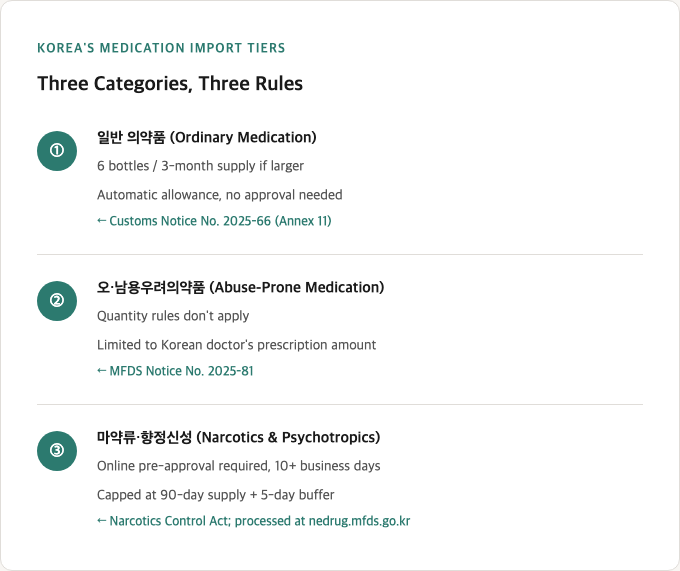
Korea splits medication rules into three tiers, not the two most guides describe. Ordinary medication gets an automatic allowance of six bottles, or a three-month supply if that is larger, per the Korea Customs Service’s current notice. A separate list of “abuse-prone” drugs skips that allowance and is capped at whatever a Korean doctor’s prescription specifies. Narcotics and psychotropics need online pre-approval before you fly. This article covers procedure only, not medical guidance.
The Full Answer
This is not medical or legal advice. Nothing here tells you whether to take, stop, or substitute a medication — it answers one narrower question: what quantity clears Korean customs automatically, what doesn’t, and who to contact if you’re over the line.
Most English-language guides describe a single split: “controlled substances” versus everything else. That framing isn’t wrong, exactly — it’s incomplete in a way that matters. Korea’s actual customs schedule separates medication into three categories, each governed by a different notice from a different agency, with different rules for exceeding the limit. This is a different checkpoint from the arrival paperwork covered in our guide to Korea’s K-ETA — that system governs who can arrive at all; these rules apply once you’re at the customs counter. The general duty-free value allowance and the declaration form itself are covered separately — including why Korea’s own English-language customs page lists a lower figure than the Korean one; this article stays on medication quantities.
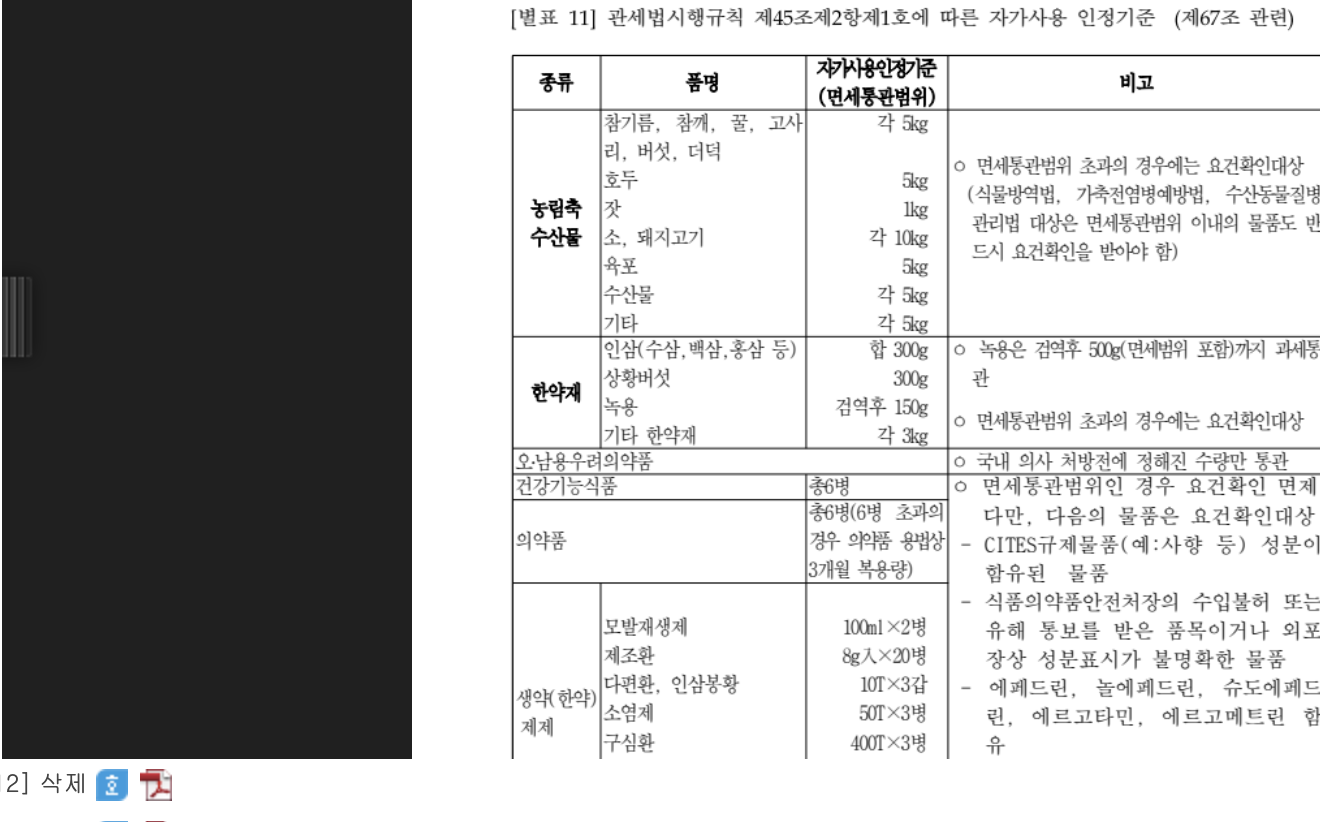
I opened the Korean government’s law portal and read Annex 11 of the Korea Customs Service’s import clearance notice (수입통관 사무처리에 관한 고시), the document that sets these quantities. The current version is Customs Service Notice No. 2025-66, amended December 17, 2025, effective the same date. It lists medication as its own row, separate from a row for “abuse-prone medication” (오·남용우려의약품) and a third for health functional foods. Three rows, three sets of rules — not two.
| Tier 1 — Ordinary medication | Tier 2 — Abuse-prone medication | Tier 3 — Narcotics & psychotropics | |
|---|---|---|---|
| Covers | Most prescription and OTC medication | Erectile-dysfunction drugs and anabolic steroids mostly, plus dapoxetine, clomipramine and furosemide | Narcotics and psychotropics, including ADHD medication (methylphenidate) |
| Quantity limit | 6 bottles, or a 3-month supply if larger | No bottle count — capped at whatever a Korean doctor’s prescription specifies | Capped at a 90-day supply, matched to your travel dates, plus up to 5 extra days |
| Who sets the rule | Korea Customs Service, Notice No. 2025-66 (Annex 11) | Quantity by Annex 11; the list of what counts by Ministry of Food and Drug Safety Notice No. 2025-81 | Narcotics Control Act, applied through nedrug.mfds.go.kr |
| Action required | None — automatic allowance at the border | None at the border, but quantity is judged against a Korean prescription | Online pre-approval, at least 10 business days before departure |
| How most English guides describe it | Folded into a single “non-controlled” bucket — and the headline number itself varies by source (6 weeks / 3 months / 6 months) | Not distinguished from Tier 1 at all — no English source reviewed for this article named the list | Described only as “controlled substances requiring approval,” without the launch date, processing time, or quantity cap |
Tier 1 — Ordinary Medication: Six Bottles, or Three Months’ Supply
For medication that isn’t on the separate abuse-prone list (covered below), Annex 11’s own wording sets the limit as “a total of 6 bottles (for quantities exceeding 6 bottles, a 3-month supply according to the medication’s dosage instructions).” In practice: six containers without further review, or — if six containers would give you less than three months at your normal dose — up to a three-month supply instead. It’s an automatic self-use allowance, requiring no application or doctor’s note at the border.
Local tip — search this and you’ll get three different answers from three different English-language sites. The U.S. Embassy in Seoul’s page on controlled substances, last updated May 13, 2026, has it right: “you may bring up to six bottles (or a three-month supply) into Korea for personal use.” A second site, Mile Asia, told readers to “bring a maximum of 6 weeks’ supply of prescription medication without additional approval” in a guide bylined May 4, 2026 — that site went offline shortly before this article was published, so it is quoted here without a link rather than pointed at a dead page. CanIBringTo runs the error the other way across three pages — medication, OTC medication, cold medicine — each giving a quantity limit of “up to 6 months supply for personal use.” Only one of the three numbers is in Korea’s actual customs schedule.
Health functional foods (건강기능식품) — vitamins, supplements, and similar products — get their own row and their own six-bottle figure in the same table, counted separately from medication. Both are quantity allowances, not value ones, though Korea Customs notes on its arrival page that what you bring under them still counts inside the same per-person duty-free value rather than on top of it. If your supplement allowance runs out, the annex says a Korean doctor’s opinion can support an exception in a reasonable range — the same pattern that governs the categories below.
One more line in Annex 11 matters if you take cold, allergy, or decongestant medication. Its remarks column lists what stays subject to import-requirement verification even inside the duty-free quantity: products containing CITES-regulated ingredients, items the drug safety ministry has refused entry or flagged as harmful, products whose outer packaging doesn’t state its ingredients clearly, and single-formulation finished drug products containing ephedrine, norephedrine, pseudoephedrine, ergotamine, or ergometrine. Staying under six bottles doesn’t buy the automatic waiver there. If your regular decongestant lists one of those five as its single active ingredient, check with Customs directly rather than assuming the allowance covers it. Buying a cold remedy after you land is a separate question from carrying one in — what Korean convenience stores and pharmacies actually stock covers that side.
Tier 2 — “Abuse-Prone Medication”: The List Where the Six-Bottle Rule Doesn’t Apply
This is the tier most English-language guides miss entirely, because it doesn’t exist in the “controlled versus non-controlled” framing. It sits under Annex 11’s “오·남용우려의약품” row, and that row carries no quantity at all — only that the amount allowed is whatever a domestic (Korean) doctor’s prescription specifies. What counts as one is set separately, in a Ministry of Food and Drug Safety notice.
I checked that notice on the same law portal: Notice No. 2025-81, amended December 17, 2025, effective February 13, 2026 — a different agency, a different number, a different effective date from the notice that sets the six-bottle rule. Article 2 names its items by active ingredient, and how it qualifies them matters. Five entries are limited to erectile-dysfunction use — alprostadil, sildenafil, thymoxamine hydrochloride, apomorphine hydrochloride, tadalafil. Five more carry no indication at all, so those entries cover the preparations generally: vardenafil, udenafil, mirodenafil, avanafil, dapoxetine. Clomipramine is listed for premature-ejaculation use. One entry is a block of oral and injectable anabolic testosterone-class steroids — nandrolone decanoate, mesterolone, methyltestosterone, stanozolol, oxandrolone, oxymetholone, fluoxymesterone, and three testosterone esters. And one entry is none of the above: furosemide, an ordinary diuretic.
That last one is why it’s worth reading the list rather than a summary of it. “Erectile-dysfunction drugs and steroids” describes most of the notice but not all of it, and a medication can land in this tier without belonging to either group.
Local tip — if your medication is on this list, the six-bottle rule doesn’t apply to you at all, regardless of how few you’re carrying. A single pill of a listed abuse-prone medication, without a Korean prescription behind it, sits outside the automatic allowance the same way twenty would. Pyeongtaek Customs uses this exact category — “erectile-dysfunction medication containing alprostadil” — as its worked example of what gets pulled aside for review. None of the English-language sources checked for this article describe the list, the notice number, or the fact that quantity is irrelevant to it.
A caution on how to read this section: this article does not judge whether any specific drug on that list is legal for you to bring, and it isn’t naming these compounds to warn you off them. It names them because Korea’s regulation names them, and because no English source in this article’s research described the category at all. The practical result, if a medication you take contains one of these ingredients, is that Customs expects the amount you carry to match what a Korea-licensed doctor would prescribe — not what your home prescription says.
Tier 3 — Narcotics and Psychotropics: Apply Before You Fly
The third tier doesn’t use the six-bottle framework at all. Narcotics and psychotropic medications — a category that includes methylphenidate — require advance online approval, separate from anything Customs handles at the border. The requirement itself isn’t new and isn’t selective: it has applied since October 23, 2009, to all travelers regardless of nationality, a point both the U.S. Embassy’s page and the drug safety ministry’s Korean-language notice state in those terms. What changed recently is only how you apply.
I read the Korean Embassy in Tokyo’s public notice on this system directly (last revised June 29, 2026). The approval portal, nedrug.mfds.go.kr, has taken online applications only since December 27, 2024 — a change none of the English-language sources checked for this article mention at all. According to the notice:
- Processing takes 10 business days, so the embassy’s advice is to apply at least that far ahead of departure.
- The quantity approved is capped at a 90-day (three-month) supply and matched strictly to your travel dates: it has to be what you’d finish during your stay, not a general stock. Travelling on to another country afterward, with the onward ticket attached, extends what that covers.
- If a flight delay or a long flight would otherwise leave you short, the notice allows up to 5 extra days’ worth on top.
- All prescription medication travels in carry-on baggage, not checked luggage.
- Required documents — a passport copy, a flight ticket showing your travel dates, and either a doctor’s diagnosis and prescription or your home country’s narcotics export authorization — must be in Korean or English; other languages need a certified translation.
- The application must come from the person carrying the medication. Approval cannot be obtained through a representative.
Local tip — the online system most guides mention only exists since December 2024, and it comes with a built-in buffer most travelers don’t know about. Processing takes 10 business days, the approved quantity is capped at a 90-day supply matched to your travel dates, and Korea explicitly allows an extra 5 days’ worth for flight delays and long flights. None of that — the launch date, the processing window, the carry-on-only rule, or the buffer — showed up in the English-language sources checked for this article; the ones that mention pre-approval at all stop at “apply in advance.”
One rule in this tier has no exception: sending or receiving narcotics or psychotropic medication by international mail or parcel is prohibited outright under Korea’s Narcotics Control Act, regardless of quantity. The embassy notice puts it bluntly — if Customs intercepts such a package it is returned or destroyed, whatever the circumstances — and Korea Customs lists postal and courier shipments as one of its two standard patterns of illegal medication entry, alongside travelers carrying it in. The approval system above is the route; having medication mailed to you afterward is not a workaround.
If You Need More Than Three Months’ Supply
For Tier 1 medication, going over the three-month allowance doesn’t mean it’s refused outright. It means a different office handles it, and it isn’t the one most guides point you toward.
Pyeongtaek Customs’ published guidance describes the route for self-treatment purposes, capped at a total customs value of US$2,000: a diagnosis from a public health center director or the head of a licensed medical institution, submitted to obtain an “import requirement confirmation exemption recommendation” (수입요건확인 면제추천) from your provincial governor’s office — not from Customs, and not from the drug safety ministry. The page publishes three phone numbers for it, and all three are public health policy divisions rather than customs offices: Seoul City at 02-2133-7535, Gyeonggi Provincial Government at 031-8008-4739, and the Gyeonggi Northern Provincial Office at 032-8030-3284. Pyeongtaek Customs lists its own travelers’ clearance division separately, at 031-8504-7244. For a sense of what US$2,000 represents against an ordinary trip, our breakdown of what a week in Korea actually costs covers spending by category.
Which office you call depends on where you’ll be staying, not where you land, so settle your route first — our guide to getting around Korea covers how the regions connect. And the app that will actually resolve a Korean government address isn’t the one you’d reach for by default, as our look at why Google Maps doesn’t work in Korea explains.
Local tip — if you go over the limit, the office to call isn’t Customs and it isn’t the drug safety ministry. It’s your destination province’s public health policy division, and the same guidance specifies that only a diagnosis from a doctor licensed in Korea is accepted — not a note from a physician at home. That one condition decides whether the route is available to you: it can’t be completed from abroad before you arrive, so it fits a long-stay visitor who can already see a doctor here far better than a short-trip traveler planning ahead.
Four legal instruments are cited together on that page for this procedure: Article 45(2)(1) of the Customs Act Enforcement Rules, the Customs Service notice designating goods requiring customs officer confirmation, Annex 11 of the import clearance notice covered above, and the drug safety ministry’s abuse-prone medication notice. And note that this is separate from anything about your visa status — it governs quantity, not length of stay, so the three-month figure has nothing to do with Korea’s 90-day visa-free entry arrangement even though the numbers look alike.
Checking Your Own Medication Against the Official List
Korea Customs Service publishes something most travelers wouldn’t expect on a government customs page: actual brand names, not just chemical classes, grouped under the active ingredient. I pulled that page directly rather than relying on a summary of it. Its heading for the table translates as “major illegal medications intercepted by Customs,” and the organising principle is stated on the page — these are products it has stopped because they contain an ingredient Korea schedules under the Narcotics Control Act. Under dextromethorphan alone, the list includes common U.S. over-the-counter cold medicines: DayQuil, Delsym, Mucinex, NyQuil, Robitussin, and Sudafed among them. Under methylphenidate, it names Medikinet, Ritalin, and Concerta.
This article isn’t going to tell you whether any specific brand there is or isn’t permitted for you to carry — that depends on your prescription, your dosage, and facts this article has no way to know. Nor does finding a brand on it settle anything by itself; what it tells you is which tier your question belongs in. The list is useful for exactly what Customs built it for: checking your own medication’s brand name before you pack, rather than discovering a problem at the airport. Korea Customs Service’s page on medication containing narcotic ingredients is the source. If you’d rather check after you land than before you pack, you’ll need working data to load it — see our comparison of eSIM, physical SIM, and pocket WiFi options in Korea.
What About Traditional or Herbal Medicine?
Annex 11 handles it in two places, and both are about bringing it in — this is an import schedule, and Korea Customs republishes the same figures on its arrival-procedure pages.
Raw herbal materials (한약재) get a row of their own, separate from medication: ginseng in any form at 300g total, sanghwang mushroom at 300g, deer antler velvet at 150g after quarantine (up to 500g clears with duty paid), and other materials at 3kg each.
The other sits inside the medication row itself. Under 의약품, a sub-entry for herbal preparations (생약(한약)제제) replaces the six-bottle figure with per-product quantities — hair-regrowth preparations at 100ml × 2 bottles, hwallakhwan and sampyeonhwan at 10 pills, baekbonghwan and woohwangchungsimhwan at 30 pills, and five more entries in the same style. Most are Chinese patent medicines rather than Korean ones, which fits the direction the schedule is written for.
Herbal medicine not named there gets no figure of its own; it sits under the general medication row, unless an active ingredient in it appears on the Tier 2 list. Buying Korean herbal products to take home is the opposite direction — a departure-side question, and our guide to Korea’s VAT refund covers what you can claim on the way out.
What You Need to Know
- Korea’s medication rules split into three tiers, not two. Most English-language guides describe only “controlled” versus “non-controlled” and miss the middle category entirely.
- The correct number for ordinary medication is six bottles, or a three-month supply — not six weeks, and not six months. Both of those alternate figures were on English-language sites ranking for this search when it was checked in August 2026.
- The abuse-prone medication list bypasses the six-bottle rule completely. Erectile-dysfunction drugs and anabolic steroids are the largest groups on it, but not the only ones. If your medication is listed, the limit is whatever a Korean doctor’s prescription specifies, with no quantity floor.
- Narcotics and psychotropics need online pre-approval through a system that has only existed since December 2024. Processing takes 10 business days, the approved quantity is capped at a 90-day supply matched to your travel dates, and up to 5 extra days’ worth is allowed for delays and long flights.
- Exceeding the ordinary three-month allowance routes through your destination province’s public health office, not Customs. Only a diagnosis from a doctor licensed in Korea is accepted for this exception, which effectively rules it out as something you arrange before you arrive.
- Certain cold and allergy medicines lose the automatic waiver even inside the six-bottle limit if they contain ephedrine, norephedrine, pseudoephedrine, ergotamine, or ergometrine as a single active ingredient.
- None of this is medical or legal advice. It describes a customs procedure — quantities, agencies, application routes — not guidance on your medication or condition.
Practical Tips
-
Sort your medication into the three tiers before you pack, not after you land. Check whether anything you’re carrying appears on the abuse-prone list, and search your specific brand name — not just the active ingredient — against Korea Customs’ published list, which is organized to be checked exactly that way.
-
If your medication is a standard prescription or over-the-counter product, stay within six bottles or a three-month supply, whichever is larger. That’s the automatic Tier 1 allowance; nothing further is required to claim it.
-
If you’re carrying narcotics or psychotropic medication, apply online at least 10 business days before departure. The system only accepts applications from the person carrying the medication, not a representative, and the approved quantity is tied to your travel dates rather than issued as a standing allowance.
-
Pack prescription medication in your carry-on, not your checked bag. The Korean Embassy in Tokyo’s notice states this as a flat rule, and the customs counter where any of this gets resolved comes after baggage claim — our guide from Incheon Airport to Seoul covers what happens once you’re through it.
-
Don’t plan around having medication mailed to you as a backup. Narcotics and psychotropics sent by international mail or parcel are prohibited outright, with no quantity exception.
-
If you’ll need more than three months of an ordinary medication, contact your destination province’s public health policy division, and know in advance that only a Korea-licensed doctor’s diagnosis is accepted for the exception.
-
Treat a generic “customs limits” article as a starting point, not a final answer. The sites checked for this article that got the headline number wrong were off in different directions — six weeks on one, six months across three pages of another — which suggests the error comes from applying a template rather than reading Korea’s own schedule.
Frequently Asked Questions
How much prescription medication can I bring into South Korea?
For medication that isn’t on the separate abuse-prone list, the automatic allowance is six bottles, or a three-month supply according to your dosage instructions if that’s larger — confirmed against Customs Service Notice No. 2025-66 (effective December 17, 2025). This is not a per-item cap on cost; it’s a quantity allowance specific to medication.
Can I bring over-the-counter medicine like cold or allergy medication to South Korea?
Yes, under the same Tier 1 allowance as prescription medication — six bottles or a three-month supply — unless it’s a single-formulation product built on ephedrine, norephedrine, pseudoephedrine, ergotamine, or ergometrine. Annex 11 keeps those subject to import-requirement verification even inside the duty-free quantity, so the six-bottle count doesn’t waive anything for them.
What happens if my medication contains a controlled substance?
It depends on which of two lists it falls under. Medication on the Ministry of Food and Drug Safety’s abuse-prone list skips the six-bottle rule and is capped at a Korean prescription’s stated amount; erectile-dysfunction drugs and anabolic steroids are the largest groups on it, though it also names dapoxetine, clomipramine, and furosemide. Narcotics and psychotropics — a category that includes methylphenidate — require online pre-approval before departure rather than any bottle-based allowance.
Do I need approval before bringing narcotic or psychotropic medication to Korea?
Yes. Apply online at nedrug.mfds.go.kr before you fly. Processing takes 10 business days according to the Korean Embassy in Tokyo’s public notice, the approved quantity is capped at a 90-day supply and matched to your travel dates, and up to 5 extra days’ worth is allowed for flight delays and long flights. The application has to come from the person carrying the medication, and prescription medication travels in carry-on baggage.
Can I bring birth control pills into South Korea?
Birth control medication isn’t on the Ministry of Food and Drug Safety’s abuse-prone medication list, so it falls under the standard Tier 1 allowance — six bottles or a three-month supply.
Can I bring Chinese or traditional herbal medicine into Korea?
Yes, and Annex 11 addresses it on the inbound side specifically. Raw herbal materials get a row of their own — ginseng 300g, sanghwang mushroom 300g, deer antler velvet 150g after quarantine, other materials 3kg each. A set of named herbal preparations, mostly Chinese patent medicines such as hwallakhwan, dapyeonhwan, gusimhwan, baekbonghwan, and woohwangchungsimhwan, carries per-product quantities instead of the six-bottle figure. Anything not named sits under the general medication row, unless an ingredient in it appears on the abuse-prone list.
What if I need more than a three-month supply?
For ordinary medication, contact the public health policy division for your destination province — Seoul City and Gyeonggi Province both publish direct phone lines — rather than Customs or the drug safety ministry. Only a diagnosis from a doctor licensed in Korea is accepted, and the self-treatment exception is capped at a total value of US$2,000.
Can I have medication mailed to me in Korea instead of carrying it?
For narcotics or psychotropic medication, no — sending or receiving it by international mail or parcel is prohibited outright under the Narcotics Control Act, regardless of quantity, and the Korean Embassy in Tokyo’s notice states that intercepted packages are returned or destroyed. This article did not confirm the mail-clearance rules for ordinary Tier 1 medication, so check with Customs directly before planning around a mailed shipment.
Related Questions
- Do You Need a K-ETA for Korea? And Should You Get One Anyway?
- Do You Need a Visa for Korea? The 90-Day Rule Most Guides Get Half Right
- eSIM vs SIM vs Pocket WiFi in Korea: What the Affiliate Guides Won’t Tell You
- Korea Customs Food Rules — Why Enforcement Got Stricter in 2026
Featured image: Photo by Christine Sandu on Unsplash