Incheon Airport Terminal 1 or 2? Which One Your Flight Uses, Codeshares Included
Last Updated on October 13, 2026
Quick Answer
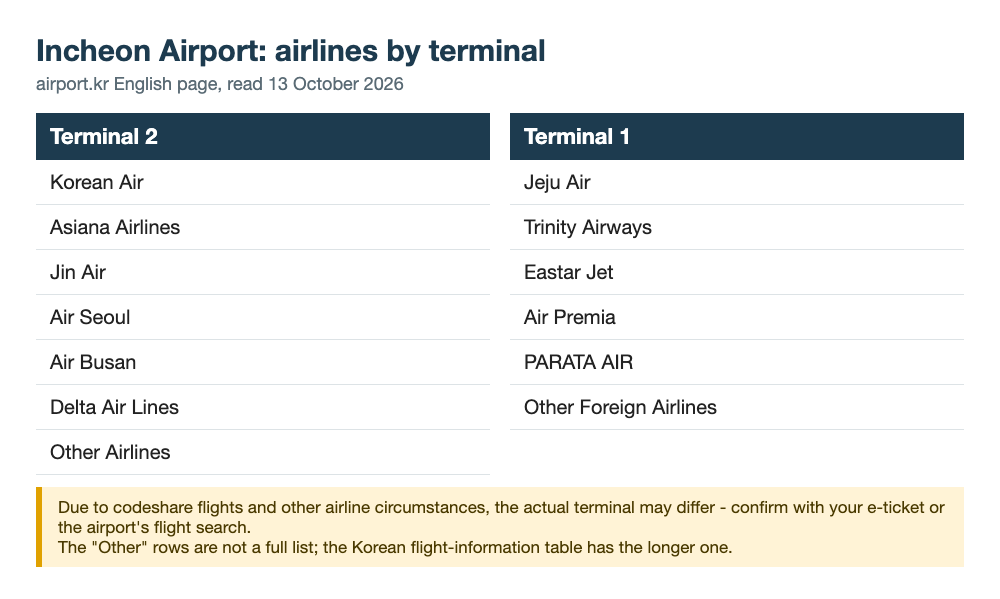
At Incheon Airport (ICN), Terminal 2 handles Korean Air, Asiana, Jin Air, Air Seoul, Air Busan and Delta. Terminal 1 handles Jeju Air, Trinity Airways, Eastar Jet, Air Premia, PARATA AIR and other foreign airlines (airport.kr, 13 October 2026). Codeshare tickets are the trap: the airport itself says the actual terminal “may differ”, and its departure board that day showed Korean Air flight numbers at Terminal 1. Check the terminal against your own flight, not your airline’s name.
The Full Answer
Incheon Airport has two passenger terminals, and the choice is not yours to make. Your flight decides it. Until January 2026 the simple version was “Korean Air at Terminal 2, almost everyone else at Terminal 1.” Then Asiana Airlines moved to Terminal 2, a list of airlines that had been stable for years shifted, and a lot of travel advice did not shift with it.
I opened the airport’s English airline page, its Korean flight-information table and its live departure board on 13 October 2026, and compared the English and Korean versions line by line. Two findings shape this guide.
First, the airport’s own English page is current. It is not the official source that went stale. The stale ones are some third-party guides, and the pattern in how they are wrong is worth knowing.
Second, the airline list only answers the question for a ticket that is flown by the airline that sold it. If your ticket has a second airline’s flight number on it, the list can send you to the wrong building. That second finding is the one I could not find explained in any English page I read.
This guide covers the airline list, the Asiana move, codeshare flights, what a wrong turn costs, the Seoul Station and Gwangmyeong Station check-in options, and the airport’s crowd forecast. For the trip from the airport into the city, see our guide to getting from Incheon Airport to Seoul.
Which Airlines Use Terminal 1 and Which Use Terminal 2
The short official list above names the big domestic carriers, and then falls back on “Other Airlines.” That leaves foreign carriers unclear, so I also read the airport’s Korean-language flight-information table. It covers scheduled regular flights from the previous month and leaves cargo out, so treat it as a snapshot rather than a permanent rule.
That table puts 14 passenger airlines at Terminal 2: Korean Air, Asiana, Jin Air, Air Busan, Air Seoul, Delta, Air France, KLM, Aeromexico, Garuda Indonesia, SAS (Scandinavian Airlines), China Airlines, Xiamen Airlines and Virgin Atlantic. Everything else with scheduled passenger service is listed at Terminal 1, about 71 airlines in total. That includes Jeju Air, Trinity Airways (the airline formerly known as T’way Air), Eastar Jet, Air Premia, PARATA AIR and Aero K, plus foreign carriers such as United, Lufthansa, Swiss, American, Air Canada, Singapore Airlines, Cathay Pacific, Qatar, Emirates, EVA Air, Thai and Vietnam Airlines.
Two things in that split catch people out:
- Foreign airlines are not all at Terminal 1. Delta, Air France, KLM and several others are at Terminal 2. A common shortcut, “Korean airlines at T2, foreign airlines at T1,” is wrong for them.
- Taiwan’s two big carriers sit in different buildings. China Airlines is at Terminal 2, EVA Air at Terminal 1.
The low-cost carriers split too. Jin Air, Air Busan and Air Seoul are at Terminal 2. Jeju Air, Trinity Airways, Eastar Jet, Air Premia and PARATA AIR are at Terminal 1. “Budget airline” tells you nothing about the terminal.
Airline lists change with each schedule season, and the table’s own header says it reflects the previous month. Look at the airport page on the day you plan your trip, not at a screenshot of it.
Asiana Is at Terminal 2 Now, and Some Guides Still Say Terminal 1
Asiana Airlines (아시아나항공) moved to Terminal 2 from 0:00 on 14 January 2026. That date comes from Korean press reporting on a December 2025 briefing by Incheon International Airport Corporation, and the airport’s own Korean flight-information table now lists Asiana at Terminal 2. Air Busan and Air Seoul moved earlier, in July and September 2025 according to secondary reports. The airport’s own table lists both at Terminal 2 as well.
The part that matters for you is what guides say. I opened 12 English-language pages on this topic. That is a pool I assembled with a web search, not Google’s top ten. Of the 12:
- Four still put Asiana at Terminal 1. Two of those four carry 2026 update dates in their page data. An update date does not mean the airline list was rechecked.
- One of the four also says all foreign airlines use Terminal 1, which is wrong for Delta, Air France and KLM, and the same page lists some of them separately under Terminal 2.
- Several others get it right, including Wikipedia, the airport’s own English page and the Turis blog, which goes as far as listing the move history. If you want a second source, Turis is a thorough one.
Local tip: update dates do not prove the list is current. A guide can show a 2026 “updated” stamp and still send Asiana passengers to Terminal 1. Use the airport’s English airline page (airport.kr) or your own flight number’s listing on the departure board.
At Terminal 2, the airport’s Korean check-in page puts Asiana in counter rows G, H and J and Korean Air in rows A to D (as listed on 13 October 2026). Asiana’s own English page divides those rows differently, so go by the counter range the departure board shows for your flight on the day.
Terminal 1 or 2 When Your Ticket Is a Codeshare
A codeshare ticket carries one airline’s name and flight number while a different airline flies the plane. This is common on routes between Korea and China, and on long-haul tickets sold through alliance partners. Since Asiana’s move, it is also where the old “my airline equals my terminal” habit fails.
What English guides say is some version of “check your e-ticket.” The airport’s own English page says the same: because of codeshare flights and other airline circumstances, the actual terminal may differ, so confirm it. That is correct and it is where the official explanation stops. It does not say why the terminal differs or what it looks like.
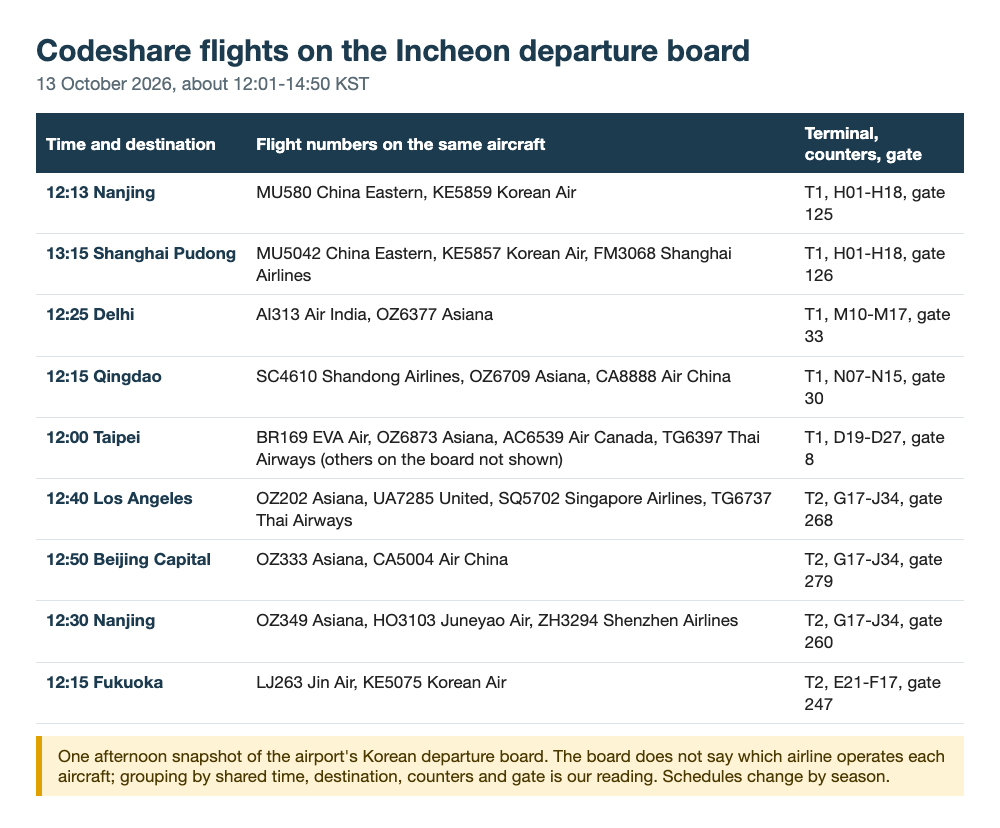
So I read the departure board. On 13 October 2026, between about 12:01 and 14:50 KST, the airport’s Korean-language departure board showed 74 rows. Many rows share a departure time, a destination, a check-in counter range and a gate. That is what a codeshare looks like: one aircraft, several flight numbers. I found 20 such groups, and within each group every row showed the same terminal.
Here are rows from that board:
- 12:13 to Nanjing has MU580 (China Eastern) and KE5859 (Korean Air). The terminal shown is Terminal 1, counters H01 to H18, gate 125. A Korean Air flight number is at Terminal 1.
- 12:25 to Delhi has AI313 (Air India) and OZ6377 (Asiana). Terminal 1, counters M10 to M17, gate 33. An Asiana number is at Terminal 1, months after Asiana moved to Terminal 2.
- 12:40 to Los Angeles has OZ202 (Asiana), UA7285 (United), SQ5702 (Singapore Airlines) and TG6737 (Thai). Terminal 2, counters G17 to J34, gate 268. United, Singapore and Thai numbers, all Terminal 1 airlines on the list, sit at Terminal 2.
- 12:30 to Nanjing has OZ349 (Asiana), HO3103 (Juneyao Air) and ZH3294 (Shenzhen Airlines). Terminal 2. Shenzhen Airlines is a Terminal 1 airline.
The pattern in these groups is consistent with the terminal following the aircraft that is actually flying, not the airline that sold your seat. The Korean Air number at Terminal 1 sits on a China Eastern group, the United number at Terminal 2 sits on an Asiana group. Read this as my reading of what the board shows. The board does not print an “operated by” line, and I did not find a published airport rule that states it as a rule, so I am describing what I saw on one afternoon, not a guarantee.
Local tip: your flight number can be at the “wrong” terminal for your airline. English guides tell you to check your e-ticket. Here is why: on the airport’s own board that afternoon, a Korean Air number was at Terminal 1 and a United number was at Terminal 2. If your ticket shows two flight numbers, the airline name that sold it does not settle the terminal. Look up the exact flight number you were given on the airport’s flight search the day before.
I also searched seven of the English pages for wording about the operating carrier (“operated by” and similar) and found no hits. Their advice stops at “check your e-ticket.” The Turis blog does answer a codeshare question in its FAQ, but by check-in counter location, not by the terminal the plane uses.
Limits: this is one afternoon, and airline schedules change with each season. I did not see an e-ticket field that names the operating terminal, so do not rely on one. Use the live board or the airport’s flight search.
If You Went to the Wrong Terminal
The two terminals are linked, and the official English page gives the figure. The Airport Railroad (AREX) ride between Terminal 1 and Terminal 2 takes 6 minutes and costs ₩1,050 (as of 13 October 2026). That is the train alone. I did not time the walk to the platform at each end, and I would not plan a tight margin around it.
The airport also runs a shuttle bus between the terminals. The only timing I found for it is an official English news item from October 2024, which gave about 15 to 20 minutes. I could not confirm the current timetable, so ask at an information desk if you need it.
A wrong terminal is worth avoiding because getting between the buildings costs extra travel. A few facts from the airport’s departure-procedure pages in Korean and English:
- Both terminals use the 3rd floor for departures.
- Gates 1 to 50 are at Terminal 1, gates 101 to 132 are in the separate Concourse building and gates 208 to 290 are at Terminal 2.
- The Concourse is reached from Terminal 1 by a shuttle train that runs 24 hours, and the pages state that you cannot return from the Concourse to Terminal 1. In the board rows above, gates 125 and 126 are Concourse gates.
- The pages say to be at your gate 30 to 40 minutes before departure.
If your gate number is in the 100s, allow time for that shuttle train rather than treating Terminal 1 as the end of the walk.
Choosing a Lounge Pass After You Know the Terminal
Settle the terminal first and everything downstream gets easier, including the lounge. The Klook booking page makes you choose a terminal before anything else.
If you would rather book a lounge before you fly, a Klook Incheon Airport lounge pass (rated 4.3 from 194 reviews) has you pick Terminal 1 or Terminal 2 and the SKYHUB or Matina lounge first, and can be cancelled for free before you use it.
I did not confirm where inside the terminal each lounge sits or whether it is before or after security, so check that on the booking page before you buy.
Checking In at Seoul Station or Gwangmyeong Station
Two city stations offer check-in away from the airport. They work differently, and the third-party English guides I read give one cutoff at most.
Seoul Station City Airport Terminal is on the second basement floor of Seoul Station on the Airport Railroad line. Per the airport’s Korean and English pages (13 October 2026), check-in and baggage drop run from 05:20 to 19:00, and immigration from 05:30 to 19:00. It is open only to passengers using the Airport Railroad Express (직통열차, the non-stop direct train). The direct-train platform is on basement level 7, with trains between 06:10 and 22:50 at intervals of 30 to 40 minutes.
The cutoff depends on your terminal:
| Your airline is at | Check-in closes |
|---|---|
| Terminal 1 | 3 hours before departure |
| Terminal 2 | 3 hours 20 minutes before departure |
Asiana’s own English page lists the 3 hours 20 minutes cutoff, which matches its move to Terminal 2. After you finish, you use a dedicated departure passage on the 3rd floor at Incheon.
Local tip: the Seoul Station cutoff is not one number. A third-party English guide I read gives a single “3 hours.” The airport’s own pages give 3 hours for Terminal 1 airlines and 3 hours 20 minutes for Terminal 2 airlines. A Terminal 2 passenger who plans around “3 hours” arrives 20 minutes too late.
Which airlines use Seoul Station. The airport’s page says only that it varies by terminal and tells you to confirm. Lists of participating airlines circulate in English and Korean, but they differ from one another, and I found no official list. Ask your airline, or call Seoul Station on 1599-7788, before you rely on it.
Gwangmyeong Station City Airport Terminal is in the KTX Gwangmyeong Station, west side, basement 1, open 06:30 to 17:00. The airport page states that immigration is done at Incheon, not at Gwangmyeong, and that anyone can use it. A limousine bus runs 05:00 to 20:20. The enquiries line is 1544-7788. If you are coming in on a high-speed train, our KTX booking guide covers the ticket side.
I did not call either desk. The hours and cutoffs above are the published ones.
Reading the Airport’s Crowd Forecast
The airport publishes a forecast of departure-hall crowds, and the English page exists. It is easy to miss, and its English is stiff.
On the airport site, “Airport congestion forecast” (공항 예상 혼잡도, English page 1410) is updated every day at 17:00. The forecast for departures is two days ahead (D+2), and the entry and exit forecast is one day ahead (D+1). You choose Terminal 1 or 2, then a date, and get a table of expected people per hour by departure-hall number, from 00:00 to 24:00.
An example from the page on 13 October 2026, for 14 October: at Terminal 1, departure halls 1 and 6 showed zero all day, and the busiest hour was 08:00 to 09:00 with 4,597 departures in total. At Terminal 2, with two departure halls, the peak was 07:00 to 08:00 at 4,449. I do not know why T1 halls 1 and 6 show zero, and the page does not explain it.
Terminal 1 also has a live wait time (English page 6654, Korean 6651) for halls 1 to 6, split east and west, in minutes. At 12:13 on 13 October it showed 9 and 6 minutes at hall 2, 13 and 12 at hall 3, 9 and 9 at hall 4, 11 and 22 (flagged as normal) at hall 5, and halls 1 and 6 as not operating. Terminal 2 is not on that screen.
Local tip: the forecast is split by departure hall, not just by terminal. Third-party English guides I read link to the congestion page at most. The table is by hall number and by hour, so you can see whether your hour is the terminal’s busiest. It updates at 17:00 for the next days, so check it the evening before.
Whether you can pick a quieter hall depends on where your check-in counter is, and I did not confirm how counters map to departure halls. Treat the forecast as a read on how early to arrive, not a way to choose your door.
What You Need to Know
- The airline list can lag the real situation. The airport’s own page was current on 13 October 2026. Some English guides were not, including pages with 2026 dates.
- Codeshare tickets can lead to the other terminal. The airport warns that the actual terminal may differ.
- Asiana is at Terminal 2. That has been true since 14 January 2026.
- There is no single “how early” figure. The airport pages give pieces: foreign airlines open their counters 2 to 3 hours before departure, Seoul Station closes 3 hours or 3 hours 20 minutes before, and you need to be at your gate 30 to 40 minutes before.
- Departure fees are inside the ticket. The airport pages say the airport usage fee and departure payment are collected with the airfare, and children under 2 are exempt. Check your own fare rules for what applies to your ticket.
- Smart Pass is unconfirmed for foreign passports. More on that in the FAQ.
Practical Tips
- Take the terminal from your flight number, not your airline’s name. Look up the exact flight number on the airport’s flight search the day before and again on the day.
- If your ticket shows two flight numbers, treat it as a codeshare. Note both numbers and check the one the airport board lists.
- Ignore an old airline list, even a recently dated one. Compare it with the airport’s own English page.
- For Seoul Station check-in, confirm two things. You need an Airport Railroad Express ticket, and your airline has to be on the desk’s list. Work backwards from 3 hours (Terminal 1 airlines) or 3 hours 20 minutes (Terminal 2 airlines).
- Look at the crowd forecast after 17:00 the evening before. It shows the hour-by-hour load by departure hall for the next day or two.
- If your gate is in the 100s, plan for the shuttle train. Concourse gates are reached by shuttle train, and you cannot come back.
- Pick a lounge pass last. Choose the terminal first, then the pass.
If you are carrying a leftover T-money balance, our T-money card guide covers getting it back. If you need to send bags ahead of you, see luggage delivery in Korea. For a taxi to the airport, our Kakao Taxi guide walks through the app. If you are claiming a tax refund on your way out, read our Korea VAT refund guide first, and if something stays behind, lost and found in Korea explains where to look. For the official airport site and other Korean sites foreigners use, see our list of Korean travel websites.
Frequently Asked Questions
Which terminal is Asiana at Incheon Airport now?
Terminal 2. Asiana moved there at 0:00 on 14 January 2026, according to Korean press reports on the airport operator’s December 2025 briefing. The airport’s English airline page and Korean flight-information table both list it at Terminal 2. Some third-party English guides still say Terminal 1, so rely on the airport’s page.
Which terminal do Star Alliance codeshare flights use when Asiana flies them?
On the departure board I read on 13 October 2026, United, Singapore Airlines and Thai numbers sharing one Los Angeles departure with an Asiana flight were listed at Terminal 2. That is a snapshot, not a published rule, so check your own flight number.
Does a Korean Air flight number mean Terminal 2?
Not necessarily. On 13 October 2026 two Korean Air numbers (KE5859 to Nanjing and KE5857 to Shanghai) appeared at Terminal 1 on groups that included China Eastern flights. Korean Air’s own flights are at Terminal 2, but a Korean Air number on someone else’s aircraft can be elsewhere.
How do I check my terminal at Incheon Airport?
Use the flight search or departure board on the airport’s own site (airport.kr), enter your flight number and read the terminal shown. The airport’s English page also tells you to check your e-ticket. Do this the day before and again before you leave for the airport.
How early should I arrive at Incheon Airport for an international flight?
The airport gives no single figure. Its pages say foreign airlines open their counters 2 to 3 hours before departure, Seoul Station check-in closes 3 hours (Terminal 1 airlines) or 3 hours 20 minutes (Terminal 2 airlines) before, and you should reach your gate 30 to 40 minutes before. Your airline’s own check-in deadline is the one that counts.
Can I check in at Seoul Station and skip the airport counter?
Yes, if your airline uses the desk and you hold an Airport Railroad Express (direct train) ticket. The desk is open 05:20 to 19:00. I found no official list of airlines, so confirm with your airline or call 1599-7788. Gwangmyeong Station offers check-in too, but immigration is done at Incheon.
Is there a way to see how crowded Incheon Airport departures will be?
Yes. The airport publishes an hour-by-hour forecast by departure hall, updated daily at 17:00, in both Korean and English. Terminal 1 also has a live wait-time screen for halls 1 to 6. Terminal 2 is not on that screen.
Can foreigners use Smart Pass at Incheon Airport?
I could not confirm it. The airport’s Korean and English pages say registration is by passport scan, for ages 7 and over, and I found no sentence limiting it by nationality. Whether a foreign passport registers in practice I did not verify. Ask your airline at check-in, or the airport’s Smart Pass line on 1577-2600.
Related Questions
- How do I get from Incheon Airport to Seoul?
- How does luggage delivery work in Korea?
- How do I get around Korea after I land?