Lost and Found in Korea: Where Your Item Is, by Where You Lost It
Last Updated on September 16, 2026
Quick Answer
Three things decide where to look: where you lost it, which company operates that place, and how many days have passed. Lost on the Seoul subway today, it is at the station — not at the line’s lost-and-found centre yet. From tomorrow to about a week, it is at the centre. After that the police hold it, and you search at minwon24.police.go.kr. Buses and taxis are a separate database.
Start Here: The Two Tables That Decide Everything
Most English guidance answers a single question — “call the Seoul subway lost and found” — as though there were one office and one number. There is not. Korea runs at least four independent lost-property systems, and your item sits in exactly one of them.
Table 1 — who physically has it, by where you lost it
| Where you lost it | Who holds it | Where to search |
|---|---|---|
| Seoul subway Lines 1–8 | Seoul Metro — the station first, then that line’s centre | Police portal (경찰민원24) |
| Seoul subway Line 9, Gaehwa–Sinnonhyeon | Seoul Metro Line 9 Corp. — Dongjak Station centre | Police portal |
| Seoul subway Line 9, Eonju–Jungang Bohun Hospital | Seoul Metro — Sports Complex Station centre | Police portal |
| KTX, regular trains, Korail-operated metro sections | Korail — station, then a major-station centre | Police portal + 1588-7788 |
| Seoul city buses, village buses, corporate and private taxis | The bus or taxi company’s own depot | finding.eseoul.go.kr + 120 |
| A Kakao T taxi, within about a week | The driver, through the app | The app’s trip history — see below |
| Incheon Airport terminals, transport centre, car parks | Incheon Airport lost property office | Police portal + email to the office |
| On the aircraft, on an airport bus, on AREX | The airline or that operator — not the airport office | That company directly |
Table 2 — where it is, by how long it has been
| Time since you lost it | Where the item physically is |
|---|---|
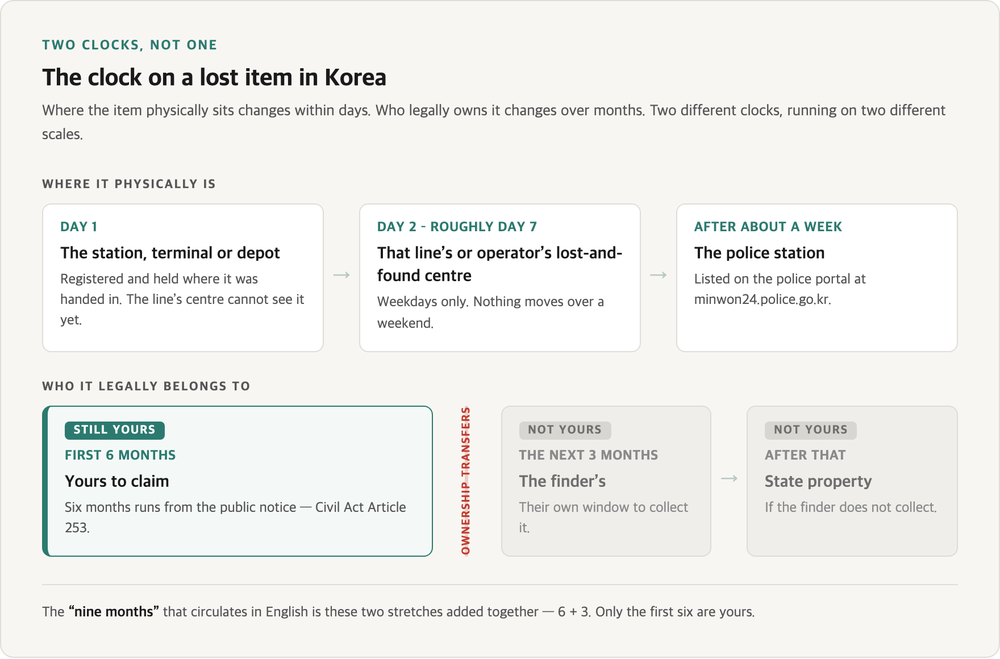
| Same day | The station, terminal, or depot where it was handed in |
| Day 2 to roughly day 7 | That line’s or operator’s lost-and-found centre |
| After about a week | The police station, listed on the police portal |
| Up to 6 months from the public notice | Still yours to claim |
| After 6 months | Ownership legally transfers to whoever handed it in |
| Months 6 to 9 | The finder’s own three-month collection window |
| After 9 months | State property |
Everything below is the detail behind those two tables.
The Full Answer: The Website Everyone Sends You To Is Not the One to Use
Every English-language guide to losing something in Korea — including Seoul’s own official English tourism site — points you at lost112.go.kr, the national police lost-property portal. That address did not respond.
I tried it from two separate networks on September 16, 2026, and both attempts timed out. The claim here is narrower than “the site has shut down”: the domain still resolves, the connection simply does not complete, and no official notice declaring it retired turned up. What is verifiable is the practical part — every Korean operator that actually holds lost property now links somewhere else.
Seoul Metro’s lost-property page is, in effect, one link — to the police civil-affairs portal. So are Metro 9’s, Korail’s and Incheon Airport’s. All four point to 경찰민원24 (Police Minwon 24) at minwon24.police.go.kr, and the lost-item search page opens without a login, without identity verification, and without a Korean phone number. That last part matters more than anything else here. You can search the national database yourself, right now, from your own phone.
One honest limitation: the portal is not a native English-language site. The header carries a dropdown listing dozens of languages, but the values behind it follow the pattern of an embedded translation widget and include broken entries — I could not confirm that selecting English actually renders the pages. Plan for a Korean interface and a browser translation extension.
Seoul Subway: Which Centre Covers Your Line
Seoul Metro splits its lost-property centres by line pairs. The centre is not at your station and not at a central office — it is at one specific station on your line.
| Lines | Centre | Located at | Phone | Hours |
|---|---|---|---|---|
| 1 & 2 | Sicheong Lost & Found (시청유실물센터) | City Hall Station | 02-6110-1122 | Weekdays 09:00–18:00 |
| 3 & 4 | Chungmuro (충무로유실물센터) | Chungmuro Station | 02-6110-3344 | Weekdays 09:00–18:00 |
| 5 & 8 | Wangsimni (왕십리유실물센터) | Wangsimni Station | 02-6311-6765, 6768 | Weekdays 09:00–18:00 |
| 6 & 7 | Taereung (태릉유실물센터) | Taereung Ipgu Station | 02-6311-6766, 6767 | Weekdays 09:00–18:00 |
| 9, Gaehwa–Sinnonhyeon | Line 9 Phase 1 centre | Dongjak Station | 02-2656-0999 | Weekdays 10:00–19:00 |
| 9, Eonju–Jungang Bohun Hospital | Line 9 Phase 2 centre | Sports Complex Station (종합운동장) | 02-2656-0797 or 02-2656-0787 — see below | Weekdays 10:00–19:00 |
All close on weekends and public holidays (as of September 2026). Lose something on a Friday night and nobody answers that phone until Monday — a strong argument for searching the police portal yourself. Our Seoul subway guide covers the basics and the 2026 tap-out rules, and Naver Map or KakaoMap will route you there on the live transit data Google Maps lacks in Korea.
Local tip — Line 9 is the one everyone gets wrong, because it has two operators and therefore two lost-and-found centres, not one. Google’s answer box gives a single Line 9 office at Dongjak Station on 02-2656-0009, open 09:00 to 18:00, citing an English travel blog; Seoul’s official English tourism page gives the same 0009 number. The operators’ own Korean pages differ: Seoul Metro Line 9 lists Dongjak Station on 02-2656-0999 for the Gaehwa–Sinnonhyeon stretch and Sports Complex Station for the rest, and states that both open at 10:00 and close at 19:00 — an hour later at each end than every other line. The English site that specialises in Korean lost property does not mention Line 9 at all.
One thing this guide will not resolve: the Sports Complex number. Seoul Metro’s own table prints 02-2656-0787 and Metro 9’s prints 02-2656-0797. Two official Korean sources, one digit apart. I read the two tables side by side and did not call either number, so try both rather than trusting a guide that quietly picked one.
This covers Seoul Metro and Line 9 only. AREX, the Sinbundang Line, Incheon Lines 1 and 2, Ui-Sinseol and Gimpo Goldline run under different operators with their own procedures.
The First 48 Hours: It Is at the Station, Not the Centre
This is where the standard English advice costs people time. The usual instruction is to call your line’s centre, on the assumption that items flow there immediately. They do not.
The published procedure at Seoul Metro, Metro 9 and Korail is identical: an item handed in at a station is registered and held at that station on the day it is found, and transferred to the line’s centre the following day. On day one the centre genuinely does not have your bag, and the person answering that phone cannot see it.
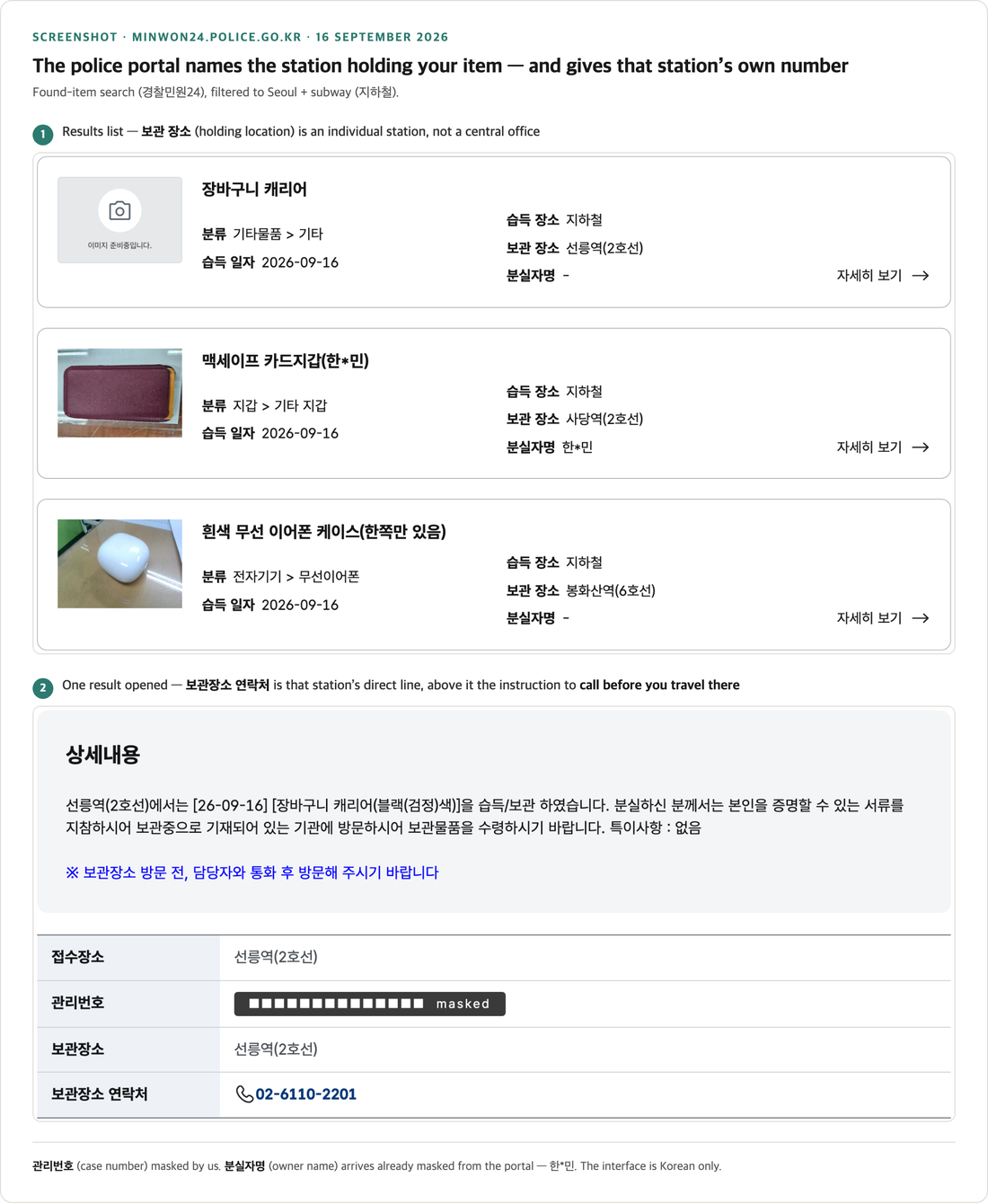
Local tip — Each result on the police portal prints the holding location as a named station — Euljiro 1-ga, Hongdae Ipgu, Cheongnyangni, Noksapyeong — together with that station’s own direct phone number, and an instruction to call before travelling there. I opened the portal on September 16, 2026 and filtered it to Seoul plus subway: roughly 2,600 items, each attached to a specific station rather than a central office. That station number is the one to call on day one, and it appears in none of the English guidance.
Two consequences. If you realise within a few hours, go back to the station you got off at before phoning centres. And the portal helps even on day one — not because the police have your item, but because the listing tells you which station does.
How to Search the Police Portal Without a Korean Account
The lost-item search is open to anyone. With no filters applied it returned 18,960 recent entries on September 16, 2026, which is why the filters matter.
The filters that actually narrow it down:
- Where it was found — 19 separate codes, with subway, taxi, train, bus and airport each their own option. Use this before anything else.
- Category — 22 top-level types covering bags, jewellery, documents, securities, clothing, electronics, wallets, ID cards, bank cards, cash and mobile phones. A lost T-money card files under cards, as a credit card would.
- Serial number, model code and IMEI — separate fields, not free text. For a phone the IMEI is far more precise than the model name.
- Owner’s name — the listings carry a masked owner-name column, which is why the portal’s own advice is to search ID cards and certificates by the name printed on them rather than by item type.
Local tip — One toggle on the search form decides half your results, and it is easy to miss: the source filter switches between police stations and non-police agencies (subway, airport and so on). Searching one and concluding that nobody handed the item in means you have looked at roughly half the database. Check both.
The portal’s own contact number is 182, staffed weekdays 09:00–18:00, charged at normal rates; from outside Korea it is +82-182 (as of September 2026).
The Clock: Six Months, Not Nine
The most consequential error in the English material comes from the one English site that specialises in Korean lost property: it states that police stations hold items for about nine months. The number is not invented, but it is the wrong one to plan around.
I pulled Article 253 of the Civil Act (민법) from the government’s legislation API rather than a search summary — the text in force as of March 17, 2026, as amended in April 2013. Article 253 says that if the owner does not assert their rights within six months of the public notice, ownership transfers to the person who handed the item in.
Local tip — Nine months is 6 + 3, and the last three months are not yours. After six months the item legally belongs to the finder; the Lost Property Act then gives that finder three months to collect it, and only if they fail does it pass to the state. Your window is the first six months.
Before the police stage, the operator-held stage is short. Seoul Metro, Metro 9 and Korail all describe centres holding items for up to about seven days before transfer to the police. That is a different clock from the one Kakao T runs on for taxis, which is about contacting the driver through the app; the two windows happen to be about a week each and mean entirely different things.
One category does not reach any of these stages. Seoul Metro and Metro 9 both discard opened food the same day, and sealed food too where the shelf life is unclear or spoilage likely — packed lunches, gimbap, fresh groceries. Do not go back for food.
Buses and Taxis Are Not in the Same System
If you left something on a Seoul city bus, a village bus, or in a taxi, the police portal is not the first place to look.
Seoul runs its own integrated public transport lost property centre at finding.eseoul.go.kr, and it covers exactly four categories of vehicle: city buses, village buses, corporate taxis and private taxis. Despite the name, the subway is not in it. I counted the total on September 16, 2026: 283,297 entries, and the holding location on each is not a police station or a city office but the operating company’s own depot — a named transport company with an in-house lost property desk.
Searching the police portal, finding nothing, and concluding that nobody handed your item in is a mistake with a specific cause — there is no single national database. Buses and taxis file here, the airport keeps a category of items it does not register nationally, and phones eventually move to a third organisation again.
The database filters by when you lost it — same day, three days, a week, a month, or a specific year and month back to 2022 — and searches by item contents, transport company name, or station name. For anything else, Seoul’s city information line is 120, staffed 24 hours a day, year-round, at normal rates (as of September 2026).
If it was a Kakao T taxi, start in the app — the ride history holds the record of which driver you had, and the Kakao Taxi guide covers that procedure and the customer service line. Come back here when it does not resolve: a corporate or private taxi in Seoul is searchable on the city database above, and the police portal has a taxi filter of its own.
Trains: KTX and Korail
Korail’s lost-property page is more useful than most: it publishes the direct number for every major station’s desk in an alphabetical Korean directory rather than routing everything through one call centre.
- If you have just got off, report it at the station office. The details that speed this up are printed on your ticket: train number, section travelled, car and seat number. Our KTX booking guide covers booking, seat types and refunds on those trains.
- If you are still on board, tell a crew member.
- If you realise later, search the police portal first, then call the rail customer centre on 1588-7788 or the station desk.
Note the number. Seoul’s official English tourism page gives +82-2-1599-7777 for KTX lost property; Korail’s own site gives 1588-7788. Use Korail’s.
Korail also publishes the collection rule, which applies more widely than visitors expect: you need your own photo ID. A proxy needs three documents — a letter of authorisation, a copy or photo of your ID, and their own ID. Korail provides the authorisation form.
Incheon Airport: Two Desks, and a List That Does Not Reach the Database
Incheon Airport’s lost property office is run jointly by the airport police and the airport corporation, and there are two of them, one per terminal (as of September 2026).
| Terminal 1 | Terminal 2 | |
|---|---|---|
| Location | Basement level 1 | Landside, 2nd floor, inside the government services centre |
| Hours | 07:00–21:30, every day | 07:00–21:30, every day |
| Phone | 032-741-3110, 3114 | 032-741-8988, 8989 |
| [email protected] | [email protected] |
Seoul’s official English page describes a single office in the Terminal 1 basement, 07:00 to 22:00, with a Gmail address. The airport’s own page gives two offices, a 21:30 close, and two corporate addresses. Email is the right channel here, and the next tip explains why.
Note the boundary too: items left on the aircraft, on an airport bus, or on the AREX train belong to the airline or that operator, not the airport office. If you lost it between the airport and the city, start with the route you took — our Incheon Airport to Seoul guide sets out which operator runs which service.
Local tip — Incheon Airport keeps a published list of “non-accepted items” that are logged internally but not registered on the national police database. Searching for them online returns nothing even while they are sitting on a shelf, which is why the email addresses matter. Held one month: ID cards including foreign ones, bank cards and passbooks, e-cigarettes, liquids and cosmetics over 100ml, neck pillows, blankets, umbrellas, used tumblers and lunch boxes, hats, gloves, single shoes, belts, accessories and re-issuable documents. Held seven days: empty suitcases, bags and pouches. Disposed of immediately: power banks, disposable e-cigarettes, butane canisters and other hazardous items, plus empty luxury shopping bags and warranty cards. If you left a power bank at security, it is already gone.
Passports follow their own route. A foreign passport found at Incheon is held for one month and then transferred to that country’s embassy — so a month after you fly home, it is not at the airport any more. Korean passports go to the Ministry of Foreign Affairs the next day. If your passport is what is missing mid-trip, your embassy is the first call rather than the airport, and the entry-record side sits with your K-ETA or visa.
Phones follow a third route. Mobile phones, tablets and smartwatches found at Incheon are held for one month and then transferred to the Handphone Lost and Found Call Centre on 1566-4300, at handphone.or.kr — although the centre’s own site prints 02-3471-1155, so expect two numbers in circulation. Note the limit of what is confirmed: that handover is documented in the airport’s guidance, and whether the same rule applies to phones handed in on the subway or a bus is not something we could verify. For a phone lost in the city, treat the portal’s IMEI field as the reliable route and consider whether a replacement SIM or eSIM gets you through the rest of the trip.
Collecting It, Including After You Have Left Korea
The collection rules are consistent across operators: photo ID in your own name, plus the proxy documents above if someone is going for you.
The new option is delivery. Seoul Metro began a home delivery service for items held at its lost-and-found centres on July 20, 2026 — you contact the centre, apply and pay, and it is couriered to you. Published rates are ₩5,000 under 2kg, ₩6,000 for 2–10kg and ₩7,000 for 10–20kg (as of September 2026). For a visitor who has already left Seoul — or Korea — that is the difference between recovering a laptop and writing it off. It is recent enough that no English guide has picked it up, and recent enough to confirm the rates when you call.
Do You Owe the Finder a Reward?
Yes, in principle, and the amount is set by statute rather than custom. The Lost Property Act, Article 4 obliges the owner to pay the finder between 5% and 20% of the item’s value. Three qualifications matter:
- The state, local governments and public institutions cannot claim it. A station employee who picks up your bag is not a claimant.
- The claim expires one month after the item is returned (Article 6).
- Where an item is found inside a managed space such as a vehicle or building, the occupier counts as the finder and splits the reward with whoever picked it up (Article 10).
What You Need to Know
- There is no single national lost-property database. The police portal, Seoul’s bus-and-taxi database, the phone call centre and the airport’s internal list are four separate systems. A blank result in one is not an answer.
- The site English guides send you to did not respond.
lost112.go.krtimed out from two networks on September 16, 2026, and every Korean operator now links tominwon24.police.go.kr. - Line 9 is the exception to everything. Two centres, two operators, 10:00–19:00 rather than 09:00–18:00, and one phone number that two official sources disagree about.
- Your claim window is six months, not nine. After six months the item legally belongs to the finder.
- Centres are weekday-only. Nothing moves between Friday evening and Monday, so search the portal rather than waiting for a callback.
- Some items are not listed anywhere. Power banks at the airport are destroyed on sight; foreign ID cards are held but not registered nationally.
- Phones need the IMEI, not the model name. Find it on the box, your carrier account, or the device backup record before searching.
Practical Tips
- Search the police portal before you phone anyone. It opens without a login, works from a foreign phone, and tells you which station holds the item and what its direct number is. Faster than working down a list of centres.
- Toggle the source filter both ways. Police stations and non-police agencies are separate result sets on the same form. Checking one is checking half.
- Go back to the station on day one. Items sit at the station of origin until the next day, so the line’s centre cannot help in the first 24 hours.
- Write down the trip details while you remember them. Line and direction, the time you got off, the station, and for trains the train number, car and seat. Every intake form asks for these.
- For a bus or taxi in Seoul, use
finding.eseoul.go.krfirst. It is the only database listing the transport company depots, and the subway is not in it. - If you are leaving the city, ask about courier delivery. Seoul Metro has delivered items since July 2026 for ₩5,000–7,000 by weight (as of September 2026), which beats a round trip back to Wangsimni.
- Bring photo ID, or send three documents. Your own ID to collect; an authorisation letter, a copy of your ID and the collector’s ID if someone goes for you.
Frequently Asked Questions
Is lost112.go.kr still the right website in 2026?
It is the address almost every English guide still gives, but it did not load from two separate networks on September 16, 2026. More usefully, all four Korean organisations that actually hold lost property — Seoul Metro, Metro 9, Korail and Incheon Airport — now link to the police civil-affairs portal at minwon24.police.go.kr from their own pages. Use that one.
Can I search Korea’s lost-and-found database without a Korean phone number or a login?
Yes. The lost-item search on the police portal opens without identity verification, and there is no registration step to browse or filter results. The interface is Korean, and the site’s language selector appears to be an embedded translation widget whose behaviour we could not confirm, so expect to use a browser translation function.
Where do I go if I left something on the Seoul subway today?
The station, not the line’s lost-and-found centre. Items are registered and held at the station where they are handed in and only transferred to the centre the following day. The police portal listing shows the holding station and its direct phone number, and the official advice is to call before travelling there.
Which lost-and-found centre covers my subway line?
Lines 1 and 2 at City Hall, lines 3 and 4 at Chungmuro, lines 5 and 8 at Wangsimni, lines 6 and 7 at Taereung Ipgu, all weekdays 09:00–18:00. Line 9 is split: Gaehwa to Sinnonhyeon is handled at Dongjak Station, Eonju to Jungang Bohun Hospital at Sports Complex Station, both weekdays 10:00–19:00 according to the operator’s own page. All are closed at weekends and on public holidays.
How long does Korea hold a lost item before I lose the right to claim it?
Six months from the public notice. Article 253 of the Civil Act transfers ownership to the finder at that point. The nine-month figure that circulates in English is six months plus the finder’s separate three-month collection window, and that second stretch is not yours.
I lost something on a Seoul bus or in a taxi — is it in the same system?
No. Seoul operates a separate database at finding.eseoul.go.kr covering city buses, village buses, corporate taxis and private taxis, with items held at the operating company’s depot. It listed 283,297 cumulative entries in September 2026, and it does not include the subway. For a Kakao T ride specifically, start with the app’s trip history.
I have already left Korea. Can my item be shipped to me?
Seoul Metro launched a courier delivery service for items held at its lost-and-found centres on July 20, 2026, priced at ₩5,000 under 2kg, ₩6,000 for 2–10kg and ₩7,000 for 10–20kg (as of September 2026). You arrange it with the centre holding the item. Other operators have their own procedures, so ask when you call.
Related Questions
- Seoul Subway: Tap-Out Rules That Changed in 2026
- How to Use Kakao Taxi in Korea: A Foreigner’s Step-by-Step Guide
- Getting Around Korea: The Transport Guide That Connects the Details