Jeju Itinerary: 3-Day and 5-Day Plans That Actually Work Without a Car
Quick Answer
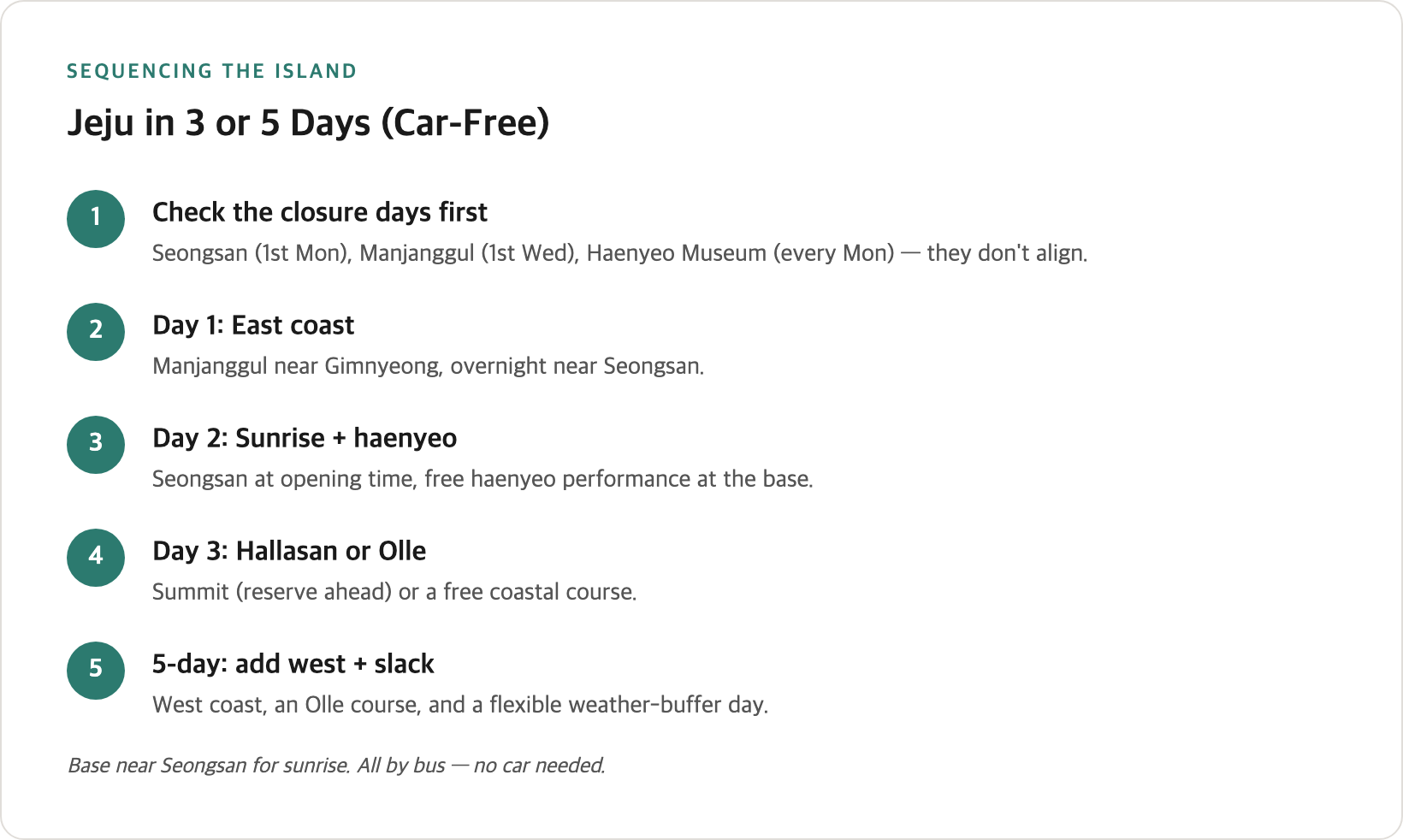
Jeju splits naturally into an east side (Seongsan, Manjanggul, Gimnyeong) and a west/central side (Hallasan, the Olle coast, Jeju City). A workable 3-day plan covers the east coast and one Hallasan or Olle day; a 5-day plan adds the west and a slower pace. The two things most itineraries ignore: several major sights have monthly closure days, and you can do all of this by bus without renting a car. Plan around the closures and the early-morning sunrise timing.
The Full Answer
Jeju itineraries are everywhere, and most share two blind spots. They assume you’re driving, which bakes in the island’s most expensive category. And they list sights without their monthly closure days, so a plan can quietly send you to a locked gate.
This guide is the hub for a Jeju trip — the individual sights have their own detailed guides, and this ties them into a sequence that respects the buses, the closures, and the sunrise timing. I built these plans in July 2026 around the current opening rules, because a good itinerary is really about sequencing constraints, not listing attractions.
The Closure Days You Must Plan Around
Before any itinerary, note these — they’re the trap.
| Sight | Closed |
|---|---|
| Seongsan Ilchulbong | First Monday of the month |
| Manjanggul | First Wednesday of the month |
| Haenyeo Museum | Every Monday |
Local tip — Jeju’s major sights each close on different monthly days — Seongsan the first Monday, Manjanggul the first Wednesday, the Haenyeo Museum every Monday. They don’t align, so there’s no single “closed day” to avoid. Check each sight against your specific dates when sequencing, because the most common itinerary failure on Jeju is arriving at a sight on its closure day.
The 3-Day Plan (East Focus, Car-Free)
Three days is enough for the east coast highlights plus one big nature day.
Day 1 — Arrival and east coast
– Land, sort a T-money card and data
– Bus east toward Gimnyeong — Manjanggul (bring a jacket, 14°C inside)
– Overnight near Seongsan for an early start
Day 2 — Sunrise and haenyeo
– Seongsan Ilchulbong at the seasonal opening time for sunrise
– The free haenyeo performance at the base afterward
– Seopjikoji nearby, then back toward the city
Day 3 — Hallasan or Olle
– Either a Hallasan summit hike (reserve ahead) or a non-summit trail / Olle course
– Depart
Local tip — Front-load the sunrise for a weekday if you can — Seongsan’s single summit path is far quieter midweek, and a weekday also dodges the domestic-tourism weekend crowds across the island. Building the itinerary around one early Seongsan morning is the sequencing decision everything else hangs off.
The 5-Day Plan (East + West + Slack)
Five days lets you add the west side and stop rushing.
Days 1–2: As the 3-day east coast plan above
Day 3 — Hallasan
– A full Hallasan summit day (8–10 hours) if you reserved, or a gentler non-summit trail
Day 4 — West coast and Olle
– An Olle coastal course — Course 7 or a west-side route
– West coast sights and beaches
Day 5 — Slow day and departure
– The Haenyeo Museum (not a Monday), a market, or a café day
– Depart
Local tip — Keep the fifth day loose. Jeju’s weather closes the Hallasan summit and cancels outdoor haenyeo performances with little notice, so a flexible final day is your buffer to catch anything the weather stole earlier. Rigid five-day plans on a weather-exposed island tend to break.
Car-Free Logistics
The whole plan works on buses, with some sequencing care.
- Base strategically: a night near Seongsan saves a pre-dawn cross-island trip for sunrise
- Learn the route numbers: 100s express, 200s trunk, 810/820 tourist loops
- Mind the 40-minute transfer window and the same-route exclusion
- Early buses are limited — sunrise and dawn hikes need checking the timetable
Local tip — The single logistics trick is where you sleep, not how you travel. An overnight near Seongsan turns an impossible pre-dawn bus into a short walk to sunrise. Cluster your accommodation by what needs an early start, and the bus network handles the rest.
What You Need to Know
-
The island splits east and west — sequence by side to save backtracking.
-
Major sights have different monthly closures — check each against your dates.
-
It all works by bus — no car needed for the major sights.
-
A weekday sunrise is quieter — build the plan around one early Seongsan morning.
-
Base near Seongsan the night before sunrise.
-
Keep the last day flexible as a weather buffer.
Practical Tips
-
Check each sight’s closure day against your specific dates.
-
Base near Seongsan for the sunrise, not in Jeju City.
-
Do the sunrise on a weekday to dodge crowds.
-
Reserve Hallasan early if you want the summit.
-
Go car-free and learn the bus route numbers.
-
Bring a jacket for Manjanggul and the Hallasan summit.
-
Keep your final day loose as a weather buffer.
Frequently Asked Questions
How many days do I need in Jeju?
Three days covers the east coast highlights and one nature day; five days adds the west side and a relaxed pace. Both work without a car.
Can I do Jeju without renting a car?
Yes. The bus network reaches the major sights, and going car-free is also the biggest budget saving. See Jeju without a car.
What’s the biggest itinerary mistake?
Arriving at a sight on its monthly closure day. Seongsan, Manjanggul and the Haenyeo Museum each close on different days that don’t align.
Where should I stay?
Base near Seongsan the night before a sunrise visit to avoid a pre-dawn cross-island trip. Otherwise Jeju City is a convenient hub.
Should I do Hallasan or the Olle Trail?
Hallasan for a big summit day (reserve ahead); the Olle Trail for a free, flexible coastal walk with no permit. Many visitors do one of each.
When should I visit Jeju?
Spring and autumn for the best weather and cheaper flights and rooms. Summer and Korean holidays are busiest and priciest.
Related Questions
- Visiting Jeju Without a Car: Buses, Fares and the 40-Minute Transfer Rule
- Jeju Travel Budget: What a Trip Actually Costs
- How to Hike Hallasan: The Reservation System Nobody Explains
- Getting Around Korea: The Transport Guide That Connects the Details
- Seoul Subway: Tap-Out Rules That Changed in 2026