Manjanggul Lava Tube: Reopened in 2026 — What’s Actually Accessible Now
Quick Answer
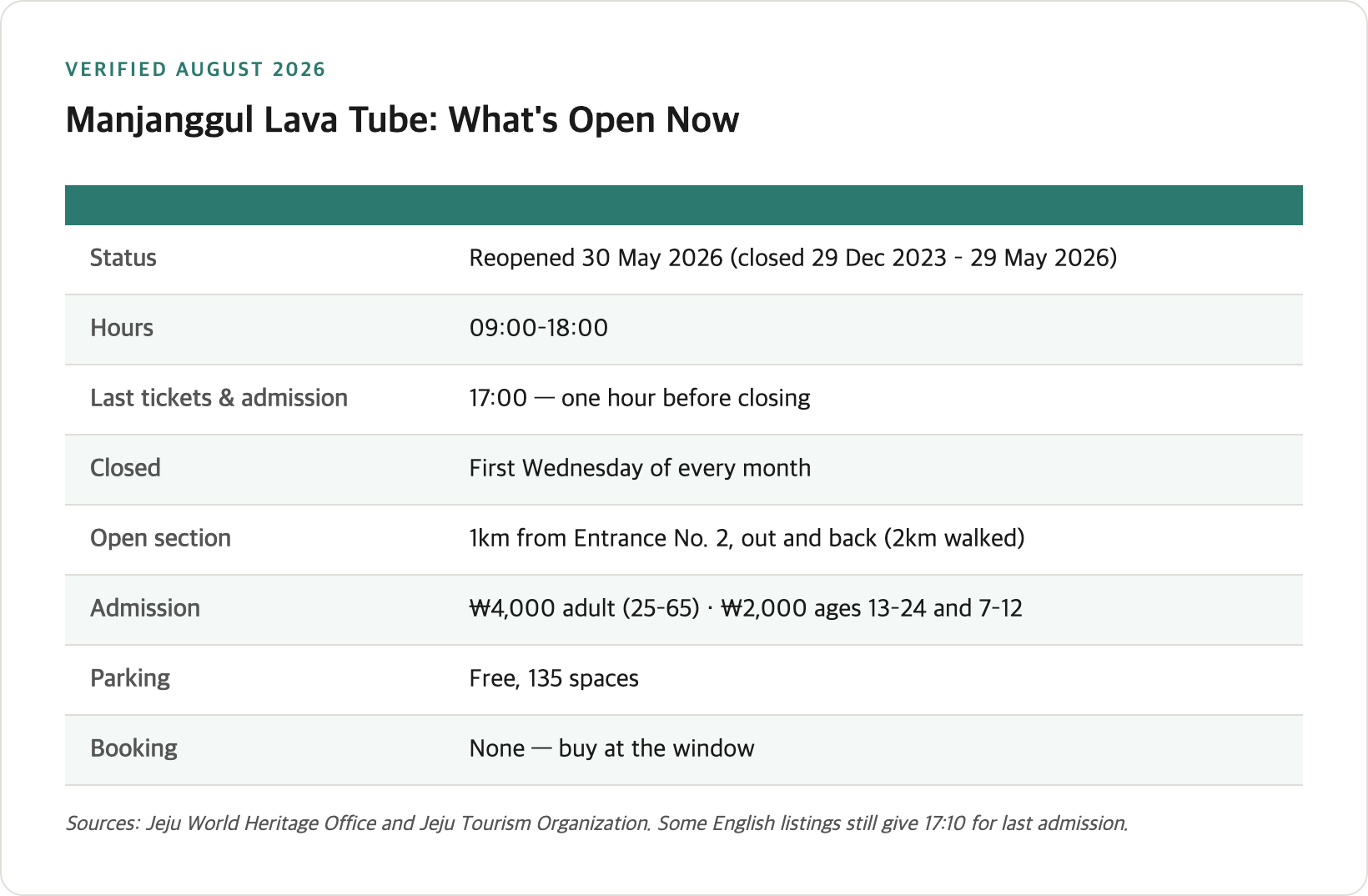
Manjanggul reopened on 30 May 2026 after two years and five months closed. Only about 1km is open, ending at the lava column — 1km each way. Hours are 09:00–18:00, but ticket sales and admission both stop at 17:00. It closes the first Wednesday of every month, costs ₩4,000 for adults, and parking is free. It is around 14°C inside, so bring a jacket even in August.
The Full Answer
Manjanggul is one of Jeju’s signature natural sights, and right now its most important fact is a recent one: it was shut for a long time and only just came back. It closed on 29 December 2023 and stayed closed for two years and five months, and a lot of the English travel content online still reflects either the pre-closure or the closed period.
That makes it a textbook case for checking current status before you build a day around a sight. I read the Jeju World Heritage authority’s own Manjanggul page and its reopening notice in August 2026, then cross-checked them against the Jeju Tourism Organization listing and the Korea Tourism Organization’s English page. The three do not fully agree — and the one that disagrees is the English one. That is the single most useful thing on this page, so it gets its own section below.
Manjanggul is run by the Jeju World Heritage Office, not by a private operator, which is why the authoritative numbers live on a jeju.go.kr page rather than on a ticketing site. There is no online booking system attached to it, and none of the official listings mention one: you buy at the window on the day.
The 2026 Reopening
Lead with the thing that changes whether you can go at all.
Local tip — Manjanggul reopened on 30 May 2026, exactly two years and five months after closing on 29 December 2023. The Jeju World Heritage Centre’s reopening notice of 18 May 2026 and the banner it still runs on its homepage both give 30 May, and Korean news coverage of the reopening agrees. Dates a day either side circulate; the operator’s own notice is the one to trust. And if your source says the cave is closed, it was written during the shutdown and nothing on it can be relied on.
The closure was not cosmetic. Korean coverage of the reopening puts the works at ₩12.1 billion and describes three changes: a viewing deck built along the whole 1km public section, LED lighting fitted with adjustable brightness, and rockfall protection installed at the points where rock had actually come down plus the sections rated most at risk. Monitors showing the cave’s temperature and humidity were also installed inside.
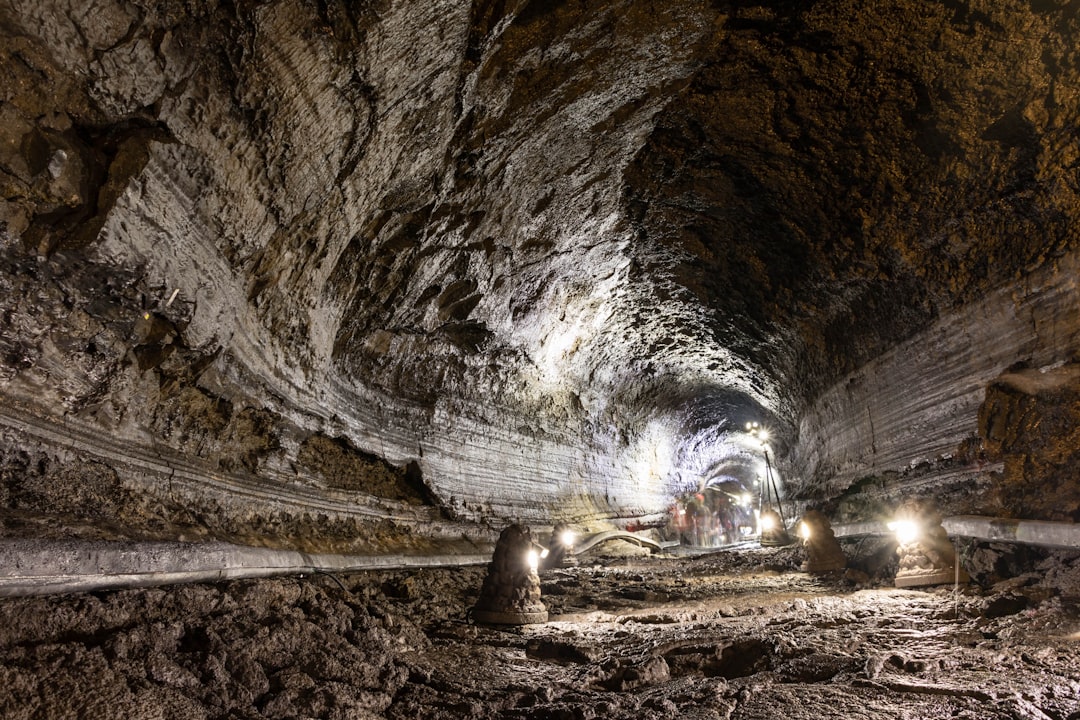
So if an older guide describes an unlit gravel floor or a longer accessible section, that is the pre-2026 cave. The lighting is now dimmer than a typical show cave by design — the stated aim was to keep the cave’s natural character rather than to floodlight it — so expect a dim walk rather than a bright one.
What’s Actually Open
Only a fraction of the tube is accessible, which surprises people expecting a long cave walk. This is worth being precise about, because “1km” gets quoted in ways that suggest a 1km loop.
The heritage authority’s own page states it plainly. Manjanggul runs about 7.4km in total and has three entrances, formed where the ceiling collapsed. Only Entrance No. 2 is open to the public, and from it you may walk 1km upstream — and then walk the same 1km back. There is no through route and no second exit, so the actual distance on your feet is 2km.
The 1km limit is not a temporary post-renovation restriction that will be lifted later. The rest of the tube has never been open to general visitors, and the heritage authority formally labels the site “Manjanggul (partially open)”. The neighbouring caves in the same lava tube system — Gimnyeonggul, Yongcheondonggul, Dangcheomuldonggul and Bengdwigul — are all listed as closed to the public, so there is no companion cave to add to the visit.
The turnaround point is the lava column: 7.6m tall, and described by both the heritage authority and the Korea Tourism Organization as the largest known in any lava tube.
How long it takes is the one number no official source publishes. What the operator does publish is the gap between the last admission and closing time — one hour — which is a fair guide to the round trip they expect. Allow an hour and you will not be rushed; allow forty minutes and you may be.
Hours, and the 17:00 Cutoff Most English Pages Get Wrong
This is the detail most likely to cost you the visit.
Local tip — Manjanggul is open 09:00–18:00, but ticket sales and admission both stop at 17:00 — a full hour before closing. The Korea Tourism Organization’s English page still says last admission is 17:10. The Jeju World Heritage Office, which actually runs the cave, and the Jeju Tourism Organization’s listing both say 17:00, and so does the reopening notice posted in May 2026. Work to 17:00. Arriving at 17:05 on the strength of an English page means driving away without seeing it.
That ten-minute discrepancy is small in isolation and decisive in practice, because the heritage authority puts the drive from Jeju Airport at roughly 50 minutes and there is nothing else to do at the site if you miss the window.
The other date to watch is the monthly closure.
Local tip — It closes the first Wednesday of every month for maintenance — and it reads oddly alongside Seongsan’s first-Monday closure. Jeju’s public attractions each have their own closure day, so check each one against your dates rather than assuming they align. The closure is also not absolute: the heritage centre posted a notice opening Manjanggul specially on Wednesday 3 June 2026, a first Wednesday, shortly after the reopening. If a first Wednesday is your only possible day, the notice board is worth checking rather than writing the day off.
I checked that notice board on 10 August 2026. There was no temporary closure or section restriction posted for Manjanggul beyond the standing first-Wednesday rule.
Tickets and Prices
The headline price is ₩4,000, but the age bands behind it are unusual and English listings flatten them.
| Ticket | Individual | Group (10+) | Applies to |
|---|---|---|---|
| Adult | ₩4,000 | ₩3,000 | ages 25–65 |
| Youth / military | ₩2,000 | ₩1,500 | ages 13–24 |
| Child | ₩2,000 | ₩1,500 | ages 7–12 |
Local tip — The youth rate runs to age 24, not 18. On Jeju’s public attractions an “adult” ticket starts at 25, so a 22-year-old backpacker pays ₩2,000, not ₩4,000 — and the same band covers serving military personnel. English listings collapse this into “adults ₩4,000, teenagers and children ₩2,000”, which quietly overcharges anyone aged 19–24 who does not think to ask. The bands are printed on the heritage authority’s own fee table.
Cash and cards are both accepted at the window. There is no combined ticket with the other UNESCO sites on the island — Seongsan Ilchulbong and Hallasan are ticketed separately, which matters if you are costing out a day. Our Jeju travel budget breakdown treats them as separate line items for that reason.
Parking is free, with 135 spaces — 60 for large vehicles and 75 for cars.
Inside the Cave: Temperature, Light and Footing
Korean reporting from inside the cave at the reopening put the internal temperature at around 14°C. Neither the heritage authority nor the Jeju Tourism Organization publishes a temperature figure, and other sources quote ranges as wide as 11–21°C, so treat 14°C as approximate rather than a constant. What is not in dispute is the direction: it is far colder than a Jeju summer day, and the change is immediate at the entrance stairs. Since the renovation there are monitors inside displaying live temperature and humidity, so you can see the actual reading rather than trust a guide.
Bring a jacket in August. The heritage authority’s own list of what to bring includes a warm jacket alongside sneakers and rain gear — an official recommendation, not a blogger’s suggestion.
Local tip — That same official list asks visitors to bring a lantern or torch — in a cave that has just had its lighting replaced. That is not an oversight. The new LED scheme was fitted with adjustable brightness and set deliberately low to preserve the cave’s natural character, so the walk is genuinely dim rather than floodlit. The heritage authority publishes this prep list only in Korean; the Korea Tourism Organization’s English page for Manjanggul carries no what-to-bring list at all. A phone torch is enough.
The floor is natural cave surface, uneven and damp in places, though the 2026 works added a viewing deck along the full public section. The official rules ban high heels, pets, and food and drink inside. Neither the heritage authority nor the Jeju Tourism Organization publishes an accessibility rating or any statement about wheelchair or pushchair access, so if that matters to your group, call the site on 064-710-7903 rather than relying on third-party pages.
A free guide service runs 09:00–16:00. It costs nothing and is not booked in advance — you sign up on site. It is not advertised on most English pages, and it ends two hours before the last admission, so it only exists for morning and early-afternoon visits.
Practical Facts
| Opening hours | 09:00–18:00 |
| Ticket sales and last admission | 17:00 |
| Closed | First Wednesday of every month |
| Admission | ₩4,000 adult (25–65) · ₩2,000 youth 13–24 and child 7–12 |
| Parking | Free, 135 spaces |
| Open section | 1km from Entrance No. 2, out and back (2km total) |
| Temperature | Around 14°C |
| Booking | None — buy at the window |
| Free guide service | 09:00–16:00, sign up on site |
| Phone | 064-710-7903 |
Getting There
The address is 182 Manjanggul-gil, Gujwa-eup, Jeju City — inland from Gimnyeong on Jeju’s northeast coast.
By car, the heritage authority gives roughly 50 minutes from Jeju Airport via Jochon, Hamdeok and Gimnyeong; about 24 minutes from Seongsanpo; and about 80 minutes from Seogwipo. Parking is free. If you are navigating, Google Maps will not give you driving directions in Korea — see Google Maps alternatives for Korea for what to use instead.
Without a car, there is a trap in the name. The intercity bus stop on the main road is called Manjanggul Ipgu — “Manjanggul entrance” — but it is not the entrance. The heritage authority states that walking from Manjanggul Ipgu to the cave takes about 30 minutes. If you get off there assuming you have arrived, you have a half-hour walk each way on top of the visit, which is an hour of your day that no English itinerary budgets for. Local buses run closer to the site, but frequencies on this stretch are low and I could not verify current route numbers from the Jeju bus authority’s own system, which does not serve its data without JavaScript — so check route numbers on the day rather than trusting any list, including ours. Our guide to visiting Jeju without a car covers how the island’s bus network actually behaves, and the Jeju itinerary plans build around it.
Combining it: Manjanggul sits on the northeast coast, so it pairs naturally with the Seongsan side of the island, and the heritage authority names Bijarim forest, Geomunoreum and the Jeju World Natural Heritage Centre as the nearby sites. The Haenyeo Museum is on the same coastal stretch, and the coastal Olle trail routes pass through Gimnyeong. Note that Geomunoreum — the volcano that created this entire lava tube system — requires advance booking, unlike Manjanggul.
Facilities on site, per the Jeju Tourism Organization listing: public parking, restrooms, a convenience store, a drinking fountain, free wi-fi, and both cash and card accepted. Card acceptance is worth noting given how cash-versus-card still varies at rural Korean attractions.
What You Need to Know
-
It reopened 30 May 2026 — older guides may say it’s closed.
-
Admission closes at 17:00, an hour before the gates do. English listings that say 17:10 are wrong.
-
Only 1km is open, from Entrance No. 2 — out and back, so 2km walked.
-
Around 14°C inside — bring a jacket even in summer.
-
Closed the first Wednesday of every month.
-
₩4,000 adult, but the youth rate covers ages 13–24 at ₩2,000. Parking is free.
-
No booking — tickets are sold at the window only.
-
The bus stop called “Manjanggul Ipgu” is a 30-minute walk from the cave.
Practical Tips
-
Work to a 17:00 cutoff, not 18:00. That is when tickets stop and admission ends.
-
Check your date isn’t a first Wednesday — and if it is, check the heritage centre’s notice board before writing the day off.
-
Bring a jacket — around 14°C inside regardless of the outside temperature, and there are monitors inside showing the real reading.
-
Bring a torch. The official prep list asks for one and the new LED lighting is deliberately dim.
-
If you’re 19–24, ask for the youth ticket — ₩2,000, not ₩4,000.
-
Don’t get off at “Manjanggul Ipgu” expecting to have arrived — see visiting Jeju without a car.
-
Allow an hour, wear shoes with grip, and use the free 09:00–16:00 guide service if you arrive in the morning.
Frequently Asked Questions
Is Manjanggul open?
Yes. It reopened on 30 May 2026, two years and five months after closing on 29 December 2023 for a ₩12.1 billion safety and lighting project. Guides written during that window say it is shut, and some written since still repeat the closure. The 1km public section from Entrance No. 2 is open on normal hours.
What time does Manjanggul stop letting people in?
17:00. The cave stays open until 18:00, but ticket sales and admission both end an hour earlier. This is the most commonly misreported fact about the site — the Korea Tourism Organization’s English page gives 17:10, while the Jeju World Heritage Office that runs the cave, the Jeju Tourism Organization listing and the May 2026 reopening notice all give 17:00. Plan for 17:00.
How much of the cave can I visit?
About 1km, from Entrance No. 2 upstream to the lava column. There is no through route, so you walk the same 1km back — 2km in total. Manjanggul runs roughly 7.4km overall and the rest has never been open to general visitors. Neighbouring caves in the same system, including Gimnyeonggul and Yongcheondonggul, are closed to the public entirely.
Do I need to book Manjanggul in advance?
No. Tickets are sold at the window on the day, and neither the heritage authority nor the Jeju Tourism Organization lists an advance-booking system. This is unlike nearby Geomunoreum, the volcano that formed the tube, which does require a reservation, and unlike Hallasan, where the summit trails are reservation-controlled.
How much does it cost?
₩4,000 for adults, but the official fee table defines an adult as 25–65. Ages 13–24, including serving military, pay ₩2,000, as do children aged 7–12. Groups of ten or more pay ₩3,000 and ₩1,500. Parking is free. Cash and cards are both accepted.
How cold is it inside?
Around 14°C, based on Korean reporting from inside the cave at the reopening. No official source publishes a figure and other sources quote ranges as wide as 11–21°C, so treat it as approximate — but in every case it is far colder than a Jeju summer day. There are monitors inside showing live temperature and humidity. Bring a jacket, which the official prep list also recommends.
How long does the visit take?
No official source publishes a walking time. The one hour the operator leaves between last admission at 17:00 and closing at 18:00 is a reasonable guide for the 2km round trip. Allow an hour to be comfortable.
How do I get there without a car?
Buses serve the area, but the main-road stop named “Manjanggul Ipgu” is about a 30-minute walk from the cave itself, according to the heritage authority. Check current route numbers on the day. Our guides to visiting Jeju without a car and getting around Korea cover how the bus network works.
Related Questions
- How to Visit Seongsan Ilchulbong: Sunrise Timing and the Monday Closure
- Visiting Jeju Without a Car: Buses, Fares and the 40-Minute Transfer Rule
- Jeju Travel Budget: What a Trip Actually Costs
- Jeju Itinerary: 3-Day and 5-Day Plans That Actually Work Without a Car
- How to Hike Hallasan: The Reservation System Nobody Explains
- The Jeju Haenyeo Museum: Opening Hours and the Monday Closure
- Walking the Jeju Olle Trail: Routes, Passports and Certification