Seongsan Ilchulbong Opening Hours: Seasonal Gates, Monday Closure
Quick Answer
Seongsan Ilchulbong (Sunrise Peak) is a UNESCO-listed tuff cone on Jeju’s east coast. Adult entry to the summit trail is ₩5,000. The gate opens 04:30 in summer, 05:00 in spring and autumn, and 06:00 in winter — fixed by season, not tied to sunrise — and the last ticket is sold an hour before closing. It closes the first Monday of every month.
The Full Answer
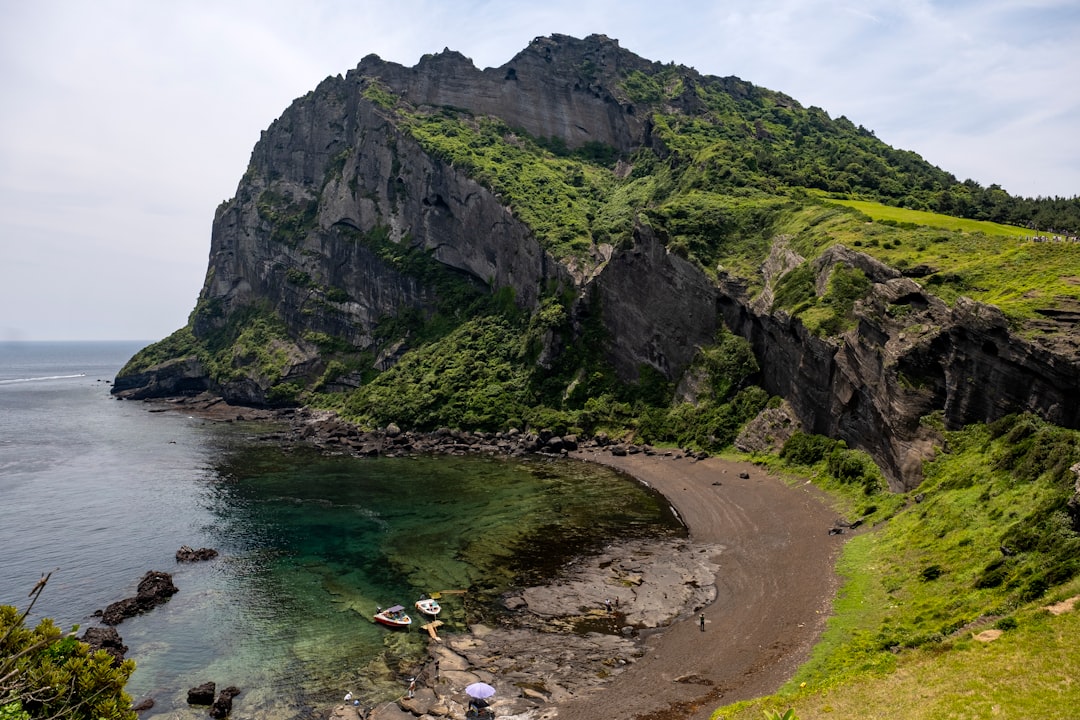
Seongsan Ilchulbong is one of Jeju’s signature sights: a 180-metre volcanic cone rising straight out of the sea, with a crater you can climb to at the rim. “Ilchulbong” means sunrise peak, and watching the sun come up from the top is the whole point for many visitors.
The catch is that all the timings that matter — when the gate opens, when the ticket office stops selling, when the sun actually rises — change through the year, and they do not move together. Show up on a winter morning at the summer opening time and you will be standing at a locked gate in the dark.
I rechecked the site’s registered operating data, the published fee table and the Korean coverage of the site in August 2026. Two things had drifted since most English guides were written: the hours were extended so that a summit sunrise is now possible at all, and the sunrise figures that circulate in English are roughly half an hour out for winter.
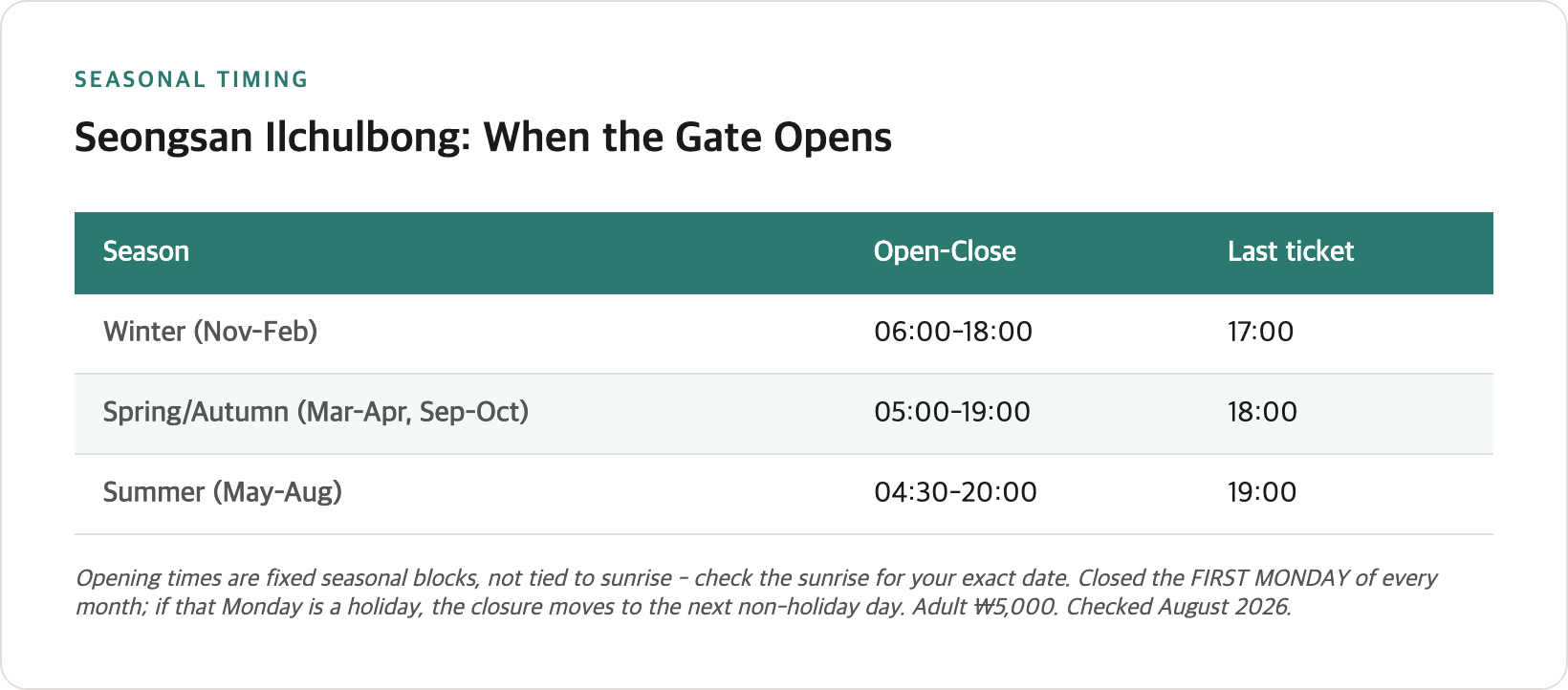
Seasonal Hours — This Is the Part That Changes
| Season | Open–Close | Last ticket |
|---|---|---|
| Winter (Nov–Feb) | 06:00–18:00 | 17:00 |
| Spring/Autumn (Mar–Apr, Sep–Oct) | 05:00–19:00 | 18:00 |
| Summer (May–Aug) | 04:30–20:00 | 19:00 |
These three blocks are the site’s registered hours, and the last-ticket rule is stated plainly in Korean listings as “ticket sales close one hour before entry closes.” Visitor reports from July 2026 match it: one describes buying a ticket by 19:00 and being expected down by 20:00.
Local tip — The opening time is a fixed seasonal block, not a sunrise-relative rule. There is no “gates open one hour before sunrise” policy at Seongsan, despite how some itineraries describe it. The gate opens at 04:30 from May through August regardless of whether sunrise that morning is at 05:10 or 05:45, and at 06:00 from November through February regardless of whether sunrise is at 07:15 or 07:40. Your margin therefore varies by several dozen minutes depending on the date — which is why you check the sunrise for your date, not the season.
The 2025 Change That English Guides Missed
If you have read an older English guide saying you cannot see sunrise from the summit of Sunrise Peak, that used to be true.
Local tip — The opening hours were extended in 2025 so that summit sunrise became possible. Two Korean write-ups from 2026 date the extension to that year, and a 2024 Korean forum thread is titled, more or less, “why does a place called Sunrise Peak only open at 7:30?” I could not find the management office’s own announcement, so treat the exact date as approximate — but the published hours today are unambiguous: 04:30, 05:00 or 06:00 depending on the season. English pages written before 2025 that tell you to watch sunrise from the beach below instead are describing a rule that no longer applies.
This matters because it changes the whole shape of the visit. The old advice — watch sunrise from Gwangchigi Beach or the seawall, then climb later — was a workaround for a gate that opened after the sun did. It is still a good option if you would rather photograph the cone than stand on it, but it is no longer the only option.
When the Sun Actually Rises
Sunrise at Seongsan swings by roughly two hours across the year, and this is where English sources are least reliable.
Korean guides that cover Seongsan specifically put winter sunrise at around 07:30, spring and autumn somewhere between 06:30 and 07:00, and midsummer at around 05:10 to 05:40. One Korean write-up from January 2026 records the sun actually breaking the horizon at about 07:35 on the morning of the visit; another notes an October sunrise “in the 06:40s”; a third gives 05:12 for a June morning.
Local tip — Several English guides — and plenty of itinerary posts — round winter sunrise at Seongsan to “about 07:00.” The Korean figures put it closer to 07:30–07:40, which means the winter margin between the 06:00 gate and sunrise is not one hour but closer to an hour and a half. That is comfortable, not tight. The genuinely tight season is midsummer, when a 04:30 gate and a sunrise near 05:12 leave you roughly forty minutes to buy a ticket and climb.
Treat all of those as approximations. Sunrise moves a minute or two every day, and none of the numbers above come from an astronomical table — they come from Korean visitors and guides describing specific mornings. Look up the exact sunrise for your date and for Seogwipo or Seongsan specifically before you set an alarm. The Korea Astronomy and Space Science Institute publishes an official sunrise calculator, and most weather apps will give you a figure for the coordinates you enter.
The Closure Nobody Mentions
Here is the one that ruins itineraries.
Local tip — Seongsan Ilchulbong is closed on the first Monday of every month — and there is a second layer almost nobody writes down in English. If that first Monday falls on a public holiday or a substitute holiday, the closure moves to the next non-holiday day rather than being skipped. So a first Monday that happens to be a holiday does not mean the site is open all month; it means the closed day slides. Check the date against the Korean public holiday calendar if your trip lands near the start of a month.
The closure applies to the paid summit trail. The free coastal section below, described next, is what people usually find still accessible on those mornings — but do not build a first-Monday sunrise around it.
The Free Section Most Visitors Walk Past
Seongsan Ilchulbong is not a single paid attraction. The path splits at the entrance.
- Right / uphill — the paid summit trail. Ticket required, stepped path to the crater rim, roughly 20–25 minutes up.
- Left / downhill — the free coastal section. No ticket. It leads down to Umutgae Beach, the black-sand cove at the foot of the cone, with an information hall on the way and a boat jetty at the bottom.
Local tip — The haenyeo (women divers) performance happens in the free section, down at Umutgae Beach — not behind the paid gate. Of the four Korean listings I checked in August 2026, three — including Visit Jeju’s own feature on haenyeo performances — give a single show at 14:00; one still shows an older two-show schedule of 13:30 and 15:00, which appears to be out of date. It runs in the open air and is cancelled in bad weather. Note that Korea Tourism Organization’s own page still describes it as viewable “with your Seongsan admission ticket,” wording that conflicts with what recent Korean visitors describe; if you only want the performance, walk left and you should not need a ticket.
The free section is also the answer for anyone travelling with people who cannot manage a stepped climb, and for a first Monday when the summit is shut. Round trip to the shore and back is comfortably under an hour. For more on the divers themselves, see where to actually see Jeju’s haenyeo.
Tickets, Discounts and What They Cost
| Ticket | Individual | Group |
|---|---|---|
| Adult | ₩5,000 | ₩4,000 |
| Youth / soldier | ₩2,500 | ₩2,000 |
| Child | ₩2,500 | ₩2,000 |
Group rates apply to larger parties, normally ten or more, and are handled at the window. Korean listings also say Jeju residents, visitors over 65 and disabled visitors enter free on production of documentation; the listings do not say whether the over-65 exemption is applied to a foreign passport, so ask rather than assume. Parking at the site is free.
There is also a discount programme worth checking. Jeju province and the Jeju Tourism Organization run a travel membership called NOWDA, which gives free or half-price admission at 27 public attractions on Jeju — Seongsan Ilchulbong among them. Its terms have already changed twice: through the end of 2025 the benefit applied to all holders regardless of membership level, and Korean write-ups from August 2026 describe a further revision from 1 July 2026 that ties free Seongsan entry to a level threshold. I could not confirm whether overseas visitors can register, so check the current terms on Visit Jeju before counting on it rather than arriving expecting free entry.
If you are pricing a Jeju trip, the Jeju budget guide puts these admission fees alongside transport and food, and the week-in-Korea cost breakdown gives the national picture. Payment at the window follows the usual Korean pattern — see cash or card in Korea if you are unsure what to carry.
Getting There, and Whether You Can Make Sunrise
Seongsan Ilchulbong sits on Jeju’s east coast, about an hour and a half from Jeju City by road. The bus stop is Seongsan Ilchulbong-ipgu (성산일출봉입구), and several routes call there:
| Route | Type | Runs between |
|---|---|---|
| 111 | Express | Jeju Airport / Jeju Bus Terminal ↔ Seongsan Port |
| 201 | Trunk | Jeju Bus Terminal ↔ Seongsan Ilchulbong-ipgu |
| 211 / 212 | Trunk | Seongsan Port ↔ Jeju Bus Terminal, via inland routes |
Seongsan Port is also where the Udo ferry leaves from, and what you are allowed to take across has changed twice since 2025. The 111 is the fast one and the only one that reaches the airport directly. The 211 and 212 take longer inland routes past Geomunoreum and Sangumburi.
The honest answer on sunrise by bus: I could not retrieve first-departure times from the Jeju bus operator’s own site, which serves its timetables through an interface that does not return them to a plain request. So I am not going to give you a first-bus time. Check the route on Jeju’s bus information system before you plan a bus-based sunrise, and assume you may need to stay in Seongsan the night before. Travellers without a car should read visiting Jeju without a car first — the early-morning gaps in Jeju’s network are the single biggest constraint on a sunrise plan, and the same problem shapes hiking Hallasan. For navigation, note that Google Maps does not do transit directions in Korea; see the alternatives.
If you would rather not piece the east coast together by bus, a guided East Jeju day tour with hotel-area pickup includes Seongsan Ilchulbong admission, though it is a daytime tour rather than a sunrise one.
If you are staying elsewhere on the island, the three- and five-day Jeju itineraries show where a Seongsan morning fits without wrecking the rest of the day. Broader transport rules are in getting around Korea.
Weather, Crowds and the Rest of the Morning
Korean visitor guides note that the summit trail can be closed outright in strong wind or heavy rain — this is an exposed coastal cone, and the upper path is a narrow stepped route with the sea on three sides. I could not find a published wind-speed threshold or an official closure notice page for Seongsan specifically. The management office on 064-783-0959 is the only same-morning source, and it is worth a call if a typhoon or a wind advisory is anywhere in the forecast. Do not rely on the Hallasan National Park closure page — that covers the mountain, not this site.
Korean coverage also mentions separate access controls on special dates, New Year’s Day sunrise being the obvious one. If you are planning a 1 January visit, assume the normal rules do not apply and check ahead.
One thing worth knowing if the summit is shut: the classic photograph of the cone is taken from the side, not from on top of it — from Gwangchigi Beach to the west, or from Seopjikoji. Gwangchigi is the one Korean photographers name, and at low tide the wet flats give a reflection of the cone. Neither viewpoint costs anything or needs a ticket, which makes them the fallback for a weather closure or a first Monday.
Weekends and Korean holidays bring heavy domestic crowds to the summit path, which is a single stepped route with limited passing room. The area pairs naturally into a half-day: the peak at opening, the free coastal section and the 14:00 haenyeo performance afterwards, and Seopjikoji nearby. Seongsan also sits on Jeju Olle Route 1, and the east coast day usually takes in Manjanggul Lava Tube — which has its own monthly closure on a different day, so check both against your dates.
What You Need to Know
-
Hours are seasonal and fixed. 04:30 (May–Aug), 05:00 (Mar–Apr, Sep–Oct), 06:00 (Nov–Feb). They are not tied to sunrise.
-
Last ticket is an hour before closing. Arriving near closing time is not enough.
-
Closed the first Monday of every month — and if that Monday is a holiday, the closure moves rather than disappears.
-
Sunrise moves about two hours across the year. Winter is nearer 07:30 than 07:00. Check your specific date.
-
There is a free section, downhill and to the left, with the haenyeo performance at 14:00.
-
The summit can close for weather. Call 064-783-0959 the morning of.
-
Fares and hours change. Confirm current figures before you go rather than trusting any guide, including this one.
Practical Tips
-
Target the opening time, not the sunrise time. In summer that means being at the ticket window at 04:30.
-
Look up sunrise for your exact date and for Seogwipo. Seasonal averages are too coarse for a 40-minute summer margin.
-
Check whether your date is a first Monday — and whether that Monday is a public holiday, which moves the closure.
-
Buy your ticket before the seasonal cut-off, one hour before closing.
-
Allow 20–25 minutes for the climb on top of your arrival buffer.
-
Go left for the free section if you want the coast, the information hall or the 14:00 haenyeo performance.
-
Call 064-783-0959 if the forecast looks windy — the summit trail closes in bad weather, and there is no live closure page for this site.
Frequently Asked Questions
What time should I arrive at Seongsan Ilchulbong for sunrise?
Aim for the seasonal opening time, not the sunrise time. The gate opens at 04:30 from May to August, 05:00 in March–April and September–October, and 06:00 from November to February. These are fixed seasonal blocks, so your margin before sunrise varies by date — check the exact sunrise for the morning you are going.
Can you actually see sunrise from the summit?
Yes, since the opening hours were extended in 2025. Older English guides that say the gate opens too late for sunrise are describing the pre-2025 schedule, when it reportedly opened around 07:30. If your source predates 2025, disregard its advice on this point.
How much does it cost?
₩5,000 for adults and ₩2,500 for youths, soldiers and children, with group rates of ₩4,000 and ₩2,000 for larger parties. Jeju residents, over-65s and disabled visitors are listed as free with documentation. Parking is free.
Is it ever closed?
Yes — the first Monday of every month. If that Monday is a public or substitute holiday, the closure moves to the next non-holiday day rather than being skipped. The summit trail can also close at short notice in strong wind or heavy rain.
How long is the climb?
Around 20–25 minutes to the crater rim on a stepped path. It is steep but short, and the path is well made with steps and boardwalk. Korean visitors typically report 20–30 minutes at an unhurried pace.
Can I see the haenyeo divers there?
Yes. The diving performance runs at Umutgae Beach in the free coastal section below the cone. Most current Korean listings give a single daily show at 14:00; older listings showing 13:30 and 15:00 appear out of date. It is free to watch and cancelled in bad weather.
How do I get there without a car?
By bus to the Seongsan Ilchulbong-ipgu stop — route 111 is the express from Jeju Airport and the bus terminal, and routes 201, 211 and 212 also call there. Early-morning services are the constraint on a sunrise visit; check the timetable on Jeju’s bus information system rather than assuming an early departure exists.
Where is the best photo taken from?
From the side rather than the summit — Gwangchigi Beach to the west is the one Korean photographers name, with a reflection of the cone on the wet flats at low tide, and Seopjikoji gives a longer view. Both are free and need no ticket.
Related Questions
- Visiting Jeju Without a Car — Buses, Fares and Transfer Rules
- Jeju Haenyeo — Where to Actually See the Women Divers
- How to Hike Hallasan: The Reservation System Nobody Explains
- Jeju Itinerary: 3-Day and 5-Day Plans That Actually Work Without a Car
- Manjanggul Lava Tube: Reopened in 2026 — What’s Actually Accessible Now
- Walking the Jeju Olle Trail: Routes, Passport and Certification
Featured image: Photo by Lightscape on Unsplash