Visiting Jeju Without a Car: Buses, Fares and the 40-Minute Transfer Rule
Quick Answer
You can see most of Jeju without renting a car. The bus network covers the airport, both cities, the coast and the main sights, using the same T-money card as the mainland. Route numbers tell you the service type: 100s are express, 200s trunk routes, 400s and 600s city feeders, 700s rural. Transfers are free within 40 minutes — longer than Seoul’s 30 — but the same route number does not qualify for a transfer discount.
The Full Answer
Jeju is marketed as a place you need a car for, and for some itineraries that is true. But the bus system is genuinely usable, far cheaper, and removes the stress of driving unfamiliar coastal roads where Google Maps gives you no navigation.
The barrier is not coverage — it is that the rules differ from the mainland in ways nobody spells out. The route-number system encodes information, the transfer window is a different length, and there is an exclusion that quietly costs people a second fare. I checked the Jeju bus information system and the local fare rules in July 2026 against the English guides, which mostly treat Jeju buses as identical to Seoul’s. When I compared the published Jeju transfer terms with Seoul’s, two differences stood out that no English guide I found had carried across.
Reading the Route Numbers
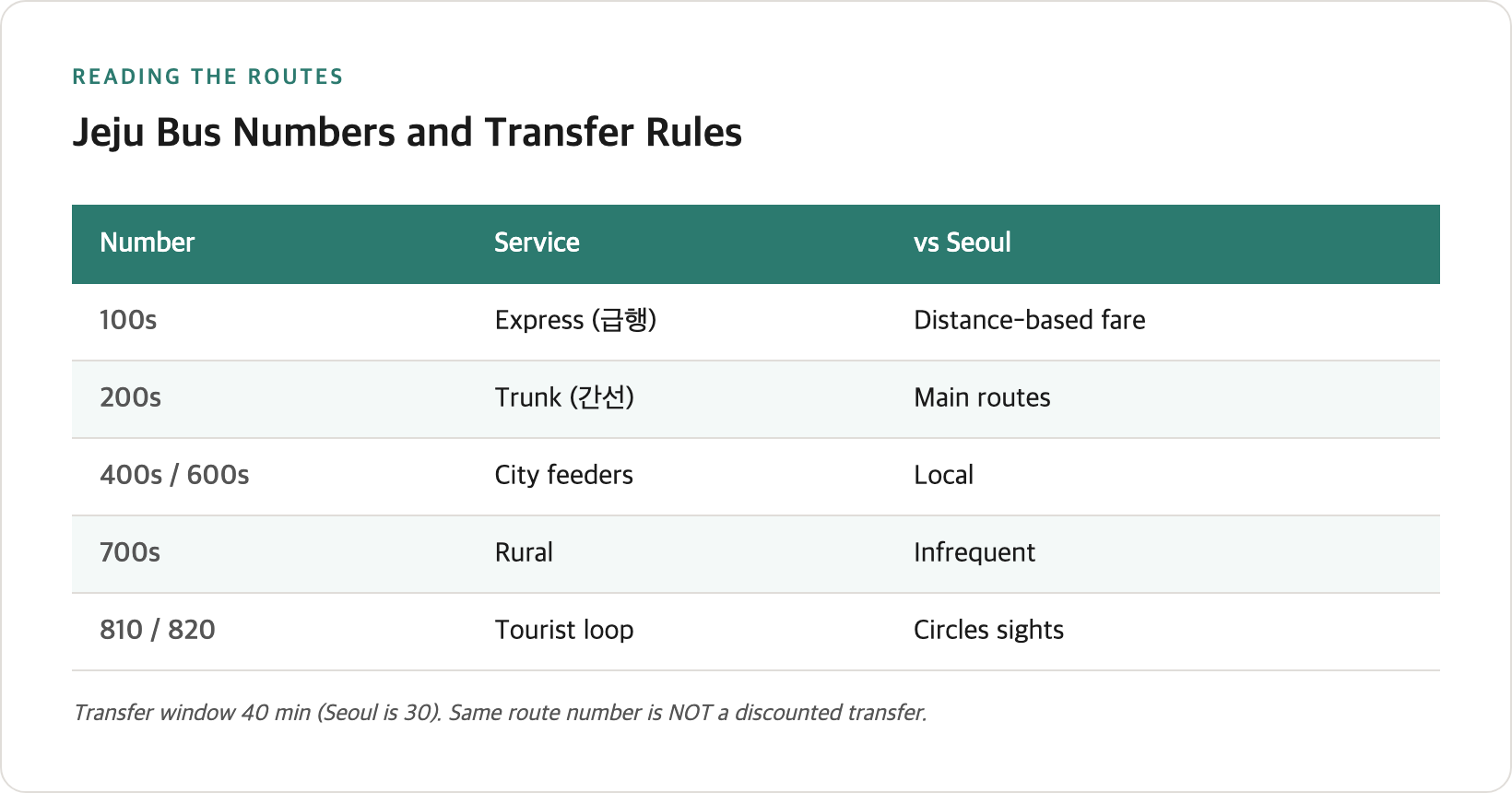
The first digit tells you what kind of service it is.
| Band | Service | Use |
|---|---|---|
| 100s | Express (급행) | Fast, limited stops, airport ↔ far coast |
| 200s | Trunk (간선) | Main intercity routes |
| 300s | Jeju City trunk | Cross-city, north |
| 400s | Jeju City feeder | Local, north |
| 500s | Seogwipo trunk | Cross-city, south |
| 600s | Seogwipo feeder | Local, south |
| 700s | Rural (읍면) | Villages, infrequent |
| 810 / 820 | Tourist loop | Circles clusters of sights |
| Four digits | Night bus (심야) | 3001–3008 Jeju City, 5001–5006 Seogwipo |
Local tip — The 810 and 820 tourist loop buses circle groups of attractions and are the closest thing Jeju has to a hop-on service, but they are almost invisible in English guides. If you are basing a day around several east- or west-coast sights, check whether a loop bus links them before piecing together trunk routes.
Fares and Paying
- Card: T-money, Cashbee and other nationwide transit cards all work
- Discount: paying by card saves ₩50 per ride versus cash on trunk, feeder and village buses
- Airport buses: pay on board by cash or card
Express (100s) fares are distance-based and higher than the flat local fare, so a long express hop from the airport costs more than a short local ride.
The Transfer Rules That Differ From Seoul
This is where Jeju quietly diverges, and where the extra fares come from.
| Seoul | Jeju | |
|---|---|---|
| Transfer window | 30 min (60 after 21:00) | 40 min |
| Max transfers | Multiple | Up to 2 |
| Same route number | Allowed | Not eligible for discount |
Local tip — Jeju’s transfer window is 40 minutes, ten more than Seoul’s daytime window — helpful given the longer gaps between rural buses. But transferring onto the same route number does not count as a discounted transfer. If you tap off and back onto another 201, you pay again. English guides copy Seoul’s rules across and miss both differences.
Local tip — Always tap off when you leave the bus. As on the mainland, the transfer discount only applies if you tapped out, and Jeju’s longer window is no help if you forgot to tap.
Sample Journeys Without a Car
- Airport → Seongsan Ilchulbong: express or trunk east along the coast — plan early for a sunrise visit
- Airport → Hallasan trailheads: buses serve both Seongpanak and Gwaneumsa, but early services are limited — factor this into your summit reservation timing
- City → Olle Trail sections: most courses start and end near bus stops — see which Olle course to walk
If stitching those east-coast stops together by bus sounds like more planning than you want, the same run — Seongsan Ilchulbong, Manjanggul and a haenyeo demonstration — is covered in one day by a guided bus that picks up in Jeju City; lunch is paid on the day rather than included, and the haenyeo segment is called off when the sea is rough.
Rural (700s) buses can be infrequent — sometimes a few an hour, sometimes fewer — so check the timetable rather than assuming turn-up-and-go. I confirmed the loop-route numbers against the operator’s own listing rather than relying on aggregated travel sites, which had them inconsistently.
Taxis: The Gap-Filler, and the 23:00 Line
Going car-free on Jeju does not mean going taxi-free. The bus network handles the long hauls cheaply — a flat ₩1,150 by card on trunk and feeder routes, ₩2,000 to board an express — but it leaves predictable gaps: the last kilometre to a guesthouse, an early start before the first bus, a rural stop where the 700-series runs a few times a day, or a late arrival at a terminal. A taxi is the tool for those gaps, and it is far cheaper to use deliberately than to fall back on.
The fares are set by the province, not by the driver or the app, and one tariff covers the whole island. I checked the Jeju provincial fare schedule and the Jeju Bus Information System fare page in August 2026: both still show the rates that took effect on 1 July 2024, with no revision since.
| Small (소형) | Mid-size (중형) | Large (대형) | |
|---|---|---|---|
| Base fare, first 2 km | ₩3,000 | ₩4,300 | ₩6,000 |
| Then, per unit of distance | ₩100 / 167 m | ₩100 / 126 m | ₩200 / 120 m |
| Slow traffic (under 15 km/h) | ₩100 / 41 sec | ₩100 / 31 sec | ₩200 / 29 sec |
| Beyond 20 km | ₩120 / 167 m | ₩120 / 126 m | — |
Mid-size is the standard car you will actually be flagging down. On top of the meter there is a ₩1,000 call fee per booking — the provincial notice specifies it applies to taxis that display a call number and have registered the fee — and a late-night surcharge of 20% between 23:00 and 04:00.
Local tip — Jeju’s late-night surcharge starts at 23:00, not midnight. That one hour is worth real money: a mid-size taxi’s base fare goes from ₩4,300 to ₩5,160 the moment the clock passes 23:00. The change was made in the November 2023 fare revision and has been in force ever since, yet Visit Jeju’s own English page still quotes a ₩3,300 base fare and says fares “increase by 20% between midnight and 4 a.m.” — I checked it again in August 2026 and it carries a “written on 2025-04-14” stamp. If you budget from the English page, you will be short on both numbers.
Local tip — There is a long-distance step nobody translates. Past 20 km, the mid-size distance rate rises from ₩100 to ₩120 per 126 m — a 20% increase — and the provincial schedule spells out that surcharges are added, not multiplied: late-night 20% plus long-distance 20% equals 40%, not 44%. English fare guides describe Korean taxi surcharges as a night rate only, and I could not find one that mentions Jeju’s 20 km step at all. It matters precisely on the trip most visitors take by taxi — the airport to Seogwipo, which is roughly 40 km.
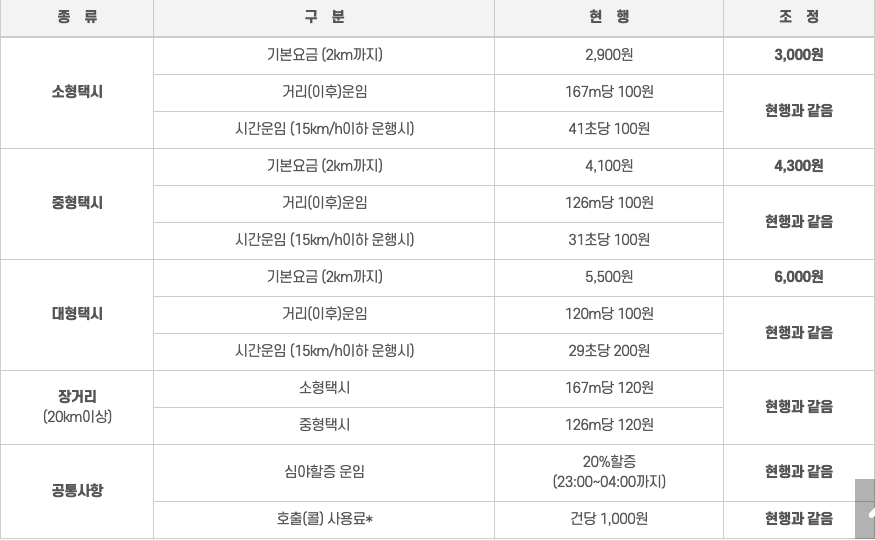
The provincial fare table as published by Jeju Province (jeju.go.kr), checked August 2026. The 23:00 start and the 20 km step are both in the “공통사항” and “장거리” rows.
What a long ride actually costs
Working that 40 km airport-to-Seogwipo run through the published tariff gives roughly ₩37,000–38,000 in daytime, and around ₩44,000 if you set off after 23:00 — before any slow-traffic time fare, which the meter adds whenever the car drops below 15 km/h. This is a calculation from the official rates, not a quoted price, so treat it as a range rather than a figure to argue with a driver about.
It also explains something confusing: English sources quote anywhere from ₩30,000 to ₩55,000 for this ride. Some are using the old ₩3,300 base, some are quoting fixed private-transfer prices, and none of them account for the 20 km step or the hour when you travel. For comparison, the same journey by bus is a fraction of that — the 600 and 800 airport limousines run to Seogwipo (the 600 via Jungmun, the 800 not), and express routes 181 and 182 link the airport and Seogwipo bus terminal directly. Budget the taxi as a supplement, not a default; see the full cost breakdown for a Jeju trip for how it compares against renting.
Hailing one, and why apps do not conjure cars
Kakao T is the app drivers actually use, and it works the same way here as on the mainland — though you will want working mobile data before you rely on it. Uber operates in Korea as UT, a venture it launched with TMAP Mobility and agreed in December 2024 to take over fully; crucially, UT dispatches licensed taxis, not private cars. Uber’s own ride-share product left Korea in 2015. In practice that means switching between Kakao T and Uber in Seogwipo at midnight is drawing from the same pool of local licensed vehicles, so a slow match is a supply problem, not an app problem.
The supply problem is real and officially acknowledged. The province’s own fare-revision document lists, among its follow-up measures, continuing to encourage late-night operation “to ease the late-night taxi shortage” (심야 택시난) — an admission in a government notice, not a traveller’s complaint. Visit Jeju’s English page gestures at the same thing when it says drivers finish earlier than in Seoul, without explaining why or what to do about it.
Two things help. First, the island does run night buses: the official listing shows four-digit 심야 routes, 3001–3008 in Jeju City and 5001–5006 in Seogwipo, with 3001 working an airport loop. Several of them run on weekdays only or holidays only, so check the timetable on the Jeju Bus Information System rather than assuming. Second, if you are arriving somewhere small very late, ask your accommodation to call a local call-taxi company for you. I looked for a verified public number for Seogwipo call taxis and found Korean blogs listing several different ones with no official source behind any of them, so I am not printing one here — a wrong number at 01:00 is worse than no number.
What You Need to Know
-
Route numbers encode the service type. The first digit tells you express, trunk, feeder or rural.
-
The transfer window is 40 minutes, not 30. Jeju differs from Seoul here.
-
The same route number is not a discounted transfer. Tapping onto another bus with the same number costs a full fare.
-
Tap off every time. No tap-out, no transfer discount.
-
Rural buses are infrequent. Check timetables for 700-series routes rather than turning up.
-
Early-morning coverage is thin. Sunrise trips and dawn hikes need careful planning.
-
Taxi late-night surcharge starts at 23:00. Not midnight, whatever the English pages say. A mid-size base fare goes ₩4,300 → ₩5,160.
-
Long taxi rides cost more per kilometre past 20 km. The distance rate steps up 20%, and it adds to the night surcharge rather than compounding with it.
Practical Tips
-
Use the same T-money card you use on the mainland. No separate Jeju card is needed.
-
Learn the number bands. 100 express, 200 trunk, 400/600 local, 700 rural, 810/820 tourist loop.
-
Remember the 40-minute window, and tap off on exit every time. The same route number does not qualify for the discount, and the longer window is useless if you never tapped out.
-
Check timetables for rural routes. Some 700-series buses run only a few times an hour.
-
Plan sunrise and hiking trips around limited early services. See Seongsan and Hallasan.
-
Use Naver Map or KakaoMap for live bus times. Google has no reliable Korean transit data.
-
Move long taxi rides before 23:00 where you can. The 20% night surcharge starts then, and on a 40 km run it stacks with the over-20 km rate for a combined 40% uplift.
Frequently Asked Questions
Can I get around Jeju without renting a car?
Yes, for most itineraries. The bus network reaches the airport, both cities, the coast and the main sights, using the same transit cards as the mainland.
How do the Jeju transfer rules work?
Transfers are free within 40 minutes, up to two, if you tap off and on with a card. Transferring onto the same route number does not qualify for the discount.
What do the bus route numbers mean?
The first digit indicates the service: 100s express, 200s trunk, 400s and 600s city feeders, 700s rural, and 810/820 tourist loops.
Is it cheaper to pay by card or cash?
Card, by about ₩50 per ride on local buses, and card is required to get the transfer discount.
Are there tourist buses?
Yes — the 810 and 820 loop routes circle clusters of attractions and suit a day built around several nearby sights.
How early do buses start?
Coverage is thin in the early morning, which matters for sunrise trips and dawn hikes. Check the timetable for your specific route.
How much is a taxi in Jeju?
The provincial tariff in force since July 2024 sets a mid-size taxi at ₩4,300 for the first 2 km, then ₩100 per 126 m, with ₩120 per 126 m beyond 20 km. A ₩1,000 call fee applies to app and phone bookings, and fares rise 20% between 23:00 and 04:00. Rates are set province-wide, so they are the same in Jeju City and Seogwipo.
When does the Jeju taxi night surcharge start?
At 23:00, not midnight, and it runs until 04:00. Several English-language pages, including Visit Jeju’s own, still describe it as starting at midnight. The 23:00 start dates from the November 2023 fare revision.
Related Questions
- How to Hike Hallasan: The Reservation System Nobody Explains
- How to Visit Seongsan Ilchulbong: Sunrise Timing and the Monday Closure
- T-money Card: Buying, Topping Up, and Getting Your Money Back
- Jeju Travel Budget: What a Trip Actually Costs, With or Without a Car
- Jeju Itinerary: 3-Day and 5-Day Plans That Actually Work Without a Car