Busan Attractions: Getting to the Spots the Subway Doesn’t Reach
Quick Answer
Busan’s best sights are where the subway isn’t. Gamcheon clings to a hillside, Yeongdo is an island, Songdo and Taejongdae need a bus. The city tour bus is the tidiest fix — one ₩20,000 day pass covers all three circular lines (as of 2026) — but it does not run on Mondays or Tuesdays, and the individual sights each close on their own day. Check the calendar before you plan the route.
The Full Answer
Busan’s signature sights — the pastel hillside of Gamcheon, the cliff lane at Huinnyeoul, the sea-cliff loop of Taejongdae, the cable car strung across Songdo bay — are genuinely spectacular. They are also, almost without exception, not on the subway. That is not a coincidence: the terrain that makes them worth seeing is the terrain a metro line cannot follow.
English guides show the photographs and skip the logistics, which leaves two different ways for a Busan day to fall apart. The first is access — turning up at a station and discovering the sight is a bus ride and a hill away. The second is quieter and more expensive: making the bus ride and the hill and finding the thing shut. These attractions are run by a mix of district offices, the city’s infrastructure corporation and private operators, and each picks its own closing day.
I read the Korean operator pages for each sight on 9 August 2026 rather than the English listings, because the listings are where the stale figures live. Several numbers had moved, one attraction turned out not to be running at all, another is about to come under a new access regime, and the closing days do not line up the way an English itinerary assumes.
The city tour bus: the tool built for exactly this problem
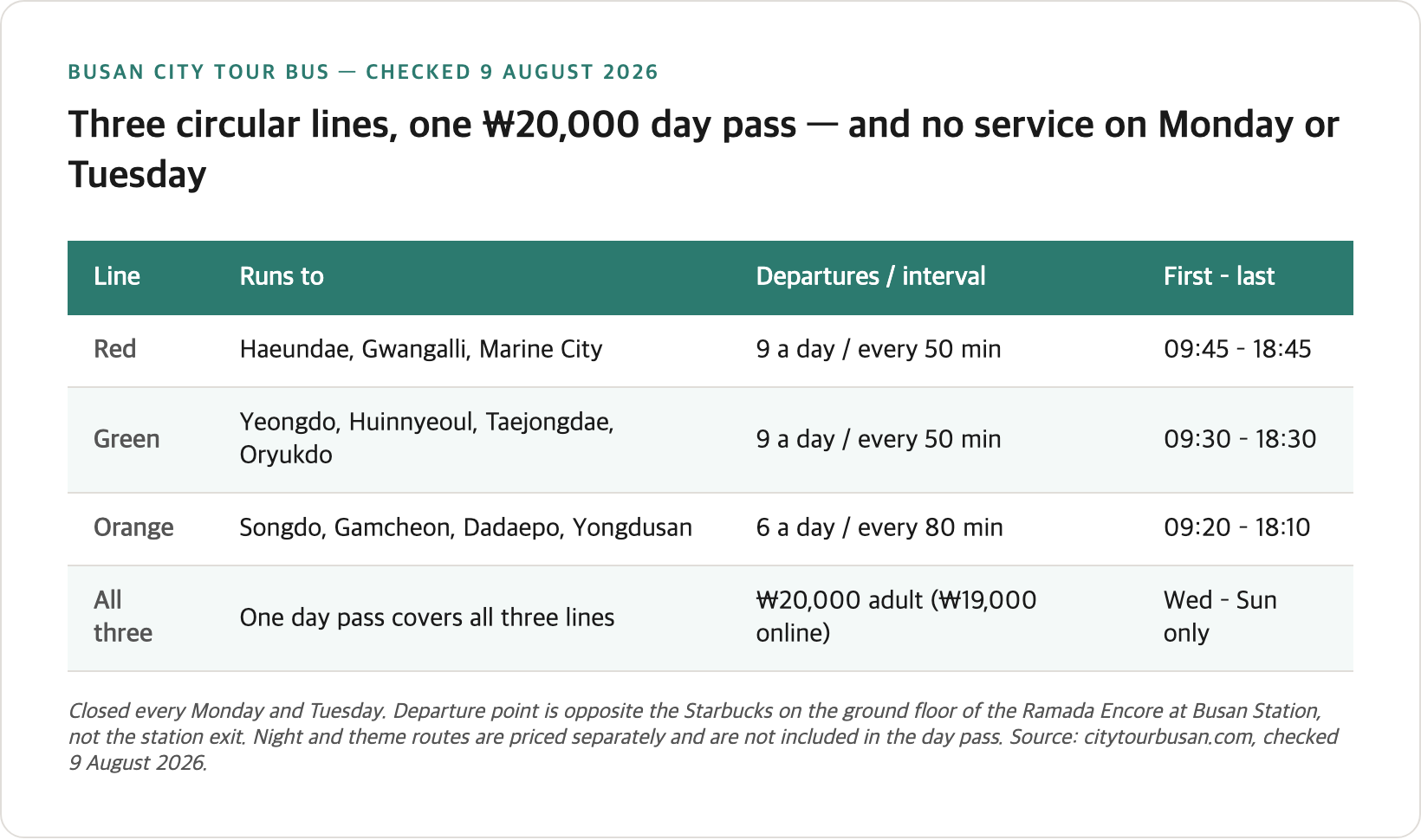
Start here, because it is the single answer to “the subway doesn’t reach it,” and English coverage of it is unusually wrong. Busan City Tour runs three circular hop-on hop-off lines out of Busan Station, and each is a string of the sights the subway misses: Red to Haeundae and Gwangalli, Green to Huinnyeoul, Taejongdae and Oryukdo, Orange to Songdo, Gamcheon and Dadaepo. Red and Green run nine times a day at roughly 50-minute intervals; Orange six times at 80-minute intervals, with first departures between 09:20 and 09:45 and last returns between 18:10 and 18:45 (as of 2026).
Local tip — Two things the English listings get wrong about this bus, and both change the plan.
One day-pass ticket covers all three circular lines, not one. The Korean fare page says it in a sentence — 당일권 티켓 1매로 레드라인, 그린라인, 오렌지라인 3개 노선을 모두 이용하실 수 있습니다 — so Gamcheon on the Orange Line in the morning and Taejongdae on the Green Line in the afternoon is one ₩20,000 ticket (₩19,000 online). The English summaries I read quote ₩15,000 and four routes. Both are out of date.
It is closed Monday and Tuesday. The Korean course page states 매주 월요일, 화요일은 정기 휴무입니다 — Wednesday to Sunday only. English pages generally carry “closed Mondays,” the usual Korean museum pattern, which is wrong here. A two-day stop landing on a Monday and Tuesday means the bus is not an option at all.
Source: citytourbusan.com course and fare pages, checked 9 August 2026.
One more detail: the departure point is not the station exit but 라마다앙코르호텔 1층 스타벅스 맞은편 — opposite the Starbucks on the ground floor of the Ramada Encore, across the plaza from Busan Station. The night bridge tour and the theme routes are separate products at ₩20,000 to ₩30,000 and are not covered by the day pass (as of 2026).
If you are arriving from Seoul, see booking KTX tickets and getting around Korea. The bus also starts a few minutes from the international ferry terminal, which makes it a tempting way to fill a departure day — but check the arithmetic. The last circular returns land between 18:10 and 18:45, and check-in for the overnight ferry to Fukuoka closes at 18:30. You need an earlier loop than the timetable suggests. For what a day like this adds up to, see what a week in Korea actually costs.
Gamcheon Culture Village
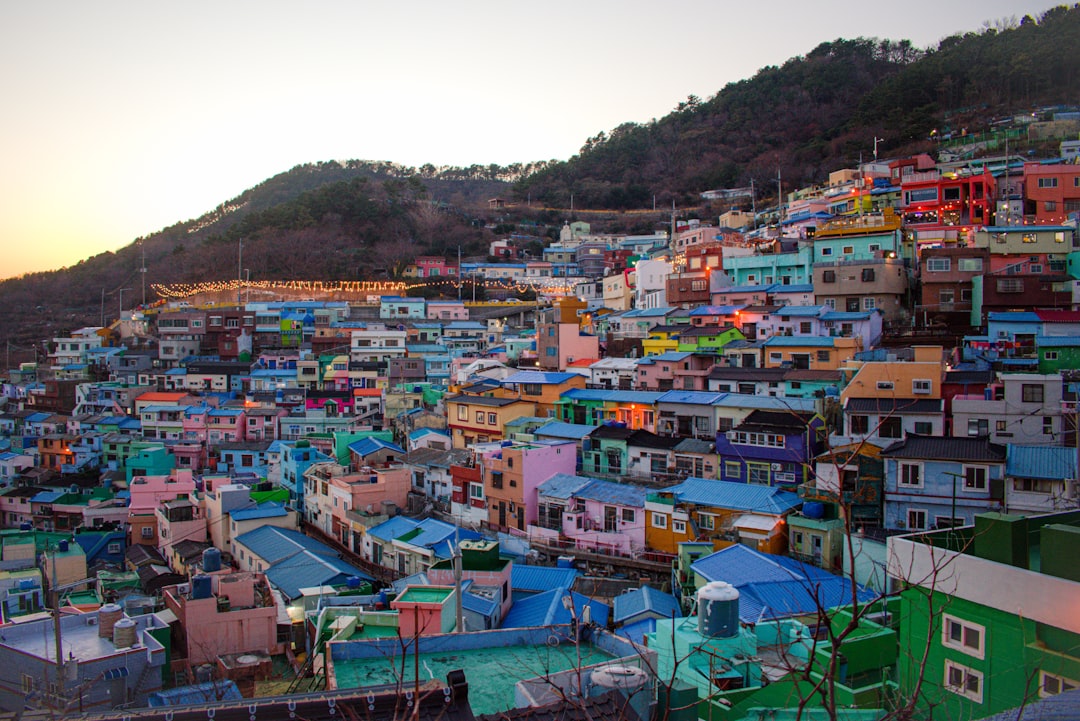
The pastel hillside everyone photographs, and the one sight where “how do I get up there” is the whole question.
Gamcheon sits on a slope in Saha-gu with no station of its own. The standard approach is Line 1 to Toseong Station (토성역), exit 6, then a village bus up the hill: Saha 1-1, Seo-gu 2 or Seo-gu 2-2, getting off at Gamjeong Elementary School. Walking up is possible and steep enough that most people regret it. The Orange Line of the city tour bus also stops here, which is the argument for the day pass if Gamcheon and Songdo are both on your list.
Note the route numbers. English guides routinely list Saha 1 among the Toseong buses; it is not one. The village’s own directions page puts Saha 1 and Saha 1-1 under Goejeong Station, and only 1-1, Seo-gu 2 and Seo-gu 2-2 under Toseong.
Built by Korean War refugees and later redeveloped as an art village, Gamcheon rewards wandering rather than ticking off viewpoints. Busan’s tourism organisation gives visiting hours as 09:00–18:00 from March to October and 09:00–17:00 from November to February, and the village’s own information centre and experience venues close at 16:00. There is no gate and no ticket; the hours are a request, put plainly on the village notice board as 그 외 시간대의 방문은 삼가주시기 바랍니다.
That request is about to become a rule.
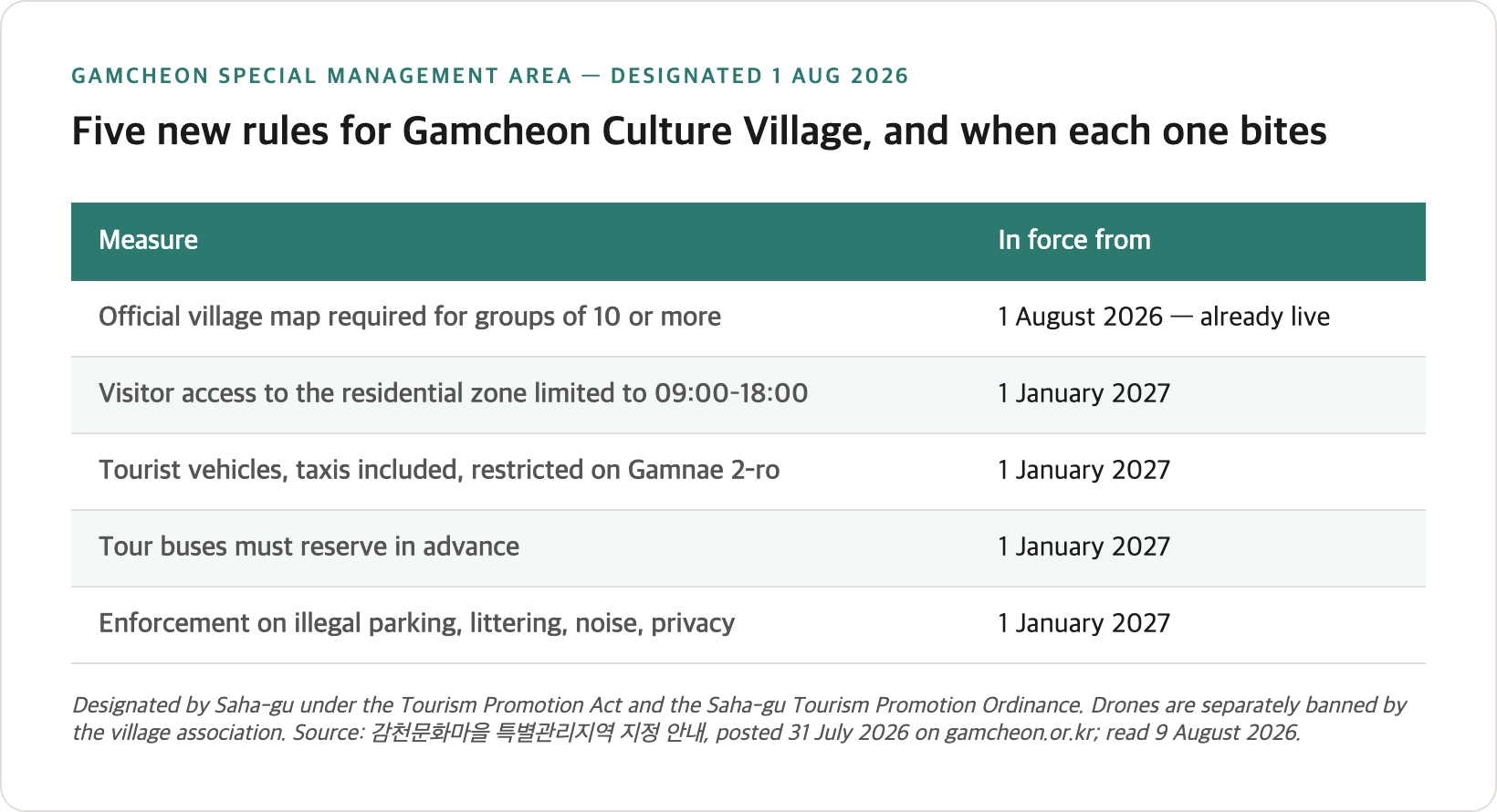
Local tip — Gamcheon was designated a Special Management Area on 1 August 2026, under the Tourism Promotion Act and Saha-gu’s tourism ordinance. I read the district’s notice poster on the village site directly. Five measures follow:
- Visitor access to the designated residential zone limited to 09:00–18:00
- Groups of 10 or more must buy the official village map — already in force
- Tourist vehicles, taxis included, restricted along Gamnae 2-ro, the main approach road
- Tour buses must reserve in advance
- Enforcement against illegal parking, littering, noise and privacy intrusion
The designation takes effect 1 January 2027. The poster is bilingual, but it sits on a Korean village site whose notices load through a JavaScript call — very likely why no English guide carries any of it. The Korea Tourism Organization’s English page still lists Gamcheon as open 24 hours with free parking. Source: 감천문화마을 특별관리지역 지정 안내, posted 31 July 2026 on gamcheon.or.kr.
This is a lived-in village, not a theme park. The village association is blunt about one consequence: 드론촬영은 안돼요 — no drones, a rule I found in no English guide. Keep your voice down, do not photograph into windows, and stay out of the marked residential lanes.
Yeongdo: Huinnyeoul and the coastal path
Yeongdo is an island, and no subway line crosses to it. Huinnyeoul Culture Village (흰여울문화마을) — the cliffside lane above the water — and Taejongdae are both reached by bus or taxi from Nampo-dong, which is itself awkward for the subway. That makes Yeongdo a double transit hop. From Nampo Station exit 6, Busan’s tourism organisation gives buses 7, 71 and 508.
Treat it as one outing, not two. Huinnyeoul and Taejongdae are both on the Green Line, in that order, and the city buses that reach one continue toward the other. Crossing back to the mainland between them costs the better part of an hour — a planning error that comes from reading a subway map rather than a bus route. Like Gamcheon, the lane is residential, and narrow enough that a group standing in it is in the way.
The bigger issue is the walk below it.
Local tip — The Jeoryeong coastal path (절영해안산책로) beneath Huinnyeoul — the seafront walk with the tunnel and the staircases — has been a construction site since 26 December 2024, and what is open now is a partial, temporary reopening on fixed hours. Yeongdo-gu’s notice of 14 January 2026 opens 꼬막계단, 무지개계단, 피아노계단 밑 하부 산책로 일부 from 15 January 2026 until work resumes, at 09:00–16:00 daily, and states plainly that 터널 뒤구간은 차단함 — the section behind the tunnel stays shut. The district had already extended the original closure once for rockfall protection works. So the walk closes at 16:00, it is not continuous, and it can close again without notice. English pages describe it as simply open, including one updated in July 2026. Source: yeongdo.go.kr 건설과 notices of 23 December 2024, 4 June 2025 and 14 January 2026.
Taejongdae, and the train that isn’t running
Taejongdae is a large coastal park at the southern tip of Yeongdo, much bigger on the ground than it looks on a map. Entry has been free since 1 September 2006, as the operator’s own FAQ says. The loop road is 4.3km and takes an hour to an hour and a half on foot.
The Danubi train (다누비열차) is the road train that normally circles that loop, and every English guide recommends it. There is a problem with that advice right now.
Local tip — The Danubi train has not been running since 4 July 2026. The Busan Infrastructure Corporation posted the notice on 7 July: 다누비열차가 긴급 안전점검으로 인해 운행이 중단되었습니다 — suspended for an emergency safety inspection, with no end date announced (“종료시”). In its place a free circular shuttle bus runs Tuesday to Sunday, ticketing 09:10–17:30 and departures 09:30–17:30, boarded with a free per-departure ticket issued first-come at the Danubi ticket office. That changes where you queue, when the last useful departure is, and the fact that you now need a paper ticket for a free bus. I found it nowhere in English. Open the Taejongdae notice board (새소식) before you go and check whether the train is back. Source: bisco.or.kr, checked 9 August 2026.
When the train does run, it stops at three places only — the observatory, the Yeongdo lighthouse and Taejongsa temple — so the suspension bridge and Sinseondae are walks either way. Its regular closure is Monday, and so is the Yeongdo lighthouse interior, while the city tour bus is closed Monday too. Monday is the worst possible day for a Yeongdo trip.
Songdo: the cable car, and the bridge underneath it
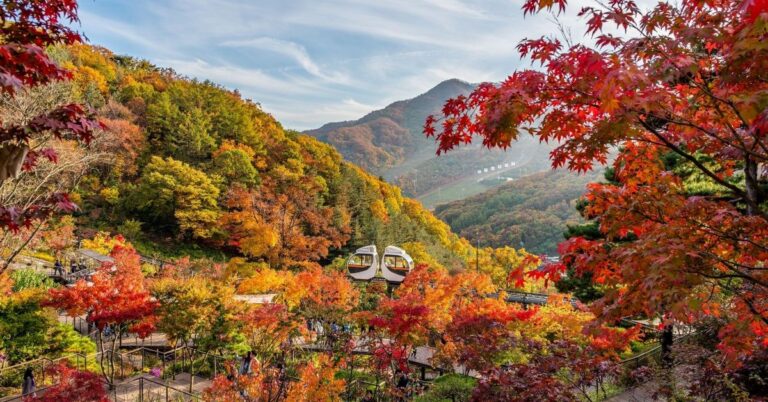
Songdo Beach sits west of Nampo and is not on the subway either. The draw is the Songdo Marine Cable Car (송도해상케이블카), branded Busan Air Cruise, which crosses the bay from the beach to Songdo Sky Park on the headland.
| Cabin | Round trip, adult | Round trip, child | One way, adult |
|---|---|---|---|
| Air Cruise (standard floor) | ₩19,000 | ₩14,000 | ₩15,000 |
| Crystal Cruise (glass floor) | ₩24,000 | ₩18,000 | ₩19,000 |
Child fare covers 36 months to 12 years; adult is 13 and over (as of 2026). The ticket window closes 30 minutes before the day’s last run, and the operator notes that service can end early depending on weather and ticketing.
Local tip — Two things about this cable car that the guides in either language will not tell you.
The fares above are the operator’s own, and almost nothing else agrees with them. They come from busanaircruise.co.kr’s Korean and English price pages, both of which I opened on 9 August 2026. Figures well below these — ₩15,000 and ₩20,000 for the two round trips — still circulate in Korean blog posts and English listings alike. The operator’s English page has the correct numbers; it simply ranks below the pages that do not.
There is no weekly closed day, so nobody warns you about the annual one. The operator shuts the line for an overhaul every March. Its notice of 19 February 2026 ([점검공지] 2026년 3월 정기 안전 점검 및 대정비 휴장 안내) set a safety inspection on 3–6 March and a full overhaul from 9 to 25 March, leaving only 1–2 and 7–8 March operating before service resumed on 26 March. Quarterly inspection closures come on top — the third-quarter 2026 notice went up on 5 August. None of it appears in English. If your trip is in March, open the Korean notice board (공지사항) first.
The wind question I could not settle. The operator’s pages say only that operation can stop in bad weather — 악천후 시 운영이 중지될 수 있습니다 — with no published wind-speed threshold in either language, so I am not inventing one. Tickets are same-day only, and a weather suspension is refunded.
The Songdo Yonggung Suspension Bridge (송도용궁구름다리) sits in Amnam Park directly below the cable car’s upper station, so it is the obvious thing to do after crossing — but it keeps its own calendar. Seo-gu district gives the closure as 매달 첫째, 셋째 월요일: the first and third Monday of the month, not every Monday, and if that Monday is a public holiday it shifts to the next day. Hours are 09:00–18:00 March to September, 09:00–17:30 October to February. That pattern breaks the standard cable-car-plus-bridge itinerary twice a month, and no English guide I saw carries it.
Yongdusan Park and Busan Tower
The exception that proves the rule: this one is central, walkable from Nampo, and free to reach.
Yongdusan Park is an open public park — no gate, no ticket. Busan Tower, also marketed as Busan Diamond Tower, is the paid part: ₩12,000 for ages 13 and over, ₩9,000 for children from 36 months to 12 and for visitors 65 and over (as of 2026). It runs 10:00 to 22:00 with ticketing closing at 21:30, and the city’s own listing gives its closed days as 연중무휴 — none.
Getting up is the part worth knowing. An escalator from Gwangbok-ro runs 24 hours a day and only goes up; coming down, you take the stairs. It decides whether you finish the day at the top of a hill or the bottom of one, and it is in no English guide I read. The Busan Museum of Movies on the same hill runs 10:00 to 17:00, closed Mondays.
The Jagalchi and Gukje market guide covers what else is walkable from here, and where to stay in Busan explains why Nampo looks central on a map and behaves differently in practice.
The far ends: Yonggungsa, Oryukdo and Nurimaru
Three more sights sit off the subway and all three are free — which is exactly why their opening hours are what catches people out.
Haedong Yonggungsa (해동 용궁사), the seaside temple in Gijang, is reached by bus 181 from Haeundae. Its own page says 입장시간 새벽 4시 30분 / 퇴장시간 오후 8시 30분, open 365 days — while the Korea Tourism Organization’s English listing gives 04:30 to 19:20. For evening light that difference is more than an hour, and the temple is the operator. One honest gap: it states plainly that 주차료는 사찰과 무관합니다, it does not run the car park, and the rates circulating in Korean contradict its own page, so I am not printing a parking figure. Lotte World Adventure Busan is in Gijang too, by Osiria Station on the Donghae Line, and its afternoon ticket starts at 3 PM, not at 4 PM as at the Seoul park.
Closer to Haeundae itself, the Blueline Park Sky Capsule fares rose on 1 May 2026 — ₩50,000 for two riders, and which slot catches the sunset shifts month by month.
Oryukdo Skywalk in Nam-gu is a free glass deck over the sea. Its operator lists it as 연중무휴 — no regular closed day — running 09:00 to 18:00 from October to May and 09:00 to 19:00 from June to September, but it shuts at short notice for snow, rain and high wind, with no published threshold.
Nurimaru APEC House on Dongbaekseom is a short walk from Dongbaek Station on Line 2. It stops admitting a full hour before it closes — 관람시간 09:00~18:00 (입장시간 09:00~17:00) — and closes the first Monday of each month, not every Monday. Its own English page was still showing a renovation-closure banner dated 28 December 2019 when I opened it, so an English speaker checking the official source gets a seven-year-old notice and no current hours at all. The beaches next door are covered in the Busan beaches guide.
Planning the access
The sights group by access route, not by proximity on a map. Cluster them that way.
| Sight | How to reach | The detail that catches people |
|---|---|---|
| Gamcheon | Toseong exit 6, bus 1-1 / Seo-gu 2 / 2-2; Orange Line | Special Management Area from 2027; no drones |
| Huinnyeoul (Yeongdo) | Nampo exit 6, bus 7 / 71 / 508; Green Line | Coastal path open 09:00–16:00 only, in part |
| Taejongdae (Yeongdo) | Bus to the park, then the shuttle | Danubi train suspended since 4 July 2026 |
| Songdo cable car | Bus from Nampo; Orange Line | Shut most of March for the overhaul |
| Songdo Yonggung bridge | Below the cable car’s upper station | Closed 1st and 3rd Monday |
| Busan Tower | Walk up from Nampo; escalator goes up only | Open daily, 10:00–22:00 |
| Oryukdo Skywalk | City bus or Green Line | No closed day; shuts for wind and rain |
| Nurimaru | Dongbaek Station, Line 2 | Last admission 17:00; closed 1st Monday |
| Nampo markets | Walkable together | Jagalchi keeps its own closing days |
| City tour bus | Ramada Encore, Busan Station | No service Monday or Tuesday |
Two notes on moving between them. Mapping apps behave differently here — see why Google Maps doesn’t work in Korea before trusting walking directions up a hillside. And Busan’s buses take the same transit cards as Seoul’s, so a T-money or Cashbee card covers everything; the Seoul subway tap-out rules work the same way on Busan’s lines.
What You Need to Know
-
The best sights aren’t on the subway. Plan bus, taxi or city tour bus connections rather than station-to-station hops.
-
The city tour bus is closed Monday and Tuesday — two days, not one. Its ₩20,000 day pass covers all three circular lines.
-
The Danubi train at Taejongdae is suspended as of 4 July 2026, with a free shuttle in its place and no announced restart.
-
Gamcheon is now a Special Management Area. Group map purchase applies from August 2026; residential-zone hours, vehicle limits and tour-bus booking take effect January 2027. Drones are banned outright.
-
Huinnyeoul’s coastal path is a building site with a partial reopening on 09:00–16:00 hours, not a continuous seafront walk.
-
Yeongdo is a double hop. Bundle Huinnyeoul and Taejongdae into one outing, and not on a Monday.
-
The Songdo cable car shuts for most of March for its annual overhaul, with quarterly closures on top.
-
Free entry does not mean open late. Nurimaru stops admitting at 17:00 and closes the first Monday of the month.
Practical Tips
-
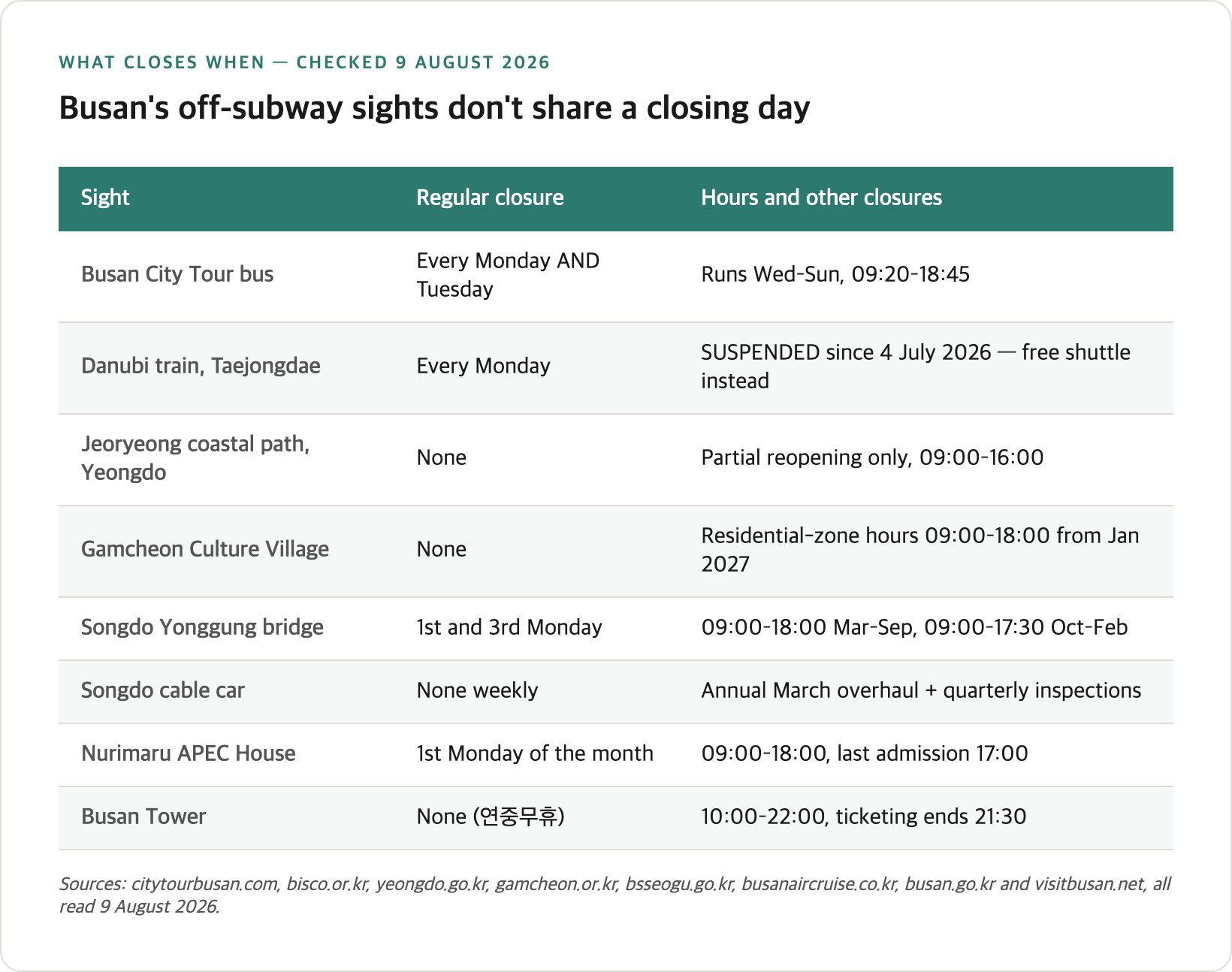
Check the day of the week before the route. Monday and Tuesday kill the city tour bus; Monday closes the Yeongdo lighthouse interior and the Yongdusan film museum; the first Monday closes Nurimaru; the first and third Monday close the Songdo bridge.
-
Buy the city tour day pass online for the 5% discount and use it across all three lines — Orange for Gamcheon and Songdo, Green for Yeongdo and Oryukdo, Red for Haeundae.
-
Check the Taejongdae notice board before you go. The Danubi train may or may not be back; the free replacement shuttle needs a paper ticket from the Danubi ticket office, issued first-come per departure.
-
Do Yeongdo’s sights as one island outing — Huinnyeoul then Taejongdae, on the same Green Line ticket — and reach the coastal path before 16:00, when the reopened section shuts.
-
If you are travelling in March, open the cable car’s Korean notice board first. The annual overhaul takes most of the month out.
-
Carry cash and a transit card. City buses and on-site ticket windows are not all card-friendly; Korean ATMs explains which machines take a foreign card.
-
Be quiet in Gamcheon and Huinnyeoul, and leave the drone at home. Both are residential villages, the alleys are people’s front doors, and Gamcheon’s new rules make that official. If you are a group of ten or more, buy the village map — that requirement is already in force.
Frequently Asked Questions
How do I get to Gamcheon Culture Village, and are there rules now?
Take Line 1 to Toseong Station, exit 6, then village bus Saha 1-1, Seo-gu 2 or Seo-gu 2-2 to Gamjeong Elementary School; Saha 1 runs from Goejeong, not Toseong. Gamcheon is also a stop on the city tour Orange Line. As for rules: Saha-gu designated the village a Special Management Area on 1 August 2026. Groups of ten or more must already buy the official map, and from 1 January 2027 residential-zone access is limited to 09:00–18:00, tourist vehicles including taxis are restricted on Gamnae 2-ro, and tour buses must book ahead. Drones are banned.
Is Yeongdo on the subway?
No. Huinnyeoul Culture Village and Taejongdae are reached by bus or taxi from Nampo-dong, which is itself awkward for the subway, so plan for a double transit hop. Both are stops on the Green Line of the city tour bus, in that order. Bundle them into one outing rather than crossing back to the mainland in between.
Is the Danubi train at Taejongdae running?
Not as of August 2026. The operator suspended it on 4 July 2026 for an emergency safety inspection and has not announced a restart date. A free circular shuttle bus runs in its place, Tuesday to Sunday, with ticketing from 09:10 and departures from 09:30 to 17:30; you collect a free ticket for a specific departure at the Danubi ticket office on a first-come basis. Check the park’s Korean notice board before travelling, because this can change without an English announcement.
How much is the Busan City Tour bus, and does one ticket cover every route?
A circular-line day pass is ₩20,000 for adults and ₩10,000 for children, or ₩19,000 and ₩9,500 booked online (as of 2026). One ticket covers all three circular lines with unlimited transfers. It does not cover the night bridge tour or the theme routes, which are separate products at ₩20,000 to ₩30,000. English listings quoting ₩15,000 are out of date.
What days is the Busan City Tour bus closed?
Every Monday and Tuesday — the operator’s Korean course page states it plainly, and the service runs Wednesday to Sunday only. This is a common planning error, because most English summaries carry “closed Mondays,” which follows the usual Korean museum pattern but is wrong here.
How much is the Songdo cable car, and is the glass floor worth it?
Round trip is ₩19,000 for adults in the standard Air Cruise cabin and ₩24,000 in the glass-floored Crystal Cruise, with child fares of ₩14,000 and ₩18,000 (as of 2026). One-way tickets are ₩15,000 and ₩19,000 for adults. The ₩5,000 gap is small enough that the Crystal cabins go first on busy days. Lower figures still circulate widely online — the fare has risen more than once.
When is the Songdo cable car closed?
There is no weekly closed day, but there is a long annual one. The operator shuts the line for a safety inspection and full overhaul every March — in 2026 that ran from 3 to 25 March with only four operating days in between, resuming on 26 March. Quarterly inspection closures are announced separately on the Korean notice board, and bad weather can suspend service at short notice, in which case tickets are refunded.
Can I see Busan’s main sights without using the subway at all?
Largely, yes — and for several of them you have to. The three city tour lines between them reach Gamcheon, Songdo, Huinnyeoul, Taejongdae, Oryukdo, Yongdusan, Gwangalli and Haeundae. The limitation is that the service does not run on Mondays or Tuesdays, so on those days it is city buses and taxis.
Related Questions
- Where to Stay in Busan: The Subway Access Nobody Warns You About
- Busan to Fukuoka Ferry: The Check-In Window English Guides Get Wrong
- Busan Beaches: Opening Dates and the Swimming Hours That Catch People Out