Busan Beaches 2026: Opening Dates, Hours and Beach-by-Beach Rules
Quick Answer
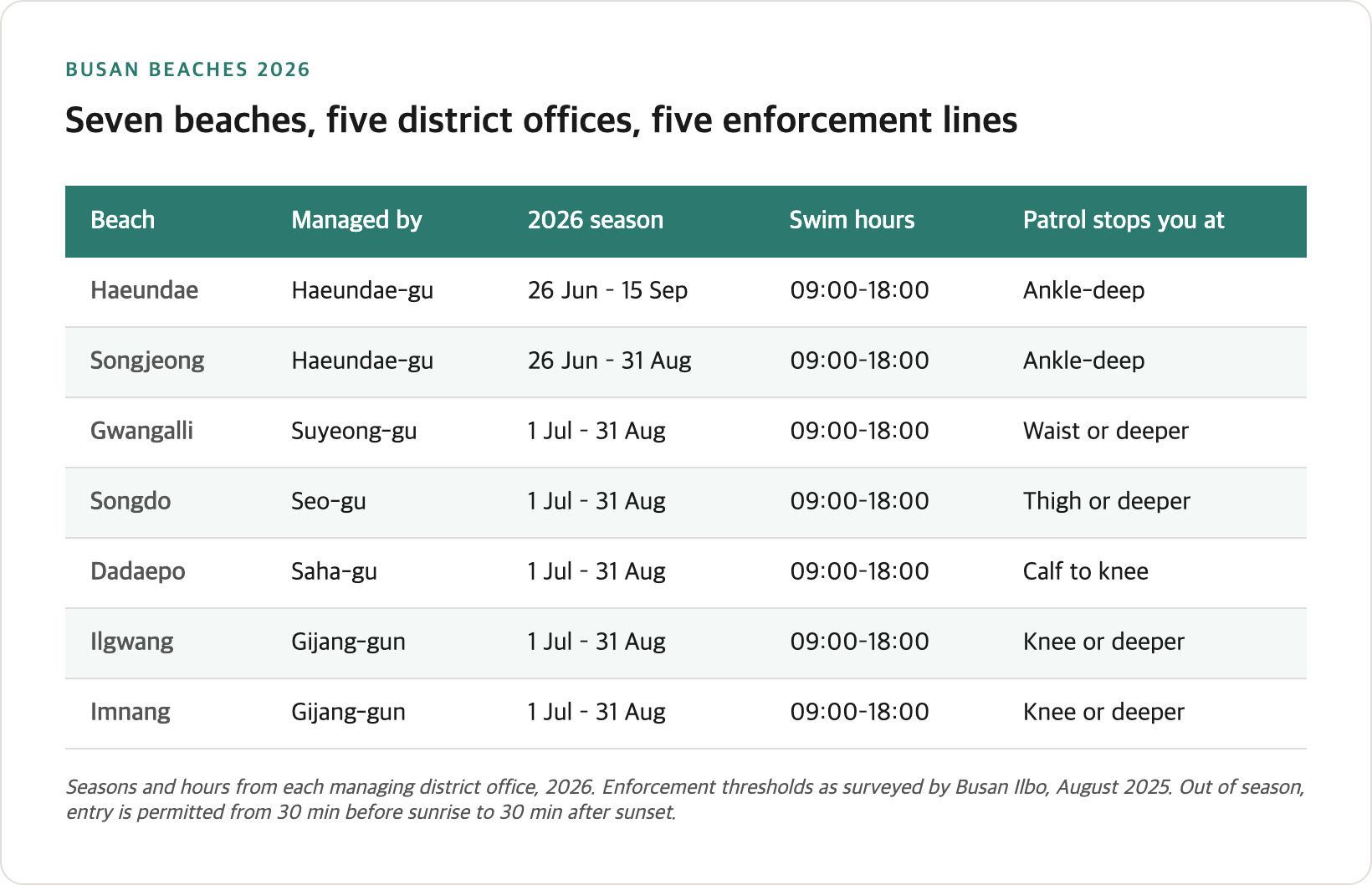
Busan’s seven public beaches (해수욕장) run on official, published seasons. In 2026 Haeundae opened 26 June and runs to 15 September; Songjeong opened 26 June but closes 31 August; Gwangalli, Songdo, Dadaepo, Ilgwang and Imnang run 1 July to 31 August. Swimming hours during the season are 09:00–18:00 at all seven. Outside those hours you can be stopped, and repeat refusal carries a fine.
The Full Answer
Gwangalli has one more date that matters after its season ends: the fireworks festival on 7 November, when the beach and the stations around it work on a different set of rules.
Most English-language writing about Busan’s beaches is about which one is prettiest. That is not the information that ruins a day. What ruins a day is turning up at Gwangalli on 28 June, or walking into the water at 18:30 in August and being marched out by a patrol team.
Busan’s beaches are not open space that happens to have sand. Each one is a legally designated 해수욕장 under the Beach Use and Management Act (해수욕장의 이용 및 관리에 관한 법률), and each is administered by the district office (구청) whose territory it sits in — five different district and county offices across seven beaches. The district sets the season, the swimming window, the rental price list and the safety staffing, and publishes all of it in Korean.
I checked the Haeundae-gu office’s own beach pages in August 2026, which carry 2026 dates, 2026 rental rates and facility charges, and were last revised on 1 and 3 July 2026. I checked Suyeong-gu’s tourism pages for Gwangalli separately, where the swimming rule is written from the other direction — “no entry from 18:00 to 09:00 the following day” during the 1 July to 31 August season. And I read Busan Ilbo’s August 2025 survey of how the seven beaches are policed after hours, which is the source of the most useful thing in this article: the seven beaches do not enforce the same rule, and the difference between them is measured in how deep you are standing.
This guide covers the 2026 dates, the swimming window, what actually happens outside it, the published prices, and the drinking and smoking rules — which are not the same at Gwangalli beach and at the waterfront park 200 metres from it.
The 2026 Opening Dates, Beach by Beach
Beaches in Korea are formally opened (개장) and closed (폐장) on dates fixed each year by the managing district. The season is when lifeguard towers are staffed, rental operators are licensed to trade, and shower and changing facilities run.
| Beach | District (관할) | 2026 season | Days | Swimming hours |
|---|---|---|---|---|
| Haeundae 해운대 | Haeundae-gu | 26 Jun – 15 Sep | 82 | 09:00–18:00 |
| Songjeong 송정 | Haeundae-gu | 26 Jun – 31 Aug | 67 | 09:00–18:00 |
| Gwangalli 광안리 | Suyeong-gu | 1 Jul – 31 Aug | 62 | 09:00–18:00 |
| Songdo 송도 | Seo-gu | 1 Jul – 31 Aug | 62 | 09:00–18:00 |
| Dadaepo 다대포 | Saha-gu | 1 Jul – 31 Aug | 62 | 09:00–18:00 |
| Ilgwang 일광 | Gijang-gun | 1 Jul – 31 Aug | 62 | 09:00–18:00 |
| Imnang 임랑 | Gijang-gun | 1 Jul – 31 Aug | 62 | 09:00–18:00 |
Haeundae’s 2026 season runs two weeks longer than every other Busan beach: 26 June to 15 September, 82 days. Songjeong — run by the same district office — opened on the same day but closes 31 August, 67 days. The other five close 31 August too. If you are in Busan in early September, Haeundae is the only one of the seven still operating as a swimming beach. These dates are reported reasonably well in English; the details underneath them are not. Between Haeundae and Songjeong, the Blueline Park Sky Capsule now costs ₩50,000 for two, not the ₩40,000 most English guides still print.
One detail sits below the headline dates and is worth carrying. The Haeundae-gu listing gives Songjeong’s season as 26 June to 31 August, but attaches a separate line to the equipment: parasols, tubes and beach beds are available 1 July to 31 August only. For the first five days the beach is open, staffed and swimmable, and there is nothing to rent. It sits in a footnote on the district’s price list rather than in the opening announcement, which is why it travels badly. Arrive in that window and bring your own shade.
Dates shift year to year, and 2026 was pushed earlier than usual because of a long hot spell. Treat the table as the 2026 position, not a permanent calendar, and check the managing district’s page before a trip in a different year.
The 09:00–18:00 Swimming Window
All seven beaches publish the same in-season swimming hours: 09:00 to 18:00. This is not a suggestion about when it is pleasant. It is the window in which the lifeguard towers are staffed and entering the water is permitted.
Haeundae staffs ten watchtowers, two patrol teams of six, seven rescue equipment stations and one defibrillator. Songjeong staffs eight towers and the same two patrol teams. At 18:00 that structure stands down, and the patrols switch from watching swimmers to moving people out of the water.
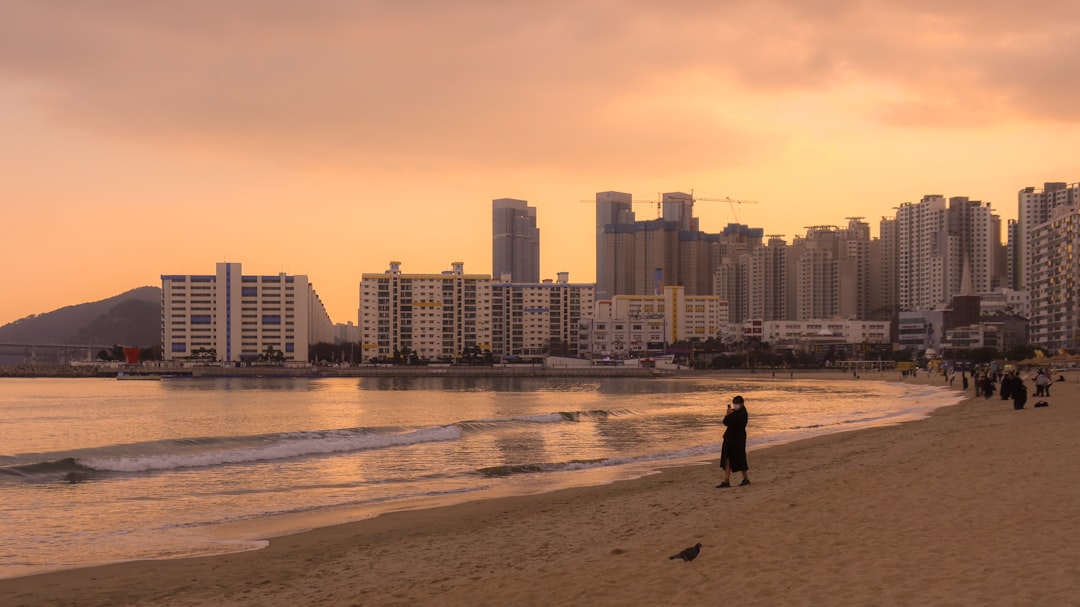
The distinction worth holding onto is that at 18:00 the beach does not close — the water does. The sand, the promenade, the convenience stores and the cafés carry on, and Gwangalli in particular is busier after dark than at noon. What ends is permission to be in the sea. Plan swimming for the staffed window and evenings for everything else.
This matters more than it sounds, because Busan’s beaches are urban. Haeundae and Gwangalli are lined with apartment towers and bars, they are lit all night, and there is nothing physically stopping you from walking into the water at 22:00. The restriction is legal and patrolled, not fenced.
Out of Season You Can Still Swim — Inside a Window
Out of season is where the English-language picture actually falls apart, and it falls apart in both directions. Some pages say the beach is simply closed. At least one long-standing English guide to Busan says the opposite — that outside the season there are no rules and you can swim whenever you like. Neither is right.
Local tip — Out of season the water is not closed and it is not unregulated — it runs on a daylight window. Entry is permitted from 30 minutes before sunrise to 30 minutes after sunset, and prohibited in the hours of darkness. Haeundae-gu wrote the night ban into its beach ordinance and brought it into force on 1 October 2022, covering Haeundae and Songjeong, after a run of night-time drownings. The English pages that address the off-season at all are split between “closed” and “no rules”, and the “no rules” version has been sitting on a Busan expat guide since well before the ordinance existed. The rule to work from is the daylight window.
So the two regimes stack: during the season, 09:00–18:00. Outside the season, sunrise minus 30 minutes to sunset plus 30 minutes. Night entry is prohibited either way, and it is the night rule that is enforced hardest, because that is when people drown.
Five Districts, Seven Beaches, and Five Different Enforcement Lines
Because each beach is administered by its own district office, each district decides for itself how deep you have to be before a patrol intervenes. Busan Ilbo surveyed all seven in August 2025 and found five different thresholds.
| Beach | Managing office | Patrol steps in when you are… |
|---|---|---|
| Haeundae | Haeundae-gu | ankle-deep |
| Songjeong | Haeundae-gu | ankle-deep |
| Dadaepo | Saha-gu | calf to knee |
| Ilgwang | Gijang-gun | knee or deeper |
| Imnang | Gijang-gun | knee or deeper |
| Songdo | Seo-gu | thigh or deeper |
| Gwangalli | Suyeong-gu | waist or deeper |
Local tip — Gwangalli’s patrols work to a waist-depth line, four steps looser than Haeundae’s. Haeundae’s ankle-deep standard has made it into English-language reporting on Busan; the rest of the table has not, and Gwangalli’s waist-depth threshold is the one that matters, because Gwangalli is where visitors actually end up after dark. Two beaches eleven minutes apart on Line 2, run by different district offices, give opposite answers to “will anyone stop me paddling here”. Busan’s beaches are not one set of rules — they are five, and the strictest applies at the beach most visitors go to.
The safety context is not decorative. Six people drowned across Busan’s seven beaches between 2023 and July 2025, which is what drove Haeundae-gu to the ankle-deep line and drove the city to press for a unified standard. If a patrol tells you to come out at Haeundae for standing in ten centimetres of water, that is the rule working as intended rather than an official being difficult.
The fine is theoretical. Being removed from the water is not.
Patrol teams issue a verbal instruction first (계도). Refusing it exposes you to a fine of up to ₩100,000 under the Beach Act (as of 2026); reporting at the time the Haeundae ordinance was introduced cited ₩50,000 as the figure actually applied.
Local tip — Across Busan’s seven beaches in 2025 there were 1,897 recorded warnings and zero fines issued. English coverage of Busan tends to lead with the ₩100,000 figure, which frames this as a money question. It is not one. The enforcement record says the ban is real and the penalty is essentially notional — what actually happens is that a patrol team walks over and makes you get out, in Korean, without negotiating. Plan around losing the swim, not around losing the money.
What the Beach Actually Costs
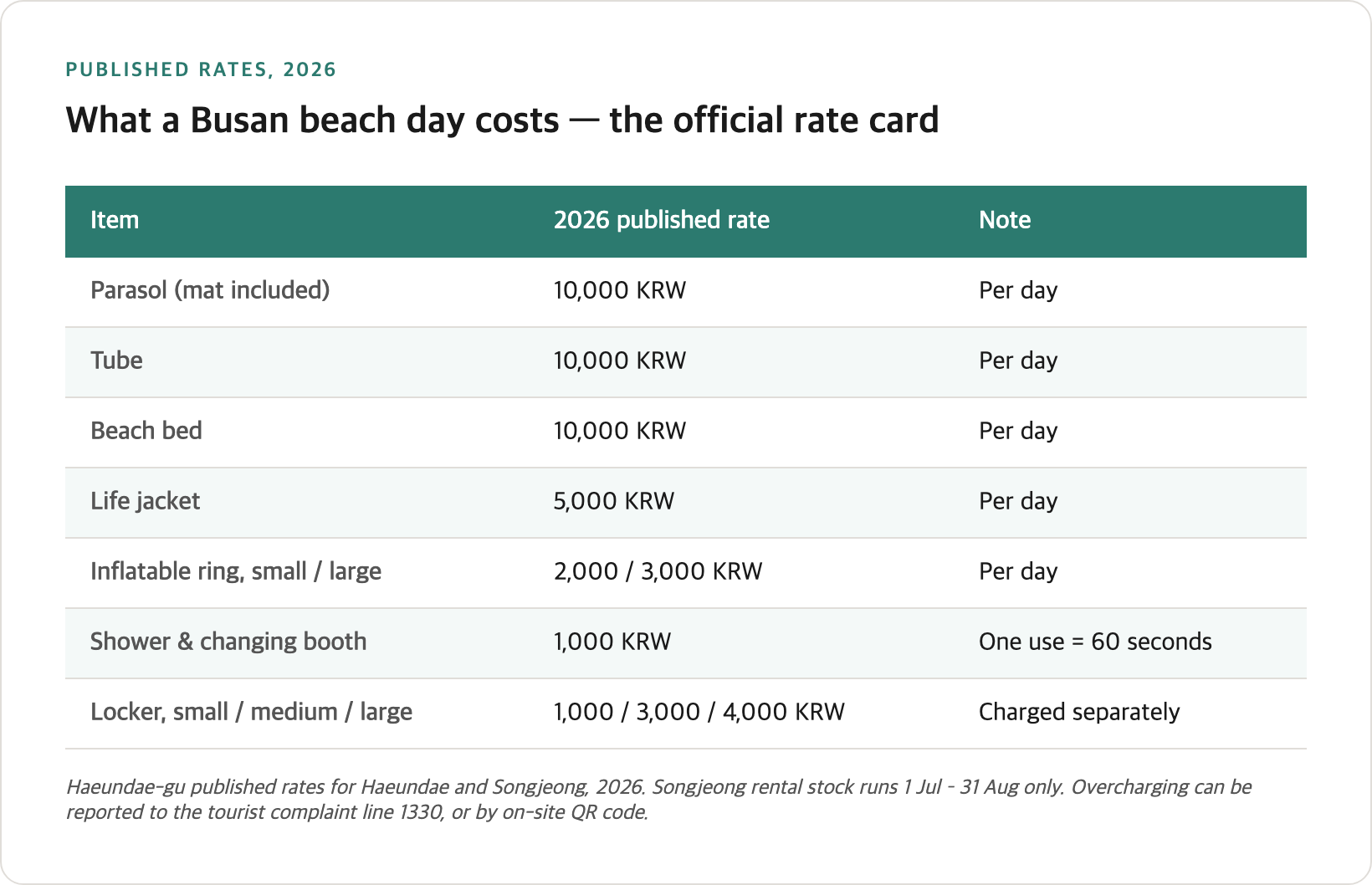
Rental prices on Korean beaches have a reputation for gouging, so the districts publish a rate card. These are the 2026 published rates from Haeundae-gu, covering both Haeundae and Songjeong.
| Item | 2026 published rate |
|---|---|
| Parasol (mat included) | ₩10,000 |
| Tube | ₩10,000 |
| Beach bed | ₩10,000 |
| Life jacket | ₩5,000 |
| Inflatable ring, small / large | ₩2,000 / ₩3,000 |
| Large boat (Songjeong) | ₩4,000 |
| Shower and changing booth, one use | ₩1,000 |
| Locker, small / medium / large | ₩1,000 / ₩3,000 / ₩4,000 (Songjeong runs ₩3,000 / ₩5,000) |
All figures as of 2026, from the managing district’s own listing. Dadaepo’s published parasol rate has run at ₩10,000 for a standard unit with a higher tier for table-style setups, so ₩10,000 is a reasonable benchmark across Busan.
Local tip — The ₩1,000 shower buys 60 seconds — and the English-language internet does not have this number at all. Haeundae-gu lists the shower and changing booth as “1회, 60초”: one use, sixty seconds, metered. Not one entry with the water left running. The English pages that mention Busan’s beach showers either say the cost “varies by facility”, or note only that showers exist, or state that the showers are free — which is the one thing they are not. This is the single most concrete number on the district’s price list and it is missing from every English source I could check. A proper rinse after a swim is three or four rounds, so carry ₩3,000–4,000 in small notes, and budget the locker separately on top.
Two practical notes on paying. Rental operators are on the sand rather than in a shop, and while many now take cards, cash is still the frictionless option — worth reading up on where cards work and where they don’t in Korea and how to get cash out of a Korean ATM before you go. If you are quoted a price well above the published rate, the tourist complaint line 1330 takes reports, and some beaches now post QR codes on site for the same purpose. Knowing the official number is what makes the complaint line usable.
Budgeting a beach day around these numbers is straightforward: a parasol, one tube and two showers is about ₩23,000 for two people, before food. That sits comfortably inside a normal daily budget for a week in Korea.
Drinking and Smoking: The Rules Change Within 200 Metres
Korea is broadly permissive about drinking outdoors, and a convenience-store beer on the sand is an ordinary Korean evening rather than an act of defiance. Busan’s beachfront has two specific exceptions that catch visitors out, and they sit almost next to each other.
Local tip — The Millak drinking ban carries a ₩50,000 fine, and only alcohol was banned — the food stayed. That Suyeong-gu designated Millak Waterside Park (민락수변공원) an alcohol-free zone from 1 July 2023 has reached English-language writing about Busan. Two things attached to it have not. First, the amount: ₩50,000 (as of 2026), which no English page I could check states. Second, and more useful, the scope — eating there is still permitted around the clock. The takeaway-sashimi-on-the-deck ritual that made Millak famous survives intact; it is only the beer that is gone. And the designation stops at the park: walk 200 metres west onto Gwangalli’s sand and no drinking restriction applies at all.
Smoking runs the other way — the beach sand is where you cannot smoke.
Gwangalli’s beach has been a designated non-smoking area since 1 July 2008, and Busan extended non-smoking designation across its beaches from 2009. Smoking in a designated non-smoking area carries a fine of up to ₩100,000. From June 2026 the definition of “tobacco” used for enforcement was widened to cover synthetic-nicotine liquid vapes, which had previously sat outside the rules — so a vape on Haeundae sand is now treated the same as a cigarette.
If you want the wider picture on where public drinking is and isn’t fine in Korea, the rules on drinking in public in Korea cover the national position, and the convenience store guide covers what you can actually buy at the CU fifty metres behind the sand.
When Swimming Gets Suspended Anyway
In season, in hours, and the water can still be closed for the day.
Suspensions are triggered by high waves, typhoon approach, strong currents, and jellyfish influx. Korean summers deliver all four. Late July through August is the typhoon-risk window on the south coast, and a jellyfish bloom can close a beach with a few hours’ notice.
English-language coverage of jellyfish in Busan is almost entirely about prevention — the nets, the removal boats, the budget the city spends each season. What it does not tell you is what a closure looks like from the sand, and I was not able to establish from Korean sources either how the daily decision is signalled at each beach or what the thresholds are, so this guide does not claim to know. What is safe to say is that the decision is made per beach by the managing district and announced on site by the patrol teams, that the same office publishes it on its own notice board, and that the practical move is to check before you change rather than after.
The Beaches by Character
| Beach | Line | What it is | Best for |
|---|---|---|---|
| Haeundae | Line 2, Haeundae Stn | The wide, famous one. Most facilities, most people, longest season | A daytime swim; early September |
| Gwangalli | Line 2, Gwangan Stn | Bridge view, café and bar strip, busy after dark | Evenings, the drone show |
| Songjeong | Line 2 + bus, or Donghae Line | Smaller, surf-oriented, calmer | Surfing, a quieter day |
| Songdo | Line 1, Nampo area + bus | Busan’s oldest public beach, cable car overhead | Pairing with Nampo-dong |
| Dadaepo | Line 1, Dadaepo Beach Stn | Wide shallow flats, sunsets, fountain | Sunsets, families |
Gwangalli’s evening case is stronger than “the water closes anyway”. The Gwangalli M Drone Light Show runs on Saturday evenings from the beach, free, visible from anywhere along the sand, and lasting roughly ten to twelve minutes. In the summer schedule it runs at 20:00 and 22:00; the winter schedule moves earlier, and the number of showings has varied between one and two, so confirm the current timetable rather than assuming. Busan’s fireworks festival takes over the same stretch of water once a year in autumn — in 2026 it is scheduled for 7 November — and brings heavy crowd and traffic management with it.
Songjeong is the one to pick if the point is being in the water rather than being at a landmark. Dadaepo’s draw is the sunset and the shallow flats rather than swimming depth.
Getting There
Busan’s beaches are reachable on the metro, which is the reason staying beachfront is a preference rather than a requirement.
- Haeundae — Line 2, Haeundae Station, a short walk to the sand
- Gwangalli — Line 2, Gwangan Station, roughly ten minutes on foot
- Dadaepo — Line 1, Dadaepo Beach Station, directly at the beach
- Songdo — Line 1 to the Nampo area, then a short bus ride
- Songjeong — Line 2 to Jangsan then a local bus, or the Donghae Line to Songjeong Station
Pay with a T-money or Cashbee card, both of which work on the Busan metro and buses. For getting to Busan in the first place, the KTX booking process puts you in Busan Station in around two and a half hours from Seoul, and the overview of getting around Korea covers the alternatives. If you are arriving from Japan, the Busan–Fukuoka ferry lands you at the International Passenger Terminal, one stop from Busan Station.
Navigation is the usual Korean problem: Google Maps will not give you walking directions here, so install Naver Map or KakaoMap first — the Google Maps alternatives for Korea explains which does what. Doing that at the airport requires a working connection, which means sorting an eSIM or SIM on arrival.
Staying beachfront buys mornings rather than access. Seomyeon, the transfer hub where Lines 1 and 2 cross, is roughly 30 minutes from Haeundae and typically cheaper than a beach-adjacent room. Since the metro reaches every major beach, a beachfront base buys the ability to be on the sand at 09:00 when the water opens, not the ability to get there at all. Where to base yourself in Busan works through the trade-off in detail.
The beaches also pair naturally with the rest of the city. Gwangalli and Haeundae sit on the eastern side; Busan’s other attractions — Gamcheon, Yeongdo, Taejongdae — cluster to the west, as does Jagalchi fish market, which is the obvious lunch stop on a Songdo or Nampo day.
What You Need to Know
-
The seven beaches run on different 2026 dates. Haeundae 26 Jun–15 Sep, Songjeong 26 Jun–31 Aug, the other five 1 Jul–31 Aug.
-
Swimming hours are 09:00–18:00 in season, uniformly across all seven.
-
At 18:00 the water closes, not the beach. Lifeguard towers stand down and patrols move people out of the sea.
-
Out of season the water is open from sunrise minus 30 minutes to sunset plus 30 minutes. Night entry is what is banned, year round.
-
Each district enforces differently — ankle-deep at Haeundae and Songjeong, waist-deep at Gwangalli.
-
Warnings come first; the fine is close to theoretical. 1,897 warnings and zero fines across Busan in 2025. The cost of breaking the rule is losing the swim, not ₩100,000.
-
The ₩1,000 shower runs for 60 seconds, and the locker is charged on top.
-
Millak Waterside Park is a no-drinking zone (₩50,000); Gwangalli’s sand is not. All beach sand is non-smoking, vapes included since June 2026.
-
The metro reaches every major beach, so a beachfront base is optional.
Practical Tips
-
Check the managing district’s page, not a travel site, for this year’s dates. Haeundae-gu, Suyeong-gu, Seo-gu, Saha-gu and Gijang-gun each publish their own, and they do not always match each other or the previous year.
-
Aim for a September swim only at Haeundae. It is the only Busan beach still operating after 31 August, and it runs to 15 September.
-
Do your swimming inside 09:00–18:00. Treat the evening as walking, eating and drone-show time.
-
Expect to be stopped at Haeundae or Songjeong for the smallest paddle after hours. Ankle depth is the intervention line there. Gwangalli’s patrols work to a waist-depth line, which is why the same behaviour gets different reactions at two beaches eleven minutes apart.
-
Carry ₩5,000 in small notes for the shower and locker. The shower is metered at 60 seconds per ₩1,000, and one round rarely covers it.
-
Drink on Gwangalli’s sand, not on the Millak deck. The park is an alcohol-free zone carrying a ₩50,000 fine; the beach is not.
-
Check the day’s swimming status before you change, not after. Waves, currents, typhoons and jellyfish all suspend swimming mid-season, and the call is made per beach by the managing district.
Frequently Asked Questions
When do Busan’s beaches open and close in 2026?
Haeundae opened 26 June and runs to 15 September, 82 days. Songjeong opened 26 June and closes 31 August. Gwangalli, Songdo, Dadaepo, Ilgwang and Imnang run 1 July to 31 August. Dates are set annually by each managing district office, and 2026 was brought forward because of an early hot spell, so they are not fixed year to year.
What are the swimming hours at Busan beaches?
09:00 to 18:00 during the official season, the same at all seven beaches. That is the window when the lifeguard towers are staffed. Outside it, patrol teams move people out of the water rather than supervising them, and entering the sea is not permitted.
Can I swim at a Busan beach at night?
No. Night entry is prohibited both in and out of season. In season the cutoff is 18:00; out of season the permitted window is from 30 minutes before sunrise to 30 minutes after sunset. Haeundae-gu wrote the night ban into its beach ordinance in October 2022 after several drownings.
What happens if I go in the water outside the permitted hours?
A patrol team gives you a verbal instruction to come out. Refusing exposes you to a fine of up to ₩100,000 under the Beach Act (as of 2026). In practice enforcement stops at the warning — across Busan’s seven beaches in 2025 there were 1,897 warnings and no fines issued. The depth at which patrols intervene differs by district: ankle-deep at Haeundae and Songjeong, waist-deep at Gwangalli.
How much is a parasol at a Busan beach?
₩10,000 for a parasol with a mat, per the 2026 rates published by Haeundae-gu for Haeundae and Songjeong. Tubes and beach beds are also ₩10,000, life jackets ₩5,000, and small inflatables ₩2,000–3,000. If you are quoted well above the published rate, the tourist complaint line 1330 takes reports, and some beaches post QR codes on site.
Can I drink alcohol on a Busan beach?
On the sand at Gwangalli or Haeundae, yes. At Millak Waterside Park at the eastern end of the Gwangalli strip, no — Suyeong-gu designated it an alcohol-free zone from 1 July 2023, with a ₩50,000 fine (as of 2026). Eating there is still allowed; only alcohol was banned. Smoking is the reverse of drinking: the beach sand is a designated non-smoking area, and since June 2026 that includes synthetic-nicotine vapes.
Is there a shower at Busan beaches, and what does it cost?
Yes, in season. Haeundae-gu lists the shower and changing booth at ₩1,000 for one use of 60 seconds (as of 2026). Lockers are separate, at ₩1,000 to ₩5,000 depending on size. Facilities run only during the official season.
Do I need to stay at the beach in Busan?
No. Line 2 reaches Haeundae and Gwangalli directly and Line 1 reaches Dadaepo, so a cheaper base at Seomyeon is about 30 minutes from Haeundae. Staying beachfront buys an easy 09:00 start when the water opens, not access.
Related Questions
- Where to Stay in Busan: The Subway Access Nobody Warns You About
- Busan Attractions: Getting to the Spots the Subway Doesn’t Reach
- Jagalchi and Gukje Market: Hours, Closures, and the Price Trap
- The Busan–Fukuoka Ferry: Check-in Cutoffs and Non-Sailing Days