Korea Customs Food Rules — Why Enforcement Got Stricter in 2026
Last Updated on August 19, 2026
Quick Answer
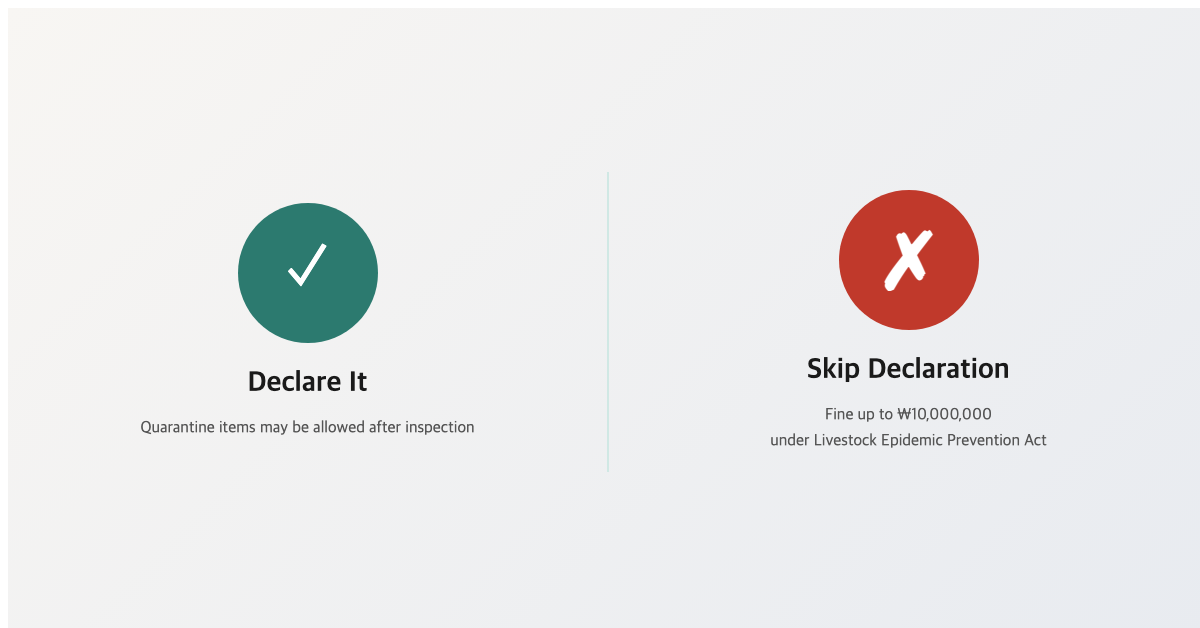
Bringing food into Korea is not illegal — not declaring it under Korea’s food quarantine rules is. Meat, meat-derived ingredients, and most fresh produce go through a separate animal or plant quarantine system, not the $800 duty-free allowance. Korea ran two nationwide quarantine crackdowns in 2026. Failing to declare a quarantine item carries a fine of up to ₩10 million by law; undeclared pork from African Swine Fever countries drew ₩5 million on a first offense in reported 2026 cases.
The Full Answer
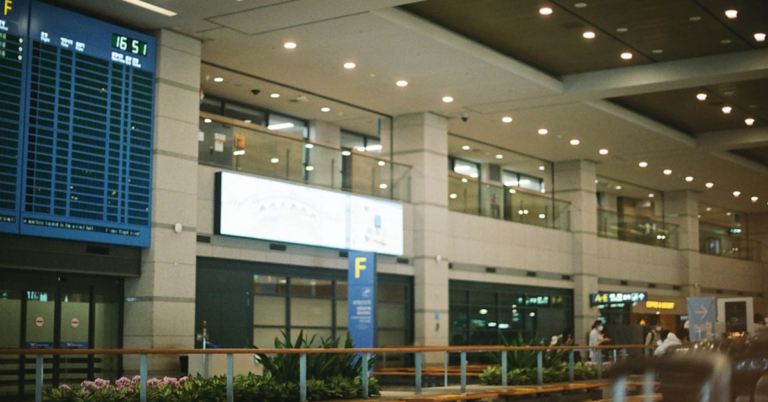
One of the more common airport-arrival surprises in Korea isn’t the immigration line or the taxi queue — it’s a quarantine officer holding up a sealed, factory-packaged instant noodle cup and explaining that it can’t come through. That is close to what actually happened at Incheon International Airport on February 11, 2026. A Taiwanese traveler had a pork-lard Taiwanese-style omelet and a pork-fat scallion pancake confiscated at the quarantine counter; by their own account, other Taiwanese travelers in the same arrivals queue lost a pork-blood rice cake and two brands of cup noodles — one jjajang-flavor, one beef-broth-flavor. The traveler posted about it afterward, the story spread among other Taiwanese travelers, and by mid-February it had been picked up by at least seven Korean outlets, including Hankyung’s February 16, 2026 report.
None of that food was raw meat carried in a cooler bag. It was sealed, commercially packaged snack food — the kind most travelers assume is fine because it looks nothing like “bringing meat into the country.” What made it a problem was the ingredient list, not the packaging, and that distinction is the part most English-language guides on this topic skip.
The rules themselves are not new, and Korea’s quarantine system hasn’t been rewritten for 2026. What changed is enforcement: two named, dated, nationwide crackdowns ran this year, and at least one of them produced a real fine that Korean media reported in detail. That’s the gap this article covers — not “can you bring food into Korea,” which most guides and Google’s own AI Overview already answer correctly for the general case, but why 2026 specifically has been a stricter year to get this wrong, and what the fine actually looks like when it happens.
This article does not tell you whether any specific food item is allowed through — that depends on its exact ingredients and Korea’s current restricted list, which changes. It explains the legal basis, the enforcement pattern, and where to check the current list yourself.
Three Systems, One Common Mix-Up
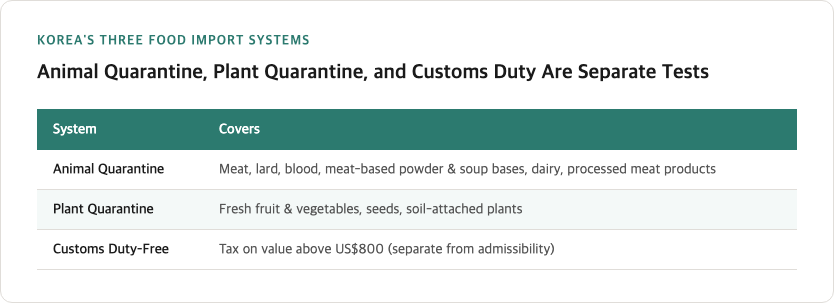
English-language guides — and Google’s own AI Overview — routinely blend three separate legal systems into one paragraph about “what you can bring to Korea.” They’re not the same system, they’re not enforced by the same agency, and mixing them up is where most confusion starts.
| System | Governing law | Agency | Covers |
|---|---|---|---|
| Animal quarantine | Livestock Epidemic Prevention Act (가축전염병 예방법) | Animal and Plant Quarantine Agency — animal quarantine division | Meat, meat-derived ingredients (including lard, blood, and meat-based soup bases), dairy, processed meat products |
| Plant quarantine | Plant Protection Act (식물방역법) | Animal and Plant Quarantine Agency — plant quarantine division | Fresh fruit and vegetables, seeds, soil-attached plants |
| Customs duty-free allowance | Customs Act | Korea Customs Service | Tax on the value of what you’re carrying above US$800 — a completely separate question from whether an item can be brought in at all |
Being under the $800 duty-free ceiling doesn’t exempt anything from quarantine. Those are two different questions — “do I owe tax on this” and “is this item allowed to enter at all” — and a food item can clear one test and fail the other. The $800 figure, what counts toward it, and why Korea’s own English-language customs page currently understates it are covered in full in our guide to Korea’s customs duty-free allowance. Medication follows a third system entirely, split into its own three tiers rather than the animal/plant split that governs food — our guide to bringing medication to Korea covers that separately.
The Legal Basis: What Korean Law Actually Says
I read the current text of Article 36 and Article 60 of the Livestock Epidemic Prevention Act on law.go.kr on August 19, 2026 — the version in effect since January 23, 2026 (Act No. 20998, amended July 22, 2025). The declaration duty sits in Article 36, Paragraph 1’s proviso: a traveler carrying designated quarantine items as accompanied baggage must declare them to the animal quarantine officer at the port of entry immediately on arrival, and submit to inspection. The penalty is separate, in Article 60, Paragraph 2, Item 6: failing to make that declaration carries a fine of up to ₩10 million.
Local tip — English-language sources that quote the ₩10 million figure almost never say which law it comes from. It isn’t a customs regulation. It’s Article 60(2)6 of the Livestock Epidemic Prevention Act, and the declaration duty it enforces is set out in Article 36(1)’s proviso — the current text is on Korea’s national law information portal (law.go.kr, Korean). ₩10 million is the statutory ceiling, not a flat penalty — the amount actually applied depends on the specific enforcement decree, and this article does not attempt to reproduce that schedule cell by cell.
Plant quarantine runs on a separate statute, the Plant Protection Act, with its own declaration and penalty structure for fresh produce, seeds, and soil-attached material. This article focuses on the animal-quarantine side, since that’s where 2026’s enforcement activity and the reported fine sit.
Korea Ran Two Nationwide Food-Quarantine Crackdowns in 2026
This is the part that’s hardest to find in English: quarantine enforcement in Korea is not a flat, year-round setting. It intensifies during named, dated campaigns tied to peak travel periods, and 2026 had at least two.
| Campaign | Dates | Routes targeted | Source |
|---|---|---|---|
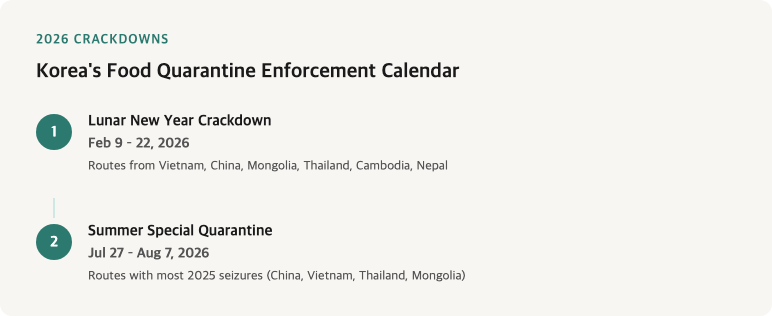
| Lunar New Year crackdown | February 9 – 22, 2026 (2 weeks) | Flights and ferries from Vietnam, China, Mongolia, Thailand, Cambodia, and Nepal | Hankyung, Feb 16, 2026 |
| Summer special quarantine | July 27 – August 7, 2026 (2 weeks) | Routes with the most 2025 seizures — China, Vietnam, Thailand, and Mongolia among others | Animal and Plant Quarantine Agency press release, Jul 23, 2026 |
The summer campaign’s own announcement is worth reading past the headline. I opened the Agency’s own release directly rather than a summary of it: according to the Agency’s July 23, 2026 press release — cross-published the same day by Korea’s official policy briefing site — quarantine officers seized and destroyed 23,801 cases (34 tons) of agricultural products and 12,019 cases (12 tons) of livestock products during the equivalent summer window in 2025. That’s the baseline the 2026 campaign was built to reduce, and it’s why the Agency is now using an AI-assisted X-ray system that automatically recognizes fruit shapes inside luggage, with stated plans to extend detection to livestock products.
Local tip — quarantine enforcement in Korea follows the calendar, and none of the nine top-ranking English results I checked in August 2026 mentions it. If you’re flying in during the two weeks around Lunar New Year or the last week of July through the first week of August, expect measurably tighter baggage checks — not a general “Korea is strict” impression, but named campaigns with published start and end dates, extra staff and detection dogs on specific routes, and (as of the 2026 campaign) AI-assisted X-ray screening. Outside those windows, checks continue but the added staffing doesn’t.
Both crackdowns run through the arrival halls at Korea’s international airports and ferry terminals — the same physical checkpoint covered in our guide to getting from Incheon Airport into Seoul, which walks through what happens between landing and clearing the terminal.
What Actually Gets Fined: The February 2026 Instant Noodle Case
The February 2026 case is worth walking through in detail because it’s the clearest example of where the theory (ingredient-based rules) meets an actual airport counter.
According to the traveler’s own account, republished by Hankyung: quarantine officers at Incheon confiscated a pork-lard Taiwanese omelet, a Taiwanese scallion pancake also containing pork fat, a pork-blood rice cake, and two instant cup-noodle products — one jjajang-flavor, one beef-broth-flavor — from several Taiwanese travelers arriving around the same time. The traveler described it afterward as entirely their own mistake, and summarized the takeaway for other travelers plainly: the ban covers meat-derived byproducts — pork fat, pork blood, duck blood — just as much as meat itself, not only whole cuts of meat.
The same report ties the enforcement directly to a specific animal-disease concern: with African Swine Fever (ASF) cases reported in Dangjin and elsewhere in South Chungcheong Province, Korea has tightened restrictions specifically on pork and pork products from ASF-affected origins. For that category — undeclared pork or pork products from ASF-affected countries — Hankyung reported a first-offense fine of ₩5 million, and separately restated the general rule that failing to declare a quarantine item can draw up to ₩10 million. The report does not describe an escalating first-offense/second-offense schedule, and this article does not claim one. What it does establish is narrower and more useful: ₩5 million is the level reported for a first offense in that specific pork category in 2026, well under the law’s ₩10 million ceiling (Article 60(2)6, above). The same report also notes that foreign nationals can face entry or stay restrictions on top of the fine.
Local tip — a fine like this isn’t limited to obvious “meat” purchases, and the packaging doesn’t matter. It wasn’t fresh meat or a homemade dish that got confiscated in the February case — it was a sealed, factory-packaged instant noodle cup, the kind sold at any convenience store. The seal doesn’t exempt it; the ingredient list does. English-language guides that explain the general “no meat” rule correctly (and several do — Google’s AI Overview among them, as of August 2026) rarely mention that a real enforcement action, with a specific fine amount, happened this year over exactly this kind of product.
What You Can Declare, and What’s Banned Outright
Not everything in this category is a flat “no.” Korea’s system has a middle tier: items that need to be declared and inspected, as distinct from items that are barred regardless of declaration.
| Category | Examples | What happens |
|---|---|---|
| Generally clears without incident | Vegetarian, seafood, or vegetable-flavor instant noodles; factory-sealed snacks with no meat-derived ingredients (chips, candy, chocolate); coffee and tea bags; commercially produced, vacuum-sealed kimchi | Usually passes without being flagged, though officers can still ask for a look |
| Must be declared, then inspected | Foods containing meat-derived ingredients that aren’t obviously “meat” — soup-base powders, seasoning packets, and similar processed items | Cleared or seized depending on origin, ingredients, and whether it was declared |
| Barred outright, regardless of declaration | Fresh or raw meat, sausages, ham, jerky, and other processed meat products; animal fat, blood, and blood-derived foods (like the pork-blood rice cake in the February case); fresh fruit and vegetables; soil-attached plants; most seeds | Confiscated and destroyed at the border, declared or not |
This is a summary, not the full list — Korea’s restricted-item catalogue changes and covers far more categories than fit in a table here. This article isn’t the place to render a final judgment on whether a specific product you’re carrying is allowed; that call belongs to the Animal and Plant Quarantine Agency and depends on exact ingredients and country of origin. When in doubt, the working rule from the February case still applies: declare it and let an officer make the call, rather than guessing based on how the packaging looks.
Even Google’s AI Overview Can’t Agree With Itself
I ran two related searches through Google on August 19, 2026, with the language and location set to English/United States, to see how the general rule was being summarized. I first searched “can I bring food into Korea”: the AI Overview gave a broadly accurate answer and cited a ₩10 million maximum fine. I then searched the narrower question “can you bring instant noodles with meat into Korea” — the same AI Overview, same day, same settings, also answered correctly about which ingredients are barred, but capped the fine at ₩5 million, half the figure it gave for the general question.
Both numbers exist in the real record covered above: ₩10 million is the statutory ceiling under Article 60(2)6, and ₩5 million is the first-offense figure reported in 2026’s actual ASF-related enforcement cases. Google’s own AI Overview stated both as if each were the maximum, in two answers generated the same day. Neither English-language guide reviewed for this article — and no source Google itself cited — pointed out the discrepancy.
Local tip — treat the specific number an AI answer gives you as a starting point, not a citation. As of August 19, 2026, Google’s AI Overview gives two different figures for the same underlying penalty depending only on how the question is phrased. The law’s ceiling is unambiguous at ₩10 million; ₩5 million is the narrower figure — what a first-time offender was reported to have paid this year in an undeclared ASF-country pork case, not a general rate for undeclared food. Neither number is wrong on its own — the problem is an AI summary presenting each as if it were the whole answer.
What You Need to Know
- Packaging doesn’t decide the outcome — ingredients do. A sealed, commercially made snack with meat-derived fat or blood in it is treated the same as loose raw meat under animal quarantine rules.
- The $800 duty-free ceiling and food quarantine are unrelated tests. Being well under the value allowance doesn’t exempt a food item from quarantine, and vice versa.
- Enforcement is heavier during two specific windows. Lunar New Year (roughly early-to-mid February) and the last week of July through the first week of August both saw named, dated crackdowns in 2026, with extra staff, detection dogs, and AI-assisted X-ray screening on flagged routes.
- The law’s ceiling is ₩10 million for any undeclared quarantine item; the reported ₩5 million figure is narrower. ₩5 million is what 2026 reporting describes for a first offense involving undeclared pork from ASF-affected countries — not a general rate for undeclared food. Both figures are real, and they answer different questions.
- This article does not adjudicate specific products. Whether an item you’re carrying is allowed depends on its exact ingredients and country of origin, which only Korea’s Animal and Plant Quarantine Agency can confirm at the point of entry.
- This is not legal advice. It explains the declaration procedure and the penalty structure — not how to argue a borderline case with a quarantine officer.
Practical Tips
-
Read the ingredient list, not the product category, before you pack anything processed. Instant noodles, soup mixes, and seasoning packets are the products most likely to contain an undeclared meat-derived ingredient without looking like “meat” on the label.
-
If you’re arriving during early-to-mid February or late July through early August, expect tighter checks than usual. Both windows saw dedicated 2026 crackdowns with additional quarantine staff and detection dogs on specific routes.
-
When in doubt, declare it rather than guess. The declaration form and process are separate from — and simpler than — arguing a borderline item’s admissibility with an officer after it’s been flagged.
-
Don’t assume the $800 duty-free allowance covers you. Value and admissibility are two different questions; check Korea’s duty-free allowance rules separately from anything about food quarantine.
-
Consider buying Korean instant noodles and snacks after you land instead of carrying food-adjacent items from home. Korean convenience stores stock a wide range within a few minutes of most hotels, which sidesteps the ingredient question entirely.
-
Check current entry requirements before you fly, not just food rules. K-ETA and visa requirements are separate systems from quarantine, but they’re worth confirming on the same pre-departure checklist.
-
Have working data ready to look up the current restricted list on arrival, not just before departure. Restricted-item lists are updated periodically; an eSIM or local data plan lets you check the current list from the arrival hall rather than relying on what you read before the flight.
Frequently Asked Questions
Can I bring instant noodles into Korea?
Vegetarian, seafood, or vegetable-flavor instant noodles generally clear without issue. Instant noodles containing meat, meat-based broth powder, or animal fat — like the products confiscated in a reported February 2026 case at Incheon — fall under animal quarantine rules and can be seized even when factory-sealed. Check the ingredient list rather than assuming the product category is safe.
What foods are banned from entering South Korea?
Fresh or raw meat, sausages, ham, jerky, and other processed meat products; animal fat and blood-derived foods; fresh fruit and vegetables; soil-attached plants; and most seeds are barred outright under animal and plant quarantine rules, regardless of declaration. This is a summary — Korea’s restricted-item list is longer and changes, so confirm specifics with the Animal and Plant Quarantine Agency rather than treating any single article as the final word.
How much is the fine for not declaring food at Korean customs?
The Livestock Epidemic Prevention Act sets a statutory ceiling of ₩10 million (Article 60(2)6) for failing to declare quarantine items. In reported 2026 enforcement cases involving undeclared pork and pork products from ASF-affected countries, the first-offense fine applied was ₩5 million. That narrower figure isn’t a general rate for undeclared food, and the reporting doesn’t set out a published first-offense/second-offense schedule — ₩10 million remains the statutory ceiling.
Is there a difference between the customs duty-free limit and food quarantine rules in Korea?
Yes — they’re separate systems. The $800 duty-free allowance, covered under the Customs Act, determines whether you owe tax on the value of what you’re carrying. Food quarantine, under the Livestock Epidemic Prevention Act and Plant Protection Act, determines whether an item is allowed to enter at all. See our full breakdown of Korea’s customs duty-free allowance for how the value system works.
Why was a traveler fined for bringing instant noodles into Korea?
In a case reported by Korean media in February 2026, a traveler arriving at Incheon had meat-fat-containing instant noodle cups and other pork-derived snack foods confiscated during Korea’s Lunar New Year quarantine crackdown. The ingredients — not the fact that it was packaged instant food — triggered the seizure and reported fine.
Are quarantine checks stricter during Lunar New Year or summer in Korea?
Both. Korea ran a two-week Lunar New Year crackdown (February 9–22, 2026) targeting flights and ferries from Vietnam, China, Mongolia, Thailand, Cambodia, and Nepal, and a separate two-week summer crackdown (July 27–August 7, 2026) concentrating staff and detection dogs on the routes with the most seizures in 2025 — China, Vietnam, Thailand, and Mongolia among others. Outside those windows, checks continue but without the added staffing and route targeting.
Can I bring sealed, packaged snacks into Korea?
Most sealed snacks without meat-derived ingredients — chips, candy, chocolate, coffee, tea — generally clear without issue. Sealing doesn’t override the ingredient rule, though: a factory-sealed product containing meat fat, meat-based broth, or animal blood is treated the same as an unpackaged version under animal quarantine law.
What happens if I don’t declare meat products at Korean customs?
Undeclared meat or meat-derived products can be confiscated and destroyed at the border, and the traveler carrying them can be fined under Article 60(2)6 of the Livestock Epidemic Prevention Act — up to ₩10 million by law, with reported 2026 first-offense enforcement at ₩5 million for undeclared pork products from ASF-affected countries. Foreign nationals can also face entry or stay restrictions in more serious cases.
Related Questions
- Korea Dropped Its Duty-Free Bottle Limit. Google Still Says 2
- Bringing Medication to Korea? The Rule Has 3 Tiers, Not 2
- Do You Need a K-ETA for Korea? And Should You Get One Anyway?