Seeing a KBO Game in Seoul — Which Team’s Tickets You Can Actually Get
Last Updated on September 1, 2026
Quick Answer
Three KBO teams play home games in Seoul: LG Twins and Doosan Bears at Jamsil Baseball Stadium (잠실야구장), and Kiwoom Heroes at Gocheok Sky Dome (고척스카이돔). Their tickets are not equally available. KBO’s own 2026 attendance data shows LG filling roughly 90% of Jamsil’s seats per game and Doosan about 88%, while Kiwoom runs at about 80%. In practice, Kiwoom is the easier ticket right now, and Gocheok’s fixed roof means no rain cancellations.
Why Jamsil Tickets Are Hard to Get
LG Twins and Doosan Bears share one stadium — Jamsil Baseball Stadium, in Songpa-gu (송파구), with a listed capacity of approximately 24,339 seats. Two teams selling tickets into the same seat count, on alternating home dates through a six-month season, is the mechanical reason Jamsil is the tighter ticket of the two Seoul venues.
According to KBO’s official crowd-tracking page, current through August 30, 2026, LG drew 1,342,711 fans across 61 home games this season — an average of 22,012 per game. Doosan drew 1,203,500 across 56 home games, an average of 21,491 per game. Those are actual head counts from KBO’s own scoreboard data, not estimates, and they are the most solid numbers in this article. LG currently ranks first in total home attendance among all ten KBO teams; Doosan ranks third.
Both teams also have a competitive reason to draw well. As of the same date, LG sits 4th in the league standings (64-51-1, a .557 winning percentage) and Doosan sits 5th (61-52-4, .540) — both within range of a postseason spot with the regular season still in progress. Neither club is coasting through a lost season, and neither is short on reasons for local fans to show up.
Our guide to choosing a KBO stadium notes there is no wrong answer among Seoul’s three teams if you’re picking by accessibility — all three stadiums are reachable by subway with comparable effort. That answer is about getting there. This one is about a different question: which team’s tickets you can actually book before they’re gone.
The Data — Seoul KBO Ticket Availability Compared
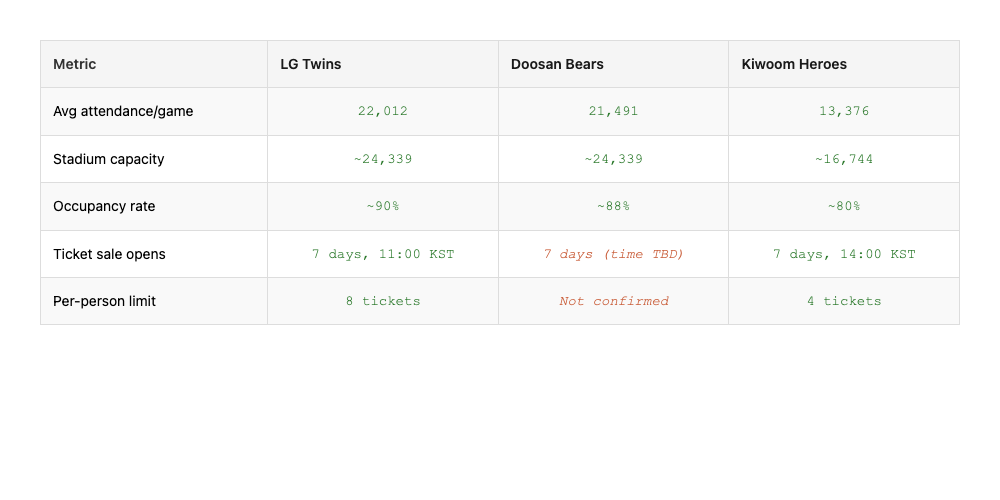
| LG Twins | Doosan Bears | Kiwoom Heroes | |
|---|---|---|---|
| Home stadium | Jamsil Baseball Stadium | Jamsil Baseball Stadium (shared) | Gocheok Sky Dome |
| Home games played (as of Aug 30, 2026) | 61 | 56 | 63 |
| Total home attendance | 1,342,711 | 1,203,500 | 842,681 |
| Average attendance per game | 22,012 | 21,491 | 13,376 |
| Approximate stadium capacity | ~24,339 | ~24,339 | ~16,744 |
| Approximate occupancy | ~90% | ~88% | ~80% |
| League standing (Aug 30, 2026) | 4th (.557) | 5th (.540) | 10th of 10 (.356) |
| Ticket sale opens | 7 days before, 11:00 KST | 7 days before (time unconfirmed — see below) | 7 days before, 14:00 KST |
| Tickets one person may buy, per game | 8 | Not confirmed | 4 |
Two things about this table are worth separating, because they carry different weight.
The average-attendance figures are the solid numbers — they come directly from KBO’s crowd-tracking page divided by each team’s games-played column, with no external inputs. The occupancy percentages are softer. They depend on stadium capacity, and capacity figures for Korean stadiums are inconsistent across sources — the 24,339 and 16,744 figures above come from Wikipedia’s stadium listings, not from an operator’s own published seating chart, which I was unable to locate for either venue. Treat the occupancy column as approximate, and lean on the average-attendance row if you want the harder comparison.
Framed without needing a capacity number at all: Kiwoom’s average draw is about 61% of LG’s, and about 62% of Doosan’s, on a per-game basis. That comparison holds regardless of exactly how large either stadium is.
Local tip — This side-by-side isn’t something you’ll find already assembled in English. Across the four searches I checked directly for this article, the English-language guides that came up describe the three teams and their stadiums, but none of them pull KBO’s own attendance numbers to compare how easy each team’s tickets actually are to get. Google’s AI Overview appeared on all four of those searches, and it answers what the stadiums are and how to buy tickets — it does not compare which team’s tickets you can realistically land.
A caveat worth stating clearly: Kiwoom’s lower occupancy tracks closely with its record — the team sits 10th of 10 KBO clubs as of August 30, 2026 (42-76-3, .356), the league’s only team below a .400 winning percentage this season. It’s a reasonable inference that a losing season is depressing demand for Kiwoom tickets, but KBO doesn’t publish an analysis connecting the two, and that causal link isn’t independently confirmed here either. This is a snapshot of the 2026 season, not a permanent property of the team. If Kiwoom’s record improves next season, this comparison could look different. Read the rest of this article as “Kiwoom tickets are the easier ticket right now,” not “Kiwoom tickets are always easy.”
What Gocheok Actually Has Going For It
Beyond the availability gap, Gocheok Sky Dome has one structural advantage neither Jamsil team can offer: it is a fixed-roof dome, so games are not called off for rain. Jamsil is open-air, and KBO games there — like most outdoor baseball — can be postponed or suspended for weather. For a visitor with a fixed travel window and only one or two nights free to catch a game, that difference matters more than it sounds like on paper: a rainout at Jamsil means rescheduling around a trip that may not have any spare days, while a Gocheok ticket is close to weather-proof.
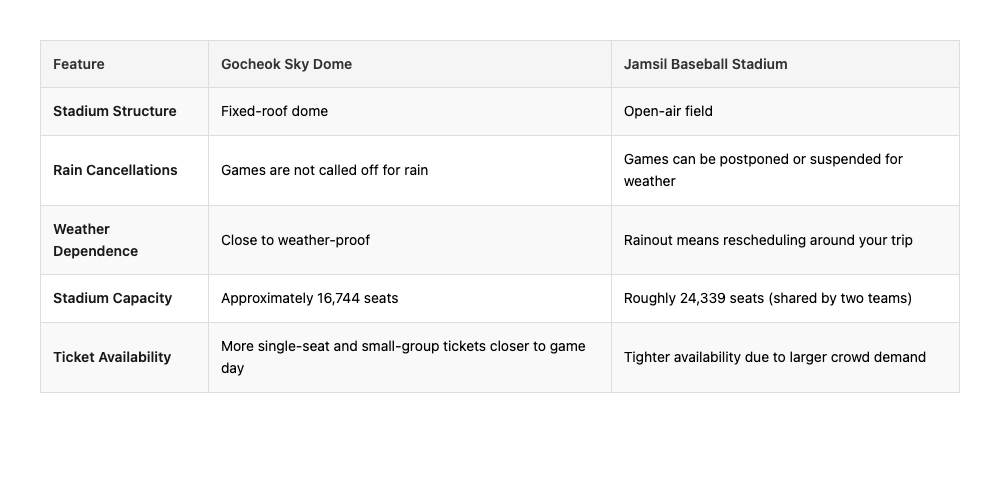
Gocheok also has a lower attendance ceiling working in a visitor’s favor in a second way: with an approximate 16,744-seat capacity against Jamsil’s roughly 24,339, even a Kiwoom game with a genuinely enthusiastic crowd is filling a smaller room, which in practice means more single-seat and small-group tickets stay available closer to game day.
The stadium is not exclusively a baseball venue — it also hosts K-pop concerts and other large indoor events, and our guide to Seoul’s K-pop concert venues covers its layout and gates in more depth than is useful here. For KBO-specific rules on what you can bring inside — bags, outside food, and the rest — see our guide to KBO stadium rules, which applies at all three Seoul venues.
Booking Logistics — Where and When to Buy
The step-by-step mechanics of buying a KBO ticket — which platform each club uses, why foreign-issued cards fail at checkout for most teams, and the workarounds — are already covered in detail in our guide to buying KBO tickets as a foreigner. This section only covers what’s specific to comparing Seoul’s three teams: when each one’s sales actually open.
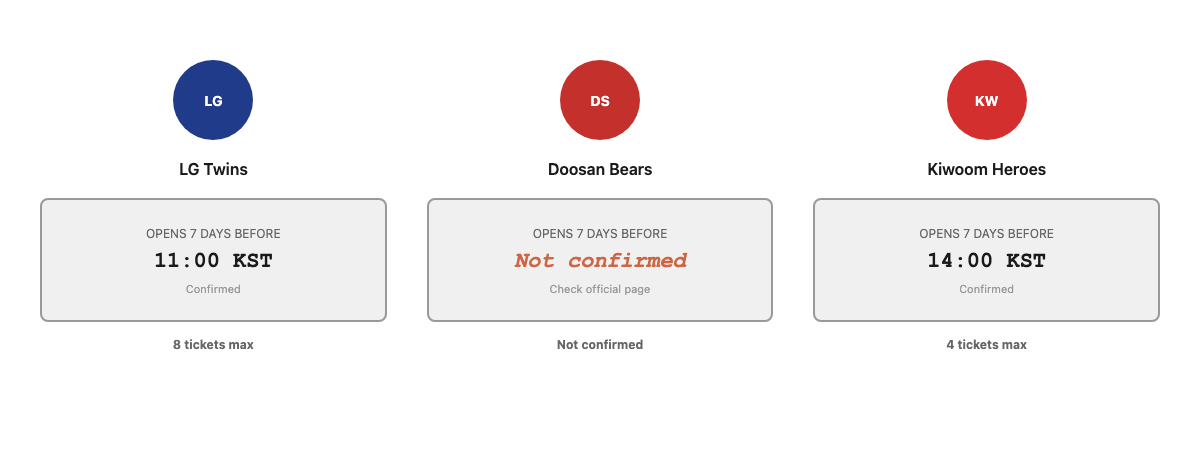
I checked LG’s and Kiwoom’s official ticket pages directly. LG’s ticket page states, in its own wording, that seats go on sale “7 days before the game, from 11:00, until one hour after the game starts.” Kiwoom’s ticket page states sales open “7 days before the game, from 2:00 PM, until one hour after the game starts” — a direct, word-for-word match on the site itself. I tried to confirm Doosan’s opening time the same way and could not: the club’s ticketing pages return errors or a login prompt to a logged-out browser, and no public page states an hour. What’s available instead is fan reporting — a Korean fan community post and a February 2026 sports-news item about Doosan’s paid “Bears Club” membership both describe general sales opening 7 days before game day, with Bears Club members getting a one-hour early window. Neither source is an official page, and neither is a basis for planning your morning around a specific minute. Treat Doosan’s opening hour as unpublished, and check the club’s own ticket page before your travel dates rather than assuming it matches LG’s.
Local tip — LG’s tickets go on sale three hours before Kiwoom’s do — 11:00 KST versus 14:00 KST, both exactly seven days ahead. Both figures are quoted from the clubs’ own ticketing pages, linked above. The gap matters in practice: if you’re chasing an LG ticket for a popular matchup, the difference between logging on at 11:00 and 11:15 can be the difference between a seat and a sellout. Kiwoom’s later window gives you more room to be a few minutes late without losing your shot. Doosan publishes no opening hour a visitor can read without a club account, so don’t plan a Jamsil booking around an assumed time.
Sale timing isn’t the only thing that differs between the two clubs’ ticket pages. So does how many seats one person is allowed to buy.
Local tip — The per-person purchase cap is not the same at both clubs, and it’s stated plainly on each ticket page linked above: LG allows 8 tickets per person per game; Kiwoom allows 4. Kiwoom repeats the figure of 4 across all four of its sales channels — online, phone, mobile app, and the Gocheok box office — so it isn’t a channel-specific limit. For a solo traveler or a couple this changes nothing. For a group of five or six it decides your whole approach: an LG game is one transaction by one person, while a Kiwoom game has to be split between two separate buyers, each needing their own verified account, and both racing the same 14:00 window. That is a real cost to set against Kiwoom’s better availability. Doosan’s cap wasn’t obtainable in the same check, for the same access reason its opening hour wasn’t.
Buying in person is also an option at all three clubs, generally at the stadium box office on game day — Kiwoom’s official page specifies its Gocheok box office opens two hours before first pitch. Doosan separately runs a limited day-of walk-up allocation, detailed in our tickets-for-foreigners guide — it’s the more realistic path into a Jamsil game once online sales have closed.
Two practical notes that apply across all three teams: most ticket platforms ask for a Korean phone number during checkout, which is one more reason to sort out an eSIM or local SIM before you try to book, and box-office purchases are generally cash or a Korean-issued card rather than a foreign card swipe.
If You Still Want to See a Game at Jamsil
None of this means skip LG or Doosan. Both clubs are in playoff contention this season, and a full Jamsil crowd is a genuinely different atmosphere from a three-quarters-full Gocheok. If a Jamsil game is the one you actually want, a few things improve your odds rather than ruling it out:
For an LG home game, be logged in and ready at exactly 11:00 KST, seven days before the date you want — that hour is stated on LG’s own ticket page, and general sales for the most in-demand matchups (LG-Doosan games in particular, since both fan bases are competing for the same seats) can move quickly in the minutes after the window opens. For a Doosan home game, the seven-day-ahead pattern appears to hold, but the club doesn’t publish the hour anywhere a logged-out visitor can read it — check Doosan’s own ticket page for the exact time rather than sitting down at 11:00 on the assumption that it matches LG. If you miss the initial window, don’t give up immediately: resale and cancellation activity on the ticketing platforms tends to pick up again in the day or two before the game, the same pattern KBO fans rely on for other in-demand events. And if online sales are closed out entirely, Doosan’s day-of walk-up allocation (linked above) is worth checking at the stadium itself before writing the date off. If you would rather skip the 11:00 scramble entirely, a Jamsil game ticket with dinner and beer is sold in English with the seat already arranged.
What You Need to Know
- The KBO regular season ends in early October. If your Seoul dates fall later in the month, FC Seoul plays three home games at Seoul World Cup Stadium in October, with its own ticket routes for visitors.
- This comparison is a snapshot of the 2026 season, not a fixed rule. Kiwoom’s lower demand tracks its last-place record. A stronger Kiwoom season next year would likely close this gap.
- Doosan’s exact sale-opening time is unconfirmed. It is consistently reported as matching LG’s 11:00 KST window, but only through fan and news sources, not an official club page.
- Stadium capacity figures are approximate. The 24,339 (Jamsil) and 16,744 (Gocheok) numbers come from third-party listings, not an operator’s own seating chart — use the average-attendance numbers if you want the firmer comparison.
- Jamsil’s 2026 season is its last in its current form. The stadium is scheduled to close for redevelopment after this season, with the teams relocating temporarily; that timeline and what it means for future visitors is covered separately in our Jamsil closure guide and isn’t a factor in ticket availability right now.
- This is regular-season data. Postseason ticketing works differently across all KBO clubs — see our postseason ticket guide if you’re visiting in October.
- The regular season was still underway as of the data above (August 30, 2026). Totals for all three teams will keep climbing through the rest of the season.
Practical Tips
- If your priority is actually getting a seat, put Kiwoom at the top of your list. At roughly 80% occupancy against LG and Doosan’s approximately 88-90%, Gocheok is consistently the easier booking of the three, and that gap held up across the full season’s data, not just a handful of games.
- For an LG home game, be online at 11:00 KST exactly seven days before the game. Sales open at a fixed hour, not a rolling window — showing up an hour later on the correct day is often too late for a popular matchup. For Doosan, look up the opening hour on the club’s own ticket page first; it isn’t published where a logged-out visitor can read it, so don’t assume it matches LG’s.
- Bring your passport if you’re buying at a stadium box office. Foreign ID is generally required for in-person purchases at all three clubs, consistent with our foreigner ticket-buying guide.
- Sort out a Korean phone number before you try to book online. Most ticket platforms require one for account verification at checkout.
- If Jamsil is sold out, check again one to two days before the game. Cancellations and resale activity are more common closer to game day than most first-time visitors expect.
- Don’t rule out a rainy-week trip if you book Kiwoom. Gocheok’s fixed roof means your ticket isn’t weather-dependent the way a Jamsil ticket is.
- If you can be flexible on which team you see, check the schedule for LG-Doosan matchups and avoid them if availability is your priority — two fan bases competing for the same Jamsil seats on the same night is the single hardest ticket to get among the three teams covered here.
Frequently Asked Questions
Which KBO team should I support if I’m visiting Seoul?
There’s no wrong choice competitively — LG, Doosan, and Kiwoom are all reachable by subway, and our KBO stadium guide covers that comparison. If getting a ticket at all is the deciding factor, KBO’s 2026 attendance data points to Kiwoom Heroes at Gocheok Sky Dome, running at a lower occupancy (approximately 80%) than LG or Doosan at Jamsil (approximately 88-90%).
Is Kiwoom Heroes a good team to watch as a first-time visitor?
Kiwoom plays at Gocheok Sky Dome, a domed stadium with no rain-cancellation risk, and its games are currently the easier ticket in Seoul. The tradeoff is a smaller, quieter crowd than a full Jamsil game — Kiwoom is 10th of 10 KBO teams in the standings as of August 30, 2026, which affects atmosphere as well as ticket demand.
Do LG Twins and Doosan Bears games sell out at Jamsil?
Not every game, but demand is consistently high — KBO’s 2026 data shows both teams filling close to 90% of Jamsil’s capacity on average across the season, and both are within range of a postseason spot, which keeps demand from dropping off.
Can I still get tickets to a sold-out Jamsil game?
Two realistic options: check the ticketing platform again one to two days before the game, when cancellations tend to appear, or ask about Doosan’s limited day-of walk-up allocation at the stadium box office — see our foreigner ticket-buying guide for how that program works.
Does Gocheok Sky Dome get rained out?
No. Gocheok has a fixed roof, so KBO games there are not postponed for rain the way outdoor games at Jamsil can be. That makes it a more reliable choice if your travel dates are fixed.
What time do KBO tickets go on sale for Seoul teams?
LG and Kiwoom both open general sales seven days before the game — LG’s official site lists an 11:00 KST opening, Kiwoom’s lists 14:00 KST. Doosan is reported to follow the same seven-day pattern, but its exact hour is not published on any page a logged-out visitor can read, so check the club’s site rather than assuming it matches LG’s.
Are LG or Doosan tickets harder to get?
They’re close. LG runs slightly higher occupancy (about 90%) than Doosan (about 88%) based on this season’s KBO attendance data, but both are meaningfully tighter than Kiwoom’s roughly 80%. A game between the two of them — both drawing from the same Jamsil seat count — is the hardest single ticket among Seoul’s three teams.
Is Jamsil Baseball Stadium closing soon?
Yes — 2026 is Jamsil’s final season in its current form before a scheduled redevelopment, with the teams moving to a temporary venue afterward. That timeline doesn’t affect ticket availability this season; it’s covered in full in our separate guide to Jamsil’s closure.
Related Questions
- How to Buy KBO Tickets as a Foreigner
- Choosing a KBO Stadium — A Guide to All Ten Teams
- Watching a KBO Baseball Game in Korea — What to Know First
Featured image: Photo by Ping Onganankun on unsplash