Gyeongju at Night: Visiting Rules for Wolji Pond, Cheomseongdae, and Daereungwon
Last Updated on August 25, 2026
Gyeongju at Night: Visiting Rules for Wolji Pond, Cheomseongdae, and Daereungwon
Quick Answer
Donggung Palace and Wolji Pond (동궁과 월지) is one site, not two, and it bans bringing in or eating food at night — drinks are the only exception — along with picnic mats, camping chairs, and drinking. The operator’s page for Cheonmachong (천마총), inside Daereungwon (대릉원), doesn’t list those rules at all. Cheomseongdae’s (첨성대) winter closing time also depends on which of Gyeongju’s own official pages you check: one says 21:00, the other says 22:00.
The Full Answer
The hours and ticket prices for Gyeongju’s three big night-open sites — Donggung Palace and Wolji Pond, Daereungwon, and Cheomseongdae — are already well covered in English. Search for “donggung palace wolji pond hours” or “cheomseongdae opening times” and the results are, for the most part, correct.
What isn’t covered is what happens once you’re inside. Each site is governed by a different layer of Gyeongju city rule-making — a tourism promotion page, a facility operator’s posted visiting rules, and a city ordinance — and these three layers don’t always say the same thing, or cover the same ground. Some of what’s banned at one site isn’t mentioned at another site run by the same operator. Some of what the ordinance restricts only applies, by its own wording, to paid sites. And on at least one point — Cheomseongdae’s winter closing time — Gyeongju’s own two official sources give different answers.
None of this shows up in the English-language guides and travel sites that rank for these searches. Several of them, in fact, actively suggest the opposite of what the posted rules say. This guide works through what each layer actually states, where they conflict, and where they simply don’t overlap — rather than treating “Gyeongju sacred sites” as one uniform set of rules.
These three sites sit in central Gyeongju, close together and easy to combine into one evening. They’re a separate cluster from the daytime sites outside the city — Bulguksa and Seokguram, covered separately, have their own ticketing and access rules that don’t overlap with anything here. So does Yangdong Folk Village, where families still live in the houses and what a visitor may enter is set by the households rather than by an operator’s opening hours.
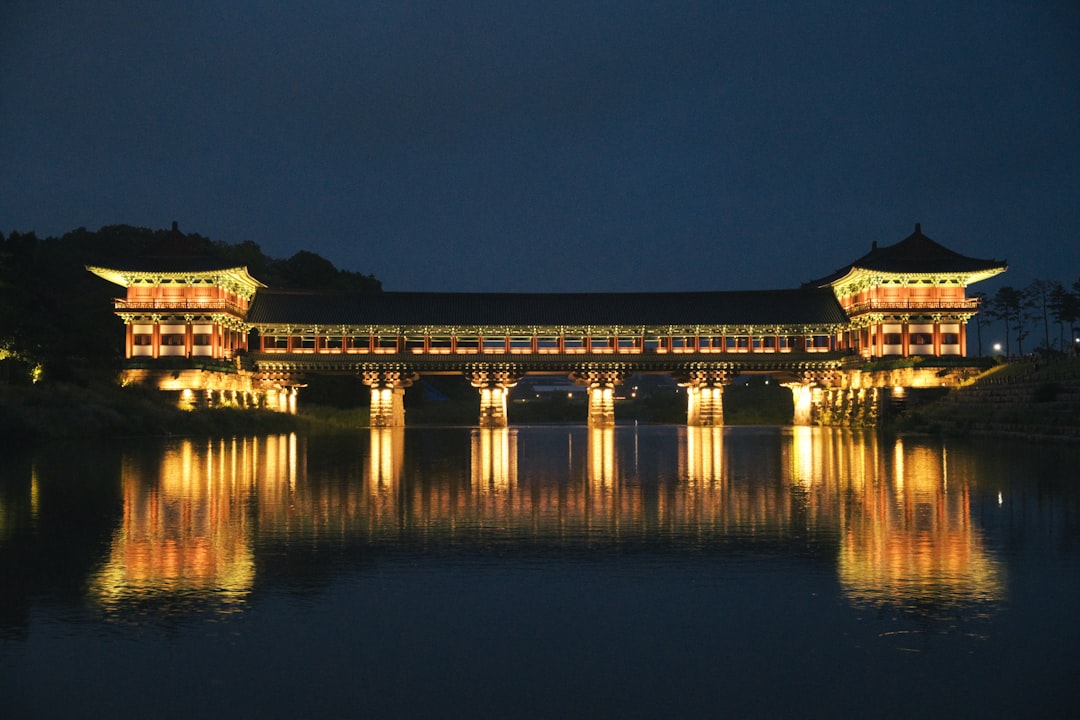
Photo by Bundo Kim on Unsplash
What Donggung Palace and Wolji Pond Actually Ban (Not Just Suggest)
Donggung Palace and Wolji Pond (동궁과 월지) is Gyeongju’s best-known night attraction — a pond ringed by reconstructed pavilions, lit and reflected in the water after dark. It’s also the one site among the three with a detailed, posted list of visiting rules, published by the corporation that runs it, the Gyeongju Facilities Management Corporation (경주시시설관리공단).
The rules, translated directly from the operator’s own page, ban:
- Bringing in or eating food, with drinks specifically excluded from the ban
- Drinking, smoking, and carrying flammable materials or cooking equipment
- Camping gear — the page names picnic mats and camping chairs specifically
- Pets, other than service animals
- Damage to facilities
That last point is worth sitting with. A search for “Wolji Pond picnic” or “Donggung Palace picnic by the pond” turns up English-language travel content — much of it from content-farm-style sites rather than established guides — actively recommending the opposite: bringing a picnic to enjoy on the grass by the water. That advice doesn’t match what the site’s own operator has posted. It isn’t that the advice is illegal exactly — it’s that it describes an activity the site’s rules explicitly prohibit, and none of the English content that ranks for these searches mentions the prohibition at all.
Local tip — Some English travel content recommends packing a picnic for the grass beside Wolji Pond. The operator’s own posted rules ban bringing in food entirely (drinks are the only exception), along with picnic mats and camping chairs. If you want to eat while you’re out, plan to do it before or after visiting, not on-site.
Same Operator, Different Rules: Why Daereungwon’s Page Reads Differently
It would be reasonable to assume that a rule posted for one Gyeongju Facilities Management Corporation site applies at its other sites too. That assumption doesn’t hold here.
I opened the operator’s page for Cheonmachong (천마총), the site inside the Daereungwon tomb complex, directly. It carries a “Visitor Information” section listing hours, ticket cutoff, and one restriction: pets aren’t allowed inside. There is no “Visiting Rules” section at all — no mention of food, drinks, picnic mats, camping chairs, or smoking. The picnic-and-camping-gear ban that’s spelled out in detail for Wolji Pond simply isn’t part of this page.
That doesn’t mean Daereungwon has no rules — it means this particular rule, as posted by this particular operator, exists for one site and not the other. Treating “Gyeongju’s night sites” as a single rulebook is the mistake to avoid here. If you’re deciding whether to bring a picnic mat to Daereungwon rather than Wolji Pond, the honest answer is that the specific ban documented for Wolji Pond isn’t documented for Daereungwon — not that Daereungwon has confirmed it’s fine.
| Site | Operator page has a “Visiting Rules” section? | Food/picnic-gear ban listed? | Pet restriction listed? |
|---|---|---|---|
| Donggung Palace & Wolji Pond | Yes | Yes — food (except drinks), picnic mats, camping chairs, drinking, smoking, cooking equipment | Yes, service animals excepted |
| Cheonmachong (inside Daereungwon) | No | Not listed | Yes |
Two other sites worth noting here: Cheomseongdae and Woljeonggyo (월정교, Woljeong Bridge) don’t appear on the facilities corporation’s list of managed sites at all — a list of 13 items covering everything from Cheonmachong to nearby campgrounds and parking lots. Neither observatory nor bridge shows up. That’s a gap worth flagging rather than filling in: it means the specific rules that apply at Wolji Pond and Cheonmachong don’t have an equivalent operator page for Cheomseongdae to check against, one way or the other.
Parking After Dark: Free at Wolji Pond, Card-Only at Cheonmachong
This is the part that doesn’t show up in any hours-and-fees guide, and it’s the one most likely to catch a driver off guard at night.
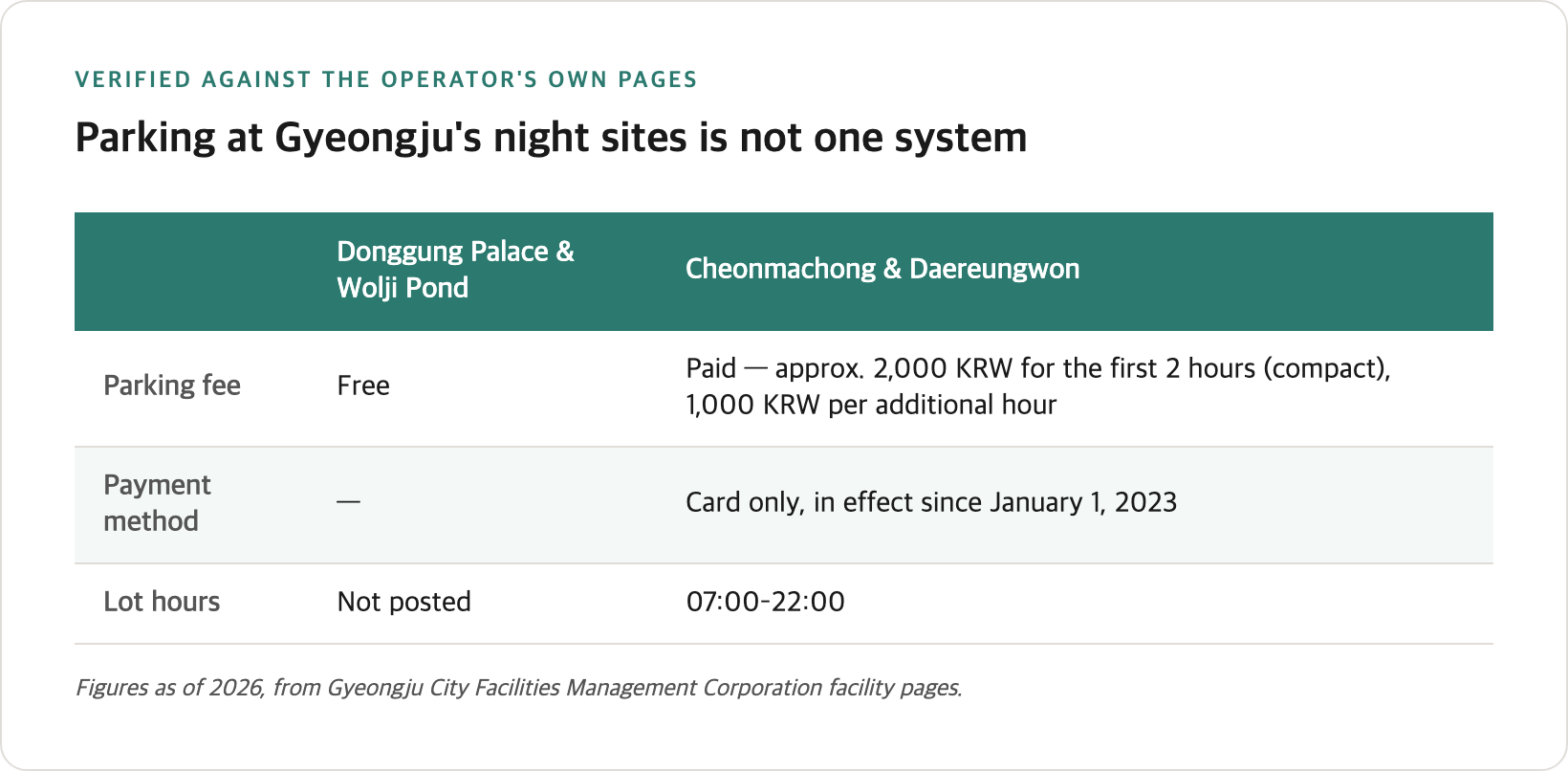
Parking at Donggung Palace and Wolji Pond is free, with no rate posted. Parking at the lot serving Cheonmachong and Daereungwon is not. It charges by time — approximately 2,000 KRW for the first two hours for a compact car, and 1,000 KRW for each additional hour, with the lot itself open from 07:00 to 22:00 (as of 2026). Larger vehicles pay roughly double. A 50% discount applies to a longer list of categories that includes people with disabilities, national merit recipients, compact and low-emission vehicles, and — specifically for Gyeongju residents — pregnant women and families with multiple children.
I also checked the parking notice on the Cheonmachong operator page directly. Its wording is short and affirmative rather than a list of what’s refused: parking fees can be paid by card only, in effect since January 1, 2023. That’s not a detail most fee-and-hours roundups mention, and it matters specifically at night: if you’ve driven to Daereungwon with only cash on hand, you may not be able to pay to get your car back out of the lot after dark.
Card-only payment has become common across Korea, not just at this lot — see our breakdown of where cash still works and where it doesn’t if you’re deciding how much cash to carry on a Gyeongju trip. If you’re relying on cash for the rest of your trip, it’s worth knowing in advance which Korean ATMs actually accept foreign cards and which don’t — the Cheonmachong lot won’t take cash either way.
Local tip — The parking rules at Gyeongju’s two big night sites are opposites, not variations. Wolji Pond parking is free. Cheonmachong/Daereungwon parking is paid, by the hour, and card-only since 2023 — bring a card if you’re driving there.
| Donggung Palace & Wolji Pond | Cheonmachong & Daereungwon | |
|---|---|---|
| Parking fee | Free | Paid — approx. 2,000 KRW/2hrs (compact), 1,000 KRW/hr after |
| Payment method | Not applicable | Card only (since Jan 1, 2023) |
| Lot hours | Not posted | 07:00–22:00 |
| Site admission | 3,000 / 2,000 / 1,000 KRW (adult/teen/child) | Free for Daereungwon grounds; 3,000 / 2,000 / 1,000 KRW for Cheonmachong |
Prices approximate, as of 2026.
Two City Sources, Two Closing Times for Cheomseongdae
This is the clearest example of Gyeongju’s own information not agreeing with itself.
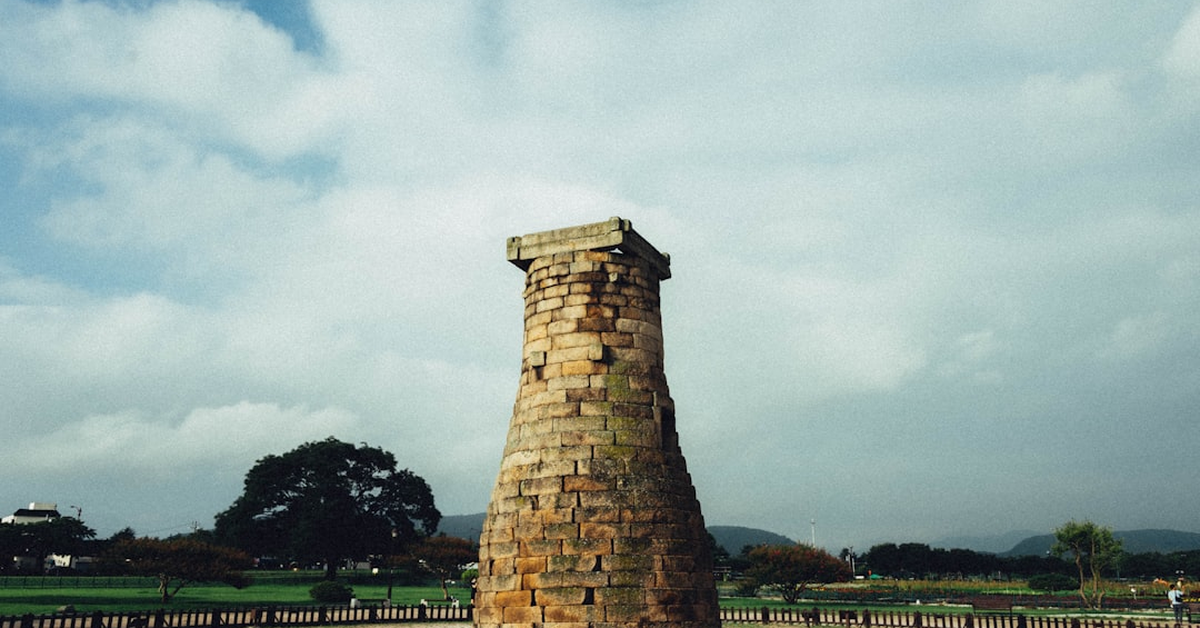
The city’s tourism promotion page for Cheomseongdae states, in the original: 관람시간 : 09:00 -22:00(동절기 21:00까지), 연중무휴 — hours of 09:00 to 22:00, with a winter cutoff of 21:00, open year-round. That’s the figure that shows up across English-language travel sites, and it appears to be a direct translation of this same page — none of the English results reference a different source.
The city ordinance that governs Gyeongju’s heritage sites gives a different answer for the same site. Article 8 of the “Gyeongju City Ordinance on the Collection and Entrusted Management of Public Admission Fees for Historic Sites” lists Daereungwon, Cheomseongdae, and Donggung Palace/Wolji Pond together in one group, open “year-round from 9:00 AM to 10:00 PM” — with no winter exception for that group. The ordinance does set separate summer/winter hours for a different category of site (“other paid historic sites”), but Cheomseongdae isn’t listed in that group — it’s listed with the 22:00, no-season-split group instead.
I checked Gyeongju city’s own tourism page and its ordinance directly, on the same day in August 2026, and they don’t agree: the tourism page gives Cheomseongdae a 21:00 winter cutoff, and the ordinance gives it 22:00 year-round. I wasn’t able to resolve which one governs in practice — that would need a phone call to the city department that administers the ordinance, which wasn’t possible for this piece. What’s confirmed is that the two official sources conflict, and that the English-language content ranking for this search has only ever surfaced one of them.
Gyeongju isn’t the only site in Korea where the posted rules and the official hours don’t fully line up with what English guides repeat — Seoul’s Changdeokgung Secret Garden has its own booking rules that most English coverage misses, and Seoul’s National Museum of Korea changed its posted hours in 2026 in a way that hadn’t fully filtered into English-language listings either.
Local tip — Gyeongju’s tourism page and its own city ordinance disagree on Cheomseongdae’s winter closing time — one says 21:00, the other says 22:00, and both are the city’s own official information. Until that’s resolved, plan around the earlier time: treat 21:00 as the real cutoff in winter rather than 22:00.
Grounds for Being Asked to Leave — and Where They Apply
The same ordinance also lists seven grounds under which the city can restrict entry or ask a visitor to leave a heritage site “for the preservation and management of cultural heritage.” Summarized from the original text, they cover:
- Carrying flammable materials or weapons
- Carrying alcohol or cooking equipment
- Bringing a pet (service animals excepted)
- Carrying musical instruments, loudspeakers, or sports/play equipment likely to disrupt others
- Drinking, or attire that’s likely to disrupt other visitors’ viewing
- Refusing staff instructions without valid reason
- Loud, disruptive, or disorderly conduct
Two things are worth separating here. Item 2 concerns carrying alcohol — a possession restriction. Item 5 is different: it concerns drinking, or clothing, that disrupts other visitors — a behavior restriction, not a blanket ban on drinking itself. The ordinance treats these as two distinct grounds, not one.
The more important caveat is scope. Article 2 of the ordinance states it applies to “paid historic sites managed directly by the city, or entrusted for management” — meaning sites that charge admission. Cheomseongdae is free, and Daereungwon’s tomb grounds have been free since December 2024 (more on that below). Whether this list of seven grounds legally extends to those free sites isn’t something the ordinance text itself resolves — Article 8 lists Cheomseongdae and Daereungwon together with the paid sites for opening-hours purposes, while Article 2 defines the ordinance’s scope as paid sites only. That’s a legal question, not one this guide is positioned to answer. What’s safe to say is narrower: the ordinance defines its own scope as paid historic sites, and both Donggung Palace/Wolji Pond and Cheonmachong charge admission.
Rules that can get a visitor turned away for reasons that aren’t obvious in advance aren’t unique to Gyeongju’s heritage sites, either — Seoul’s jjimjilbangs run on a similar principle, with their own posted grounds for refusing entry that most first-time visitors don’t find out about until they’re at the door.
Free Entry for Hanbok Wearers at Lunar New Year and Chuseok
Article 10 of the ordinance lists 23 separate categories of visitors who are exempt from admission fees — most of them predictable (children aged six and under with a guardian, visitors aged 65 and over, holders of a disability registration card, Gyeongju residents). Note that serving military personnel aren’t on that exemption list; the discounted 2,000 KRW rate they get at the ticket window is a separate thing from the ordinance’s exemptions. One category is more specific, and useful if your trip happens to line up with it: visitors wearing hanbok (한복) during the Lunar New Year and Chuseok holiday periods qualify for free admission, and the ordinance specifically states this includes foreign visitors — 설날 및 추석연휴 한복 착용자(외국인을 포함한다) in the original text.
That’s a narrow window — it applies during the holiday periods themselves, not year-round — but it’s worth knowing if your Gyeongju visit happens to fall during Seollal or Chuseok and you’re already planning to rent a hanbok for photos. The full exemption list also includes categories tied to Gyeongju residency and specific ID documents, which won’t apply to most foreign visitors — the hanbok exemption is the one that does.
Seoul runs a comparable rule at Gyeongbokgung, where wearing hanbok also affects admission — the specifics differ by palace and by city, so it’s worth checking each site’s own terms rather than assuming one hanbok rule covers every site you visit.
If you’re still working out how to reach Gyeongju or get around once you’re there, our guides to booking the train down from Seoul and getting around Korea more broadly cover that separately.
What You Need to Know
- Rules differ by site page, not by operator. The Gyeongju Facilities Management Corporation runs both Wolji Pond and Cheonmachong, but only Wolji Pond’s page carries a detailed visiting-rules section. Don’t assume one applies to the other.
- Cheomseongdae and Woljeonggyo aren’t on the facilities corporation’s managed-site list at all. That list runs to 13 items and neither appears on it, which means there’s no equivalent operator rules page to check for either.
- Daereungwon’s free admission is recent and was once temporary. A 2024-12-27 ordinance amendment removed a sunset clause that had kept the free-entry policy time-limited, making it permanent. Cheonmachong, the ticketed tomb inside the park, is unaffected and still charges admission.
- The ordinance’s grounds for removal are written for paid sites. Whether they extend to free sites like Cheomseongdae isn’t settled by the ordinance’s own text — see above.
- Free stroller and wheelchair rental is available at Donggung Palace and Wolji Pond — the operator’s page offers it for visitors with an infant under 24 months or with limited mobility, on filling in a short form, and suspends it during heavy snow, rain, or strong winds. The Cheonmachong page has no equivalent section.
- Group discounts require at least 20 people at both Donggung Palace/Wolji Pond and Cheonmachong — a single family or small group pays the standard individual rate.
Practical Tips
- Leave the picnic mat and camping chair at the hotel if you’re heading to Wolji Pond. They’re explicitly named on the operator’s banned-items list, along with food other than drinks.
- Bring a card, not cash, if you’re driving to Cheonmachong or Daereungwon at night. The lot there has taken card payment only since January 1, 2023.
- Plan around a 21:00 closing time for Cheomseongdae in winter, not 22:00. Gyeongju’s own tourism page and city ordinance disagree; the earlier figure is the safer one to build a schedule around.
- Don’t cut it close to the 21:30 ticket cutoff at Wolji Pond. The Korean-language version of the city’s tourism page specifically warns that arriving near closing can mean you don’t get in — a line the English version of the same page doesn’t include.
- Check whether a rule is site-specific before assuming it applies elsewhere in Gyeongju. The picnic-gear ban documented for Wolji Pond isn’t documented for Daereungwon; that’s a difference in what’s posted, not necessarily in what’s permitted.
- If you’re visiting during Seollal or Chuseok and already renting a hanbok, ask about the fee exemption — the ordinance grants free admission to hanbok wearers, foreign visitors included, during those holiday periods specifically.
- Bring only drinks if you want refreshments at Wolji Pond. Drinks are the one exception carved out of the site’s food ban; everything else, food-wise, stays outside.
Frequently Asked Questions
Can you bring food or a picnic mat to Wolji Pond at night?
No. The operator that runs Donggung Palace and Wolji Pond lists food as banned except for drinks, and separately bans picnic mats, camping chairs, and other camping gear, along with drinking, smoking, and cooking equipment. Some English-language travel content suggests packing a picnic for the grass by the pond — that isn’t what the site’s own posted rules say (as of 2026).
What time does Cheomseongdae close in winter?
It depends which official source you check. Gyeongju’s tourism page lists a winter closing time of 21:00, while the city ordinance that governs its heritage sites lists a year-round closing time of 22:00 with no winter exception for Cheomseongdae specifically. The two haven’t been publicly reconciled as of 2026 — treat 21:00 as the safer planning figure if you’re visiting late in winter.
Is Daereungwon really free to enter, or do you need a ticket?
The tomb park itself (Daereungwon) is free to walk through, and the grounds are open from 09:00 to 22:00 year-round. Free admission became a permanent rule on December 27, 2024, when the city dropped a sunset clause that had kept the policy time-limited before then — English coverage picked up the free-admission headline but generally not the fact that it had been temporary. Only Cheonmachong, the ticketed tomb exhibit inside the park, charges a separate admission, and its ticket window closes at 21:30.
Do you need a separate ticket for Cheonmachong inside Daereungwon?
Yes. Cheonmachong is priced apart from the free park around it — approximately 3,000 KRW for an adult, 2,000 KRW for a teenager or service member, and 1,000 KRW for a child (as of 2026). Groups of 20 or more pay a reduced rate of roughly 2,400 / 1,600 / 800 KRW across the same three brackets, so a single family or a pair of friends pays the standard individual price. Ticketing and entry close at 21:30, half an hour before the site itself does.
Can staff make you leave Donggung Palace or Daereungwon for drinking or bringing camping chairs?
At Wolji Pond, drinking and camping gear are listed as banned outright by the site operator, so enforcement there wouldn’t need a separate legal basis. City ordinance also gives staff at Gyeongju’s paid heritage sites grounds to restrict entry or ask visitors to leave for carrying alcohol or cooking equipment, or for drinking or behavior that disrupts other visitors, among seven listed grounds. That ordinance is written for paid sites; whether it extends to free ones like Cheomseongdae isn’t something the text itself settles.
Are pets allowed at Gyeongju’s night attractions?
No, not at the sites the city facilities corporation directly manages. Both the Donggung Palace/Wolji Pond page and the Cheonmachong page list pets as not permitted, with an exception for service animals. The city ordinance covering paid heritage sites treats it the same way, listing “bringing a pet” as one of its seven grounds for restricting entry or asking a visitor to leave, again excepting assistance dogs. Cheomseongdae and Woljeonggyo aren’t on the facilities corporation’s managed-site list, so there’s no equivalent operator page posting a pet rule for either one.
What time is the last entry at Donggung Palace and Wolji Pond?
Ticketing and entry close at 21:30, half an hour before the site itself closes at 22:00, and the same 21:30 cutoff applies at Cheonmachong. The Korean-language version of the city’s tourism page adds a specific warning that arriving close to that cutoff can mean visitors aren’t able to get in — a line that doesn’t appear on the English version of the same page. English guides do cover crowding and full parking lots at night; what they don’t connect it to is the ticket cutoff itself.
Is parking free at Gyeongju’s night sites?
It depends which lot. Parking at Donggung Palace and Wolji Pond is free. The lot serving Cheonmachong and Daereungwon charges by time — approximately 2,000 KRW for the first two hours for a compact car, 1,000 KRW per additional hour (as of 2026) — and has taken card payment only since January 1, 2023, so a cash-only visitor can’t settle the fee there.
Related Questions
- Bulguksa and Seokguram in 2026: What’s Actually Free, and What Isn’t
- How to Rent a Hanbok Near Gyeongbokgung — What Isn’t in the Price
- Gyeongbokgung Tickets in 2026: Free Days, Closures, and the Hanbok Rule