Busan Fireworks Festival 2026: Tickets, Hotels, and Getting Out of Gwangalli
Quick Answer
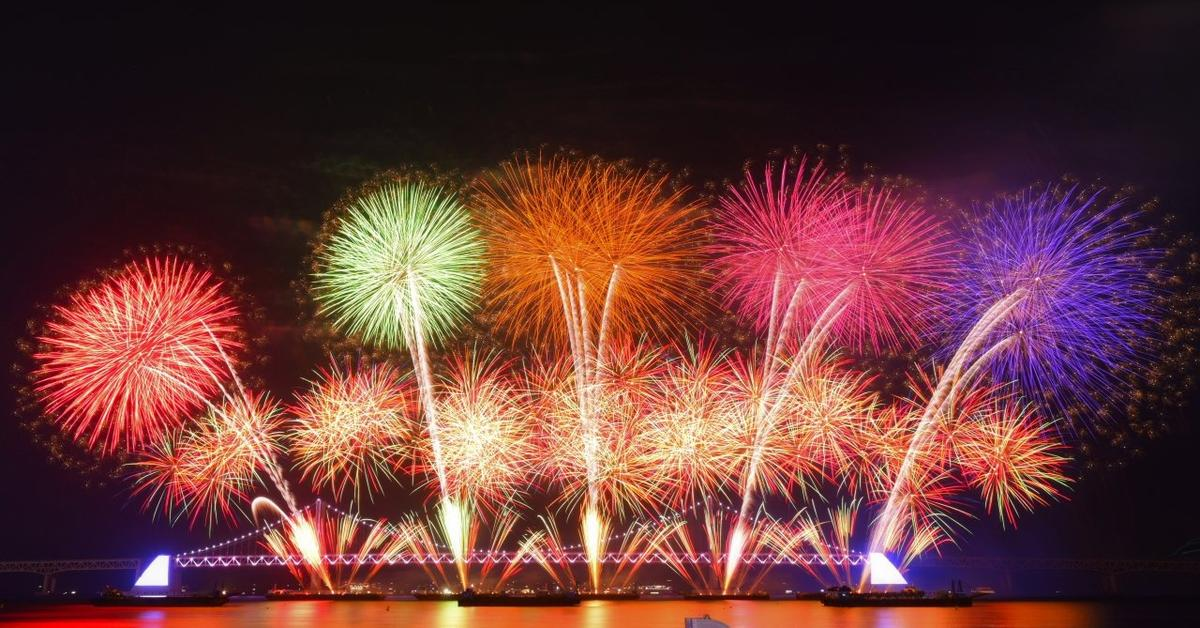
The 21st Busan Fireworks Festival (부산불꽃축제) runs on the evening of Saturday, November 7, 2026 at Gwangalli Beach (광안리해수욕장), with the show from 19:00 to 20:00. Reserved seats (R ₩100,000, S ₩70,000, as of September 2026) sell through five channels on the Korean official site but only three on the English one; Busan Bank’s two are missing. Three overlapping autumn events squeeze Busan rooms, not two, and last year’s plan let trains pass Gwangan Station without stopping once platforms filled.
The Full Answer
Busan’s fireworks festival is the city’s largest single-night tourism draw, and English-language coverage of it is not thin — the date, the venue, the two seat tiers, and the 18:00 arrival cutoff are all documented on the festival’s own English site and in several existing guides. What’s missing isn’t the basic facts. It’s the layer underneath them: which of the five official sale channels actually shows up on the English page, whether the international ticket window is a permanent fixture or something new, and what actually happens to the crowd at Gwangan Station (광안역) once the show ends.
This guide works through those three questions in order — ticket channels, the accommodation squeeze, and the walk back to the subway — rather than repeating the booking basics that English guides already cover well.
Where to Buy Tickets: Five Channels in Korean, Three in English
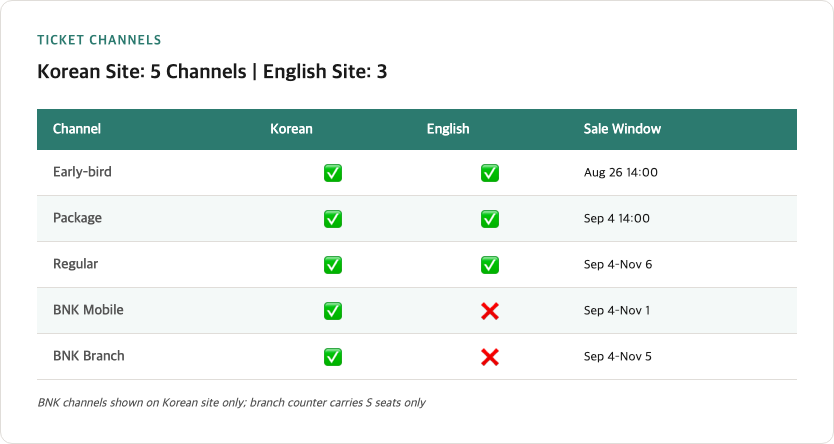
I opened the official Korean and English ticket pages side by side on September 30, 2026, and counted the listed sale channels directly rather than skimming: five rows on the Korean page, three on the English one.
| # | Channel | Korean site | English site | Sale window |
|---|---|---|---|---|
| 1 | Early-bird | ✅ | ✅ | Aug 26, 14:00–23:59 (sold out in about a minute) |
| 2 | Accommodation package | ✅ | ✅ | Sep 4, 14:00 – Oct 25, 23:59 |
| 3 | Regular ticket | ✅ (Interpark) | ✅ (NOL World) | Sep 4, 14:00 – Nov 6, 17:00 |
| 4 | Busan Bank (BNK) mobile banking | ✅ | ❌ | Sep 4, 14:00 – Nov 1, 23:59 |
| 5 | Busan Bank (BNK) branch counter | ✅ | ❌ | Sep 4, 14:00 – Nov 5, close of business (S seats only) |
The regular ticket is the same product listed twice under one product ID — once on Korea’s domestic Interpark storefront, once on the international NOL World storefront. What we could confirm is that the product ID is the same; how the seats behind it are allocated is not something the listings state.
Local tip — A couple of English write-ups already mention that Busan Bank sells tickets too, so the existence of the channel isn’t a secret. What’s missing is the operating detail: neither gives the actual sale windows, and neither flags that the branch counter only carries S seats and can sell out early — it shuts a day before the main sale closes (5 November, at close of business), and the mobile-banking window shuts four days before that, on 1 November. If you’re relying on English sources alone, you’d know the bank sells tickets but not when the window shuts or what it’s limited to.
Whether a foreign visitor can actually complete a purchase at a BNK branch counter is something I could not confirm. The official page doesn’t mention any nationality restriction or ID requirement for the counter sale — in theory, anyone who walks in and pays should be able to buy S-seat tickets there. But the page doesn’t specify accepted payment methods, and I have no way to verify whether a foreign-issued card works at the counter. Treat this as unconfirmed rather than assuming either way.
What is confirmed, and reported nowhere in English as of this writing, is that the international-visitor ticket window itself is new. Korean coverage from the sale’s opening week (newspim.com, September 4, 2026) describes a passport-verification-only sales channel on NOL World as a first-time allocation for 2026, introduced partly in response to inbound travel-agency demand from Taiwan and elsewhere. The domestic and international listings share the same product ID, sold through two separate storefronts — Interpark requires no passport, NOL World does.
Local tip — The passport-only ticket window on NOL World isn’t something that’s always existed for this festival. Korean reporting from the day sales opened describes it as a new allocation this year, added after inbound travel agencies reported unusually early sell-outs of their pre-booked blocks. Whether Busan keeps a separate international window in future years isn’t something anyone can confirm yet — treat 2026 as the first year of this arrangement, not an established pattern.
Choosing a Seat and Actually Getting One as a Visitor
Both seat tiers are randomly assigned within their section rather than reserved to a specific spot — this is already stated on the English-language resale listings, so it isn’t new information, but it matters for expectations. R seats (table plus chair, ₩100,000 as of September 2026) and S seats (chair only, ₩70,000) both work this way. Busan residents get a 10% discount (R ₩90,000 / S ₩63,000, as of September 2026) on presentation of local ID or a recent residence document; for foreign residents, an Alien Registration Card or domestic residence report showing a Busan address substitutes for the ID check — a detail already covered on the official English product page.
A few operational rules apply regardless of where you buy: seats must be claimed by 18:00 or the ticket is void with no refund, tickets bought after October 11 are picked up on-site rather than shipped, and wheelchair seating is booked only by phone (1544-1555), not online.
For visitors buying through an international resale platform rather than the Korean site directly, two listings carry the actual November 7 seating for this year’s show. KKday’s listing is the larger of the two by booking volume — its page shows well over two thousand past bookings — and it’s available in English here. Klook carries the same seating with a smaller review count so far, and it’s bookable here.
One thing worth checking before booking through any resale platform: some listings advertise “fireworks” in the title without actually selling seats to this event. I checked several tours marketed with “Fireworks Show” in the name and found customer reviews spread evenly across every month of the year — a sign of a standing night cruise that runs year-round rather than a once-a-year festival seat. If a listing’s reviews cluster in November only, it’s tied to the actual event date; if they’re spread across the calendar, it almost certainly isn’t.
The Room Squeeze: Three Overlapping Periods, Not Two
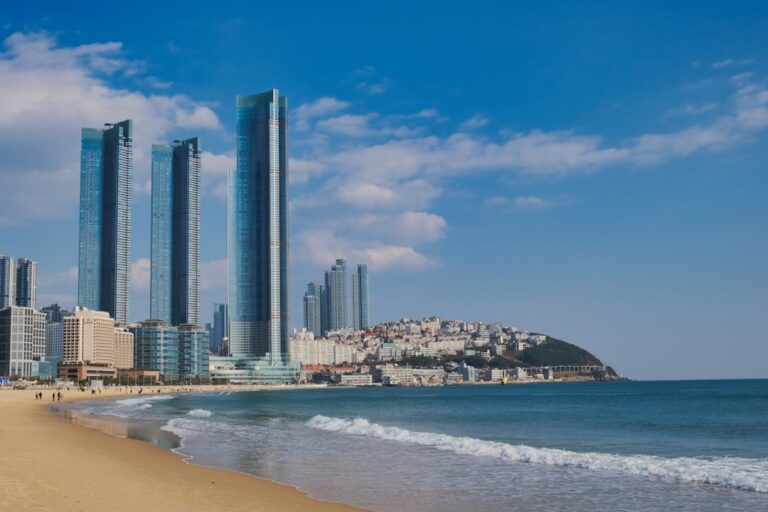
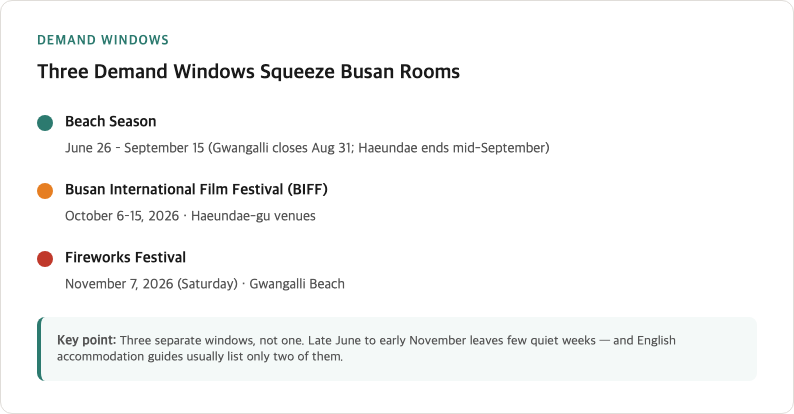
Most English coverage of Busan’s autumn crowding treats the fireworks festival as a single isolated squeeze on hotel availability. It isn’t. Our guide to where to stay in Busan already documents three overlapping high-demand windows rather than two: the summer beach season, which ends on a different date at each Busan beach — Gwangalli closes on August 31, and Haeundae is the only one of the seven still operating into mid-September — the Busan International Film Festival (31st edition, October 6–15, 2026), and the fireworks festival itself on November 7. BIFF’s main venues cluster in Haeundae-gu, the same district that absorbs much of the fireworks crowd’s overflow accommodation once Gwangalli itself fills up.
The practical effect is a longer high-price window than a one-event festival would suggest, and one that starts nearly a month before the fireworks show itself. If you’re booking Busan accommodation for early-to-mid October or the first two weeks of November, checking BIFF’s dates against your own travel window is worth doing before assuming the fireworks festival alone is what’s driving prices up.
Getting there on the day has its own calendar. November 7 falls on a Saturday, and KTX’s free-cancellation window is weekday-only — a Saturday Seoul–Busan seat carries a cancellation fee even a day ahead, so book the return leg you actually intend to use rather than the flexible-looking one. If you’re changing hotels that day rather than arriving into one, Busan’s same-day luggage drop-offs close at 10:50 AM — earlier than the 11:00 the operator’s own English page quotes.
Getting Out of Gwangalli: What Happened Last Year
The 2026 (21st edition) official traffic-control plan had not been published as of late September 2026. I checked the festival’s own traffic-control page directly and found the posted infographic still labeled for the 20th anniversary, dated November 15, 2025 — a full year out of date for this year’s event. Treat everything below as last year’s pattern, not a confirmed rule for November 7, 2026, and check the official page again closer to the date.
Last year’s plan phased in road closures around Gwangalli through the afternoon and evening: a first stage from 10:00 closing a short stretch of the coastal road near the festival entrance, expanding through two more stages by late afternoon, and by 17:00 extending closures further along Gwangnam-ro — though public transit routes were still running at that point. The harder cutoff came at 18:00, when eleven bus routes (nine regular lines plus two village buses) running along Gwangnam-ro were suspended entirely and rerouted via Suyeong-ro.
For the subway, Busan Ilbo’s coverage of the 20th festival describes a conditional response — empty trains added through Suyeong, Gwangan, and Geumnyeonsan stations if crowding built up, and non-stop passes through some stations “if a crowd-crush risk emerges.” A Namuwiki entry on Gwangan Station states this more flatly, describing non-stop passes through Gwangan and Geumnyeonsan as effectively routine on festival evenings and recommending Suyeong or Millak stations instead — while noting those alternatives get crowded too, with ridership that evening running roughly five times a normal day’s volume. Community wiki entries are a weaker source than a news report, so treat the certainty of that claim with more caution than the conditional wording from Busan Ilbo.
Of the six English-language sources I checked for this festival, one mentions in passing that trains have run past stations in past years. None of the six gives the alternate stations or the 18:00 bus suspension. Most stop at “take line 2.”
Local tip — Last year, once the show ended, Busan’s transit authority ran empty trains through Gwangan and Geumnyeonsan stations without stopping whenever the platforms got dangerously full, meaning people already on the platform there had no choice but to walk to Suyeong or Millak station instead — and even those get crowded. The 2026 traffic plan hadn’t been published as of late September, so this is last year’s pattern, not a confirmed rule. Check the official page again in early November before you plan your route home.
If you’d rather watch from somewhere other than the main Gwangalli grandstand, the festival’s official listing gives the event area as Gwangalli Beach together with Igidae (이기대) and Dongbaekseom (동백섬), and the show is visible from points along that coast without a ticket. Dongbaekseom is a short walk from Dongbaek Station on Line 2, alongside Nurimaru APEC House — our guide to reaching Busan’s spots the subway doesn’t reach covers its hours and the monthly closing day, neither of which is on its own English page. These viewing spots don’t solve the subway crowding on the way home, since everyone converges on the same handful of stations regardless of where they watched from.
What You Need to Know
- The 18:00 seat-arrival cutoff is a hard rule, not a suggestion. Ticket holders who haven’t reached their seat by 18:00 lose admission and the ticket isn’t refunded — this applies to R and S seats bought through any channel.
- BNK’s two channels don’t appear on the English ticket site at all. If you want to buy through Busan Bank rather than NOL World or a resale platform, you’ll need to use the Korean-language site or visit a branch directly.
- The international ticket window is new this year, not an established feature. It launched alongside the 2026 sale in response to travel-agency demand; there’s no way to know yet whether Busan keeps a separate international allocation for future festivals.
- Seats are randomly assigned within R or S, not chosen. You can’t pick a specific row or section — this applies whether you book through the official site or a resale platform.
- Tickets bought after October 11, 2026 are picked up on-site, not shipped. Factor in time to collect your ticket before the 18:00 seat-arrival cutoff if you’re buying close to the date.
- The 2026 traffic and transit plan wasn’t public as of late September. Anything about road closures or subway disruption is based on last year’s pattern until Busan publishes this year’s version.
- BIFF overlaps the run-up to the fireworks festival, not just the festival itself. If you’re booking Busan accommodation anywhere from early October through mid-November, both events affect pricing, not just the one you’re attending.
Practical Tips
- Book your seat before checking accommodation, not after. With three overlapping demand windows stacking into the same six-week stretch, rooms near Gwangalli fill well before ticket sales close on November 6.
- If buying through NOL World or Interpark rather than a resale platform, use the English site for the regular ticket, package, or early-bird options — but check the Korean site if you specifically want a BNK channel. The English site simply doesn’t list Busan Bank’s two sale windows.
- Check resale listings for review dates before booking, not just the title. Reviews clustered in November point to actual event seating; reviews spread evenly across the year point to a standing tour using the festival’s name as a search hook rather than selling entry to it.
- Plan your exit route before the show starts, not after. Deciding in advance whether you’re heading to Suyeong or Millak station beats trying to figure it out in a crowd once the show ends.
- If you’re not committed to a ticketed seat, consider watching from Igidae or Dongbaekseom instead of the main grandstand. Both are free viewpoints, though they don’t avoid the subway crowding afterward.
- Eat before you stake out a spot rather than counting on buying food near the beach afterward. If you’re filling the daytime hours around Nampo-dong before heading over to Gwangalli, Busan’s major markets each close on a different day, and none of those schedules adjusts for festival crowds — worth checking the calendar before building a day around Jagalchi or Gukje.
- If you’re arriving from Japan, factor the extra travel day into your booking window. Some visitors time the festival with a Fukuoka–Busan ferry crossing, which has its own check-in cutoff separate from the festival’s ticket deadlines.
Frequently Asked Questions
Can foreigners buy Busan Fireworks Festival tickets through Busan Bank (BNK)?
The official page for both BNK channels — mobile banking and the branch counter — doesn’t state a nationality restriction. In theory, anyone able to complete the purchase should be able to buy. What isn’t confirmed is whether foreign-issued payment cards work at the counter or within the banking app; this hasn’t been tested, so treat it as unconfirmed rather than assuming it works.
What’s the difference between the NOL World ticket and the Busan Bank ticket?
They’re different sales channels for the same event, and the listings don’t state how seats are divided between them. NOL World (and its domestic counterpart, Interpark) sells the standard regular ticket and is listed in English; Busan Bank’s mobile-banking and branch-counter channels sell through a separate process, aren’t listed on the English site, and the branch counter only carries S seats.
Is the international-visitor-only ticket window a permanent feature, or new this year?
It’s new for 2026. Korean reporting from the sale’s opening week describes it as a first-time allocation, introduced after travel agencies reported strong early demand from overseas, including Taiwan. Whether Busan continues a separate international window in future years isn’t confirmed.
What happens if I don’t reach my seat by 18:00?
Admission is refused and the ticket isn’t refunded. This rule applies across all official sale channels for both R and S seats — arriving after 18:00 with a valid ticket doesn’t guarantee entry.
How crowded does Gwangan subway station get after the fireworks, and is there a better station to use?
Based on last year’s festival, yes — Gwangan and nearby Geumnyeonsan saw non-stop train passes when platforms became dangerously full, pushing people toward Suyeong or Millak stations instead, though those also got crowded. The 2026 plan for subway operations wasn’t published as of late September 2026, so this reflects last year’s pattern rather than a confirmed rule for this year’s show.
Should I book Busan accommodation around the fireworks festival, BIFF, or both?
Both, if your dates fall anywhere between early October and mid-November. BIFF runs October 6–15, 2026, the fireworks festival is November 7, and both compete for rooms in the same Haeundae-gu and Gwangalli-adjacent areas — treating them as separate, non-overlapping demand periods will underestimate how early you need to book.
Can I still get a seat if the R/S tickets sell out through the official channels?
Two resale platforms, KKday and Klook, carry the same November 7 seating as separate listings. Both randomly assign seats within R or S the same way the official channels do, and neither guarantees a refund if plans change.
Do wheelchair users need to book differently?
Yes — wheelchair seating is booked by phone only, at 1544-1555, rather than through the standard online ticket flow used for R and S seats.
Related Questions
- Where to Stay in Busan: Access, and the Licence Check Nobody Mentions
- Busan Beaches 2026: Opening Dates, Hours and Beach-by-Beach Rules
- Lotte Giants at Sajik Stadium: A Busan Baseball Guide