Can You Bring a Rental Car to Udo Island? Korea’s Rules Changed Twice in 2026
Quick Answer
No, not in a standard gas or diesel rental car — Udo (우도) has restricted outside vehicles since 2017. But since 2025, fully electric rental cars and 16-seat charter buses can cross on the ferry. The rule moved the other way too: as of March 19, 2026, the low-speed scooters and carts English guides tell you to rent on the island were banned as unregistered and uninsured. The restriction runs through July 2029.
The Full Answer
Most English-language guides to Udo describe one rule and stop there: rental cars from the mainland can’t cross, so rent a scooter or an electric cart once you’re on the island instead. That was accurate in 2024. It is no longer the full picture in either direction.
Jeju’s local government first restricted outside vehicles on Udo in August 2017, citing traffic and safety problems on the island’s narrow roads. The restriction has been renewed five times since, and in 2025 it stopped being a flat ban and became something more specific — one category of car got let in, while a different category of vehicle, the kind most English guides point tourists toward, got pushed out. Both changes matter more to a visitor than the headline “cars are restricted,” and neither shows up in the search results that currently rank for this topic.
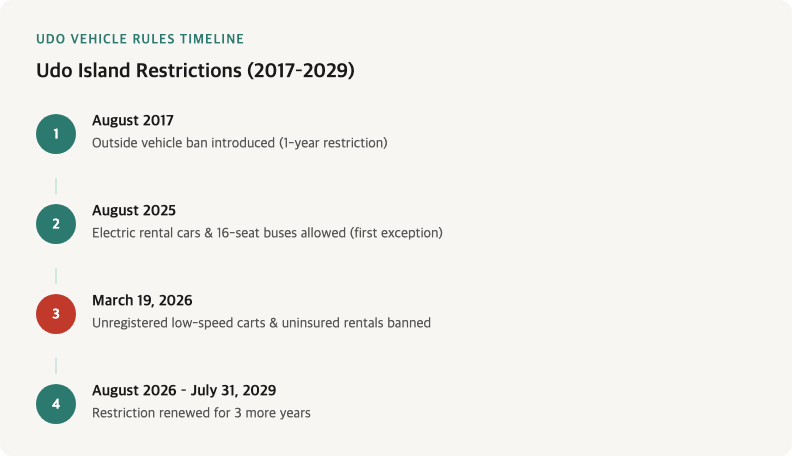
A Timeline: Three Changes, Not One
It helps to separate what changed, and when, rather than treat “the Udo car rule” as a single fixed thing.
| When | What happened |
|---|---|
| August 2017 | Outside vehicles restricted for the first time (1 year) |
| 2018–2022 | Renewed three times (+1 year, +3 years, +3 years) |
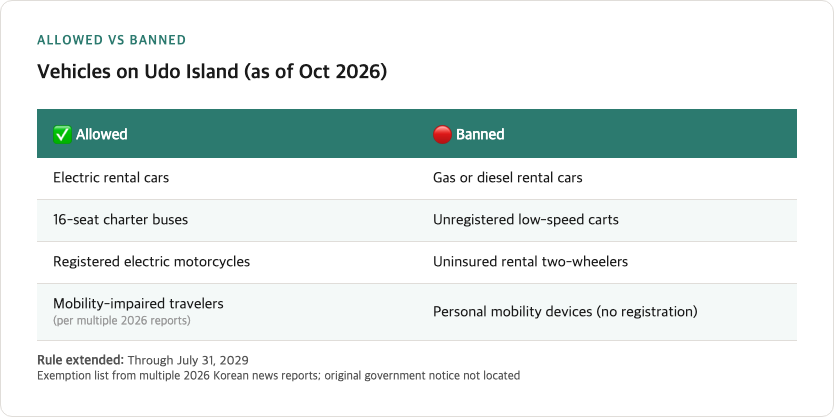
| August 2025 | Renewed again — and for the first time, electric rental cars and 16-seat charter buses were let through. Sub-25km/h rental scooters, mopeds and personal mobility devices were also allowed in, with no registration requirement |
| March 19, 2026 | That last part reversed. Unregistered low-speed carts, sub-25km/h rental two-wheelers, and any vehicle without compulsory insurance were banned again. Registered electric motorcycles stayed legal |
| August 2026 | The restriction itself renewed for 3 more years, through July 31, 2029 |
Korean reporting refers to the March 2026 change as a “4th” order and the August 2026 renewal as a “5th extension” — two different counters tracking two different things (a mid-period rule change versus the restriction’s overall lifespan). Because the numbering is genuinely confusing even in Korean, it’s more useful to think of this by date than by ordinal: electric cars got an exception in 2025, unregistered low-speed vehicles lost theirs in March 2026, and the whole system is locked in through mid-2029.
I cross-checked four independent 2026 Korean news reports on the March ruling — two from Kyunghyang Shinmun, plus Headline Jeju and Jeju Maeil — and all four describe the same scope: unregistered carts, sub-25km/h rental two-wheelers, and uninsured vehicles, with registered electric motorcycles unaffected.
Local tip — Most English guides still say Udo’s car ban is absolute. It hasn’t been since August 2025: a fully electric rental car can legally make the ferry crossing. If your mainland rental is gas or diesel, the restriction still applies to you in full.
Local tip — This isn’t a temporary or recently-introduced rule. It’s been renewed five times since 2017 and is now locked in through July 2029 — most English coverage of Udo doesn’t mention that the restriction has an end date at all, let alone that it was just extended.
Why Scooters and Electric Carts Got Banned Again
This is the part that matters most for anyone planning to rent something once they’re on the island, because it’s also the part where current English-language advice and current Korean regulation point in opposite directions.
When the August 2025 rule let in low-speed rental two-wheelers without a registration requirement, some operators used that opening to put something else on the road: unregistered, golf-cart-style electric carts marketed as “low-speed mobility” vehicles. These carts don’t meet Korea’s vehicle safety standards, which means they can’t be formally registered — and a vehicle that can’t be registered can’t carry compulsory insurance either. If one of these carts is involved in a collision, neither the rider nor anyone they hit has an insurance claim to make.
Seven government and enforcement agencies ran a joint crackdown starting March 19, 2026. One operator alone was fined 212 separate times in about a month — 100,000 won per violation, 21.2 million won total — and kept operating under a changed business name anyway. On June 18, 2026, three cart-rental operators and five individuals, including company representatives, were referred to prosecutors on charges under the Motor Vehicle Management Act, the Passenger Transport Service Act, and the Act on Guarantee of Compensation for Loss from Car Accidents.
None of that shows up in the English-language results currently ranking for Udo scooter rentals. Several of them actively recommend renting a scooter or electric cart at the dock with no mention of registration or insurance status, and at least one English travel post describes renting an electric scooter without the usual license as a selling point rather than a warning sign.
Local tip — As of March 2026, renting a scooter or electric cart on Udo is only legal if it’s a registered electric motorcycle with compulsory insurance — not the unregistered low-speed cart some shops still rent out quietly. Three operators were referred to prosecutors in June 2026 for exactly this. If a shop skips a written rental contract or only takes cash, that’s the same pattern regulators flagged — not just a minor inconvenience.
I looked for any update on enforcement after the June 2026 prosecutions and found none past that date in either English or Korean coverage. That doesn’t mean illegal operators stopped — it means I couldn’t confirm whether they did, so treat this as a documented enforcement action as of mid-2026, not a claim that the island is now clean.
Who Qualifies for an Exception
Four categories of vehicle have a legal way onto the ferry, according to multiple 2026 Korean news reports that independently list the same four:
- Mobility-impaired travelers — people with disabilities, those aged 65 or older, pregnant travelers, or anyone accompanying a child under 6
- Fully electric or first-class low-emission rental cars (electric or hydrogen)
- 16-seat charter buses
- Rental vehicles belonging to guests staying overnight on Udo, since there’s no other way for them to move their luggage or reach accommodation off the main dock road
I checked Jeju provincial government’s press release archive directly for the original order listing these exemptions and could not locate it — the archive search didn’t surface it, and the public notice board links led only to index pages. What I can confirm is that four separately published 2026 reports (Jeju Transportation Welfare News, Seoul Shinmun, Jnuri, and Headline Jeju) converge on the same four categories, which is solid but short of an original government notice.
There’s no single standard form to prove any of these categories — travelers are expected to bring documentation relevant to their situation (disability registration, ID showing age, proof of pregnancy, accommodation booking) and confirm directly with whichever rental company or ferry operator they’re using before departure.
Local tip — If you think you qualify for an exception — traveling with someone elderly, pregnant, or with a disability, or staying overnight on Udo — bring proof and confirm with your rental company beforehand. There’s no standardized form, and ferry staff can turn away a vehicle at the dock if the paperwork doesn’t satisfy them.
Getting to Udo Without Bringing a Vehicle at All
For most day-trip visitors, none of the exceptions apply anyway, which makes the practical question simpler: how do you get around once you’re there without a car. Udo is commonly covered by bicycle, electric bicycle, a registered electric scooter, or a guided group tour, none of which require bringing anything across on the ferry.
If you’re already planning to get around the rest of Jeju without a rental car, Udo doesn’t actually change that approach much — it just adds a second, shorter ferry leg on top of the bus network you’re already using. The island is also where Jeju’s Olle Trail has its own dedicated route, Course 1-1, which is walkable with no vehicle of any kind. If you’re building Udo into a wider trip, our 3-day and 5-day Jeju itinerary guide is built around exactly this car-free sequencing.
A bundled day tour sidesteps the rental question entirely by handling transport for you: one option pairs Udo with Seongsan Ilchulbong and a tangerine-picking stop in a single day, and its listing states the tour is offered in English — it can be booked through Viator here. Buying a tour does not cover the crossing itself, though: the Udo ferry ticket and the island’s on-island transport fee are paid separately on the day, and one tour reseller’s listing puts them at ₩11,000 and ₩21,000 respectively — ₩32,000 combined — as of October 2026.
Whichever way you get there, Naver Map or KakaoMap will route you around Udo more reliably than Google Maps, which is worth having open if you’re trying to find a legally registered e-bike or electric-motorcycle rental shop rather than the first stand near the dock. Some island rental counters lean on cash-only, no-contract transactions — the same pattern regulators flagged in the unregistered cart operators — so it’s worth reading our broader guide to paying by cash or card in Korea before you go — and if you’re mapping out what a Udo side trip adds to overall costs, see our Jeju travel budget breakdown.
The ferry itself runs from two points — Seongsan Port, right next to Seongsan Ilchulbong, and the smaller Jongdal Port, which runs fewer daily departures and is more exposed to rough seas on the eastern side. On fares, the most current figure I could find is a reseller’s, not an operator’s: one tour reseller lists the Udo ferry ticket at ₩11,000 round-trip as of October 2026, with a separate ₩21,000 island transportation fee on top. That is a reference price published by a company selling tours, not an official published tariff. Older Korean sources from 2023–2024 put the adult round trip at approximately 10,500 won. I could not confirm a current 2026 rate from the ferry operator’s own site — its fare table is published as an image rather than text — so treat any figure here as approximate and confirm before you travel.
What You Need to Know
- “Rental cars are banned on Udo” is now only half true. Gas and diesel rental cars still can’t cross. Fully electric rental cars and 16-seat charter buses can, as of 2025.
- The scooter and electric cart advice in most English guides is out of date. As of March 19, 2026, unregistered low-speed carts and uninsured rental two-wheelers are banned — only registered electric motorcycles and electric bicycles are clearly legal.
- An uninsured vehicle means no insurance payout if something goes wrong, for the rider or for anyone they hit. This is a safety and liability issue, not just a rule you might get fined for breaking.
- The restriction isn’t temporary. It’s been renewed five times since 2017 and currently runs through July 31, 2029.
- Exceptions require proof, not just a claim. Mobility-impaired travelers, electric/low-emission rental cars, 16-seat charter buses, and Udo overnight guests qualify — but there’s no standard form, so confirm with your rental company or ferry operator ahead of time.
- Whether an International Driving Permit covers Udo’s e-bike and scooter rentals is unconfirmed. One English guide claims a Vienna Convention IDP with a motorcycle endorsement is required for electric scooters; Korean rental-shop notices we found only mention holding onto a licence, with no stated distinction between a domestic, foreign, or international one. Our separate breakdown of which licences Korea actually recognises for driving covers rental cars under the Road Traffic Act in detail, but that framework hasn’t been confirmed to extend to Udo’s small e-bike and scooter counters — ask the specific shop before you rely on any permit type.
Practical Tips
- Confirm your rental car is fully electric before assuming it can cross. A hybrid or plug-in hybrid is not the same thing — the exception applies to fully electric and hydrogen vehicles.
- Don’t assume a cheap dockside scooter or cart is legal just because a shop is renting it out. Registered electric motorcycles are legal; unregistered low-speed carts are not, regardless of what the shop tells you.
- Ask to see the vehicle’s registration and insurance before you ride, or at minimum ask directly whether it’s a registered electric motorcycle. A shop that avoids the question or skips a written contract is a warning sign, not a shortcut.
- If you qualify for an exception, bring documentation and confirm in advance. Ferry staff can refuse boarding at the dock if your paperwork doesn’t satisfy them, and there’s no universal form to fall back on.
- Budget your Udo ferry fare separately from any day tour you book. Tour operators commonly price the ferry and on-island transport as an on-site add-on rather than including it.
- Use Naver Map or KakaoMap, not Google Maps, to find rental shops and navigate the island. Google Maps has no turn-by-turn driving directions in South Korea at all — a legal restriction on exporting Korean mapping data, not a gap it will patch — so it won’t route you to a specific shop or confirm whether it is still trading.
- If walking appeals to you more than renting anything, Udo’s Olle Trail Course 1-1 covers the island with no vehicle question at all.
Frequently Asked Questions
Can I bring my rental car to Udo Island?
Only if it’s fully electric. Jeju has restricted outside vehicles on Udo since 2017, but since August 2025, fully electric rental cars and 16-seat charter buses are allowed to cross on the ferry. Gas and diesel rental cars are still not permitted, with narrow exceptions for mobility-impaired travelers, qualifying low-emission vehicles, and guests staying overnight on Udo.
Is an electric rental car allowed on the ferry to Udo?
Yes, as of the 2025 rule change. This is a recent exception to a restriction that used to apply to essentially all outside vehicles, and it’s not reflected in most English-language guides, which still describe the ban as absolute.
Can I rent a scooter or electric cart once I’m on Udo?
Only if it’s a registered electric motorcycle with compulsory insurance. As of March 19, 2026, unregistered low-speed carts, sub-25km/h rental two-wheelers, and any uninsured vehicle are banned, following a crackdown that led to criminal referrals for three operators in June 2026.
Why were low-speed scooters and carts banned on Udo in 2026?
A rule change in August 2025 allowed low-speed rental vehicles onto the island without a registration requirement. Some operators used that opening to run unregistered, golf-cart-style electric carts that don’t meet vehicle safety standards and therefore can’t carry insurance. Regulators reversed that part of the rule in March 2026 after safety concerns and repeated violations.
What happens if I’m caught riding an unregistered cart on Udo?
Beyond the legal exposure — operators have faced fines and criminal referral — the practical risk falls on you as a rider: an unregistered, uninsured vehicle means there’s no insurance claim available if you’re in a collision, whether you caused it or not.
Who qualifies for an exception to the Udo vehicle ban?
Mobility-impaired travelers (including those over 65, pregnant travelers, or anyone with a child under 6), fully electric or low-emission rental cars, 16-seat charter buses, and rental vehicles belonging to guests staying overnight on Udo. Multiple 2026 Korean news reports converge on this list, though we could not locate the original government notice to confirm it in full.
Do I need an international driving permit to rent an e-bike on Udo?
This is unconfirmed. One English-language guide states that electric scooters require a Vienna Convention International Driving Permit with a motorcycle endorsement, but Korean-language rental shop notices we checked only mention holding a licence generally, without specifying which type. Confirm directly with the shop before relying on any particular permit.
How much does the Udo ferry cost, and does it carry cars?
One tour reseller lists the Udo ferry ticket at ₩11,000 round-trip as of October 2026, plus a separate ₩21,000 island transportation fee — a reseller’s reference price rather than an official published tariff. Older 2023–2024 Korean sources put the adult round trip at approximately 10,500 won, and we could not confirm a current 2026 rate from the ferry operator itself. The ferry does carry vehicles, but only those covered by the exceptions above — a standard rental car cannot be loaded regardless of fare paid.
Related Questions
- Visiting Jeju Without a Car: Buses, Fares and the 40-Minute Transfer Rule
- Jeju Haenyeo: Where to Actually See the Women Divers
- Driving in Korea on a Foreign Licence — Where the English Guides Go Wrong
Featured image: Photo by Minku Kang on Unsplash