eSIM vs SIM vs Pocket WiFi in Korea: What the Affiliate Guides Won’t Tell You
Quick Answer
For most visitors, an eSIM is the easiest way to get data in Korea — no queues, active the moment you land. The problem is which one. Most “best eSIM” guides are affiliate pages for one or two global brands, and none of them name the network your data actually rides on — Airalo’s own Korea page doesn’t either, it only says it “shows” the network without ever naming one. Korea’s own government speed tests show SKT and KT trading the lead by under 1% a year, so the brand name tells you less than the guides imply. What actually differs is the fine print: SKT’s own tourist eSIM caps nothing but top speed, while resold global eSIMs typically throttle hard after roughly 3GB a day.
The Full Answer
Search “best eSIM for Korea” and you get a wall of confident recommendations, most pointing at the same one or two global brands. That is not a coincidence — it is affiliate structure. The brand pays a commission, so the guide recommends it, and the comparison quietly leaves out both the local carriers that don’t pay commissions and the one detail that actually matters: which network you’re buying.
That is a genuine information gap, and it is exactly the kind this blog exists to fill. I checked Korea’s own network quality reports, SKT’s official roaming site, and Airalo’s public Korea page directly in September 2026, rather than repeating what other English guides say about each other’s products. Three things came out of that: the “which network is fastest” question is closer than any guide admits, the “unlimited” label means something different depending on who sells it, and the local carrier’s own eSIM is cheaper than the figures that circulate in English.
Does Your Phone Support eSIM?
Not every recent phone supports eSIM, and not every eSIM-capable phone can run an eSIM alongside a physical SIM.
- iPhone XS, XS Max, and XR support eSIM but not at the same time as a physical SIM — it’s one or the other.
- iPhone 11 and later support a physical SIM and an eSIM running together.
- Samsung Galaxy models sold in Korea support eSIM starting with the Z Flip4 and Z Fold4, released in the second half of 2022 — older and budget Galaxy models generally do not.
- Tablets, smartwatches, and laptops support eSIM far less consistently than phones do.
Dial *#06# before you travel. If an EID number shows up alongside your IMEI, the phone supports eSIM. If it doesn’t, you’re looking at a physical SIM or pocket WiFi instead.
The Three Options
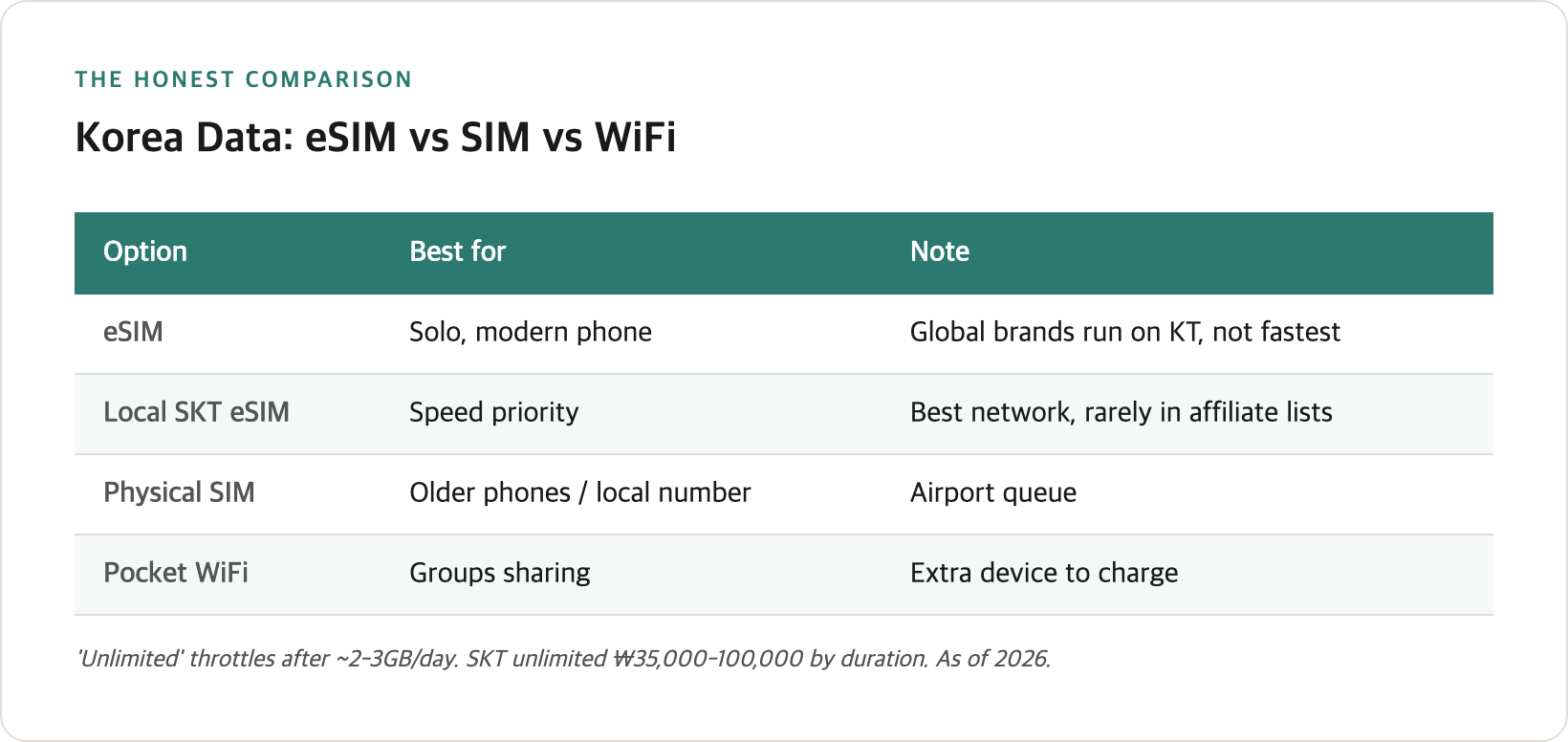
| Option | Best for | Watch out |
|---|---|---|
| eSIM | Most travellers, modern phones | Phone must support eSIM (see above) |
| Physical SIM | Older phones, want a local number | Queue at airport, swap card |
| Pocket WiFi | Groups sharing, multiple devices | Extra device to carry and charge |
An eSIM wins for a solo traveller with a recent phone. Pocket WiFi makes sense for a family sharing one connection. A physical SIM is the fallback for older or eSIM-incompatible handsets. Sort this out alongside your visa or K-ETA and your KTX tickets as pre-departure admin.
The Network Question Nobody Answers
This is the detail that separates a page selling convenience from a page selling accuracy.
Local tip — I checked Airalo’s own South Korea page directly in September 2026. It does not name a network anywhere. The page only describes a feature — “shows the primary network the eSIM uses” — without ever stating what that network is. Other sites don’t agree on it either: some describe Airalo as running mainly on SK Telecom, others say it sits on KT’s 4G with only certain plans reaching SKT 5G. The real finding isn’t which network wins — it’s that the sellers themselves keep the answer vague.
Local tip — Korea’s own network quality tests — run annually by the Ministry of Science and ICT and the National Information Society Agency — show SKT and KT trading the 5G download lead year to year rather than either one running away with it. SKT led in 2024 (1064.54Mbps versus KT’s 1055.75Mbps); KT edged ahead in 2025 (1030.25Mbps versus SKT’s 1024.50Mbps). Both gaps were under 1%. SKT has consistently held a clearer edge on latency instead — 18.42ms versus KT’s 19.19ms in the most recent comparable test — and a separate private analytics report (Opensignal, not a government source) ranked SKT highest across most consumer-experience categories in 2025. None of this nuance shows up in English “best eSIM” comparisons, which tend to just assert one network is fastest and stop there. The 2025 test also changed its methodology — measurement points expanded from roughly 400 to 600 locations, and it introduced a new “required-speed pass rate” metric (basic tasks like web browsing and messaging passed 99%+ of the time across all three carriers; high-definition streaming passed 98.18%), which the government now treats as closer to how a network actually feels than the raw average-speed number alone.
What “Unlimited” Actually Means
The word does a lot of quiet work, and it means something different depending on who is selling it.
Local tip — I checked SKT’s own tourist eSIM terms on skroaming.com directly. The listed condition is “unlimited use of data during the period of use,” with a maximum speed of 100Mbps — no daily gigabyte figure anywhere in the terms. Global resale eSIMs work differently: reviewers across multiple sites consistently describe a Fair Usage Policy that throttles speed to roughly 1Mbps after about 3GB of high-speed data in a single day. Both products are marketed as “unlimited.” Only one of them behaves that way for a full day of normal use.
For ordinary travel — maps, messaging, the odd video — you’re unlikely to hit either limit. For heavy streaming or tethering a laptop all day, the difference between no daily cap and a 3GB one becomes the whole story. Read the daily-throttle figure, not just the headline word, when comparing plans.
What a Local SKT eSIM Actually Costs
skroaming.com is SK Telecom’s own site for inbound roaming customers, and its prices run lower than the figures that circulate in English guides.
| Duration | Official SKT price (as of September 2026) |
|---|---|
| 5 days | ₩27,500 |
| 10 days | ₩38,500 |
| 15 days | ₩55,000 |
| 30 days | ₩71,500 |
| 60 days | ₩107,000 |
| 90 days | ₩143,000 |
Usage is metered in hours from the moment you activate it, not from the day you buy it — a 5-day plan runs 120 hours, so buying early and activating on landing costs you nothing.
Local tip — As of September 2026, SKT’s own site runs a sign-up promotion on plans of two days or longer: a free T-money transit card (worth approximately ₩3,000) and a free Royal Palace Pass (worth approximately ₩10,000, for purchases from February 10, 2026 onward). Promotions change — check current terms before you buy.
KT and LG U+ also sell tourist eSIMs directly, but this guide checked SKT’s sign-up process in the most detail, since its English-language registration flow was the clearest of the three to verify end to end.
SKT is the largest of the three carriers by subscriber numbers, and its 5G eSIM is sold in English here.
Do You Need a Korean Phone Number?
Most eSIMs, including the cheapest ones, are data-only. That covers almost everything — Naver Map, KakaoMap, and messaging apps all work on data alone.
- Data-only eSIM: cheapest, covers navigation and messaging
- eSIM with number: needed if a booking or service must SMS you a Korean number
- Physical SIM: the easiest way to get a local number if you specifically need one — handy since some payment apps need a Korean number
Local tip — On SKT’s tourist eSIM, a phone number is only included on plans of two days or longer, and the fine print undersells what you actually get: incoming calls and texts are free the moment the number is registered, but sending anything yourself requires a separate top-up through SKT’s site. Registration is by foreign passport only — a Korean ID won’t work — done either online before you land or at the SKT roaming counter at Incheon Airport, and each passport registers one plan at a time. If a booking only needs to reach you, the free incoming side covers it. If you need to call or text out, budget for the charge.
Ride-hailing and food-delivery apps sometimes ask for a Korean number during sign-up. If Kakao T or a similar app won’t proceed without one, a physical SIM is the more reliable fix — an eSIM number you haven’t topped up for outgoing use won’t solve it. Which specific apps require this changes often enough that checking the one you actually plan to use, before relying purely on data-only service, is worth the extra minute.
Activating and Timing
- Buy before you fly, activate on landing — the smoothest path
- Airport counters at Incheon sell physical SIMs and some eSIMs if you’d rather do it in person
- Setup time: usually minutes, though some global eSIMs report 20–30 minutes to connect the first time
Local tip — Install the eSIM at home but set activation for your arrival — most providers let you schedule it. That way you land with data live and skip both the airport queue and the “why won’t this connect” troubleshooting while jet-lagged.
Marketplaces sometimes advertise a discount against airport-counter pricing. Checked against SKT’s own published rate table directly, that gap looks more like a marketplace coupon than a real difference in the underlying product — worth some skepticism the next time you see “up to 20% off airport price” in an ad.
What You Need to Know
-
The “best eSIM” guides are mostly affiliate pages that don’t name a network — Airalo’s own page doesn’t either.
-
SKT and KT trade the 5G speed lead year to year, under 1% apart; SKT holds a steadier edge on latency.
-
SKT’s own tourist eSIM has no daily data cap — most resold global eSIMs throttle after roughly 3GB a day.
-
Local carrier pricing beats what most English guides quote — SKT’s official 5-day plan is ₩27,500, not the ₩35,000+ figures that circulate.
-
A Korean number on SKT’s eSIM is free to receive, not free to send from — outgoing calls and texts need a top-up.
-
Not every phone supports eSIM, and some older iPhones can’t run one alongside a physical SIM.
-
Buy before you fly, activate on landing for the smoothest start.
Practical Tips
-
Check eSIM compatibility before you buy. Dial
*#06#and look for an EID number alongside your IMEI. -
There are two easy ways to buy SKT’s tourist eSIM: directly from skroaming.com, which carries the full unlimited plan and the current sign-up promotion, or through the Klook listing above if you already book through that app.
-
Read the daily-cap language, not just the word “unlimited,” when comparing any plan.
-
Data-only is enough for maps and messaging for most itineraries.
-
Register with your passport before you land if you want a working Korean number, and budget separately for outgoing calls and texts.
-
Buy before you fly, schedule activation for arrival.
-
Factor it into your trip budget — data is a small but real line item, and the official price is lower than most guides quote.
Frequently Asked Questions
What’s the best eSIM for Korea?
It depends on priority, and no guide — including this one — can name a single winner on network alone: SKT and KT trade Korea’s own 5G speed tests within 1% of each other year to year. Global brands like Airalo are convenient but don’t disclose which network they use. A local SKT eSIM, bought directly, is competitively priced and comes without a daily data cap.
Does my phone support eSIM?
Dial *#06#. If an EID number appears with your IMEI, your phone supports eSIM. iPhone XS/XR support it but not alongside a physical SIM; iPhone 11 and later support both together. Korean-market Galaxy phones support eSIM from the Z Flip4/Z Fold4 (second half of 2022) onward.
What does “unlimited data” really mean?
It depends on the seller. SKT’s own tourist eSIM lists no daily cap, only a 100Mbps ceiling. Most resold global eSIMs apply a Fair Usage Policy that throttles speed to roughly 1Mbps after about 3GB in a day. Normal travel use rarely hits either limit.
Do I need a Korean phone number?
Usually not. Data-only eSIMs cover maps and messaging. If you do get a number through SKT’s eSIM, incoming calls and texts are free, but outgoing use needs a separate top-up — and registration requires a foreign passport.
eSIM or physical SIM?
eSIM for compatible modern phones and convenience; physical SIM for older or incompatible handsets, or if an app specifically requires a working Korean number for outgoing verification.
How much does a local SKT eSIM cost?
Officially, ₩27,500 for 5 days, ₩38,500 for 10 days, and ₩71,500 for 30 days (as of September 2026), usage-metered in hours from activation, not from purchase. Plans of two or more days from skroaming.com currently include a free T-money card and Royal Palace pass — check current terms, as promotions change.
When should I activate it?
Install at home and schedule activation for your arrival, so you land with data live and skip the airport queue.
Related Questions
- Why Google Maps Doesn’t Work in Korea — and What to Use
- Do You Need a Visa for Korea? The 90-Day Rule
- Incheon Airport to Seoul: Every Option, Including the Night Bus
- How to Book KTX Tickets as a Foreign Visitor
- Using Kakao T for Taxis in Korea
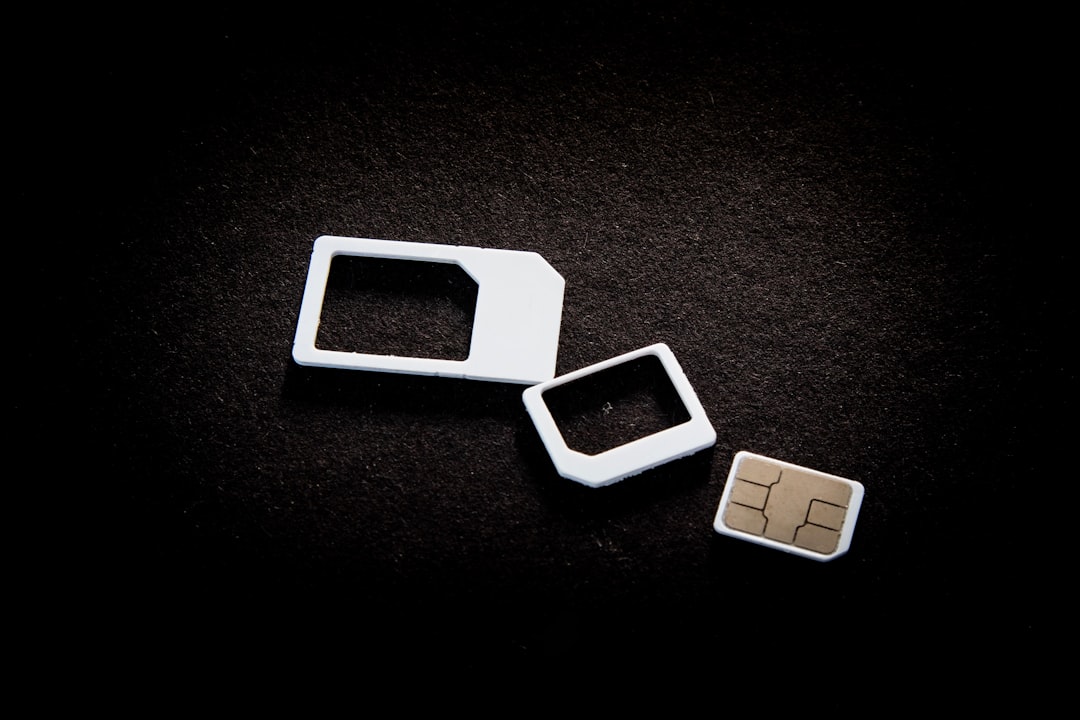
Featured image: Photo by User_Pascal on Unsplash