Jeju Travel Budget: What a Trip Actually Costs, With or Without a Car
Quick Answer
Jeju costs more than the Korean mainland in specific categories — transport especially. A car-free trip runs cheaper than most guides assume, because buses are inexpensive and the island’s attractions are individually cheap (₩4,000–5,000 entries). The single biggest budget decision is car versus no car: rental plus fuel plus parking adds up fast, while the bus network covers most sights for a fraction of it. Attractions and food are modest; transport is where Jeju’s cost sits.
The Full Answer
Jeju gets described two ways in English: “cheap like the rest of Korea” or “expensive resort island.” Neither is quite right. The attractions are cheap, the food is reasonable, and the accommodation spans budget to luxury like anywhere. What’s genuinely more expensive — and what tips a Jeju budget — is getting around.
That makes the car decision the pivot of the whole budget, more than accommodation or food. I checked current Jeju costs in July 2026 against the mainland weekly budget to show where the island differs, because the “is Jeju expensive” question really means “should I rent a car.”
The Car Decision Dominates
This is the choice that moves your total more than any other.
Local tip — The car-versus-no-car choice is the biggest lever in a Jeju budget, and the reason hides in a cost English guides quietly omit: the headline rental rate almost always excludes 완전자차 — full collision-damage waiver. I checked several Jeju rental listings in July 2026, and adding full CDW runs roughly ₩8,000–10,000 a day on top of the advertised price. Korean renters treat it as near-mandatory because single-vehicle accidents on Jeju’s unfamiliar coastal roads are common — local insurers put them at around 30% of rental claims. Fuel and parking stack on further, while the bus network skips the whole category. A guide that quotes only the base rate makes a car look cheaper than it really is.
A car buys flexibility and reaches a few spots buses don’t, but it is where Jeju’s cost premium concentrates. For a first visit hitting the major sights, the buses do the job.
What a rental costs is one question; whether you are allowed to collect the keys is another. This page covers the cost. Driving in Korea on a foreign licence covers the eligibility side — which permits the law recognises, how long the one-year window runs, and where rental counters ask for more than the statute does.
Category Breakdown
Attractions are the reassuring part — they’re cheap.
| Category | Rough cost |
|---|---|
| Attractions | ₩4,000–5,000 each (Seongsan, Manjanggul) |
| Hallasan | Free (reservation only) |
| Olle Trail | Free |
| Local bus | ₩1,150 flat (간선·지선); express (급행) ₩2,000+ |
| Rental car | Substantial over several days |
| Food | Similar to mainland, seafood can run higher |
| Accommodation | Budget guesthouse to luxury resort |
Local tip — The headline sights are individually cheap — ₩4,000–5,000 entries, and the two best-known hikes (Hallasan and the Olle Trail) are free. A day of sightseeing costs remarkably little in admissions. This is why the transport decision dominates: everything else is modest, so the car is the outlier that swings the budget.
Where Jeju Costs More Than the Mainland
- Transport — the clearest premium: rental, taxis, and the ferry if you island-hop to Udo or Gapado
- Seafood — fresh seafood, especially at coastal restaurants, can run higher than mainland
- Peak season — summer and holidays push accommodation and flights up sharply
Local tip — Here’s the counterweight to that transport premium: unlike mainland Korea’s distance-based bus fares, Jeju’s ordinary trunk and branch buses (간선·지선) are a flat ₩1,150 by card, however far you ride — a cross-island trip costs the same as a short hop. Only the faster express (급행) buses are distance-based, starting at ₩2,000 and climbing past 20 km. Stay on the regular buses and every ride is ₩1,150, with transfers discounted inside the window, so a full day of bus-hopping can total just a few thousand won. English guides usually quote a vague “₩1,200–1,500 a ride” and miss that the everyday fare is flat.
Sample Daily Budgets
Rough all-in daily figures, excluding flights to the island:
- Budget (car-free): ₩50,000–80,000 — guesthouse, buses, cheap eats, a couple of ₩4,000 sights
- Mid-range: ₩120,000–200,000 — hotel or nicer guesthouse, some taxis or a rental, restaurant meals
- Comfort (with car): ₩250,000+ — resort, rental car, seafood restaurants, paid experiences
The car-free budget isn’t just cheaper — it’s often more relaxed, since Jeju’s coastal roads are unfamiliar and Google Maps gives no driving navigation.
What You Need to Know
-
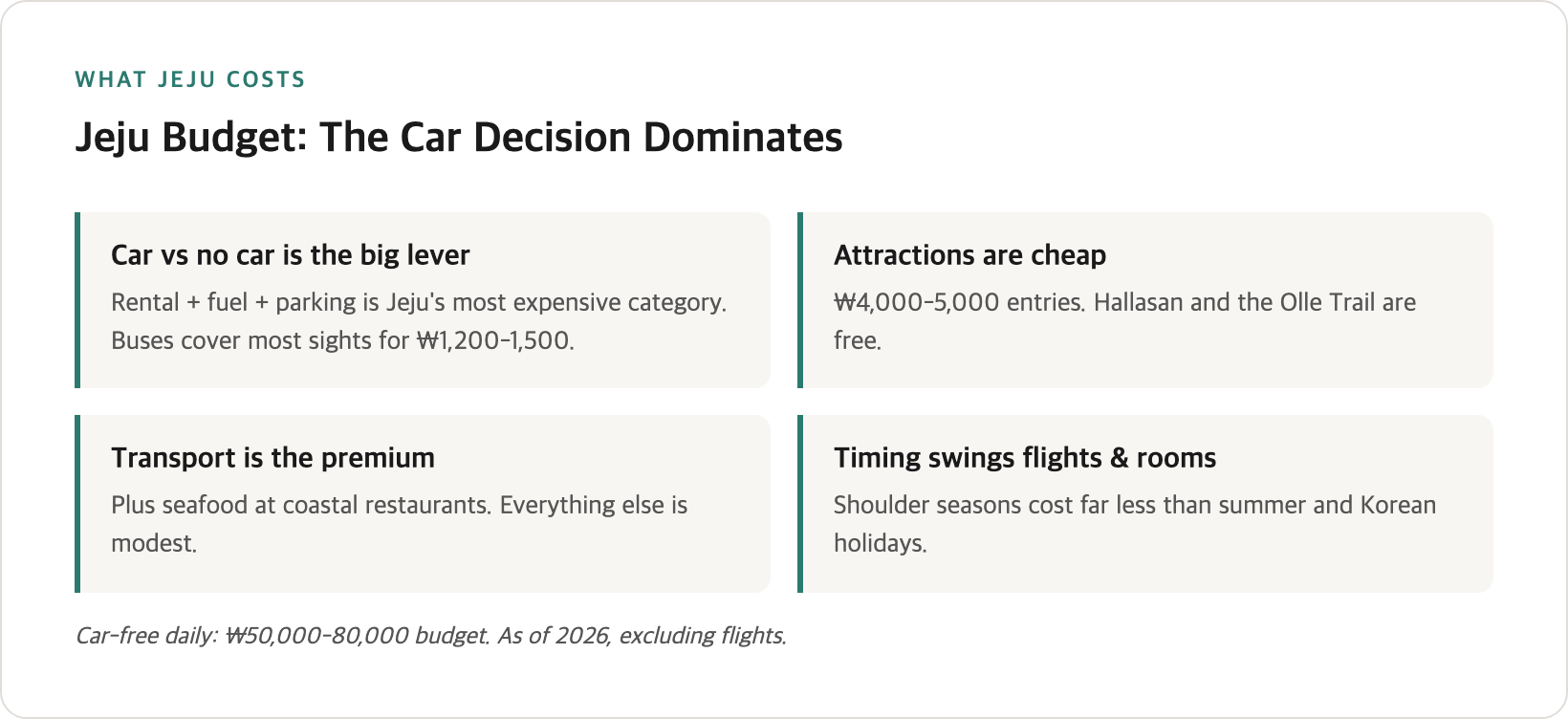
The car decision is the biggest budget lever — bigger than accommodation.
-
Attractions are cheap — ₩4,000–5,000, with Hallasan and Olle free.
-
Buses cover most sights — a flat ₩1,150 on the regular (간선·지선) lines.
-
Transport is Jeju’s cost premium over the mainland, plus seafood.
-
Flights and rooms spike in peak season — shoulder seasons save on both.
-
Car-free is the single biggest saving for a first visit.
Practical Tips
-
Decide car vs no car first — it swings the whole budget.
-
Go car-free to save most — buses reach the major sights.
-
Budget little for attractions — they’re ₩4,000–5,000 each.
-
Do the free hikes — Hallasan and the Olle Trail.
-
Travel in shoulder season for cheaper flights and rooms.
-
Expect seafood to cost more at coastal restaurants.
-
Use the same T-money card as the mainland for buses.
Frequently Asked Questions
Is Jeju expensive to visit?
Not especially, except for transport. Attractions are cheap and food is reasonable; the premium is in getting around, particularly car rental.
Should I rent a car in Jeju?
It’s the biggest budget decision. A car adds flexibility but is the island’s most expensive category. Buses cover most major sights far more cheaply — see Jeju without a car.
How much does a day in Jeju cost?
Roughly ₩50,000–80,000 car-free on a budget, ₩120,000–200,000 mid-range, and ₩250,000+ with a rental car and resort, excluding flights.
Are Jeju’s attractions expensive?
No. Entries are typically ₩4,000–5,000, and the two best-known hikes — Hallasan and the Olle Trail — are free.
When is Jeju cheapest?
Shoulder seasons — spring and autumn — for both flights and accommodation, which also offer the best walking weather. Summer and Korean holidays are the priciest.
What costs more than the mainland?
Transport (rental, taxis, ferries) and fresh seafood at coastal restaurants.
Related Questions
- Visiting Jeju Without a Car: Buses, Fares and the 40-Minute Transfer Rule
- Jeju Itinerary: 3-Day and 5-Day Plans That Actually Work
- How Much Does a Week in Korea Cost?
- Jeju Haenyeo: Where to Actually See the Women Divers
- Getting Around Korea: The Transport Guide That Connects the Details