Noraebang in Korea: How Coin and Standard Karaoke Rooms Actually Work
Updated for August 2026
Quick Answer
A noraebang (노래방) is a private singing room you rent by the hour, typically ₩15,000–30,000 (as of 2026). A coin noraebang (코인노래방) is a booth you pay by the song, usually ₩500 each. Both are licensed as singing practice halls, which means the venue is legally barred from selling you alcohol. Anywhere that serves soju with your microphone is operating under a different licence.
The Full Answer
Singing is the most accessible K-pop activity in Korea, and it is the one with the fewest gatekeepers. You cannot get inside an agency building, and getting into a music show recording takes an application window and a Korean-language notice. A noraebang takes a ₩1,000 note and a walk down a stairwell.
That accessibility is exactly why the English-language guides stop where they do. They explain the format well — private room, tablet or remote, a tambourine, free extra minutes at the end — because all of that is visible in the first ten minutes of your first visit. What they do not explain is the layer underneath: the business licence that decides what the room may serve you, the statutory rules on who may walk in and when, and a monthly software authorisation that decides whether last week’s comeback single will actually play.
I read the current text of the Music Industry Promotion Act (음악산업진흥에 관한 법률) and its enforcement decree and enforcement rules in August 2026, along with two published legal interpretations from the Ministry of Government Legislation, and I checked Kumyoung’s own operator FAQ for how new songs reach the machines. I also read the ten English-language noraebang guides currently ranking for the obvious searches. Three of them state a rule about minors that the statute contradicts in its own text, and two of them tell you to order soju to a room where the operator is legally forbidden from bringing it. Those contradictions are the reason this article exists.
One thing to settle first: none of this is about whether you will enjoy it. You will. It is about the four or five points where the room does not behave the way an English guide told you it would.
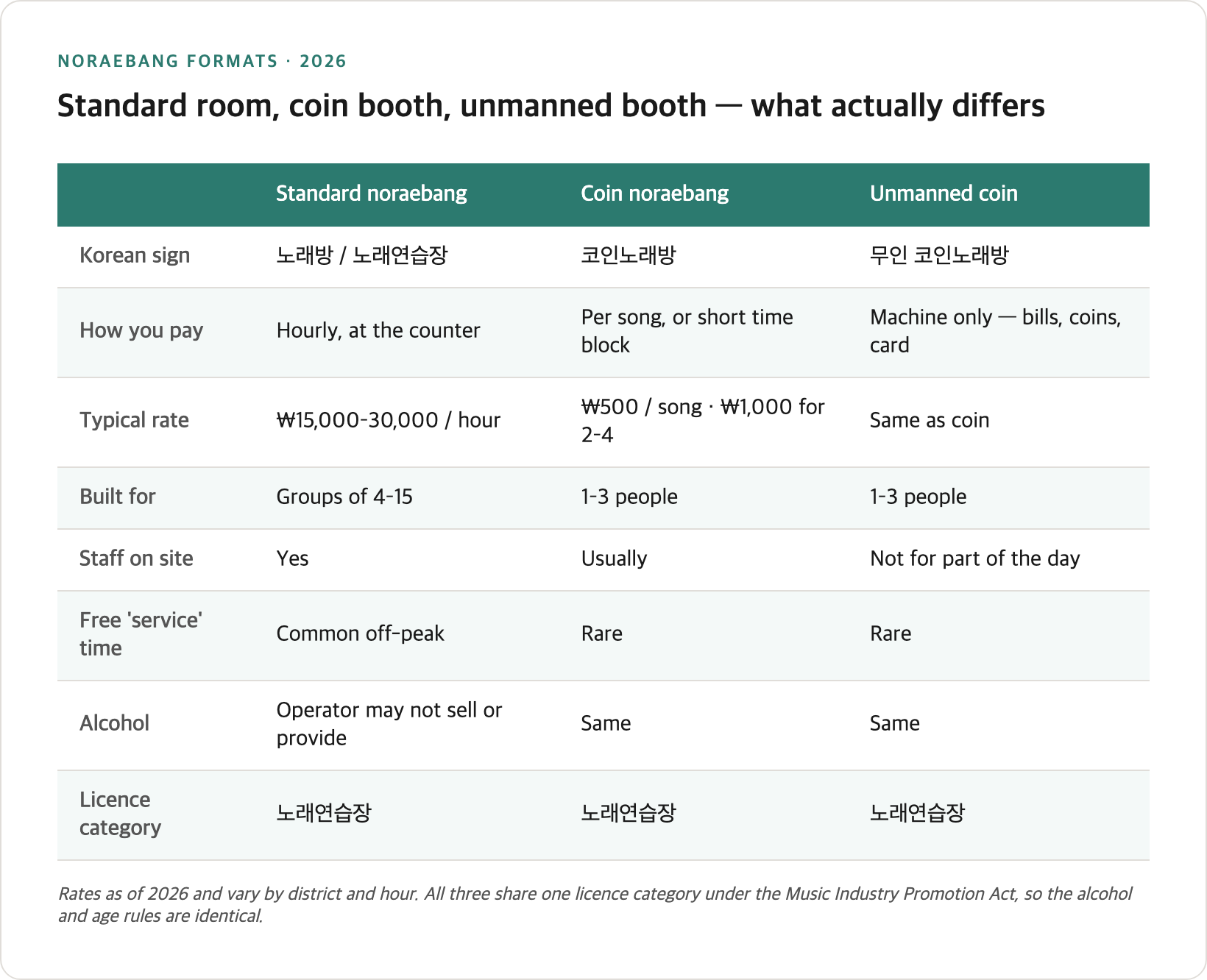
Photo by Andrea De Santis on Unsplash
The Three Formats You Will Actually See
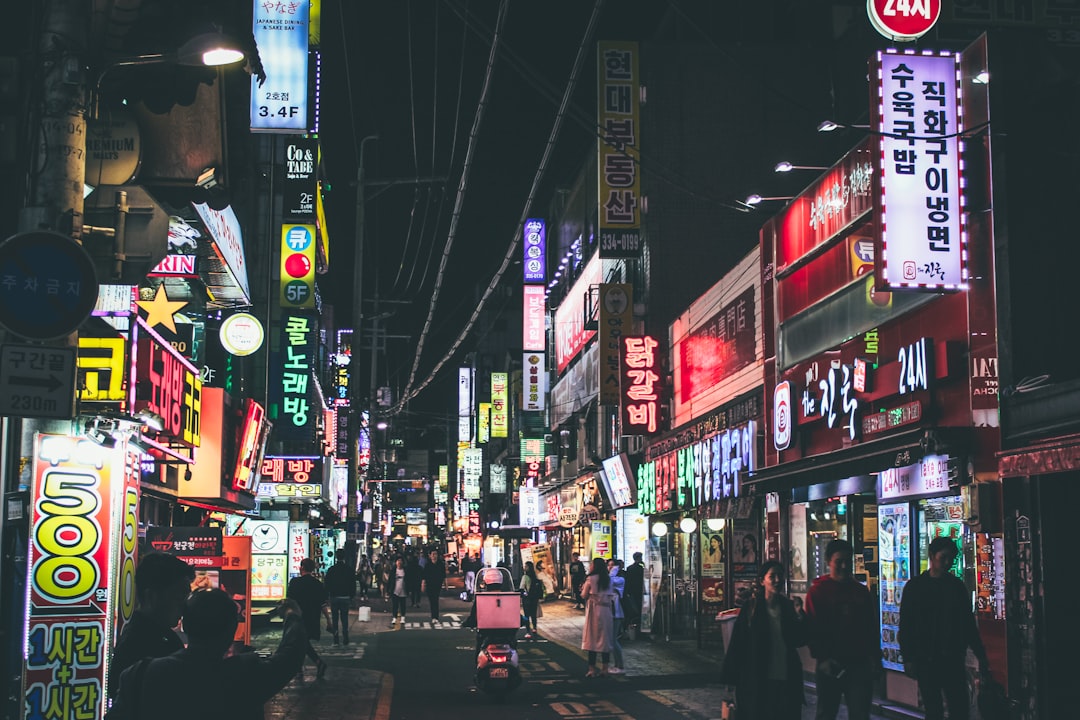
Walk any commercial street in Seoul and you will pass all three within a few blocks. They look similar from the stairwell and behave very differently once you are inside.
Standard noraebang. A staffed counter, a corridor of numbered rooms sized for four to fifteen people, and an hourly rate. You pay at the counter, usually before you sing. Rooms come with two microphones, a remote or tablet, a tambourine, and a songbook. Free snacks and water are common. This is the format built for a group, and per person it only makes sense as a group.
Coin noraebang. A row of small booths, most sized for one to three people, charged per song or in short time blocks. You feed a bill or coin into a machine, or scan a QR code, and pick an empty booth. This format arrived in the mid-2010s and reshaped the market, largely because it made singing alone normal rather than odd. If you are travelling solo, this is your format.
Unmanned coin noraebang. Structurally the same as above, but with no staff on site for part of the day. Korean-language descriptions of the format note that many are unstaffed through the daytime with someone arriving in the evening, though this varies venue to venue. Practically it means the payment machine is the only thing standing between you and a booth, and there is nobody to break a large note or answer a question.
The Korean words on the sign help. 노래방 and 코인노래방 are what almost everything you will walk past says. The legally registered category is 노래연습장 (singing practice hall), and that is the phrase that determines the rules below.
What It Costs, and What “Service” Means
Rates move with the neighbourhood and the hour, and the ranges published in 2026 by English and Korean sources both land in roughly the same place.
Standard rooms run approximately ₩15,000–30,000 per hour (as of 2026), with the low end common in the late morning and early afternoon and the high end after 21:00 in nightlife districts. Larger rooms and hotel-adjacent venues go higher. Coin booths are typically ₩500 per song, with bundles that reduce the unit price — ₩1,000 for two to four songs is the usual structure, and ₩3,000–5,000 buys a half-hour block at many venues (as of 2026).
The one piece of pricing that is not on the board is 서비스 (seobiseu), or service time — free extra minutes added at the end of a paid hour. English guides describe this correctly and it is real. Two things they tend to leave out: it is discretionary, not owed to you, and it dries up when the venue is full. Off-peak, ten to thirty minutes is common. At 23:00 on a Friday in Hongdae, expect nothing.
If you are budgeting a night out around this, an hour of singing sits alongside the other costs covered in what a week in Korea actually costs — it is one of the cheaper things you will do.
Finding Your Song, and Why It Sometimes Will Not Play
Two companies supply almost all the machines. TJ Media (TJ미디어) dominates, with a blue interface, and Kumyoung (금영엔터테인먼트) runs second with a red one. Each assigns its own song number to the same track, so a number you noted at one venue is useless at the other.
Both publish a free public song search. TJ’s is at tjmedia.com and Kumyoung’s is at kysing.kr, and both let you search by title, artist, or number and return the machine’s song number directly. Looking your set up before you go is standard practice among Korean users and takes about two minutes.
One quirk worth knowing before you try it: on TJ’s own search page, foreign artists are frequently indexed by their Korean-transliterated name. Searching 아이유 returns results where “IU” may not. If a K-pop track comes back empty in Latin script, retype the artist in Hangul.
Inside the room, the remote or tablet has a 한/영 toggle that switches the keyboard between Korean and English. Miss it and English titles will not resolve, which is the single most common reason a visitor concludes a song “isn’t in the system.”
Local tip — a song can be in the index and still refuse to play. Korean karaoke machines carry a monthly authorisation the venue has to keep current. Kumyoung’s own operator FAQ states plainly that “periodic monthly authentication is required” and that unauthenticated new songs “become unusable after a set period”; machines connected to the internet update daily, and the ones that are not depend on a dealer visit. The practical effect is that a venue running behind on its authorisation will still list this month’s releases but will not perform them. English guides say the opposite — that new songs arrive monthly and you can sing a hit “a few weeks after release,” with no mention that the venue has to pay to keep that true. If a brand-new comeback single will not start, it is almost never your search. Walk to a newer or franchise-branded venue and it will usually play.
Alcohol: What the Licence Actually Permits
This is where the English-language guides diverge from each other, and where two of the currently ranking 2026 guides give advice that does not match the statute.
Article 22(1) of the Music Industry Promotion Act lists what a noraebang operator must observe. The third item is unambiguous: the operator shall not sell or provide alcohol (주류를 판매·제공하지 아니할 것). The verb matters. “Provide” covers handing it to you free, not just charging for it — so an operator cannot legally supply the drink, the glass service, or the bottle, whatever the arrangement.
The fourth item bars the operator from employing or brokering hostesses (접대부) or touting for customers. A separate provision, Article 22(2), goes wider: nobody may, for profit, drink alongside customers or entertain them in a noraebang, or broker anyone to do so. That one carries a criminal penalty of up to one year’s imprisonment or a fine of up to ₩3,000,000 under Article 34.
So what about the venues that clearly do serve alcohol with a private singing room? They exist, and they are legal — under a different licence entirely, granted through the Food Sanitation Act rather than the Music Industry Promotion Act:
| Venue type | Licensed under | Alcohol | Singing | Hostesses | Minors |
|---|---|---|---|---|---|
| 노래연습장 (noraebang, coin noraebang) | Music Industry Promotion Act | Operator may not sell or provide | Yes | Prohibited | Only in a designated youth room, 09:00–22:00 |
| 단란주점 (danran jujeom) | Food Sanitation Act | Yes | Yes | Not permitted | No |
| 유흥주점 (yuheung jujeom) | Food Sanitation Act | Yes | Yes and dancing | Permitted | No |
Local tip — “noraebang” on the sign does not tell you which one you are entering. Two English guides currently ranking for noraebang searches tell readers that soju and beer can be delivered to the room, or that BYOB is fine “at some venues.” Under the Act, a registered 노래연습장 operator cannot lawfully do that at all. If a room is serving you alcohol, you are either in a 단란주점 or 유흥주점 — where the bill structure is entirely different — or in a venue taking a licensing risk on your behalf. The practical read: a venue with a per-hour room rate, a snack tray and no drinks menu is a 노래연습장. A venue with a drinks menu and a service charge is not, and the evening will cost several times more. If anyone offers to arrange company for the room, that is the brokering the Act criminalises, and it is a signal to leave.
If drinking is the point of the evening rather than the singing, the honest answer is to do it somewhere designed for it — the norms are covered in drinking in Korea, and the food side in why you cannot just order drinks. Plenty of Korean groups drink at a restaurant or bar first and treat the noraebang as the sober-ish second stop. If that order gets away from you, hangover remedies is the other end of the same evening.
The Age Rules, Where English Guides Get It Wrong
If you are travelling with a teenager, this is the section that matters, and it is the one where the English-language SERP is most confidently incorrect.
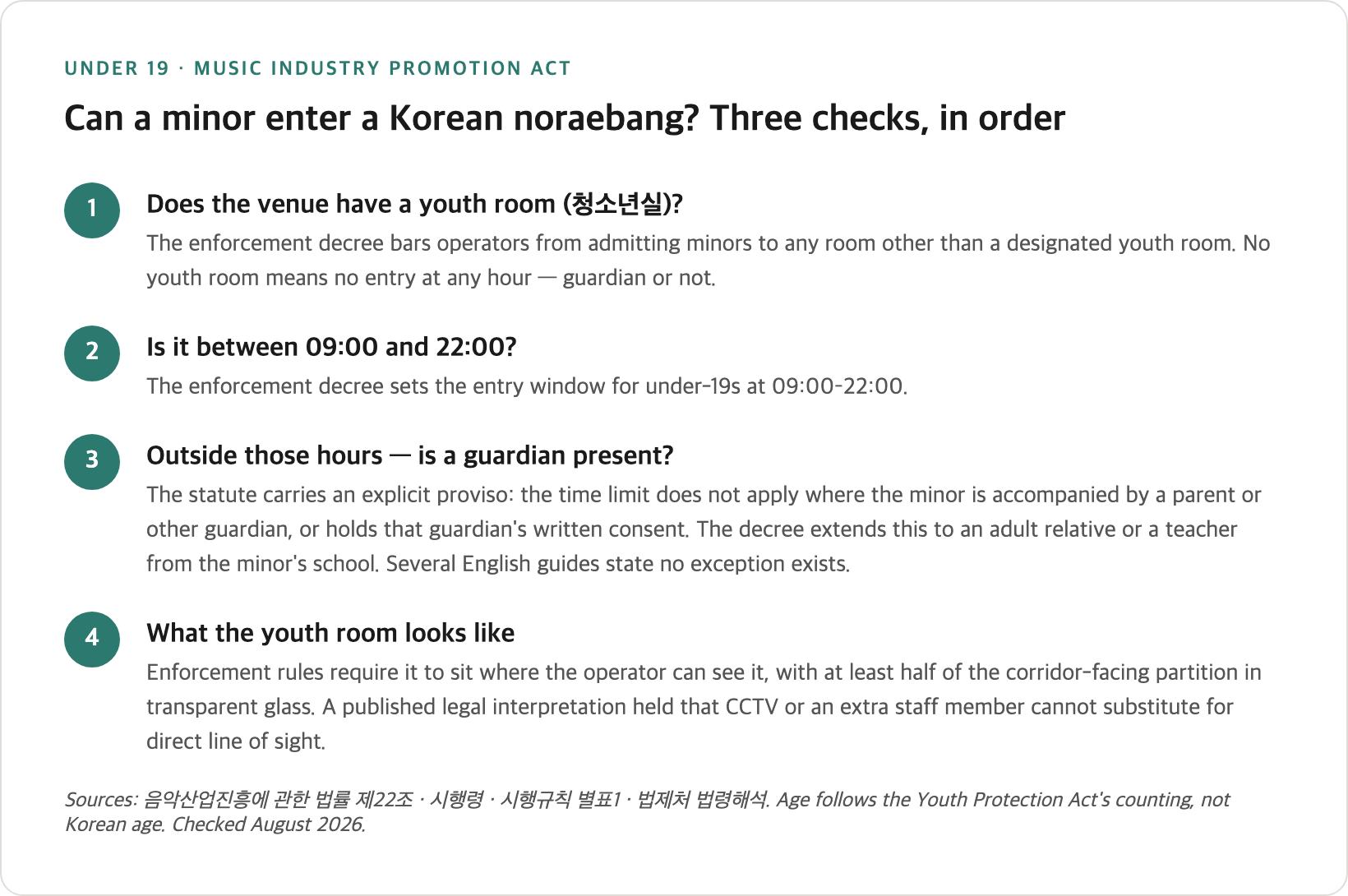
Three of the ten guides I read state a version of the same claim: minors under 19 cannot enter a noraebang after 22:00 even with a parent. One of them puts it exactly that way. The statute says otherwise, in its own text.
Article 22(1)(2) requires operators to keep minors out outside the entry hours set by decree — and the enforcement decree fixes those hours at 09:00 to 22:00. But the same clause carries an explicit proviso: the restriction does not apply where the minor is accompanied by a parent or other guardian, or carries that guardian’s written consent. The decree extends the exception to an adult relative, a teacher from the minor’s school, or a person in an equivalent supervisory position.
So the curfew has a written exception. It is the second rule that English guides miss entirely, and it is the one that will actually shape your evening.
A noraebang is classified under the Youth Protection Act as an establishment minors may not enter. The workaround built into the law is the 청소년실 (youth room) — a designated room that a venue may install, into which minors may be admitted. The enforcement decree’s operator obligations state that minors must not be admitted to any room other than the youth room. So:
- A venue without a youth room cannot admit anyone under 19 at any hour, guardian or not.
- A venue with one may admit them, but only into that room.
And the youth room has a physical specification most visitors would not guess. Under the enforcement rules, it must be sited where the operator can see it clearly, and at least half of the partition facing the corridor must be transparent glass. The Ministry of Government Legislation has interpreted this strictly: in a published opinion, it held that installing CCTV in a spot the operator cannot see directly, or posting an extra staff member there, does not satisfy the requirement. A separate 2015 interpretation confirmed that having a youth room does not remove a noraebang from the minors-prohibited category — it only creates a narrow, supervised exception inside it.
The practical version: a 17-year-old in your group will be put in a glass-walled room in the operator’s line of sight, or turned away. Neither outcome is in any English guide I found.
One more thing that trips families up — “under 19” here follows the Youth Protection Act’s counting, the same one behind the drinking age, and it is not the same arithmetic as Korean age. Bring passports. Staff at staffed venues do check.
Paying at an Unmanned Booth
English guides list the payment options as cash, card, T-money, Kakao Pay QR, and Toss. For a short-term visitor, two of those are usually unavailable, and no guide I read says so.
Kakao Pay and Toss are regulated financial services, and both verify that the mobile number you register is held in your own name with a Korean carrier. Toss states in its own help documentation that identity verification through a self-owned mobile line has been mandatory since October 2023. A prepaid tourist SIM bought at the airport is frequently not registered in your name in the carrier’s records, which is where verification fails. This is the same wall described in the eSIM and SIM comparison and in why some Korean apps reject foreign cards.
That leaves cash and, at newer venues, a card reader. Coin booths take ₩1,000 notes and ₩500 coins; many bill acceptors will not take ₩10,000 notes, and there is nobody on site to break one. Withdraw before you go — which ATMs take foreign cards covers the machines that work — or break a note at a convenience store on the way, which is the faster fix and gives you a drink to take in. The unstaffed self-photo booths that sit in the same nightlife blocks work the same way: ₩1,000 notes, no one on site, and no brand that will commit in writing to whether a foreign-issued card goes through.
What You Need to Know
- The licence, not the sign, decides what the room can serve. 노래방 on a sign tells you nothing about the licence behind it. A room that brings you a bottle is not a 노래연습장.
- A booth alone is normal, not eccentric. Coin noraebang were built around single users, and singing solo at 15:00 on a Tuesday will not draw a second glance.
- Service time is a courtesy, not an entitlement. Ask if you like, but do not plan the evening around it, and do not expect it when the venue is busy.
- Microphone covers are free and worth taking. They sit in a box at the counter or by the booth entrance.
- The scoring function can be switched off. It is on the remote, and turning it off changes the mood of a group session considerably.
- Late-night is when the price and the crowd both peak. So does the wait for a booth. Check the last-train times before you settle in — the singing outlasts the subway easily.
Practical Tips
- Look up your song numbers before you leave the hotel. Use tjmedia.com or kysing.kr, search by title or artist, and note the number. Two minutes of work saves ten minutes of thumbing a tablet on the clock.
- Retype foreign artist names in Hangul if the search comes back empty. 아이유 rather than IU. The catalogues are indexed by the Korean rendering more often than the Latin one.
- Find the 한/영 button on the remote first. Everything English-language depends on it, and it is not labelled in English.
- Carry ₩1,000 notes and ₩500 coins for unmanned booths. Assume Kakao Pay and Toss will not work on a tourist SIM, and assume nothing on site can break a ₩10,000 note.
- Go before 18:00 if you want the cheap rate and an empty booth. Afternoon pricing at standard rooms is often half the evening rate, and service time is far more likely.
- If a very new release will not start, change venues rather than troubleshooting. It is the machine’s authorisation, not your search.
- Leave immediately if anyone offers to send company to your room. That is the brokering Article 22 criminalises, and the venue is not one you want to be billed by.
Frequently Asked Questions
How much does a noraebang cost in Korea?
Standard rooms run approximately ₩15,000–30,000 per hour (as of 2026), charged for the room rather than per person, so a group of six pays the same as a pair. Coin noraebang charge roughly ₩500 per song, with bundles bringing the unit price down — ₩1,000 for two to four songs is typical, and ₩3,000–5,000 buys about half an hour. Afternoon rates at standard venues are frequently half the late-evening rate, and prices in nightlife districts run above those in residential neighbourhoods.
Do noraebangs have English songs?
Yes. Both major systems carry substantial English, Japanese and Chinese catalogues alongside Korean. The obstacle is usually the interface rather than the library — the remote or tablet defaults to a Korean keyboard, and you need the 한/영 toggle to type Latin script. If a title still will not resolve, search by artist instead, and try the artist’s name written in Hangul.
Can you go to a noraebang alone in Korea?
Yes, and coin noraebang exist largely because of it. Booths are commonly built for one to three people, you pay by the song rather than renting a room, and solo users are the norm rather than an exception. Standard hourly venues will also let you in alone, but you pay the full room rate, which makes the coin format the sensible choice for one person.
Can you drink alcohol in a Korean noraebang?
Not one licensed as a 노래연습장. The Music Industry Promotion Act bars the operator from selling or providing alcohol, and “providing” covers giving it to you free. Venues that legally serve drinks with a singing room hold a different licence — 단란주점 or 유흥주점 under the Food Sanitation Act — and charge accordingly. Some English guides describe soju being delivered to noraebang rooms; that does not match what the Act permits the operator to do.
Can minors go to a noraebang in Korea?
Only in limited circumstances. Entry hours for under-19s are set by decree at 09:00 to 22:00, and the statute carries an explicit exception for a minor accompanied by a parent or guardian, or carrying that guardian’s written consent — several English guides state incorrectly that no such exception exists. Separately, minors may only use a designated youth room (청소년실), so a venue without one cannot admit them at any hour.
What is “service time” at a Korean noraebang?
서비스 (seobiseu) is free extra singing time added at the end of a paid session, commonly ten to thirty minutes at standard hourly venues. It is entirely at the operator’s discretion. It is most likely during quiet afternoon hours and least likely on a weekend night when rooms are turning over.
Why won’t the newest K-pop song play?
Machine catalogues depend on an authorisation the venue must renew monthly. Kumyoung’s operator documentation states that periodic monthly authentication is required and that unauthenticated new songs stop working after a set period; internet-connected machines update daily, while offline ones wait for a dealer. A venue behind on this will still list recent releases without being able to play them. Trying a newer or franchise-branded venue usually solves it.
What is the difference between a noraebang and a coin noraebang?
A noraebang rents you a private room by the hour with staff at a counter, microphones, a tambourine and usually free snacks. A coin noraebang charges per song or in short time blocks, uses smaller booths built for one to three singers, and is frequently unstaffed for part of the day. The legal category is the same for both — 노래연습장 — so the alcohol and age rules apply identically.
Related Questions
- K-pop Company Buildings in Seoul: What You Can Actually Enter
- How to Attend a K-pop Music Show in Korea: The Routes That Still Work
- Drinking Age in Korea: Who Can Legally Drink, and How It’s Counted
- Korea’s Year-End Music Festivals: Can You Actually Get In?
- Gocheok and KSPO Dome: Reading Korean Seat Maps and Getting Home After