KBO Postseason Tickets for Foreigners — NOL and the Box-Office Route
Last Updated on October 14, 2026
Quick Answer
KBO postseason tickets sell exclusively through NOL Ticket, up to four per person online. For the 2026 wild card round, KBO also let foreigners with a passport, fans aged 65 and over, and people with disabilities buy one ticket at the stadium box office on game day. Returned tickets go on sale at the venue two hours before the game. Check each round’s notice, because later rounds’ rules weren’t confirmed.
The Full Answer
The postseason format itself — wild card, semi-playoff, playoff, Korean Series — is already well covered in English. en.namu.wiki’s KBO postseason page lays out the round-by-round win conditions accurately, and KBO’s own official English procedures page (eng.koreabaseball.com) confirms the same structure. There’s no gap to fill there, so this article covers it in a couple of paragraphs below and links out for anyone who wants the full breakdown.
What the English pages I opened leave out is the ticketing layer. Postseason tickets are not bought the way regular-season tickets are, and the workarounds English guides recommend for the regular season stop applying once the postseason begins. Just as important, the fix for fans who can’t use the online system is now written into KBO’s 2026 sales rules: a passport-based box-office purchase on game day. If you’re new to KBO altogether, our guide to going to a KBO game covers the regular-season basics this article assumes.
I could not locate KBO’s own Korean-language notice for the 2026 postseason tickets — its ticketing page lists only regular-season vendors for the ten clubs. The box-office rule below therefore rests on Korean news reports of the announcement that matched each other: Etoday, Topstar News and Gukje News. All three describe the wild card round. KBO announced the rest of the postseason calendar on October 7, and the dates in the next section come from reporting on that announcement.
Local tip — foreigners can buy at the box office on game day, and none of the English guides I opened say so. The Korean reports quote the rule directly: fans aged 65 and over, people with disabilities (registration card or welfare card) and foreigners (passport) may buy at the box office, one ticket per person, on the day of the game. Of five English-language pages I opened on this topic, including two HaniSeoul guides, none mentions it. The rule was reported for the 2026 wild card round, so confirm each later round’s notice before you count on it. The reports don’t say how many seats are set aside or whether a separate window handles these buyers, so don’t assume a seat is guaranteed.
The 2026 Postseason at a Glance
The regular season ended on October 12, not October 7 — October 7 was the day KBO announced the postseason schedule. The reports I read don’t explain why the final day landed on the 12th. A league-wide “heat wave break” had shut the schedule down from August 5 to 9, and the back half of the season ran late, but I haven’t seen a source tying the October 12 finish to it. Final standings: 1 KT Wiz, 2 Samsung Lions, 3 KIA Tigers, 4 LG Twins, 5 Doosan Bears. KIA beat LG in Gwangju on the final day to take 3rd place.
| Round | Start | Where (as announced) |
|---|---|---|
| Wild card (LG vs Doosan) | October 14, 6:30 PM; October 15 if a second game is needed | Jamsil, Seoul (LG’s home as the 4th seed) |
| Semi-playoff (best of 5) | October 17, 2:00 PM | Games 1–2 (Oct 17–18) in Gwangju; games 3–4 (Oct 20–21) at the wild card winner’s stadium; game 5 (Oct 23) in Gwangju |
| Playoff (best of 5) | October 25 | Games 1–2 (Oct 25–26) in Daegu; games 3–4 (Oct 28–29) at the semi-playoff winner’s stadium; game 5 (Oct 31) in Daegu |
| Korean Series (best of 7) | November 2 | Opens in Suwon (KT Wiz, the regular-season winner); games 1, 2, 6 and 7 are there, and the latest possible finish is November 10 |
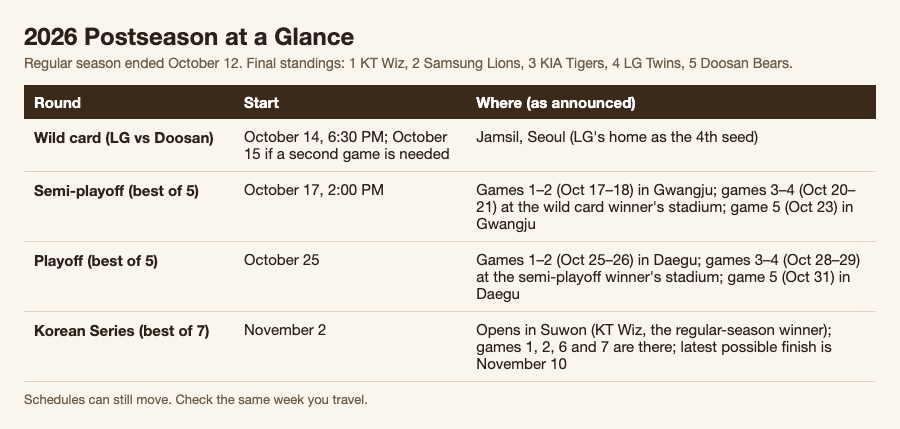
Schedules can still move. Check the same week you travel.
How the Playoff Format Works, Briefly
Four teams below first place fight for three remaining spots. The 4th- and 5th-place teams meet first in a wild card round of up to two games, where 4th place only needs one win (or even a tie) to advance, while 5th place has to win both games. The wild card winner then plays 3rd place in the semi-playoff, the winner of that plays 2nd place in the playoff, and the winner of that faces 1st place in the Korean Series — a best-of-seven that has used a 2-3-2 home-field format (games 1, 2, 6, and 7 at the top seed’s home stadium) since 2025. At every round, the home stadium belongs to whichever remaining team finished higher in the regular season.
One practical consequence: the venue for the middle games of each series isn’t fixed until the previous round ends. In the 2025 postseason, roughly two days separated the end of the wild card round and the start of the semi-playoff — a short enough gap that anyone building a trip around watching a specific round needs to treat the location of games 3 and 4 as provisional. That two-day figure comes from a single year’s schedule rather than a published standard interval, so treat it as a rough guide. Because the higher remaining seed always hosts first, a series can shift from Seoul to a regional city on short notice — worth knowing if your trip depends on Korea’s wider transit system or booking a KTX ticket on short notice between cities.
One Seoul-specific note: Gocheok Sky Dome (고척스카이돔), home of the Kiwoom Heroes, is Seoul’s only fully enclosed stadium and also one of the city’s main K-pop concert venues. Kiwoom finished outside the top five, so Gocheok hosts no postseason games this year.
Postseason Tickets Are a Different System, Not Just a Different Price
During the regular season, each of the ten teams sells its own tickets, split across a handful of separate platforms depending on the club — and KT Wiz’s Wizzap app, which takes foreign cards and an email sign-up with no Korean phone number required, is the one channel English guides consistently point foreign fans toward. None of that carries over once a team reaches the postseason.
Postseason games are organized by the KBO itself rather than by individual clubs. The Korean reports name NOL (Yanolja) as the exclusive seller, through its ticket website, its app and its customer center, with a limit of four tickets per person. According to en.namu.wiki’s postseason section, which I checked directly on August 11, 2026, prices run roughly two to three times regular-season prices, and the pre-sale privileges paid club members get during the regular season don’t carry into the postseason either. I haven’t re-checked the multiple against 2026 price lists. Team-run box offices and team-specific apps aren’t part of the online process; the league runs the sale, not the club whose stadium is hosting the game.
That matters directly for the Wizzap workaround. Once a KT Wiz home game becomes a postseason game, it’s NOL Ticket handling the sale, not KT’s own app — so the one online path that regularly gets recommended to foreign fans no longer applies. HaniSeoul’s ticket guide for foreigners, one of the higher-ranking English pages on this topic, now carries a general caution that postseason sales methods differ and that regular-season on-site tips shouldn’t be relied on. That caution is accurate. What the page doesn’t carry is the specific 2026 rule — the passport route at the box office.
For the wild card round, the Korean reports put the on-sale times at 2:00 PM on October 13 for game 1 and 3:00 PM the same day for game 2. For the 2025 Korean Series, Korean news reporting from October 2025 put ticket sales opening at 11:00 AM for Game 1, with subsequent games’ windows opening roughly an hour apart. I found no on-sale times for the semi-playoff and later rounds, and one reporting source says each round is announced separately, so treat the wild card times as an example rather than a pattern.
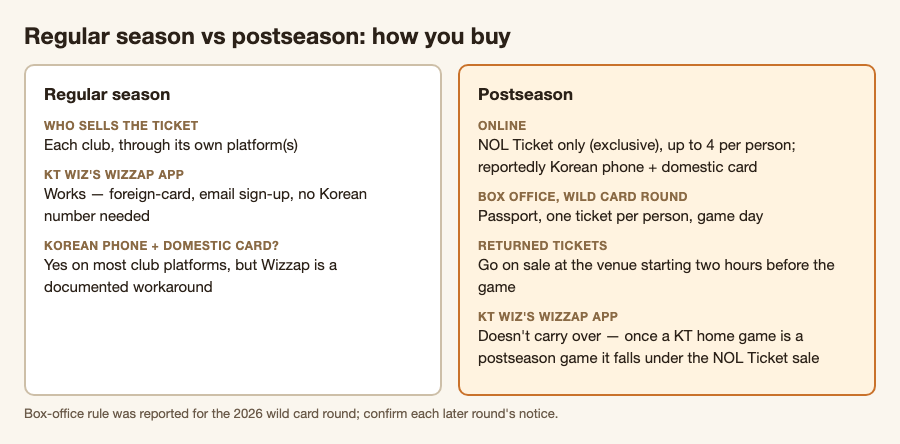
| Regular season | Postseason | |
|---|---|---|
| Who sells the ticket | Each club, through its own platform(s) — see our team-by-team breakdown of buying KBO tickets as a foreigner | KBO centralizes the sale, exclusively through NOL Ticket (up to 4 per person) |
| KT Wiz’s Wizzap app | Works — foreign-card, email sign-up, no Korean number needed | Doesn’t carry over — once a KT home game is a postseason game it falls under the NOL Ticket sale |
| Typical price | Standard season pricing | Roughly 2–3x regular-season prices (en.namu.wiki) |
| Sales window | Open on an ongoing basis through the season | Opens per round, close to game dates |
| Korean phone + domestic card? | Yes on most club platforms, but Wizzap is a documented workaround | Online: reportedly yes (see below). Box office, wild card round: passport, one ticket per person, game day |
Online Needs a Korean Phone and Card — the Box Office Is the Foreign Route
The online barrier is the registration requirement NOL Ticket shares with essentially every domestic Korean ticketing site, and it isn’t specific to the postseason.
A former KBO club general manager, Ryu Sun-kyu, wrote in a September 2025 opinion column that overseas-based foreign fans could not pre-book postseason tickets online, because registration requires both a Korean mobile phone number and a domestically issued payment card. Foreign fans were one of three groups he treated together — the others were older fans and fans with disabilities — as people an all-online system leaves out. He was arguing, as a former club executive, that the postseason needs an official walk-up allocation.
That is the same set of groups the 2026 box-office rule names: 65 and over, disabled, foreign. I can’t show that the column caused the rule, and I haven’t re-verified the phone-and-card requirement for 2026, so the first point is only an observation. His column also noted that limited walk-up sales already existed in Korean baseball: some clubs had begun setting aside roughly one percent of seats for on-site sale at regular-season games, and the KBO itself put 200 walk-up seats on sale at the All-Star Game for exactly these groups. In 2025, no such channel had been established for postseason games. For 2026 one has been announced, at least for the wild card round.
Wizzap not working for postseason tickets means a KT Wiz fan needs a different plan. The phone-and-card requirement means anyone trying to book online from outside Korea, regardless of team, is shut out of NOL’s online sale. The box-office route is the way around it, and it requires being in Korea on game day with your passport. If you’re already in Korea on a long enough stay to have a Korean number and a Korean-issued card — through a local eSIM or SIM setup and the right kind of account — the online route may work for you too.
Local tip — the barrier is the ID verification underneath the app, and the 2026 answer is at the box office, not in another app. English coverage does name the Korean phone-verification problem — HaniSeoul names it for Interpark and Ticketlink — but answers it with an app recommendation, as if switching platforms solves it. A former club general manager’s September 2025 column states plainly that the deeper issue is registration itself. The 2026 wild card notice answers it with a passport and a trip to the ticket window on game day. Treat that as a wild card fact until you see the notice for your round.
What About Rain Delays?
Korea’s postseason runs through its wettest stretch of autumn weather, and 2025 gave a clear example of what a rainout does to the calendar. OSEN reported that rain canceled two games on October 3, 2025 — in Gwangju and Changwon — on what was supposed to be the final day of the regular season. These were regular-season games, not postseason ones, and the Changwon game was still deciding the fifth and last postseason place. The knock-on was that the wild card round’s opening game moved back a full day, from October 5 to October 6, and every later round moved with it: the semi-playoff to October 9, the playoff to October 17, and the Korean Series to October 25. The article’s own framing treats this as a one-off complication for that particular year (“얄궂은 가을비” — “an unlucky autumn rain”).
The 2026 rules are different from regular-season play. According to Korean reports of the October 7 announcement, the 2026 postseason applies no “no-game” ruling and no rain-called game; only the suspended-game rule applies. A game that can’t start because of rain is moved to the next day. If a suspended game is completed, only that game is played that day and the games already scheduled are pushed back a day. So a rainout doesn’t end a game early on a technicality, and it can slide the series, and your ticket’s date, by a day or more.
Historically, en.namu.wiki’s postseason page states that once the KBO sets a postseason schedule it has run almost exactly as published, with only a handful of rain-related pushes across the league’s history. So treat a published postseason date as reliable but not guaranteed, and check for updates the same week you travel. Before you buy, check NOL Ticket’s refund and rescheduling terms for rain, which I haven’t verified.
If You Can’t Get a Ticket, You Can Still Watch
Not securing a seat doesn’t mean not being able to watch a KBO postseason game while you’re in Korea. Bars and pojangmacha (포장마차) that show baseball are a normal part of the culture around the sport, particularly during a Korean Series run, and that’s a lower-effort option if the box office has nothing left or you can’t be there on game day. If you want a sense of what that kind of night out looks like — ordering, seating norms, what to expect — this site’s guide to pojangmacha covers the practical side of it.
What You Need to Know
- The 2026 postseason is scheduled. The regular season ended on October 12; the wild card round opened October 14 at 6:30 PM in Jamsil, the semi-playoff starts October 17 in Gwangju, the playoff October 25 in Daegu, and the Korean Series November 2 in Suwon, with a latest possible finish of November 10.
- Postseason tickets sell only through NOL Ticket online, up to four per person — not through the team-run channels or apps, including KT Wiz’s Wizzap, that work during the regular season.
- Foreigners with a passport can buy one ticket at the box office on game day, per the wild card round notice as reported in Korean media. Later rounds’ rules weren’t confirmed.
- Returned tickets go on sale at the venue starting two hours before the game.
- Postseason tickets run roughly two to three times regular-season prices. For how that fits into a broader trip budget, see this site’s breakdown of what a week in Korea costs.
- Online registration reportedly needs a Korean phone number and a domestic payment card, per a former club general manager’s 2025 column.
- Host stadiums for games 3 and 4 of each series depend on who advances. Games 1 and 2 are at the higher seed’s home.
- No-game and rain-called rulings don’t apply in the 2026 postseason. Only the suspended-game rule does; rained-out games move to the next day.
Practical Tips
-
If you’re in Korea and can’t use NOL online, plan the box-office route. Bring your passport, go on the day of the game, and expect to buy one ticket per person. That rule was reported for the wild card round, so look up the notice for the round you want first.
-
Don’t plan around a specific box-office quantity. The reports don’t say how many seats are set aside or whether these buyers use a separate window. Arrive early and keep a backup plan, such as a bar that shows the game.
-
If you already have a Korean phone number and a domestically issued card, register a NOL Ticket account before your team clinches a spot. Sales windows for postseason games open close to game day, not weeks in advance, so having the account ready removes one step under time pressure.
-
Don’t assume a regular-season workaround like Wizzap carries into the postseason. Once a game is a postseason game, it’s sold through NOL Ticket regardless of which team is hosting.
-
Check the stadium, not just the round. Games 3 and 4 of the semi-playoff and playoff are held at the stadium of the team that advanced from the previous round, as listed in the table above. If the series is in Seoul, Jamsil is on the subway network, so you don’t need a car. Our guide to Jamsil’s final season covers the stadium’s situation. Jamsil hosts the wild card round, and if LG advance, semi-playoff games 3 and 4 on October 20–21 are scheduled there as well.
-
If your trip runs into November, the season isn’t necessarily over. The Korean Series opens November 2 in Suwon, and a seventh game would be played there on November 10.
-
Bring both a foreign card and cash to the box office. I could not confirm which payment methods the postseason box office accepts. Domestic card requirements show up more than once in this system — see this site’s guides to cash versus card in Korea and using Korean ATMs as a foreigner if a vendor won’t take a foreign-issued card.
Frequently Asked Questions
When does the KBO postseason start in 2026?
The wild card round started October 14, 2026 at 6:30 PM at Jamsil, with a second game on October 15 if needed. The semi-playoff starts October 17 at 2:00 PM in Gwangju, the playoff October 25 in Daegu and the Korean Series November 2 in Suwon, according to Korean reports of KBO’s October 7 announcement. The regular season ended October 12. Check KBO’s official site the week you travel.
Which teams made the 2026 KBO postseason?
KT Wiz finished first, followed by Samsung Lions, KIA Tigers, LG Twins and Doosan Bears. LG and Doosan meet in the wild card round, the winner plays KIA in the semi-playoff, that winner plays Samsung in the playoff, and the survivor faces KT Wiz in the Korean Series.
Can foreigners buy KBO postseason tickets?
Yes, in two ways. Online through NOL Ticket, which reportedly needs a Korean mobile number and a domestically issued payment card, and at the stadium box office on game day with a passport, one ticket per person. The box-office rule was reported for the 2026 wild card round, so check each later round’s notice. The reports don’t say how many seats are available or whether a separate window handles these buyers.
Does KT Wiz’s Wizzap app work for postseason tickets?
Plan on no. Wizzap is a team-run channel for KT Wiz regular-season home games, and postseason sales are centralized by the KBO through NOL Ticket regardless of which team hosts — so a KT home game in the postseason falls outside what Wizzap sells. KT has not published a postseason notice spelling this out, so treat this as a conclusion drawn from the league-level sales rule rather than a statement from the club.
How much more expensive are postseason tickets than regular-season tickets?
Roughly two to three times regular-season prices, according to en.namu.wiki’s postseason ticketing information, checked directly for this article. I haven’t compared that multiple against 2026 price lists.
Where will the 2026 Korean Series be held?
It opens November 2 in Suwon, KT Wiz’s home. KT Wiz finished first, so games 1, 2, 6 and 7 are in Suwon, and November 10 is the latest possible final day. The venue for games 3 to 5 depends on which team wins the playoff.
What happens if a KBO postseason game is rained out?
In the 2026 postseason, no-game and rain-called rulings don’t apply; only the suspended-game rule does. A game that can’t be played because of rain moves to the next day, and the rest of the schedule can slide. In 2025, rain on the regular season’s final day pushed the wild card opener from October 5 to October 6 and shifted every later round with it. Historically, en.namu.wiki notes that KBO postseason schedules have run almost exactly as published.
Can I buy postseason tickets at the stadium if online sales don’t work for me?
Yes, if you are a foreigner with a passport, at least for the 2026 wild card round: the box office sells one ticket per person on the day of the game, per Korean reports of KBO’s announcement. Returned tickets also go on sale at the venue starting two hours before the game. The reports don’t give the number of seats, so don’t count on a specific allocation, and check the notice for later rounds.
Related Questions
- Korea eSIM and SIM Card Guide: Why a Korean Number Matters Beyond Data
- Cash or Card in Korea: Where Foreign Cards Actually Stop Working
- Korean Drinking Culture: What to Expect at a Bar or Pojangmacha
Featured image: Photo by lovelyheewon on Pixabay