Bulguksa and Seokguram in 2026: What’s Actually Free, and What Isn’t
Updated for August 2026
Quick Answer
Bulguksa (불국사) and Seokguram Grotto (석굴암) have both been free to enter since May 4, 2023, under an amended Cultural Heritage Protection Act. Two English-language guides published in late 2025 still list a fee, and one of them claims the free period was temporary and paid entry has since been reinstated — it hasn’t. What still costs money at both sites is parking: approximately 2,000 KRW for cars, 4,000 KRW for buses (as of 2026).
The Full Answer
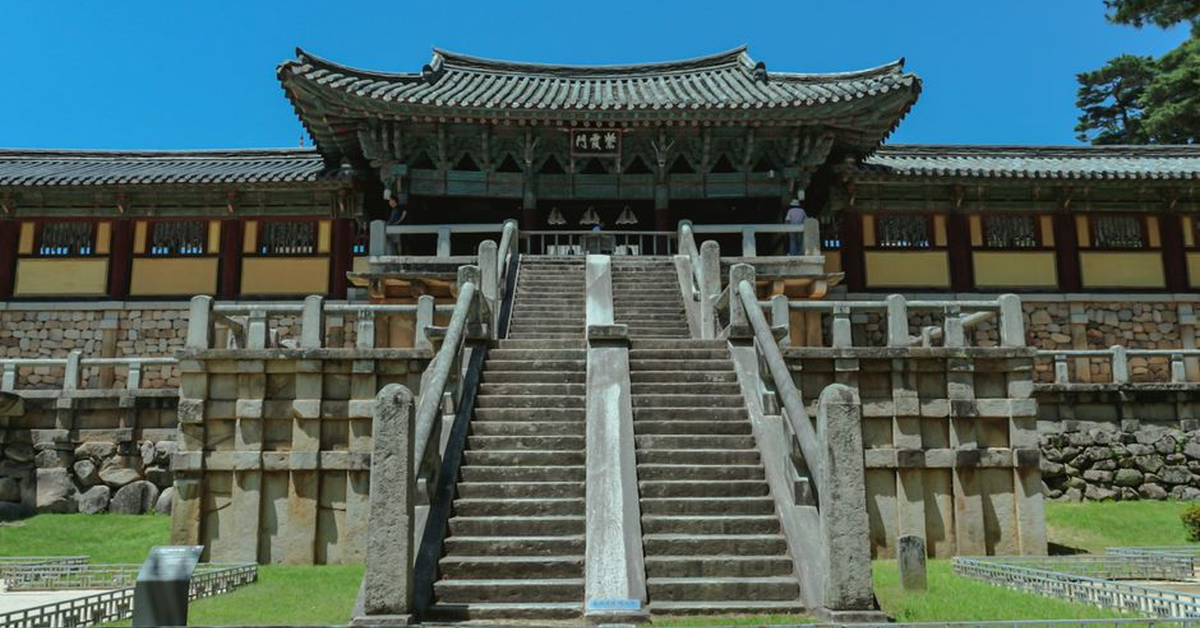
Bulguksa and Seokguram sit on the slopes of Mt. Tohamsan (토함산) outside Gyeongju (경주), and together they’re the reason most people add this city to a Korea itinerary at all. Both were inscribed as a single UNESCO World Heritage site in December 1995. Bulguksa is the temple complex most people picture — stone terraces, wooden halls, courtyards built up the hillside. Seokguram, about 20 minutes further up the mountain, is a different kind of site entirely: an artificial stone grotto shrine, built around a single seated Buddha figure that visitors see only through a glass wall.
The surface facts are already well covered in English — the UNESCO listing, the general layout, the fact that these two sites are usually visited together. What isn’t covered as well is what changed underneath in the last three years: a 2023 law that made both sites free, a fee table several English guides never updated, a seasonal closing schedule that most sources flatten into one number, and a direct bus route from Gyeongju’s KTX station that didn’t exist before 2023.
I read both temples’ own fee pages — bulguksa.or.kr and seokguram.org — directly in August 2026, along with the 2023 government notice announcing the fee waiver and Gyeongju city’s 2023 press release on the new KTX-station bus route. I also worked through the English-language results that currently rank for the searches a visitor planning this trip would actually run. Several are accurate. Two are not, and both were published within the past year.
None of this is an argument against going. It’s the handful of places where these two sites don’t behave the way an English guide currently tells you they will.
Why Bulguksa and Seokguram Are Free in 2026 — and Why Two English Guides Still Say Otherwise
South Korea amended the Cultural Heritage Protection Act to let the government and local authorities cover admission costs at temples holding state-designated cultural heritage. The waiver took effect on May 4, 2023, and applies to 65 temples under the Jogye Order, Bulguksa and Seokguram among them. Five sites that hold only regional (not national) heritage designations were left out, since those fall under separate local funding.
Both temples’ own websites state the change plainly and identically: admission has been free since May 4, 2023, under the revised law. Neither page mentions any reversal.
Local tip — Two English-language guides published in late 2025 still list a 5,000 KRW entrance charge for Bulguksa. One goes further, telling readers that “some sources reported a brief free-admission period in 2023, but paid admission has since been reinstated.” Neither the Bulguksa nor the Seokguram official site backs that up. Both still state the fee waiver dating to May 2023, with no mention of any reinstated charge, and a 2023 news report on the policy names 65 temples nationwide, Bulguksa and Seokguram included. Read the Bulguksa fee page directly if you want to check it yourself before you go.
I also opened the 2023 news report naming all 65 temples covered by the waiver, rather than trusting a secondhand mention of it — Bulguksa and Seokguram both appear on that list, alongside better-known sites like Haeinsa and Tongdosa.
Not every dated Korean source gets this right, either. At least one undated Korean blog still quotes a 6,000 KRW admission price with no publication date attached — a reminder that “written in Korean” doesn’t automatically mean current. If a source doesn’t show when it was published, treat any price or hours listed on it as unverified.
What Still Costs Money: Parking at Both Sites
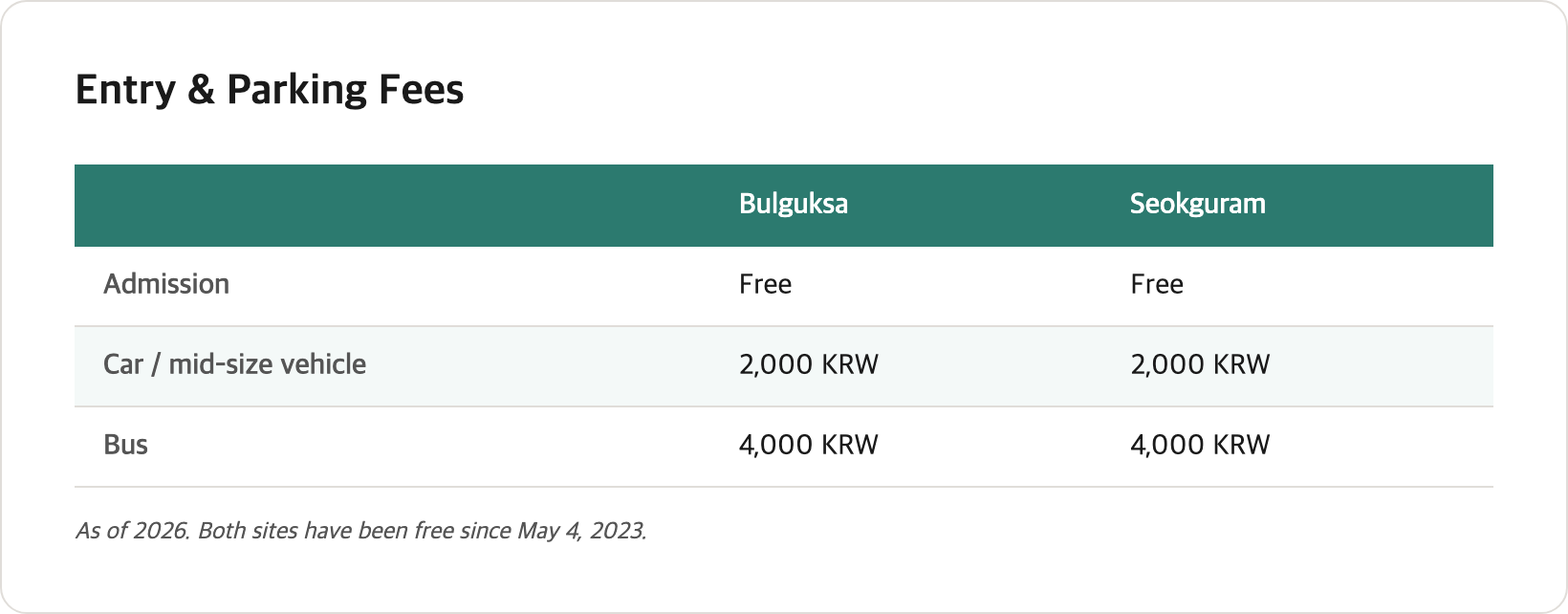
Free admission doesn’t mean a free visit. Both Bulguksa and Seokguram charge separately for parking, and the two fee tables — admission and parking — sit on the same official page, which is likely part of why some guides conflate “the site is free” with “everything here is free.”
| Bulguksa | Seokguram | |
|---|---|---|
| Admission | Free | Free |
| Car / mid-size vehicle | 2,000 KRW | 2,000 KRW |
| Bus | 4,000 KRW | 4,000 KRW |
These are the current official rates (as of 2026). One undated Korean blog lists older figures — 1,000 KRW for cars, 2,000 KRW for buses — which appear to predate a rate increase and shouldn’t be relied on for current planning.
If you’re arriving without a car, this section doesn’t apply to you at all — the shuttle bus and taxis don’t carry a parking charge. Bring cash or a card either way; parking booths at Korean heritage sites are inconsistent about which they accept, and a Korean ATM in central Gyeongju is the easier fix than hunting for one near the temple gate.
Free entry at these two sites also doesn’t generalise across the rest of Gyeongju — Yangdong Folk Village, another UNESCO-listed site in the same city, still charges for admission.
When the Gates Actually Close: Bulguksa and Seokguram’s Three-Season Schedule
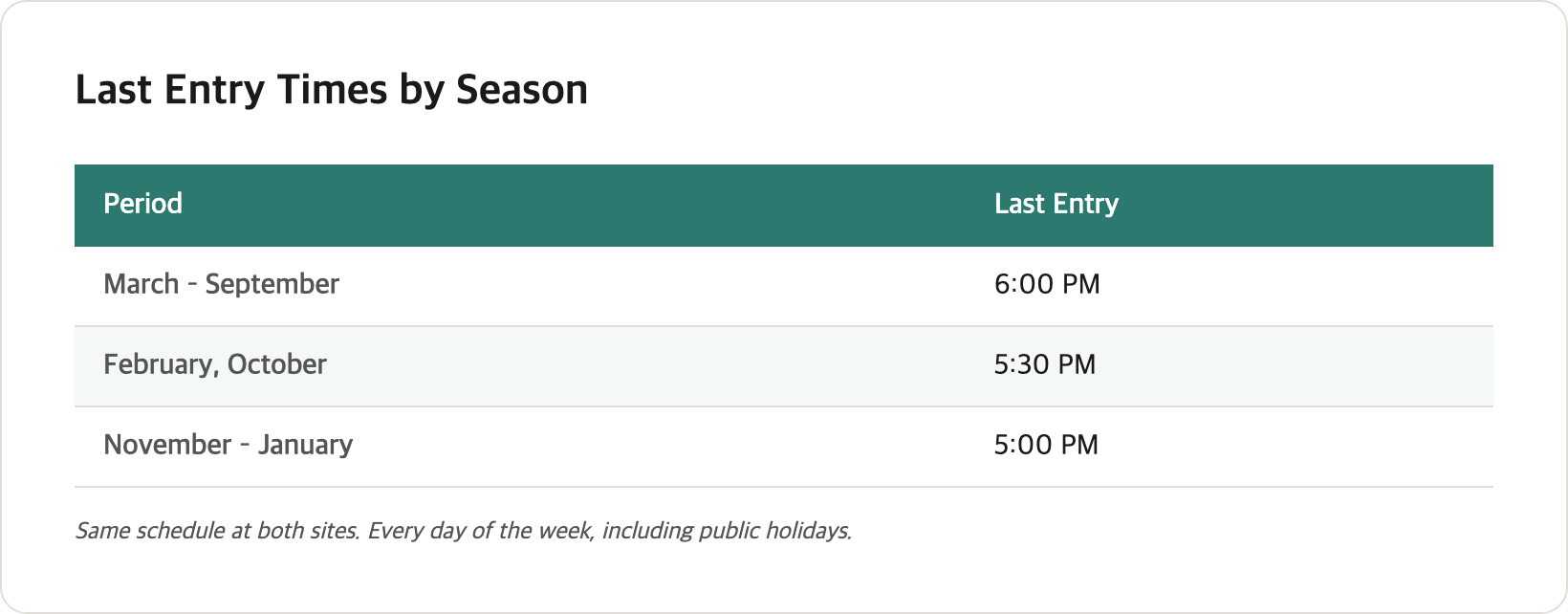
Both sites run on the same last-entry schedule, and it has three tiers rather than the single closing time most English write-ups give you.
| Period | Last entry |
|---|---|
| March – September | 6:00 PM |
| February, October | 5:30 PM |
| November – January | 5:00 PM |
The schedule is identical at both sites, applies every day of the week including public holidays, and neither site closes for the year at any point.
Local tip — Most English guides flatten these three tiers into two, and several get the opening time wrong on top of it. One Gyeongju-specific site states the temple “opens at 7am year-round,” closing at 6:00 PM from March through November and 5:30 PM from December through February. Another gives two seasons only — 07:00 to 18:00 for March through October, 08:00 to 17:30 for November through February. Both open the gates two hours earlier than they actually open, and both stretch the 6:00 PM closing months past where the official table ends it. Bulguksa’s own fee-and-hours page gives all three tiers, and the 9:00 AM opening, in a single table. Show up at 5:30 PM in December expecting the summer closing time, and the gate will already be shut.
If your day runs up against one of those cutoffs, Gyeongju’s night-open sites in the city centre — Wolji Pond, Cheomseongdae, and Daereungwon — keep their own evening hours and their own posted visiting rules.
Getting Between Bulguksa and Seokguram: Shuttle Bus, Hike, or Both
The two sites aren’t next to each other — Seokguram sits higher up Mt. Tohamsan, and the standard route from Bulguksa is a dedicated shuttle bus, seat bus route 12, that departs from the Bulguksa parking area (across from the local city bus stop) and takes approximately 20 minutes.
How often that bus actually runs is where English-language sources start to disagree, and not in a small way. One personal travel blog from 2026 describes it running “only once every hour” and mentions a 25-minute wait. A translated 2023 blog post says every 30 minutes. A Reddit thread and a late-2025 travel blog both say “every 30 to 40 minutes.” A Korean transit-tracking wiki page gives a more specific answer: 60-minute intervals on weekdays and 30-minute intervals on weekends, with the first departure from Bulguksa at 8:40 AM and the first from Seokguram at 9:00 AM, and a last departure that shifts by season.
That weekday/weekend split would explain why English accounts land on such different numbers depending on when the writer happened to visit — but it comes from a single wiki source, not an official transit table, so treat it as a plausible explanation rather than a confirmed schedule. What’s safe to plan around either way: budget for a wait of up to an hour, more on a weekday, and don’t assume the bus you see leaving is the last one of the day, since the final departure time changes with the season.
The alternative is walking. A hiking trail behind Bulguksa’s main parking area covers the same ground — approximately 3 km, with a walk time of roughly 1 to 1.5 hours over uneven, sloped terrain with stairs. It isn’t a route for anyone with mobility limitations, but it’s a reasonable substitute if the shuttle timing doesn’t line up with your plans.
At the Seokguram end, the bus drops passengers at a stop roughly a 3-minute walk from the ticket booth — that figure is consistent across the Korean sources that mention it. From the ticket booth to the viewing platform itself is a further walk, and sources disagree on exactly how long; budget extra time rather than assuming the ticket booth is the endpoint.
For getting to Gyeongju itself and around it more generally, the transport guide for Korea covers the basics, and a T-money card works on both the shuttle and Gyeongju’s city buses, so there’s no need to carry separate change. Naver Map or Kakao Map handle Korean bus routing far better than Google Maps does here, and having mobile data set up before you land makes checking a live bus schedule on-site much simpler than it sounds from a blog post written months earlier.
Arriving by KTX: Gyeongju Station, Still Labelled Singyeongju
If you’re coming to Gyeongju by KTX, you’ll arrive at Gyeongju Station (경주역) — the station most English guides, most maps, and Gyeongju’s own English tourism pages still call Singyeongju Station (신경주역). It sits about 12 km outside central Gyeongju. English guides routinely route you through a transfer to get from there to Bulguksa — a commuter train onward to a second, downtown “Gyeongju Station” first, or a local bus and then another. That advice is a step behind: there is only one Gyeongju Station now, and it is the one your KTX pulls into. According to Gyeongju city, route 700 was already running direct from the station before 2023, and there is now a second direct option.
Local tip — Since February 27, 2023, route 711 has run from this station to Bulguksa via Tongildong (통일전), ten times a day, with no train transfer in between. I read Gyeongju city’s own 2023 notice on the route launch directly rather than relying on a secondhand summary of it. The English guides that do cover 711 send you through a connection that can no longer be made: one lists its departure times accurately — 7:07, 8:08, 10:21 and so on — but first tells you to “take the connecting commuter train (Mugunghwa line) to Gyeongju Station proper,” and places 711’s departures there. That downtown station, in Seongdong-dong, closed at the end of December 2021 when the Donghae Line was rerouted around the city centre; the 1918 building reopened in December 2022 as a cultural venue, Gyeongju Culture Center 1918. Local Mugunghwa and ITX-Maeum trains do still stop in the city, at Seogyeongju Station — but there is no “Gyeongju Station proper” left to transfer into, because that name was given to the KTX station itself, renamed from Singyeongju in 2023 with signage and ticketing switched over that December. Tellingly, the 7:07 first departure that guide lists is exactly the time the city notice gives for 711 leaving Singyeongju. Part of why the mix-up survives is that Gyeongju’s own English tourism page still writes only “Seoul Station-Singyeongju Station” and never uses the current name at all. A companion route, 710, runs between the station and the Bomun tourist district over the same period. The city’s own figure for how much the combined frequency of the two new routes improved things — from roughly 90 minutes down to about 30 — describes both routes together rather than route 711 on its own, so treat “about every 30 minutes” as a combined estimate rather than a guaranteed wait for 711 specifically.
The naming problem isn’t confined to that one tourism page, either — the city’s own transport directory diverges from itself depending on which language you read it in.
Local tip — Gyeongju city’s transport page doesn’t say the same thing in Korean as it does in English, and I opened both language versions on August 31, 2026 to compare them line by line. The Korean page lists two train stations, gives 경주역 the address 경주시 건천읍 경주역로 80 — the KTX station you actually arrive at — and never uses the word 신경주 anywhere on it. The English page lists three, keeps “Gyeongju Station” and “Singyeongju Station” as separate entries, and gives “Gyeongju Station” the address 266 Wonhwa-ro (Seongdong-dong) — the downtown building that stopped taking trains in December 2021 and reopened as Gyeongju Culture Center 1918. That is a step beyond the outdated name on the tourism page above: an English-reading visitor who follows the address is being sent to a station where no train stops. The same pair of pages also gives Seogyeongju Station two different addresses — 현곡면 하구리 992-1 in Korean, 486-1 Geumjang-ri, Hyeongok-myeon in English. I have not established which of those two is current, so treat Seogyeongju’s address as something to check against the rail operator rather than against either city page.
Local city buses 10 and 11 also connect the station to Bulguksa, at around 40 minutes, and remain a fallback if 711’s timing doesn’t suit your arrival. If you’re booking the KTX leg of the trip, the KTX booking guide covers refund windows and seat classes, and if Gyeongju is one stop on a longer trip, the week-in-Korea cost breakdown is a useful way to see where a day like this sits in a broader budget.
Photography Rules Inside Seokguram Grotto
This is one area where English coverage already gets it right, so there’s no gap to fill — only a rule worth repeating because it catches people off guard on the day. Photography is not permitted inside the grotto, behind the glass wall that separates visitors from the seated Buddha figure. Korean and English sources agree on this without exception.
The one documented departure from the rule is on Buddha’s Birthday, when visitors who register in advance for the day’s prayer service may be allowed past the glass to pray directly in front of the statue. Whether photography is permitted during that session isn’t addressed in either temple’s public materials, so the safer assumption for anyone attending is that it still isn’t.
What You Need to Know
-
Admission is free at both sites, but parking isn’t. The two fee tables are on the same page — free entry, paid parking — and it’s easy to conflate the two if you only skim the total.
-
Last entry has three seasonal tiers, not one. 6:00 PM from March to September, 5:30 PM in February and October, 5:00 PM from November to January, every day of the week including holidays.
-
There is no combined Bulguksa-Seokguram ticket, because there’s nothing left to combine. Both sites are already individually free, so a paid bundle ticket doesn’t exist. Two of the English guides that still charge for admission also recommend buying a combination ticket for the pair — one calls it the “most straightforward option,” the other “solid value.”
-
The shuttle bus between the two sites doesn’t run on a single fixed interval. Published English figures range from every 30 minutes to hourly, and one Korean transit source attributes that spread to a weekday/weekend split — which isn’t confirmed against an official timetable. Budget for up to an hour, and don’t assume the last bus you see is later than it actually is.
-
Route 711 runs direct from Gyeongju’s KTX station to Bulguksa, ten times a day, and has since February 2023. The English guides that mention it send you onward by commuter train to a downtown “Gyeongju Station” first — a station that closed in December 2021. Singyeongju and Gyeongju Station are the same platform: the KTX station was renamed in 2023.
-
Photography inside Seokguram Grotto is not allowed, with no confirmed exception outside a Buddha’s Birthday prayer session that has its own separate registration process.
Practical Tips
-
Check the official fee page yourself before you go, especially if you’re working from a guide published before mid-2026 — the free-entry status is easy to get wrong secondhand, and the source takes seconds to check.
-
Bring small cash or a card for parking, not for admission. The two are billed separately, and parking booths aren’t always consistent about accepted payment.
-
Match your visit date to the correct closing tier, not a single number pulled from a guide written in a different season. December and July have last-entry times an hour apart.
-
Don’t count on the shuttle running every 30 minutes. Build in a buffer of up to an hour, and have the hiking trail in mind as a backup if the timing doesn’t work.
-
If you’re arriving by KTX, check when route 711 next leaves the station before you accept a guide’s commuter-train transfer into a downtown “Gyeongju Station.” That station closed in 2021, and Singyeongju was renamed Gyeongju Station in 2023 — 711 goes direct to Bulguksa from where you already are.
-
Set up mobile data before you land so you can check the live shuttle schedule and route options on-site rather than relying on a fixed number from a blog post.
-
Don’t plan to photograph inside Seokguram’s grotto. Photograph the exterior and the approach instead, and save the memory card space.
Frequently Asked Questions
Are Bulguksa Temple and Seokguram Grotto free to visit in 2026?
Yes. Both have been free since May 4, 2023, under an amended Cultural Heritage Protection Act covering 65 temples nationwide. Parking is charged separately — approximately 2,000 KRW for cars and 4,000 KRW for buses (as of 2026) — but there’s no admission fee at either site.
Is there a combined ticket for Bulguksa and Seokguram?
No, and there doesn’t need to be one. Both sites are individually free, so a bundled paid ticket isn’t part of the current system. Two English guides that still list an admission fee also advise buying a combination ticket at the entrance — a recommendation to buy something that isn’t sold. You don’t need to look for one, budget for one, or ask about one at the gate.
How do I get from Bulguksa to Seokguram Grotto?
The standard route is seat bus route 12, a dedicated shuttle that departs from Bulguksa’s main parking area and takes approximately 20 minutes to Seokguram. A hiking trail behind the parking area covers the same 3 km distance in roughly 1 to 1.5 hours for visitors who prefer to walk or want a backup if the bus timing doesn’t fit their schedule.
How often does the shuttle bus between Bulguksa and Seokguram actually run?
English-language accounts vary widely — anywhere from every 30 minutes to hourly — likely because the frequency differs by day of the week. One Korean transit-tracking source lists 60-minute intervals on weekdays and 30-minute intervals on weekends, though that figure comes from a single source and hasn’t been independently confirmed against an official transit table. Budget for a wait of up to an hour to be safe.
Can I hike from Bulguksa to Seokguram instead of taking the bus?
Yes. A trail behind Bulguksa’s parking area runs approximately 3 km to Seokguram, with a typical walk time of 1 to 1.5 hours over sloped, uneven terrain with stairs. It’s not suited to visitors with mobility limitations, but it’s a workable alternative to the shuttle.
Does Bulguksa’s closing time change by season?
Yes, in three tiers: last entry is 6:00 PM from March through September, 5:30 PM in February and October, and 5:00 PM from November through January. The same schedule applies at Seokguram, every day of the week including public holidays.
Can I take photos inside Seokguram Grotto?
No. Photography behind the glass wall enclosing the seated Buddha figure isn’t permitted, and Korean and English sources agree on this. The only documented exception is a registered prayer service held on Buddha’s Birthday, and even then it’s unclear whether photography is allowed during it.
What’s the fastest way to reach Bulguksa from Singyeongju KTX Station (now Gyeongju Station)?
Route 711, running since February 2023, goes direct from the station to Bulguksa via Tongildong, ten times a day. Watch the station names when you read English guides: several route you onward by commuter train to a downtown Gyeongju Station before catching 711 there. That station closed in December 2021, and Singyeongju was renamed Gyeongju Station in 2023, so the two names now mean one platform, and it is the one your KTX arrives at. Route 700 also runs direct from the same station, and local buses 10 and 11 are a working fallback at around 40 minutes.
Related Questions
- Gyeongbokgung Tickets in 2026: Free Days, Closures, and the Hanbok Rule
- National Museum of Korea: Free Entry, New 2026 Hours, and What to See First
- Booking KTX: Refund Windows and the Standing-Seat Trade-off