How to Buy Medicine in Korea — It’s 11 Items at the Convenience Store, Not 13
Last Updated on August 29, 2026
Quick Answer
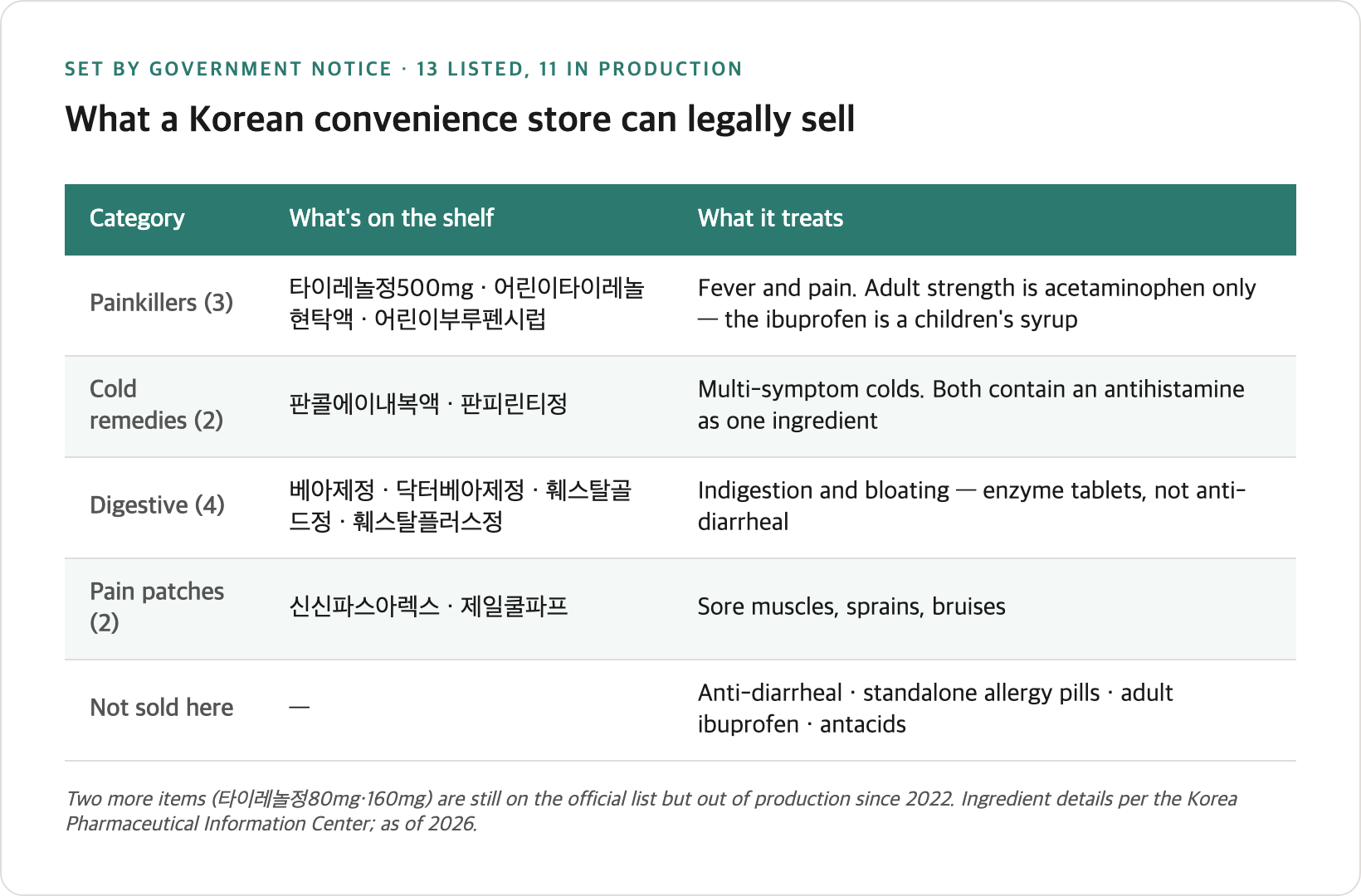
Convenience stores can legally sell 13 basic medicines, but two have been out of production since 2022, so in practice the count is 11: painkillers, two cold remedies, four digestive tablets, and two pain patches. There’s no anti-diarrheal medicine, allergy pill, or adult-strength ibuprofen on that list — for those, go to a pharmacy. Pharmacies close nights and Sundays more often than guides assume, so finding one that’s open matters as much as knowing what’s on the shelf.
The Full Answer
Korea runs a two-tier system for buying medicine, and almost every problem a traveler runs into comes from not knowing where the line sits. Tier one is the convenience store: a fixed, government-defined list of “safety-focused medicines” (안전상비의약품) that any registered 24-hour store can sell, no pharmacist required. Tier two is the pharmacy (약국): everything else, including most of what a traveler from the US, UK, or Australia would consider basic — allergy pills, adult ibuprofen, anti-diarrheal tablets — sits behind a pharmacist’s counter, not a convenience store register.
The list of what a convenience store can sell hasn’t changed in wording since it was set in 2012, so it’s easy to assume it’s fixed. It isn’t, exactly: two of the original 13 items stopped being manufactured in 2022, the Ministry of Health and Welfare is currently planning to expand the list to as many as 20 items by December 2026, and the ministry has tried this before and been blocked by pharmacist opposition. None of that shows up in the travel-guide version of this story. It shows up in Korean news coverage and in the law itself — which is where the rest of this article comes from.
Local tip — Not every convenience store can sell these items — only ones registered with the local district office as a 24-hour, no-holiday store. Article 44-2 of the Pharmaceutical Affairs Act (약사법 제44조의2②) makes round-the-clock operation a condition of registration, not a marketing choice. In practice this means the stores you can buy from are the ones running 24 hours; a store that closes at midnight legally cannot sell them.
It’s 11 PM and Your Stomach Doesn’t Feel Right — What’s Actually on the Shelf
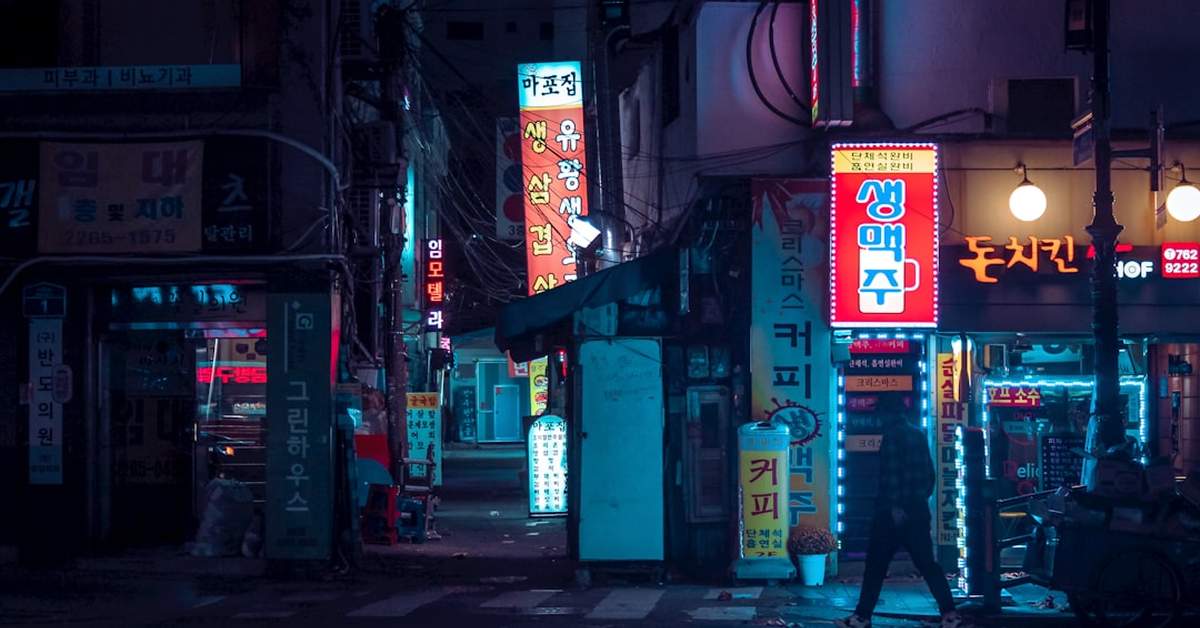
Say it’s late, the pharmacies near you are dark, and you have a headache, a cold coming on, or a stomach that feels off after a big dinner. This is exactly the situation the convenience store list was built for — small, single-purpose remedies you can grab without a pharmacist. Here’s the current list, with the Korean name you’ll see on the shelf so you’re not guessing at packaging you can’t read.
| Korean name | Romanized | What it’s for |
|---|---|---|
| 타이레놀정500mg | Tylenol-jeong 500mg | Acetaminophen 500mg tablet — fever and pain |
| 어린이타이레놀현탁액 | Eorini Tylenol Hyeontakaek | Children’s Tylenol liquid suspension — fever and pain |
| 어린이부루펜시럽 | Eorini Burupen Syrup | Children’s ibuprofen syrup — fever, pain, inflammation |
| 판콜에이내복액 | Pancol-A Naebogaek | Multi-symptom cold liquid — fever, cough, runny nose, sore throat |
| 판피린티정 | Panpyrin-T-jeong | Multi-symptom cold tablet — fever, cough, sore throat |
| 베아제정 | Beaje-jeong | Digestive enzyme tablet — indigestion, bloating, overeating |
| 닥터베아제정 | Dakteo Beaje-jeong | Digestive enzyme tablet — same use as Beaje-jeong, different formula |
| 훼스탈골드정 | Hwaeseutal Gold-jeong | Digestive enzyme tablet — indigestion, bloating |
| 훼스탈플러스정 | Hwaeseutal Peulleoseu-jeong | Digestive enzyme tablet — indigestion, bloating |
| 신신파스아렉스 | Sinsin Paseu Arekseu | Medicated pain-relief patch — sore shoulders, back pain, bruises |
| 제일쿨파프 | Jeil Kul Papeu | Cooling medicated patch — sprains, bruises, joint pain |
Two more items are still printed on the official government list but have been out of production since 2022: 어린이용타이레놀정80밀리그람 (children’s Tylenol 80mg tablet) and 타이레놀정160밀리그람 (Tylenol 160mg tablet — a low-dose adult tablet, not a children’s product despite often being used that way). Both were made by the same manufacturer, which moved production overseas and stopped supplying them — the government notice that defines the list was never formally updated to remove them, so it still says 13 even though the shelf says 11. Production stopping isn’t the same as every shelf clearing at once, so a store could in principle still have old stock of either; you just shouldn’t plan around finding it.
Local tip — The number you’ll see quoted for this list is 13, because 13 is what the government notice still says. I cross-checked three Korean news outlets — Money Today, the Hankook Ilbo, and the Korea JoongAng Daily, the last of which publishes in English — and all three independently report that only 11 are currently in production. The two out-of-production items are both low-dose Tylenol tablets, the 80mg and the 160mg, not the adult 500mg version. If a store doesn’t have either of those two, that’s why — it isn’t a stocking problem at that particular branch. The children’s Tylenol suspension and the children’s ibuprofen syrup are different products and are still made.
Korean convenience stores are already worth knowing beyond this list — our guide to how they actually work, including the seating and microwave rules covers the rest of what’s on the shelf. The medicine section runs on its own rulebook, separate from everything else in the store.
If what you actually need is a cold remedy and you don’t know the Korean word for it, 감기약 (gamgiyak) is the general term for cold medicine — asking a clerk “감기약 있어요?” (“Gamgiyak isseoyo?” — “Do you have cold medicine?”) will point you at Pancol-A or Panpyrin-T, the two options on the shelf.
What’s Not on the Shelf — And What to Ask for at a Pharmacy
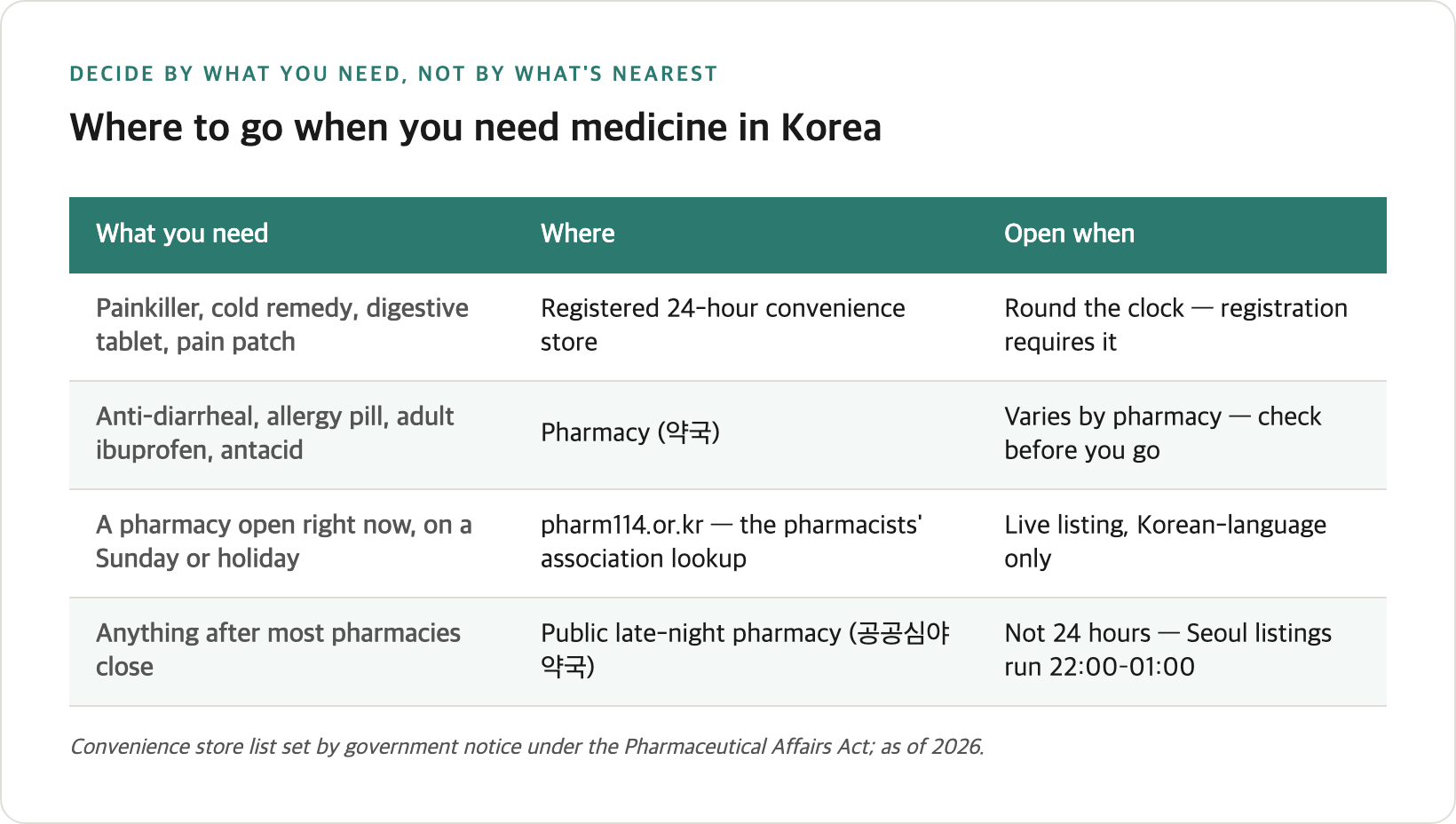
The convenience store list was built around a narrow idea of “safety-focused” self-care, and it leaves out several things a traveler is likely to want. There’s no anti-diarrheal medicine (지사제, jisaje) anywhere on the 11-item list — the four digestive tablets are enzyme complexes for indigestion and bloating, not something that treats diarrhea. There’s no standalone allergy pill. There’s no adult-strength ibuprofen — the only ibuprofen product on the list is the children’s syrup. And there’s no antacid or proton-pump-inhibitor-style heartburn medicine.
For any of these, the answer is the same: go to a pharmacy (약국, yakguk), not a bigger convenience store. A few phrases, built from the Korean terms above, are enough to get what you need without more vocabulary than that:
- 지사제 있어요? (Jisaje isseoyo?) — “Do you have anti-diarrheal medicine?”
- 알레르기약 있어요? (Allereugiyak isseoyo?) — “Do you have allergy medicine?”
- 소화제 있어요? (Sohwaje isseoyo?) — “Do you have digestive medicine?” — useful if the convenience store’s enzyme tablets aren’t strong enough and you want a pharmacist’s recommendation instead.
Local tip — “No allergy medicine at convenience stores” is the usual one-line summary, and as a statement about a standalone antihistamine, it’s accurate. It’s not the whole picture. I checked the ingredient listings for the two cold remedies on the shelf — Pancol-A and Panpyrin-T both list chlorpheniramine maleate, an antihistamine, as part of their multi-symptom formula (2.5mg per dose in Pancol-A, 2mg per tablet in Panpyrin-T, according to the Korea Pharmaceutical Information Center (약학정보원)). So a convenience store cold remedy will give you some antihistamine effect alongside the fever reducer — just not a standalone allergy tablet, and not a dose built for allergies specifically. This detail comes from Korean pharmaceutical reference pages rather than the government’s own drug database, which I wasn’t able to load directly during this research — treat the ingredient figures as a secondary source, not the regulator’s own filing.
Adult ibuprofen, antacids, and dedicated allergy pills are all ordinary pharmacy items — the gap is at the convenience store register, not in Korea generally.
It’s Sunday and Every Pharmacy Near You Looks Closed
When the pharmacy in front of you is dark, the useful question isn’t what the standard hours are — it’s which pharmacy near you is open right now. There’s an official tool built for exactly that question, and the fact that it exists is itself the most reliable thing anyone can tell you about Sunday and holiday coverage: if opening hours were uniform, nobody would need a nationwide “which pharmacy is open today” service.
The Korean pharmacists’ association runs that lookup at pharm114.or.kr (“휴일지킴이약국,” roughly “Holiday Guardian Pharmacy”), with a map and a district-by-district search for pharmacies open right now, plus a separate list of public late-night pharmacies. I opened the site directly on August 29, 2026, and scanned the page text for the word “English” — it returned zero matches. The page title, footer, and every visible label are in Korean only, and there’s no language toggle. It’s a genuinely useful tool that no English-language guide I found mentions; most instead suggest searching Google Maps for “English pharmacy,” which finds you an English speaker but not necessarily one that’s open. An eSIM or local data connection lets you run the site’s Korean text through a translation app’s camera mode even without reading Korean yourself.
Local tip — “Public late-night pharmacy” (공공심야약국) sounds like it means 24 hours, and it isn’t. The program is a national subsidy scheme running since 2022, not a city-by-city arrangement, but the hours are a fixed evening window rather than round-the-clock — Seoul’s public late-night pharmacies run roughly 22:00 to 01:00, not later. And the program doesn’t cover the whole country: as of 2026 it operates in 146 of Korea’s 226 districts, at around 240 individual pharmacies nationwide. Outside that window, or outside a covered district, this program won’t be the answer — pharm114.or.kr’s regular search is the better first stop.
Landing at Incheon and Feeling Unwell
Airports feel like they should run on their own clock, but Incheon’s pharmacies don’t operate 24 hours either. Based on the pharmacy listings I found for Terminal 1, none of the four pharmacies keep round-the-clock hours — they run somewhere between roughly 06:00–22:00 and 07:00–20:30 as of August 2026, depending on the specific counter and its location in the terminal. If you land late at night or on an early departure, don’t plan around being able to buy medicine airside; the safer assumption is that Incheon’s pharmacies keep something close to normal daytime hours, not airport-hours-are-different hours. (Terminal 2 has its own pharmacy as well, though its hours weren’t confirmed for this article — check on arrival rather than assuming it matches Terminal 1.)
If you’re heading into the city rather than staying near the airport, our guide to getting from Incheon Airport to Seoul covers the transport options — a 24-hour convenience store at your arrival point or in the city is a more reliable bet for something like a headache tablet than counting on an airport pharmacy being open.
The List Is About to Change — But Not Yet
As of August 2026, the Ministry of Health and Welfare has said it plans to expand the convenience store list from 11 items to as many as 20 in a revised notice targeted for December 2026, as part of its second-half policy plan for the year. The ministry’s stated reasoning is straightforward: the law that created this category has always allowed up to 20 items, and the actual list has been stuck at 13 (now 11) since 2012. Candidates reportedly under discussion include anti-diarrheal medicine, stomach-settling remedies, and artificial tears — items directly relevant to what this article says you currently can’t get at a convenience store.
This is a plan, not a done deal. The Korean pharmacists’ association opposes expanding the convenience-store list, citing oversight and misuse concerns — particularly acetaminophen overdose risk among teenagers — and a legally required three-year review of the list hasn’t actually convened since 2018 because of that opposition, which is a large part of why the list is still stuck at 11 items eight years later. If you’re reading this after December 2026, it’s worth checking whether the revision actually took effect before assuming the 11-item list in this article is still current.
Local tip — If the anti-diarrheal medicine gap in the section above is the reason you’re reading this, keep an eye on this expansion specifically — it’s one of the named candidates for the December 2026 list, not a random guess about what might get added. As of this writing, though, it isn’t approved yet, and the ministry itself has been careful to describe it as a plan under review rather than a finalized change.
If You Take a Regular Medication Korea Treats Differently
A few common medications sit on the opposite side of the counter from where travelers from the US, UK, or Canada expect. The daily birth control pill (Mercilon and similar brands) is an over-the-counter, general medication in Korea — no prescription needed. The morning-after pill, by contrast, is prescription-only here; a Korean pharmacy can’t sell it without a doctor’s prescription, which typically means a same-day visit to a clinic or hospital rather than a pharmacy counter. Melatonin runs the same direction — it’s a prescription drug in Korea, sold under brand names like Circadin for short-term insomnia treatment, not an over-the-counter supplement the way it is in US and UK pharmacies and supermarkets.
None of these gaps are things you can shop your way around at a convenience store or a regular pharmacy visit without paperwork. If you already take a prescription medication regularly and are planning to bring your own supply into Korea rather than source it here, our guide to bringing medication into Korea covers the customs side — quantity limits, which drugs need pre-approval, and how that’s a completely separate process from anything in this article.
What You Need to Know
- The legal cap on this whole category is 20 items, not 13. Article 44-2 of the Pharmaceutical Affairs Act sets a ceiling of 20 “safety-focused medicines” the ministry can designate by notice — and the notice itself has simply never been raised to that ceiling since it was first set in 2012.
- Buying limits apply per item, per visit. Under the enforcement rule attached to Article 44-4 of the Pharmaceutical Affairs Act, a store can sell only one package of a given item per purchase, and cannot sell any of these items to a child under 12 (including elementary school students). This applies at every registered store — it isn’t a shop-by-shop policy.
- Opened packaging can’t be sold. Selling an item that’s already been opened is against the same set of rules, so what you buy will always be sealed.
- Payment is a separate question from availability, and this article didn’t check it. How a foreign-issued card behaves in Korea depends on where you’re paying, which is its own topic — cash and card use in Korea and how Korean ATMs handle foreign cards cover that ground rather than this one.
- There’s no official “English-speaking pharmacy” certification program. A search for one during this research turned up nothing from the government or the Korean pharmacists’ association — what exists instead is an informal concentration of pharmacies with English-speaking staff near international hospitals (Asan, Samsung Seoul, Severance) and in expat-heavy neighborhoods like Itaewon and parts of Gangnam.
Practical Tips
-
Learn the Korean category words before you need them, not after. 감기약 (gamgiyak, cold medicine), 지사제 (jisaje, anti-diarrheal), and 소화제 (sohwaje, digestive medicine) cover most convenience-store and pharmacy requests on their own — pointing at a shelf works too, but knowing the word for what you don’t see saves a trip.
-
If a convenience store doesn’t have the 80mg or 160mg Tylenol tablet, that’s a supply issue, not a stocking gap at that one branch. Both have been out of production since 2022; don’t waste time checking a second or third store for those two. The children’s Tylenol suspension and the children’s ibuprofen syrup are separate products and are still on the list.
-
Bookmark pharm114.or.kr before you need it, not during an emergency. It’s entirely in Korean, but the map and district search still work with a translation app’s camera mode pointed at your screen, and it’s the same tool a Korean local would use.
-
Don’t count on “public late-night pharmacy” meaning all night. Where the program exists — 146 of Korea’s 226 districts as of 2026 — Seoul’s example runs roughly 22:00 to 01:00, not later. Check the specific pharmacy’s hours through pharm114.or.kr rather than assuming a fixed schedule.
-
If you’re flying through Incheon at an odd hour, don’t plan around an airport pharmacy being open. The Terminal 1 pharmacies checked for this article run daytime-to-evening hours, not around the clock — a 24-hour convenience store covers headache and cold basics better than waiting for the airport pharmacy to open.
-
Pack melatonin from home if you rely on it. It’s prescription-only in Korea, unlike the US or UK, so it’s the one common item on this list you genuinely can’t pick up at a pharmacy without a doctor’s visit — see our guide to bringing medication into Korea for the quantity rules on carrying your own supply.
-
If you’re out at night and it’s a hangover rather than a stomach bug, the same 11-item shelf covers both. Rounds culture in Korea means a late-night headache is common enough that convenience stores stock for it either way — the painkiller and digestive tablets on the list don’t care what caused the symptom.
Frequently Asked Questions
What medicine can I buy at a convenience store in Korea?
As of 2026, 11 of the 13 legally listed items are still in production: an adult acetaminophen tablet, a children’s acetaminophen suspension, a children’s ibuprofen syrup, two multi-symptom cold remedies (Pancol-A and Panpyrin-T), four digestive enzyme tablets, and two medicated pain patches. Two more items — the 80mg and 160mg low-dose Tylenol tablets — are still on the official list but haven’t been manufactured since 2022, so don’t plan around finding them.
Can I buy medicine for diarrhea at a convenience store in Korea?
No. None of the 11 currently available items treat diarrhea — the four “digestive” tablets on the list (Beaje-jeong, Dr. Beaje-jeong, and the two Hwaeseutal tablets) are enzyme complexes meant for indigestion, bloating, and overeating, not anti-diarrheal medicine. There’s no anti-diarrheal product anywhere on the government’s list, at any convenience store, regardless of chain. For anti-diarrheal medicine, you need a pharmacy; ask for 지사제 (jisaje, “Jisaje isseoyo?”).
Can I buy allergy medicine at a convenience store in Korea?
Not as a standalone product. There’s no dedicated antihistamine tablet on the convenience store list. Two of the cold remedies, Pancol-A and Panpyrin-T, do contain chlorpheniramine — an antihistamine — as part of a multi-symptom formula, according to their published ingredient listings, but neither is sold or dosed as an allergy medicine specifically. For a standalone allergy pill, go to a pharmacy and ask for 알레르기약 (allereugiyak).
How do I find a pharmacy that’s open right now in Korea?
The official tool run by the Korean pharmacists’ association, pharm114.or.kr, lists pharmacies currently open by district, including public late-night pharmacies where the program operates. The site is Korean-only with no English toggle. A translation app’s camera mode can bridge the language gap; Google Maps search for “pharmacy” nearby is a workable fallback but won’t confirm current opening status the way pharm114.or.kr’s live listing does.
What time do pharmacies open and close in Korea?
There isn’t one national timetable to quote, which is why the Korean pharmacists’ association runs a live lookup at pharm114.or.kr showing which pharmacies are open at that moment, including on Sundays and public holidays. Use that rather than assuming a standard schedule. Where a “public late-night pharmacy” program operates (146 of Korea’s 226 districts as of 2026), it typically covers a fixed evening window rather than being open all night; Seoul’s example runs roughly 22:00 to 01:00.
Can I buy melatonin in Korea?
Not over the counter. Melatonin is classified as a prescription drug in Korea, sold under brand names like Circadin (서카딘) for short-term insomnia treatment in adults 55 and older, unlike the over-the-counter supplement status it has in the US and UK. A Korean pharmacy legally can’t sell it without a doctor’s prescription, even in small quantities, so most travelers who rely on it bring their own supply rather than trying to buy it here.
Is the morning-after pill available over the counter in Korea?
No — it requires a doctor’s prescription in Korea, which typically means a same-day clinic or hospital visit before a pharmacy can dispense it, rather than a walk-in pharmacy purchase. This runs opposite to what many travelers expect: the regular daily birth control pill (Mercilon and similar brands) is available over the counter at any Korean pharmacy without a prescription, while the emergency version needs one.
Is there an English-speaking pharmacy in Seoul?
There’s no official government or pharmacist-association certification for “English-speaking” pharmacies in Korea — a search for one during this research found no such program. In practice, pharmacies with English-speaking staff tend to cluster near major international hospitals (Asan, Samsung Seoul, Severance) and in neighborhoods with larger expat populations, like Itaewon and parts of Gangnam, but that’s an informal pattern rather than a listed directory.
Related Questions
- Korean Age in 2026: The Law Unified It, but Three Systems Still Coexist
- Korean Hangover Cures: What Actually Works (and What’s Just a Drink)
- How Much Does a Week in Korea Cost? A Real Breakdown by Category