Seoul Subway Accessibility: Platform Gaps, Ramps, and the Right Door
Last Updated on September 16, 2026
Quick Answer
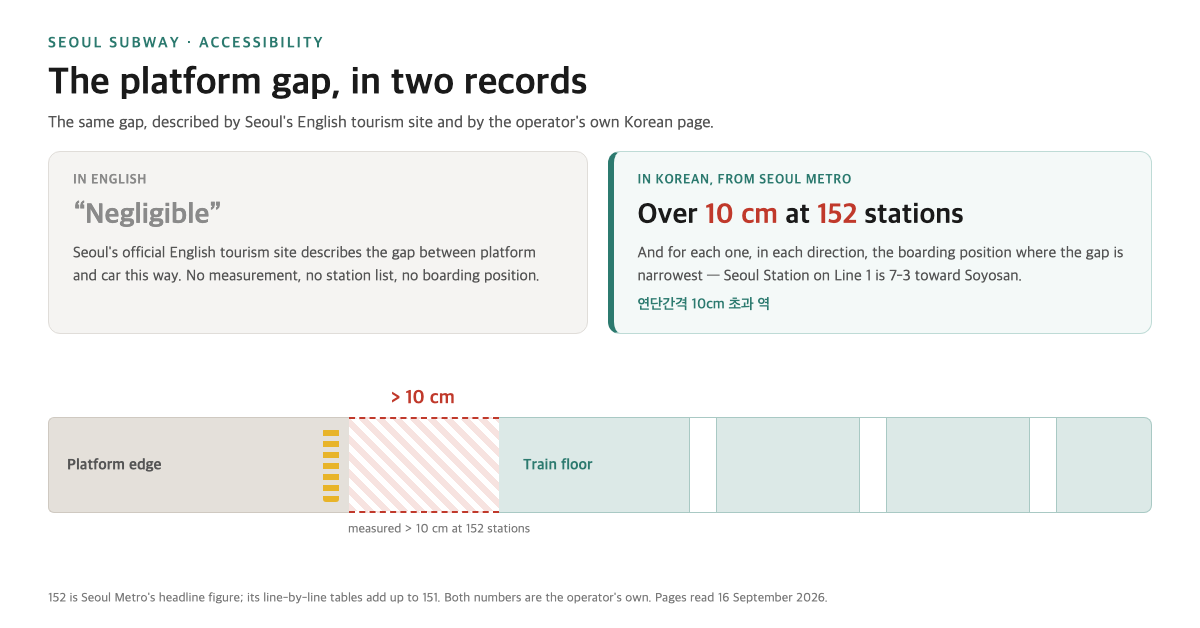
Seoul Metro’s Korean pages carry three things its English pages don’t: a list of 152 stations where the platform gap exceeds 10 cm, the single narrowest boarding position at each one, and a portable boarding ramp stocked at 203 stations that you can request in advance by phone. Seoul’s official English tourism site describes the same gap as negligible.
The Full Answer
Almost every English-language guide to Seoul subway accessibility answers one question: how do I get from the street down to the platform without stairs. That question now has a good answer. Seoul finished its “one station, one route” (1역사1동선) programme on December 29, 2025 — 338 stations across 11 lines, at a total cost of ₩175.1 billion (₩72.8 billion national funding plus ₩102.3 billion from the city). At least one English guide published in September 2026 goes further and lists, station by station, which exit the street-level elevator surfaces at. That work is done, and we are not going to repeat it here.
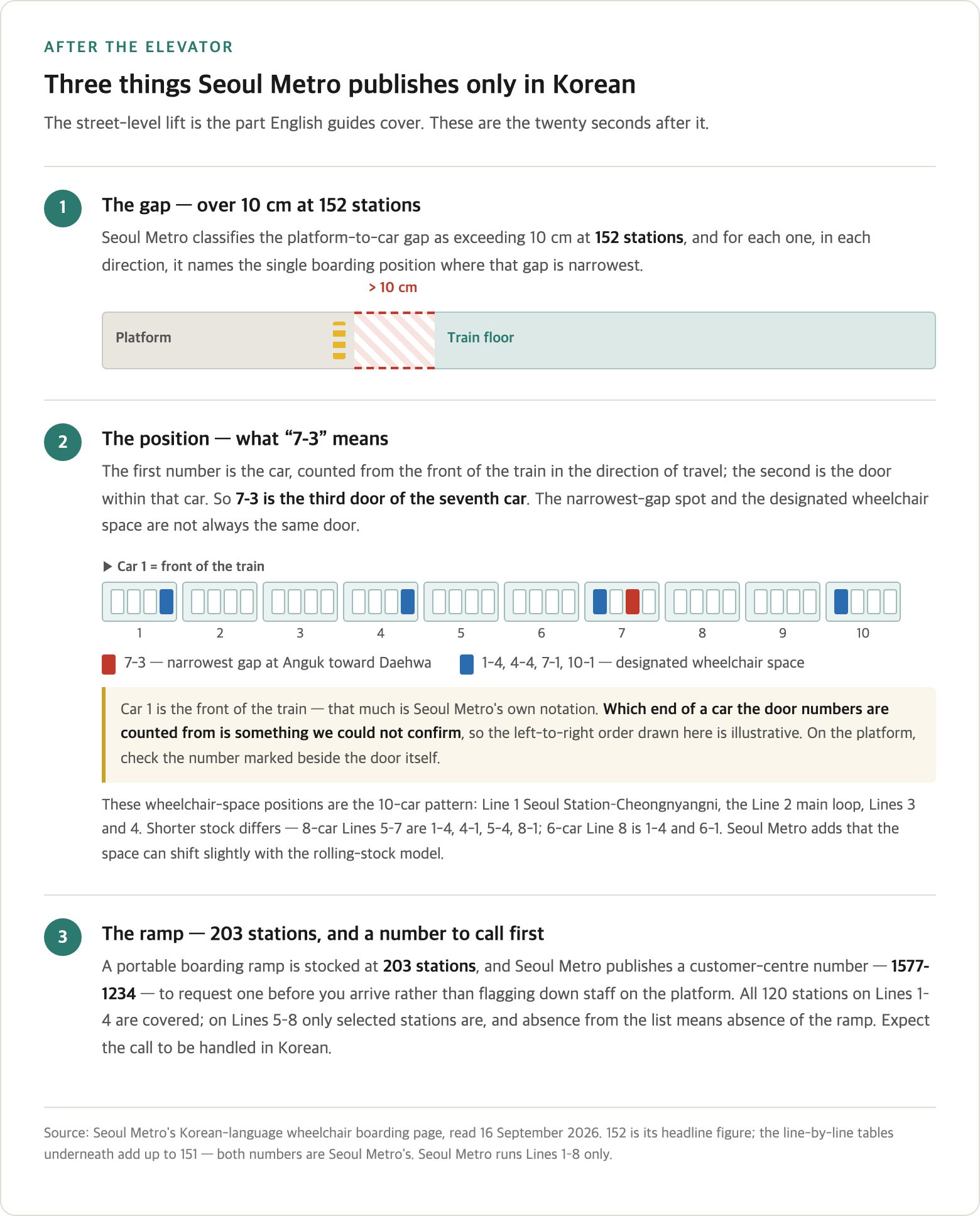
What nobody has written in English is what happens in the twenty seconds after that. You are on the platform. The train arrives. Between the platform edge and the car floor there is a gap, and at 152 stations Seoul Metro’s own engineers classify that gap as over 10 cm — roughly four inches — wide enough that front castors drop into it. There is one spot on each platform where that gap is narrowest, and Seoul Metro publishes it by station and by direction. There is a portable ramp at 203 stations that staff will lay across the gap, and a number to request it before you arrive. There is a designated wheelchair space inside the train, at fixed door positions that vary by line.
None of that is on Seoul Metro’s English site. I checked: seoulmetro.co.kr/en/equipmentList.do returns a 404, and the English navigation menu carries Cyber Station, fares, tickets, nursing rooms, luggage and safety — but not the accessibility pages. The Korean site has all three. This article is those three pages, read and converted into something you can act on.
What “One Accessible Route” Actually Guarantees
The 1역사1동선 programme has a precise definition, and reading it explains almost every complaint travellers have about Seoul stations. Seoul’s own wording: a route by which a mobility-impaired passenger can move from outside the station to the platform by elevator, without another person’s help. One route. Per station.
It does not mean every exit has an elevator. At most stations exactly one does, and which one is not negotiable — come up the wrong stairwell and there is no second lift a block away. At Gyeongbokgung Station on Line 3, for example, the street-level elevator is at Exit 4, while our Gyeongbokgung ticketing guide points visitors to Exit 5, which surfaces inside the National Palace Museum concourse. Both are correct and they are different exits: Exit 5 is the shortest walk to the palace ticket office, Exit 4 is the one with the lift. If you need the lift, you come up at 4 and walk.
That pattern repeats across the network, which is why the street-level exit tables that now exist in English are worth having. They are just not the whole journey.
One scope note before the numbers start. Every figure in this article comes from Seoul Metro’s own systems, and Seoul Metro runs Lines 1 through 8 only. Line 9, the Ui-Sinseol and Sillim light rail lines, AREX (the airport line), Shinbundang, and the Korail-operated stretches of Line 1 and the Gyeongui-Jungang and Suin-Bundang lines belong to other operators and do not appear in this data at all — a query for Line 9 returns zero rows. That means “not in our table”. It does not mean “no elevator”. At interchange stations such as Gimpo Airport, Yeouido and Express Bus Terminal, another operator’s elevator may serve the same building.
The Platform Gap: 152 Stations, and Where Seoul Metro Says to Board
This is the fact that does not exist in English, and where the English-language record is actively wrong.
Seoul’s official English tourism site, english.visitseoul.net, states that gaps between the platform and the car are negligible. WheelchairTravel.org describes the gap as small and easily crossed by wheelchairs and scooters. Seoul Metro’s Korean-language wheelchair boarding page (seoulmetro.co.kr, menuIdx=769) opens with a scope line that reads, in translation: “Applies to: stations with a platform gap exceeding 10 cm (152 stations).”
Then it does something no English source does. For each of those stations, in each direction, it names the single boarding position where the gap is narrowest.
I read those tables directly rather than a summary of them, and one detail is worth stating plainly: the page’s headline figure is 152 stations, while the line-by-line tables underneath add up to 151 — Line 1 (10), Line 2 (35), Line 3 (34), Line 4 (20), Line 5 (20), Line 6 (13), Line 7 (15), Line 8 (4). Both numbers are Seoul Metro’s.
Two things stand out from the list itself.
The whole of Line 3 is on it. All 34 stations from Jichuk to Ogeum, consecutively, with no gaps in the sequence. Line 3 is the palace line — Gyeongbokgung, Anguk, Jongno 3-ga — and also the line to Express Bus Terminal. If your itinerary runs on Line 3, every platform you use is one Seoul Metro classifies as a wide-gap platform.
Gangnam is not on it. Neither is Itaewon. The list is a physical measurement rather than a ranking of old or busy stations, and some of the busiest stops measure under the threshold.
Local tip — Seoul’s official English tourism page calls the platform gap negligible. Seoul Metro’s own Korean engineering page classifies 152 stations as having a gap over 10 cm and publishes, for each one, the exact boarding position where the gap is narrowest — for example, Seoul Station on Line 1 lists 7-3 toward Soyosan and 1-4 toward Sindorim. An operator does not publish a narrowest-spot table for a gap that is negligible, and that table has no English-language equivalent.
Reading “7-3”
The positions are written as two numbers joined by a hyphen, and they are not seat numbers or exit numbers. The first is the car, counted from the front of the train in the direction of travel. The second is the door within that car. So 7-3 means the third door of the seventh car. It is the notation Seoul Metro uses throughout its own documents, and it is how staff will understand you if you ask.
The number changes by direction. Gyeongbokgung is 1-1 toward Daehwa and 10-1 toward Ogeum — opposite ends of the platform. Standing where it worked on the outbound trip will not put you at the narrowest point on the way back.
The Portable Ramp: 203 Stations, and a Number You Can Call First
English guides that mention ramps stop at “ask station staff for a ramp.” Nobody says where the ramps are, how many stations have them, or that you can request one before you arrive.
The same Seoul Metro page carries both. The wording, translated: passengers who need the portable safety ramp at stations with a wide gap between train and platform should contact the station concerned or the customer centre on 1577-1234.
Coverage is not uniform, and this is the part that needs care:
| Line | Stations stocked | Notes |
|---|---|---|
| Lines 1–4 | All 120 stations in Seoul Metro’s sections | Line 1 Seoul Station–Cheongnyangni, Line 2 City Hall–Yongdu, Line 3 Jichuk–Ogeum, Line 4 Bulamsan–Namtaeryeong |
| Line 5 | 38 stations | Includes Gwanghwamun, Yeouido, Dongdaemun History & Culture Park, Wangsimni, Gimpo Airport |
| Line 6 | 13 stations | Includes Hapjeong, Noksapyeong, Yeonsinnae, World Cup Stadium — not Itaewon |
| Line 7 | 27 stations | Includes Express Bus Terminal, Konkuk University, Gangnam-gu Office, Isu |
| Line 8 | 5 stations | Mongchontoseong, Jamsil, Sanseong, Dandaeogeori, Moran |
Total: 203 stations (as of September 2026).
On Lines 1 to 4, every station in Seoul Metro’s section is covered, so you can simply assume a ramp exists. On Lines 5 to 8 the stocking is selective, and a station that is not on the list does not have one — Itaewon on Line 6 is the clearest example for visitors, since it is a heavily touristed stop that appears on neither the ramp list nor the wide-gap list.
Local tip — The ramp is stocked at 203 stations and Seoul Metro publishes a customer-centre number, 1577-1234, to request it ahead of arrival rather than flagging someone down on the platform. English guides treat the ramp as an on-the-spot favour to ask a staff member for. Calling ahead is the documented route, and it is the difference between a planned boarding and a missed train. Expect the call to be handled in Korean.
Where the Wheelchair Space Is Inside the Train
Google’s AI summary for this question says the wheelchair space is “usually located near the ends of specific cars.” A widely shared Facebook answer says the last car is usually the empty one. Both are guesses, because the numbers have not been carried into English — and an AI summary cannot produce a fact that does not exist in its source language.
Seoul Metro publishes it by line, in the same door-position notation:
| Line / section | Wheelchair space boarding positions | Train length |
|---|---|---|
| Line 1 (Seoul Station–Cheongnyangni), Line 2 main loop, Line 3, Line 4 | 1-4, 4-4, 7-1, 10-1 | 10 cars |
| Lines 5, 6, 7 | 1-4, 4-1, 5-4, 8-1 | 8 cars |
| Line 8 (Amsa Historic Park–Moran) | 1-4, 6-1 | 6 cars |
| Line 2 Seongsu–Sinseoldong branch | 1-4, 4-1 | 4 cars |
| Line 2 Sindorim–Kkachisan branch | 3-4 toward Sindorim, 4-1 toward Kkachisan | 6 cars |
Seoul Metro attaches its own caveat to this table, and it belongs here: the position of the wheelchair space inside the car varies somewhat depending on the rolling stock model. Treat these as where to wait, not as a guarantee about a specific train.
Local tip — The designated wheelchair space is not “near the end of the train”. It is at four fixed door positions on a 10-car train — 1-4, 4-4, 7-1 and 10-1 — and at different ones on the shorter Line 5–8 stock. Google’s AI summary of this question says “usually located near the ends of specific cars,” because the numbers are not published in English, and an AI summary cannot produce a fact that exists only in Korean. Waiting at the right marker is the difference between rolling on and walking through six cars.
Read alongside the gap table, the two lists sometimes disagree. At Gyeongbokgung toward Ogeum, the narrowest gap is at 10-1 — which is also a wheelchair-space door. At Myeongdong toward Bulamsan, the narrowest gap is 4-4, which is a wheelchair-space door on a 10-car Line 4 train. But at Anguk toward Daehwa the narrowest gap is 7-3, and the nearest wheelchair space is 7-1. You are choosing between the smoothest boarding and the designated space, and no English-language guide gives you the numbers to make that choice.
Checking Whether the Elevator Is Working Right Now
A static list of elevators tells you what was built. It does not tell you what is running this morning, and for a station with exactly one accessible route, one broken elevator is the whole route.
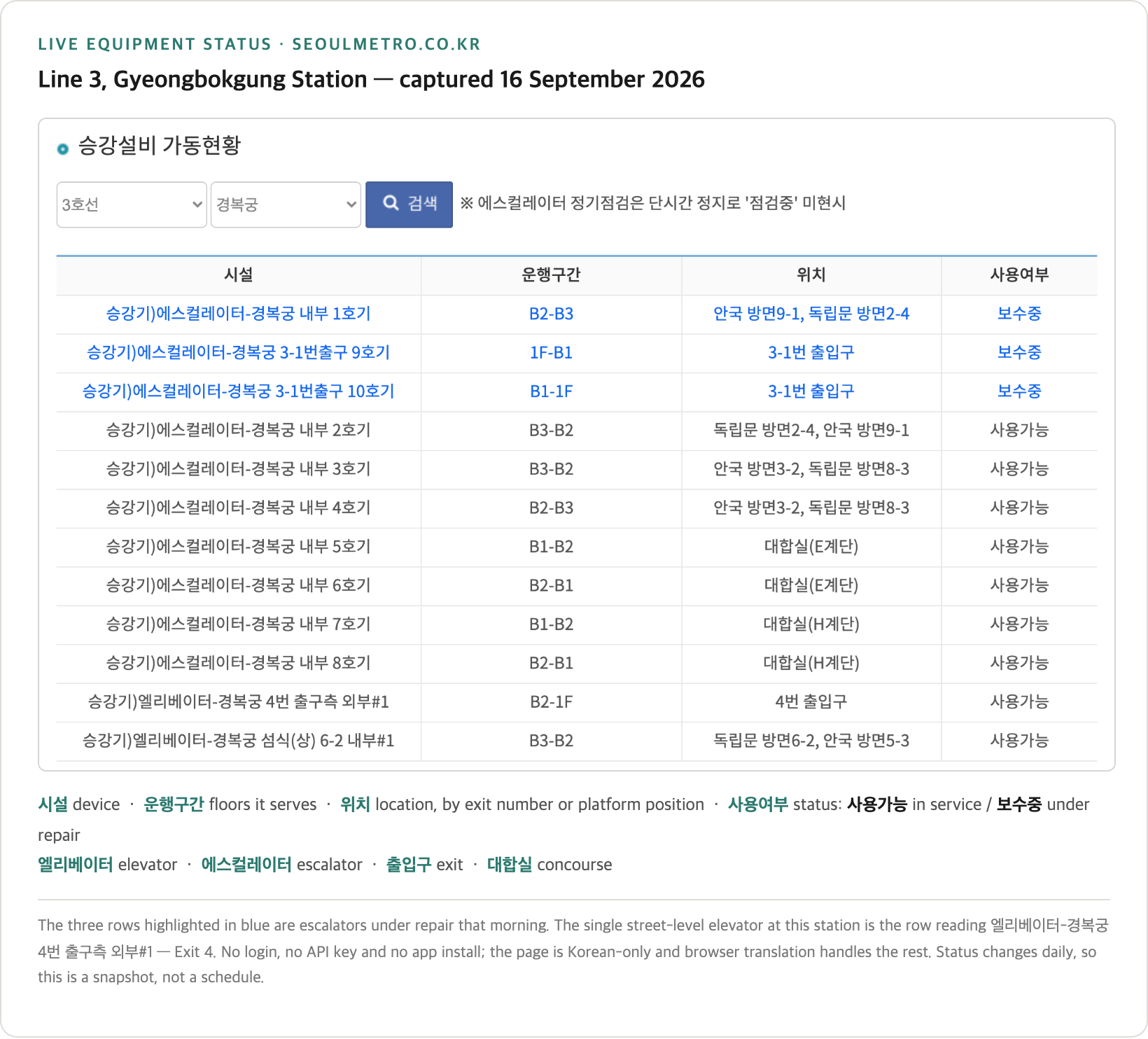
Seoul Metro publishes live equipment status at seoulmetro.co.kr/kr/equipmentList.do. Pick a line and a station and you get every device: name, location by exit number, the floors it serves, and a status field reading 사용가능 (in service) or 보수중 (under repair). No login, no API key, no app install. It is Korean-only, but what you need to recognise is the station name, 엘리베이터 (elevator) and 보수중 (under repair), and browser translation handles the rest.
I pulled the full feed across all eight lines on the morning of September 16, 2026. It returned 2,820 devices, of which 156 — 5.5% — were flagged under repair: 138 escalators, 11 elevators, 5 moving walkways and 2 wheelchair lifts. I cross-checked that number against Seoul Metro’s separate breakdown endpoint, which totals the same 156 by line. At least two of the eleven elevators out of service that morning were the only platform-to-concourse elevator at their station.
The specific stations are not worth printing, because the list changes daily. The useful numbers are the shape of it: around five percent of Seoul Metro’s vertical equipment is out at any given time, most of it escalators, and roughly one elevator in eighty. That is a low failure rate and a real one, and at a single-route station it is the difference between a journey and a dead end.
Local tip — You can check whether a specific elevator is running right now, from a browser, without an account, an API key or a Korean app. Seoul Metro’s live equipment page returns every device at a station with a status field. The English-language guides that raise this problem — one states outright that static official information cannot guarantee an elevator is operating at the moment of travel — do not point to the page that solves it, and the one that mentions Seoul Metro’s own subway app notes it is mainly in Korean.
The Wheelchair Lifts Are Being Removed, Not Installed
WheelchairTravel.org tells readers, in the present tense, that stations without elevators have been made wheelchair accessible by mechanical lifts that move up and down stairways. Google’s AI summary repeats a version of this, suggesting you call an attendant at the station office.
That advice describes a system Seoul is dismantling.
The stairway lift has a long and contested history here. It was introduced around the 1988 Seoul Paralympics, expanded after disability access legislation in 1997, and became the focus of a safety campaign after two deaths: a fall at Oido Station in January 2001 that killed an elderly woman, and a fall at Singil Station in October 2017. Yonhap reported in July 2024 that Seoul Metro had begun removing them — 23 lifts at 17 stations in the first tender, out of 103 then in service — because the one-route-per-station programme had made them redundant. Seoul Metro’s caveat in that reporting: at some stations, removing the lift would make the accessible route excessively long, so removals are agreed case by case with the city and the lift safety authority.
In the live feed I pulled on September 16, 2026, 55 wheelchair lifts remain in service across Lines 1 to 8, spread over 30 stations. Two of them were under repair that morning.
These two numbers come from different instruments and should not be subtracted from each other: 103 was Seoul Metro’s own figure announced in July 2024, and 55 is what appears in the live operational feed in September 2026. What is clear is the direction of travel. Planning a journey around a stairway lift in 2026 means planning around equipment that may not be there.
A handful of stations still carry several: Namguro has six, Sindang on Line 6 has five, Sinseoldong on Line 1 and Express Bus Terminal on Line 7 have four each, and Kkachisan and Gasan Digital Complex have three each. If you are routed through one of those, the lift is currently the route.
Local tip — The stairway lift is not Seoul’s answer to a station without an elevator any more. It is being taken out, station by station, after two fatal falls and a long safety campaign — 23 units at 17 stations went in the first removal tender alone, and 55 remain across Lines 1–8 today. English guides written in the present tense, including one of the most widely cited wheelchair travel resources, still describe lifts as the mechanism that makes lift-free stations accessible. That sentence is now closer to a historical note than a travel instruction.
Station by Station: The Stops Visitors Actually Use
Street-level elevator exits are from Seoul Metro’s live equipment feed; boarding positions are from its wheelchair boarding page. Both were pulled on September 16, 2026, and both cover Seoul Metro-run Lines 1–8 only.
| Station | Street-level elevator | Narrowest boarding position | Notes |
|---|---|---|---|
| Gyeongbokgung (3) | Exit 4 only | 1-1 toward Daehwa / 10-1 toward Ogeum | The palace ticket-office exit is 5; the elevator is at 4 |
| Anguk (3) | Exit 6 only | 7-3 toward Daehwa / 8-2 toward Ogeum | Station for Changdeokgung’s Secret Garden, a five-minute walk from Exit 3 — not the lift exit |
| Myeongdong (4) | Exit 1 only | 4-4 toward Bulamsan / 1-2 toward Oido | Exit 4 is the Namsan Ormi inclined elevator, a separate facility covered in our N Seoul Tower guide |
| Hongdae Ipgu (2) | Exit 8 only | 7-2 inner loop / 3-2 outer loop | AREX and Gyeongui-Jungang platforms are other operators’ |
| Itaewon (6) | Exit 2 only | Not on the wide-gap list | Also not stocked with a portable ramp |
| Chungmuro (4) | Exit 7 | 1-2 toward Bulamsan / 5-2 toward Oido | Four elevators inside; Line 3 platform gap is 8-1 / 3-2 |
| Seoul Station (1) | Exits 2, 3 and 4 | 7-3 toward Soyosan / 1-4 toward Sindorim | Line 4 platform gap is 8-1 / 1-1. KTX concourse is Korail’s, not in this data — see our KTX booking guide |
| City Hall (1/2) | Between Exits 1 and 2 (L1); Exit 9 (L2) | L1 10-2 / 2-1; L2 7-3 inner / 4-1 outer | Three platform elevators between the two lines |
| Jongno 3-ga (1/3/5) | Between Exits 12 and 13 (L1); Exit 8 (L3) | L1 10-2 / 2-2; L3 5-1 / 4-3 | Five platform elevators, long interchange corridors. The station for Jongmyo Shrine — Exit 8, one of its two shrine exits, is also the Line 3 lift exit |
| Dongdaemun History & Culture Park (2/4/5) | Exit 1 (L2); Exit 4 (L4) | L2 10-2 / 9-2; L4 4-2 / 5-1; L5 1-2 / 8-3 | Three lines, five platform elevators |
| Jamsil (2/8) | Exits 1 and 6 (L2); Exit 9 (L8) | L2 7-3 inner / 3-3 outer | One wheelchair lift still in service here |
| Express Bus Terminal (3/7) | Line 7 Exit 4 only | L3 2-3 / 6-4; L7 2-2 / 8-1 | Four wheelchair lifts still in service, the most of any central station |
| Gangnam (2) | Exits 1 and 10 | Not on the wide-gap list | One of the few major stops measuring under 10 cm |
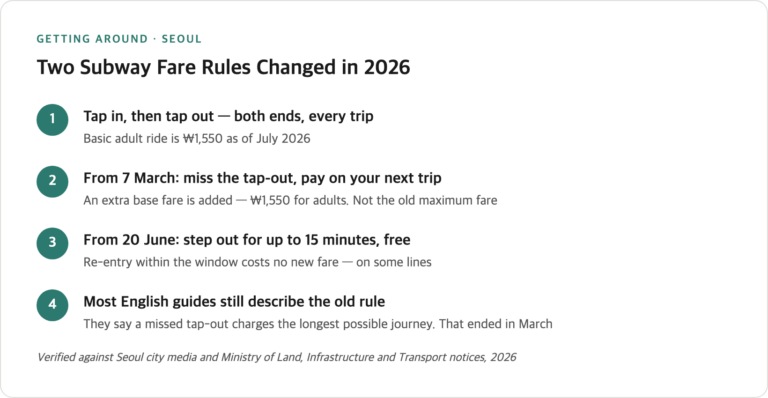
If you are working out a wider route rather than a single station, our guide to getting around Korea covers the intercity picture, and the Seoul subway fare rules — tap-out penalties, the 15-minute re-entry rule, transfer windows — are a separate matter from physical access and worth reading before you travel. Paying is simplest with a T-money card.
What This Data Does Not Cover
- Korail’s stretch of Line 1 is the real gap in the record. December 2025 reporting, cited in an English guide but not read here in the original, named Namyeong, Sinimun and Hankuk University of Foreign Studies as still lacking elevators. It is flagged as unverified rather than repeated as fact.
- Bus and taxi alternatives are not covered here. If an elevator is out and you need a fallback, our Kakao Taxi guide covers hailing without Korean.
- Routing apps. We did not test whether any map app can route around stairs, so nothing here rests on that. Korean map apps are still worth installing, for the separate reasons that Google Maps performs badly in Korea.
- Nursing rooms, accessible toilets and power-wheelchair charging points are counted on Seoul Metro’s separate facilities page (menuIdx=366), station by station. That page is also Korean-only.
What You Need to Know
- One route per station is the design standard, not one route per exit. At most stations there is a single street-level elevator, and which exit it surfaces at is not negotiable. Choose the exit before you leave the platform, not after you reach the concourse.
- The gap is a measured value, not an impression. 152 stations exceed 10 cm by Seoul Metro’s own classification, and the entire Seoul Metro section of Line 3 is on that list. English-language sources describing the gap as negligible are not describing the same measurement.
- Boarding positions change by direction. 7-3 outbound does not mean 7-3 on the return. Check both legs.
- Ramps are stocked at 203 stations and can be requested in advance on 1577-1234. On Lines 1–4 assume one exists; on Lines 5–8 check the station list, because absence from it means absence of the ramp.
- Around 5% of vertical equipment is out of service at any moment. That is 156 of 2,820 devices on the morning of September 16, 2026, including 11 elevators. Check the live status page the morning you travel.
- Stairway lifts are being removed. 55 remain on Lines 1–8. Do not build a plan around one without confirming it is still there.
- This data stops at Line 8. Line 9, the light rail lines, AREX and all Korail track belong to other operators and are outside it.
Practical Tips
- Look up the narrowest boarding position for both directions before you go. Screenshot the two positions for each station on your route — the page is Korean-only, and you may not have signal underground.
- Call 1577-1234 the day before if you need a ramp at a Line 5–8 station. On Lines 1–4 every station is stocked, so an on-the-spot request is realistic. On the outer lines it is not.
- Check the live equipment page the morning you travel, not the night before. Status flips to 보수중 when maintenance starts. At a station with one elevator, that single line of text is the entire accessibility picture.
- Wait at a wheelchair-space door rather than the geometrically nearest one. On 10-car trains that is 1-4, 4-4, 7-1 or 10-1; on 8-car Lines 5–7 it is 1-4, 4-1, 5-4 or 8-1. Boarding at a random door can mean moving through several cars or getting off and re-boarding.
- Treat the exit with the elevator as a separate decision from the exit nearest your destination. They are frequently different, as at Gyeongbokgung.
- On Line 3, assume the wide gap. All 34 Seoul Metro stations on it are classified over 10 cm, including the palace stops and Express Bus Terminal.
- Do not plan around a stairway lift. If your route depends on one, confirm it is still listed in the live feed for that station — 55 remain network-wide and the number is falling.
Frequently Asked Questions
Which exit has the elevator at Gyeongbokgung Station?
Exit 4. It is the only street-level elevator at Gyeongbokgung Station on Line 3, running from the concourse level to the street, and there is one further elevator between the platform and the concourse. Note that Exit 5 is the exit most guides recommend for the palace itself, because it surfaces inside the National Palace Museum concourse near the ticket office. If you need the lift, use Exit 4 and walk from there.
Is there a gap between the train and the platform on the Seoul subway?
Yes, and at 152 stations Seoul Metro classifies it as exceeding 10 cm. Seoul’s English tourism site describes the gap as negligible, which does not match the operator’s own engineering classification. For each of those 152 stations Seoul Metro publishes the single boarding position where the gap is narrowest, by direction — for example 7-3 at Seoul Station toward Soyosan. The entire Seoul Metro section of Line 3 is on the list.
Where is the wheelchair space on a Seoul subway train?
At fixed door positions rather than “near the end of the train”. On 10-car trains (Line 1 Seoul Station–Cheongnyangni, Line 2 main loop, Lines 3 and 4) the positions are 1-4, 4-4, 7-1 and 10-1. On 8-car Lines 5, 6 and 7 they are 1-4, 4-1, 5-4 and 8-1. On 6-car Line 8 they are 1-4 and 6-1. The first number is the car counted from the front, the second is the door within that car. Seoul Metro notes the space can shift slightly depending on the rolling stock model.
Can I ask Seoul subway staff for a boarding ramp?
Yes, and you can request it before you arrive. Seoul Metro stocks a portable boarding ramp at 203 stations and publishes a customer-centre number, 1577-1234, for requests. All 120 stations on Lines 1–4 are covered; on Lines 5–8 only selected stations are, so check the list rather than assuming. The call is handled in Korean.
How do I check if a Seoul subway elevator is out of service?
Seoul Metro’s live equipment status page lists every elevator, escalator, moving walkway and wheelchair lift by station, with its location and a status of 사용가능 (in service) or 보수중 (under repair). It needs no login or app. On the morning of September 16, 2026, 156 of 2,820 devices were flagged under repair, including 11 elevators. Check it the day you travel — status changes daily.
Do Seoul subway stations still have wheelchair lifts?
Some do, but they are being removed rather than added. Seoul Metro began removing stairway lifts after the one-station-one-route programme, starting with 23 lifts at 17 stations in 2024 out of 103 then in service. As of September 16, 2026, 55 remain in service across Lines 1–8 at 30 stations, with Namguro, Sindang, Sinseoldong and Express Bus Terminal holding the most. English guides that present lifts as the standard alternative to elevators are describing a system in retreat.
Which Seoul subway lines are not covered by Seoul Metro’s accessibility data?
Seoul Metro operates Lines 1 to 8, and its equipment feed covers only those. Line 9, the Ui-Sinseol and Sillim light rail lines, AREX, Shinbundang and all Korail-operated sections — including parts of Line 1 and the Gyeongui-Jungang and Suin-Bundang lines — are run by other operators and return no rows. At shared stations such as Gimpo Airport, Yeouido and Hongdae Ipgu, another operator may have elevators that this data does not show.
Related Questions
- Seoul Subway: Tap-Out Rules That Changed in 2026 — the fare side of the same network, including the 2026 tap-out penalty and re-entry window
- How to Get to N Seoul Tower — Cable Car, Bus, Free Shuttle, and the Namsan Ormi — the free inclined elevator from Myeongdong Exit 4, which is not the station’s own lift at Exit 1
- Incheon Airport to Seoul: Every Option, Including the Night Bus — arriving with luggage, before any of this applies