Getting Around Korea: The Transport Guide That Connects the Details
Quick Answer
Korea’s transport is cheap, fast and easy once you know the system. A single T-money card covers subways, buses and taxis nationwide. Use Naver Map or KakaoMap, not Google Maps, for navigation. Cross-city travel runs on the KTX and slower trains. The catches: fare rules changed twice in 2026, transfer windows differ between Seoul and Jeju, and the app everyone recommends for taxis needs a Korean card. This guide ties the pieces together.
The Full Answer
Getting around Korea is genuinely one of the easier parts of a trip — but “easy” hides a set of specifics that catch visitors out, mostly because the rules aren’t uniform and some changed recently. This is the overview; each piece has its own detailed guide, and the point here is how they connect.
This hub draws on the current 2026 rules across the network. The through-line: Korea’s transport works nationwide on one card, but the details — transfer windows, app choice, payment quirks — vary by city and mode in ways no single tourist guide maps. Get the overview, then follow the links for the parts your trip needs.
One Card for Everything
Start here, because it simplifies the rest.
Local tip — A single T-money card covers the whole country — Seoul, Busan, Jeju, on subways, buses and most taxis, plus convenience-store purchases. Buy it at any convenience store on arrival for ₩2,500–4,000. You don’t need separate cards for separate cities. The one thing to plan is the refund at the end — the card fee isn’t refundable, and leftover balance has its own rules.
The Apps: Not the Ones You’d Guess
This trips up almost everyone.
Local tip — Google Maps does not do driving navigation in Korea and its transit data is thin — use Naver Map or KakaoMap instead, both free with English modes. This isn’t a minor preference; it’s a legal restriction on map-data export, so there’s no workaround. Install a Korean map app before you land, alongside sorting mobile data.
Local tip — For taxis, the app everyone recommends — Kakao Taxi — needs a Korean card and phone number to register payment, which foreign visitors often can’t complete. Hailing a street taxi and paying with a T-money card or physical card is frequently easier. Our step-by-step Kakao Taxi guide walks through the setup and what to do if payment registration fails. This is part of the wider cash-and-card gap that catches foreign cards out.
City Transit: Cheap, With Rules That Changed
Local transit is the bargain of any Korea trip, but 2026 brought changes.
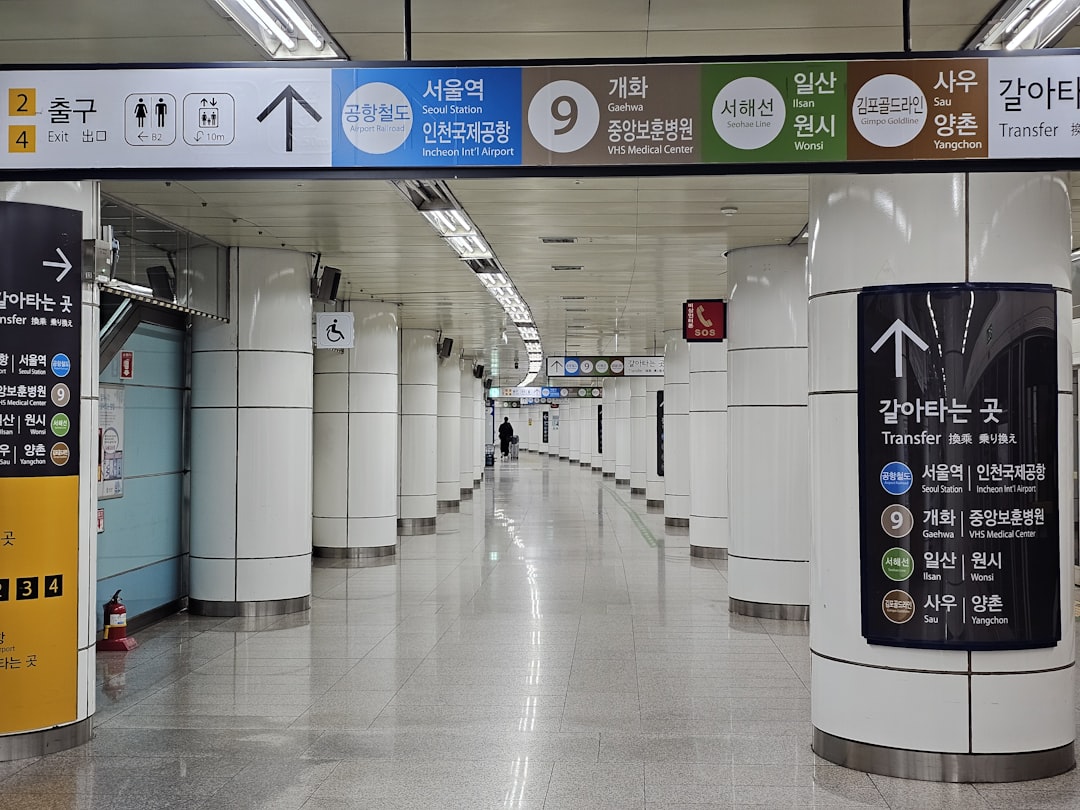
Local tip — The Seoul subway changed its fare rules twice in 2026 — a penalty for missed tap-outs (from March) and a 15-minute re-entry exemption (from June). Most guides still describe the old system. Always tap out, even at open gates, because a missed tap now follows you to your next trip.
Local tip — Transfer windows differ by region — Seoul allows 30 minutes (60 after 21:00), but Jeju gives 40 minutes and excludes the same route number. Guides written about Seoul get applied countrywide, and that’s where surprise fares come from. Check the local rule when you leave the capital.
Between Cities: Trains and the Airport
For longer hops, the rail network does the work.
- KTX — the fast train, Seoul to Busan in ~2.5 hours; slower ITX and Mugunghwa cost much less on the same routes
- Busan–Fukuoka ferry — the overland route out of Korea, with its own check-in deadline hours earlier than an airport’s
- Incheon Airport to Seoul — AREX train, limousine buses, or the night bus for late arrivals
- Intercity buses — reach places trains don’t
- Domestic flights — mainly for Jeju, which is an island
- Driving yourself — legal on a foreign permit for one year from the day you enter, and Korean law recognises more permit types than the English guides list
Local tip — The KTX refund rules differ between weekdays and weekends, and slower trains (ITX, Mugunghwa) run the same routes at 30–50% less. English guides present KTX as the intercity train, quietly removing the cheaper half of the network. On shorter hops the time penalty is small.
Putting It Together
A typical trip’s transport, in sequence:
- Land — sort data, buy a T-money card, get into Seoul
- In the city — subway and bus on the card, Naver/Kakao for routing
- Between cities — KTX or slower trains
- On Jeju — buses, no car needed, with different transfer rules
- Cash gaps — carry some for taxis and markets
Local tip — The single mindset shift that makes Korean transport easy: one card, Korean maps, and check the local rule when you change cities. Everything else follows from those three. The fares are so low that budgeting transit precisely is almost pointless — put your planning energy into the overall trip budget instead.
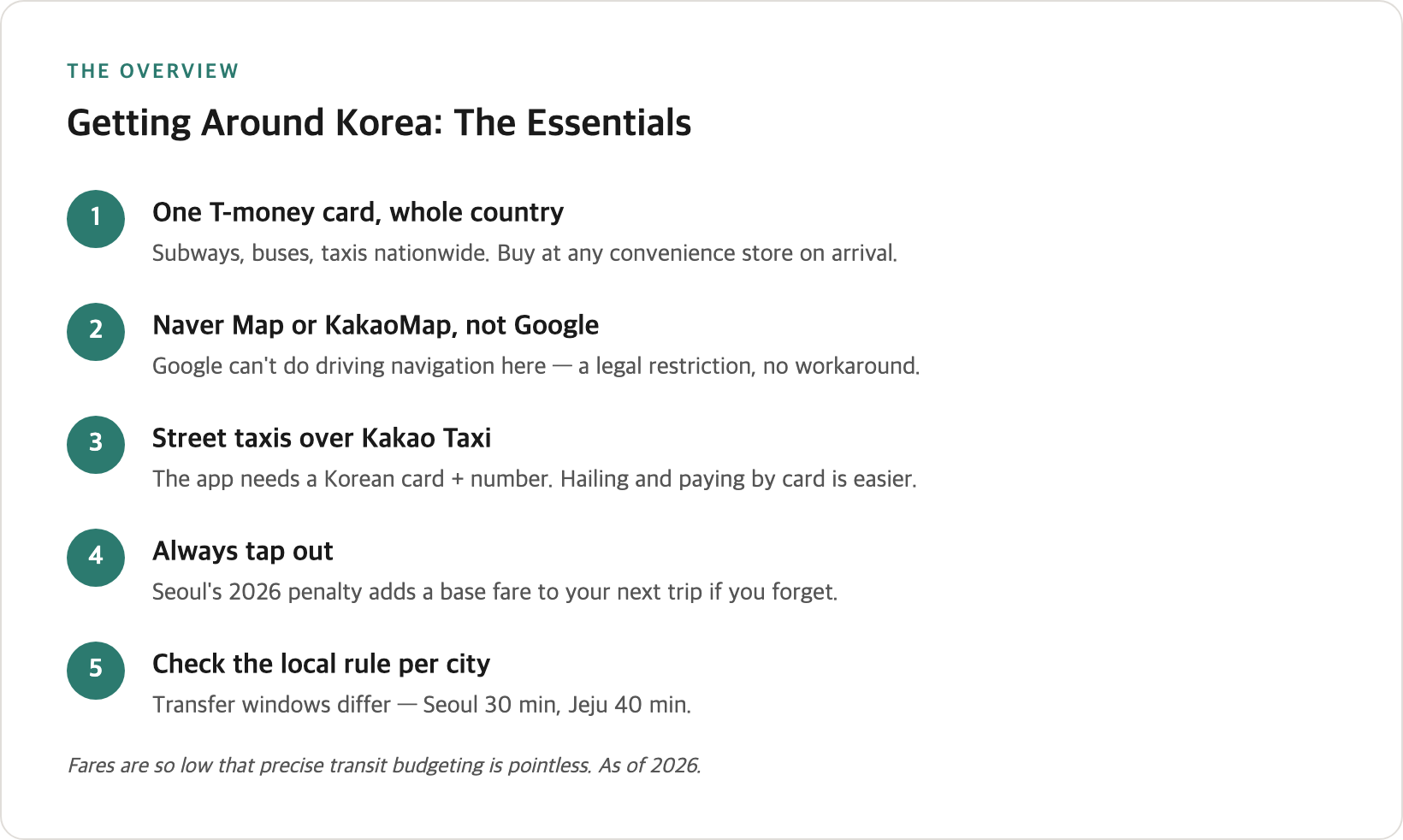
What You Need to Know
-
One T-money card covers the whole country — subways, buses, taxis.
-
Use Naver Map or KakaoMap — Google Maps can’t navigate driving here.
-
Kakao Taxi needs a Korean card — street taxis are easier for visitors.
-
Seoul subway fare rules changed twice in 2026 — always tap out.
-
Transfer windows differ by region — Seoul 30 min, Jeju 40 min.
-
Slower trains cost far less than KTX on the same routes.
Practical Tips
-
Buy a T-money card on arrival — it covers everything.
-
Install Naver Map or KakaoMap before you land.
-
Hail street taxis rather than fighting Kakao Taxi’s card requirement.
-
Always tap out on the subway — the 2026 penalty follows you.
-
Check the local transfer rule when you leave Seoul.
-
Consider slower trains between cities to save.
-
Go car-free on Jeju — buses cover the sights.
Frequently Asked Questions
How do I get around Korea?
A single T-money card covers subways, buses and taxis nationwide. Use Naver Map or KakaoMap for navigation, and the KTX or slower trains between cities.
Do I need a different transit card for each city?
No. One T-money card works in Seoul, Busan, Jeju and elsewhere. Only the local transfer rules differ.
Why can’t I use Google Maps?
A legal restriction on exporting Korean map data means Google Maps can’t do driving navigation and has thin transit data. Use Naver Map or KakaoMap instead.
What’s the cheapest way between cities?
Slower trains — ITX-Saemaeul and Mugunghwa — run the same routes as KTX at 30–50% less, with a modest time penalty on shorter hops.
How do I pay for taxis?
A T-money card or physical card on the meter for street taxis. The Kakao Taxi app needs a Korean card and number, which foreign visitors often can’t set up.
Did the subway rules really change in 2026?
Yes — a missed-tap-out penalty from March and a 15-minute re-entry exemption from June. Most guides still describe the old system.
Related Questions
- Seoul Subway: Tap-Out Rules That Changed in 2026
- T-money Card: Buying, Topping Up, and Getting Your Money Back
- Why Google Maps Doesn’t Work in Korea — and What to Use
- Do You Need a Visa for Korea? The 90-Day Rule Most Guides Get Half Right
- Korean Age in 2026: Why the Drinking Age Still Uses the Old System
- Booking the Ski Shuttle From Seoul: What Korea’s Resorts Leave Out