Korean Convenience Stores: The Microwave Rule, the Parasol Grey Area, and the Service Counter
Quick Answer
Korean convenience stores (CU, GS25, 7-Eleven, Emart24) are a genuine food destination, not just a shop — hot food, seating, microwaves, and famous beer deals. But there are quiet rules: not every store has an eating area, the outdoor parasol tables are technically unauthorised for drinking at, and some cup noodle cups can’t go in the microwave. Knowing the combos and the rules turns a convenience store into one of Korea’s best cheap meals.
The Full Answer
The Korean convenience store is rightly praised in English guides — the food is good, cheap and everywhere. Less commonly covered is the operating detail: where you’re actually allowed to eat and drink, which cups are microwave-safe, and the combo culture that Koreans take for granted.
These are small things, but they’re the difference between using a convenience store like a local and standing outside a store wondering if you can drink your beer at that table. I checked the Korean-language coverage of convenience-store eating rules and combos in July 2026 — the everyday knowledge that never makes it into a tourist guide.
Where You Can Actually Eat and Drink
Start with where you can and can’t consume what you bought.
Local tip — Not every convenience store has seating. Many have a bar counter or a few tables where you can heat a lunchbox and eat, but plenty don’t. If a store has no eating area, take your food to your accommodation or a park — don’t assume every branch is a place to sit and eat.
Local tip — The outdoor parasol tables outside some convenience stores are technically unauthorised installations, and drinking at them sits in a legal grey area — periodically the subject of crackdowns and confusing news reports. Eating is generally fine; the parasol-table drinking specifically is the murky part. Indoor seating, where it exists, is the safe bet.
The Microwave Trap
A genuinely useful safety point.
Local tip — Not all cup noodles are microwave-safe. Polystyrene (PS) cups should not go in the microwave — only paper or microwave-safe containers. Check the cup before you nuke it. The usual method is hot water from the store’s dispenser anyway, but if you’re microwaving, read the cup. It’s the kind of thing every Korean knows without thinking about it, and easy to miss if you don’t read Korean packaging.
For most cup noodles, the store’s hot-water dispenser is the intended method — fill, wait, eat. The microwave is for lunchboxes and rice.
The Combos Koreans Actually Order
There’s a whole informal cuisine of convenience-store combinations.
| Combo | What it is |
|---|---|
| Mark-jeongsik | Cup noodle + triangle kimbap in it |
| Buldak + cheese | Spicy fire noodles with cheese to tame the heat |
| Chamchi-mayo + hotbar | Tuna-mayo kimbap with a sausage |
| Cup rice + egg | Microwaved for a fuller meal |
These combos aren’t random — they’re a small local food culture, each with its own name, and trying one is a cheap, genuinely Korean experience that beats eating each item separately.
What Else Convenience Stores Do
Beyond food, they’re service hubs — including for foreigners.
- Currency exchange: CU has unmanned exchange kiosks (15+ currencies) in tourist areas; Emart24 has digital ATMs handling exchange, up to about USD 2,000/day
- Foreigner prepaid cards: WOWPASS and Tmoney travel cards sold and reloaded here — useful for the cash-only gaps
- Transit top-ups: load your T-money card
- Beer deals: the 4-cans-for-₩10,000 promotion
- Parcel, bill payment, ATMs: the everyday service layer
Local tip — Convenience stores in tourist areas double as foreigner service points — currency exchange kiosks, digital ATMs, and prepaid-card sales that specifically solve the problems overseas cards run into. If Kakao Taxi won’t take your card, a WOWPASS bought at a convenience store fixes it — for a visitor, the tourist-area branches function closer to a one-stop admin desk than a shop.
Buying Alcohol
Convenience stores sell alcohol nearly around the clock, with ID checks common.
Local tip — Alcohol is sold almost 24/7, and ID checks are routine — carry your passport. The drinking age is 19 by year age, so the cutoff is your birth year, not your birthday. This is the easiest place to buy soju and beer in Korea, at the lowest prices — see the wider drinking culture for etiquette.
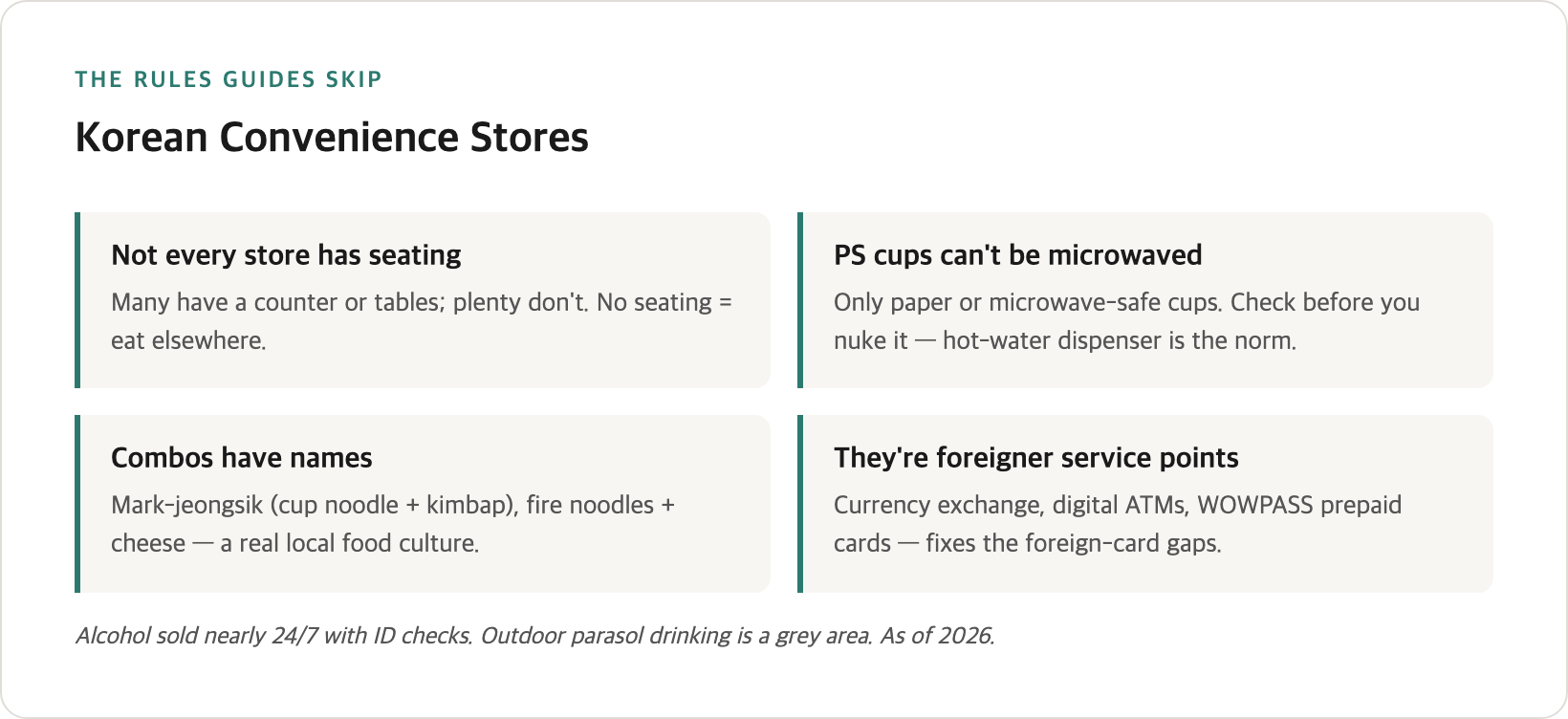
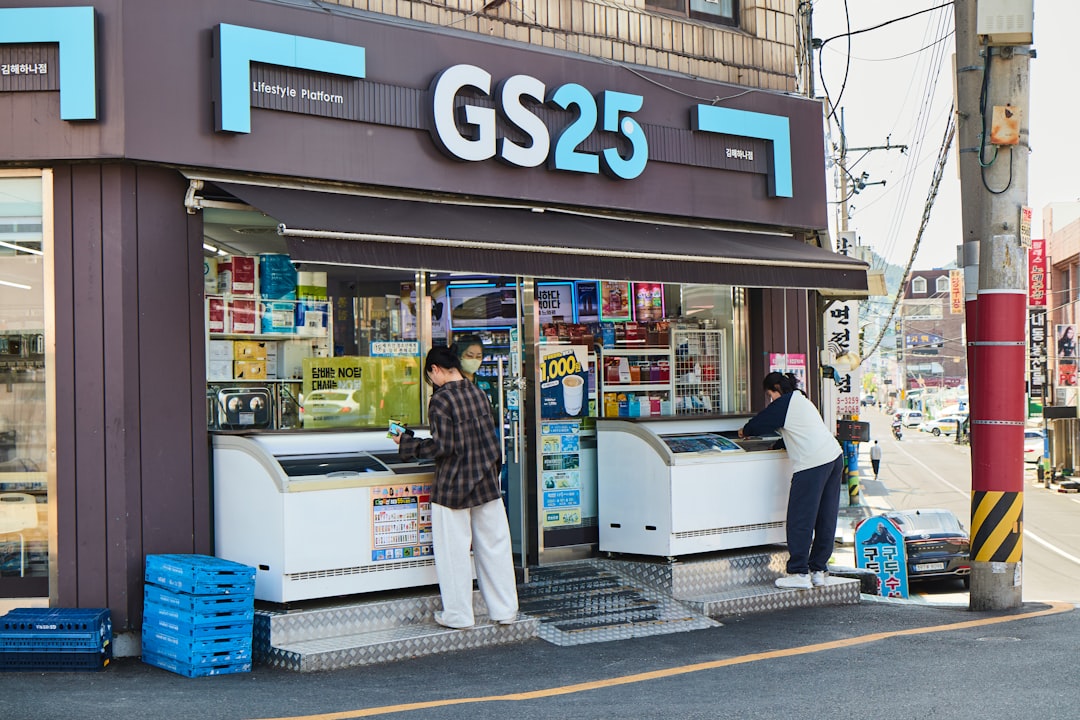
Photo by Polina Kneis on Unsplash
What You Need to Know
-
Not every store has seating — check before assuming you can eat in.
-
Outdoor parasol-table drinking is a legal grey area — indoor seating is safe.
-
PS cup noodles can’t be microwaved — use hot water or check the cup.
-
Combos have names — mark-jeongsik and others are a real local food culture.
-
They’re foreigner service points — exchange, ATMs, prepaid cards.
-
Alcohol is sold nearly 24/7 with routine ID checks.
Practical Tips
-
Check for an eating area before planning to sit and eat.
-
Read the cup noodle cup before microwaving — PS is unsafe.
-
Use the hot-water dispenser for cup noodles, the microwave for rice.
-
Try a named combo like mark-jeongsik for the local experience.
-
Use them for exchange and prepaid cards in tourist areas.
-
Carry your passport for alcohol ID checks.
-
Grab the 4-can beer deal — cheapest alcohol in Korea.
Frequently Asked Questions
Can I eat inside a Korean convenience store?
Many have a bar counter or tables, but not all. If there’s no seating, take your food to your accommodation or a park.
Can I drink alcohol at the outdoor tables?
It’s a legal grey area — the parasol tables outside some stores are technically unauthorised, and drinking at them is periodically cracked down on. Indoor seating is the safe option.
Can I microwave cup noodles?
Only if the cup is paper or marked microwave-safe. Polystyrene (PS) cups should not be microwaved. The store’s hot-water dispenser is the usual method.
What should I order at a Korean convenience store?
Try a named combo — mark-jeongsik (cup noodle with a triangle kimbap), fire noodles with cheese, or tuna-mayo kimbap with a hotbar. They’re a cheap local food culture.
Can I exchange money at a convenience store?
In tourist areas, yes — CU has unmanned exchange kiosks and Emart24 has digital ATMs handling exchange and prepaid cards, useful for the gaps where foreign cards fail.
Can I buy alcohol there?
Yes, nearly around the clock, with routine ID checks. Carry your passport; the drinking age is 19 by year age.
Related Questions
- Korean Beer: Local Brands, Strengths, and the 4-for-₩10,000 Deal
- Cash or Card in Korea? The Apps That Won’t Take Your Foreign Card
- Drinking Age in Korea: Who Can Legally Drink
- Pojangmacha: How to Read a Korean Street-Food Tent (and Not Get Ripped Off)
- Makgeolli: Which Bottles You Can Shake and Which You Can’t
- Korea Customs Food Rules — Why Enforcement Got Stricter in 2026