Gocheok Sky Dome vs KSPO Dome: Seats, Stations, and Getting Out
Quick Answer
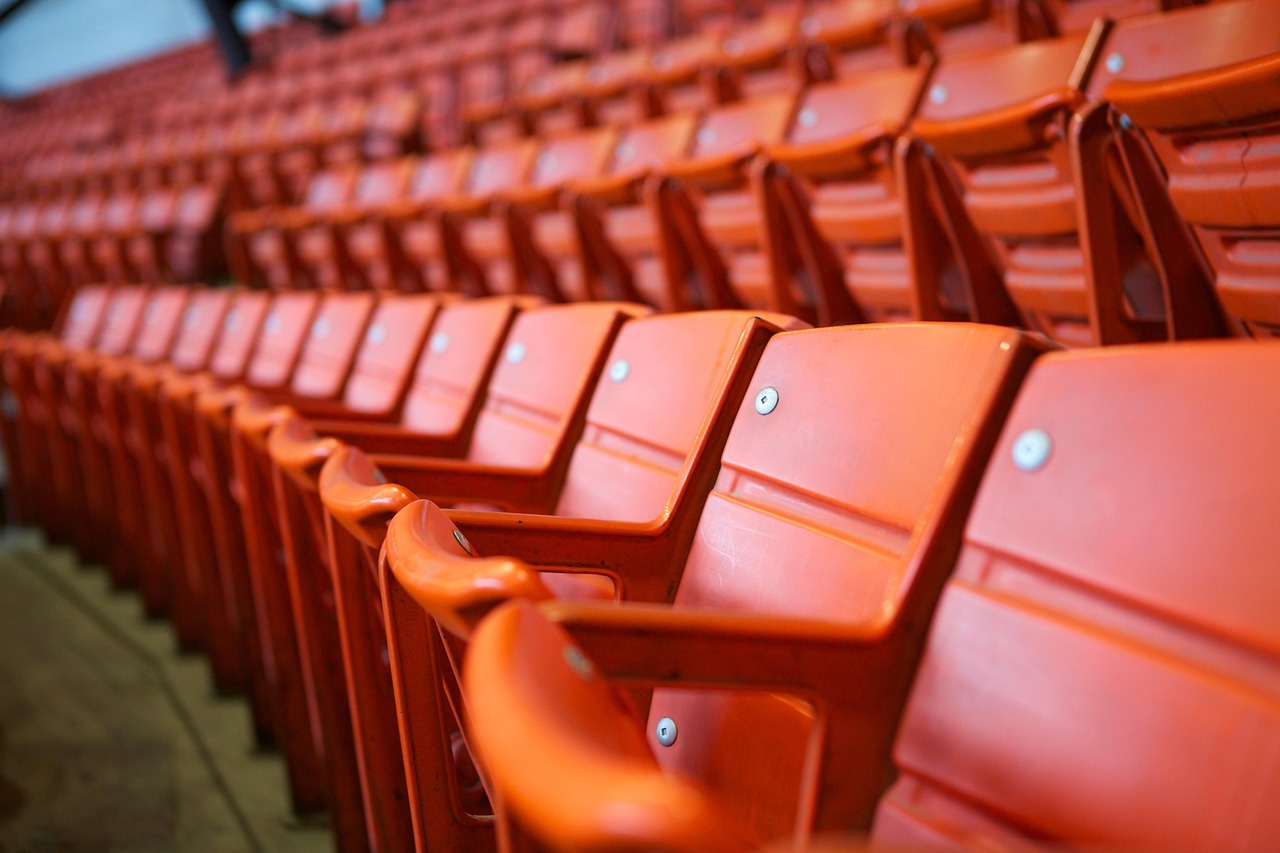
Most large K-pop concerts in Seoul land at one of two venues. Gocheok Sky Dome (고척스카이돔) is a converted baseball dome with roughly 16,600 fixed seats, reached from Guil Station on Line 1. KSPO DOME (KSPO돔) is a circular 15,000-seat arena inside Olympic Park, on Lines 5 and 9. The difference that matters is not the stage — it is how you get out.
The Full Answer
Picking a seat and getting to the door is the part of a Seoul concert night that English-language guides cover well. Arrive early, collect your ticket with your passport, expect the merchandise queue to form hours ahead, expect the exit to be slow. All of that is accurate and you can find it in several places. What those guides skip is the routine that starts once the crowd clears — a stop at a photo booth for a souvenir strip, and, often enough, a lost-and-found call for a lightstick or phone that didn’t make it out with you.
What those guides do not cover is the physical infrastructure the crowd has to move through, because that information lives in Korean — on the Seoul Facilities Corporation’s own venue page, on the Olympic Park operator’s park-use page, and in Korean transit references that no one writing a fan guide has reason to open. Guil Station is not simply “small.” Olympic Park does not simply “surround” the arena. Both facts have specific operating consequences, and both are written down.
I opened four Korean-language official pages for this in August 2026: the Seoul Facilities Corporation’s Gocheok Sky Dome access and seating pages (sisul.or.kr), and the Olympic Park operator’s park-use and KSPO DOME venue pages (ksponco.or.kr). The numbers below come from those, not from other English guides. Where an English guide and a Korean official page disagree, I have said which is which. Where I could not confirm something, I have said that too.
This is a venue guide, not a ticketing guide. How the sale itself works — the queues, the ID checks, the resale rules — is a separate problem, and so is attending a free music show recording, which uses different buildings entirely.
The Two Venues at a Glance
| Gocheok Sky Dome 고척스카이돔 | KSPO DOME KSPO돔 | |
|---|---|---|
| Type | Converted baseball dome, fully enclosed | Purpose-built circular arena |
| Opened | Late 2015 | Built for the 1988 Seoul Olympics; reopened after remodelling in 2018 |
| Also called | 고척돔 | 올림픽체조경기장 (Olympic Gymnastics Arena) |
| Fixed seats | approximately 16,600 | approximately 15,000 (14,594 fixed) |
| Operator | Seoul Facilities Corporation (서울시설공단) | Korea Sports Promotion Foundation (국민체육진흥공단) |
| Nearest station | Guil (구일), Line 1, Exit 2 — approximately 3 min | Olympic Park (올림픽공원), Lines 5 & 9, Exit 3 |
| Backup stations | Guro approximately 20 min · Gaebong approximately 15 min | Mongchon Toseong (Line 8) · Hanseong Baekje (Line 9) |
| Express service | Express trains do not stop at Guil | Line 9 express does stop at Olympic Park |
| Setting | Street-level site by the Anyang Stream | Inside a public park with posted closing times |
| Roof | Fixed. It does not open | Steel-framed roof since the 2018 remodel |
Two entries in that table are worth pulling out, because English sources get them wrong or leave them out.
Gocheok’s roof is fixed. At least one English concert guide describes Gocheok as having a “retractable roof system.” It does not. Seoul city’s own construction announcements describe it as a 완전돔 — a full dome — and the roof is a fixed translucent membrane designed to let daylight through, not to open. What that buys you is narrower than “weatherproof”: a Gocheok show goes ahead in rain instead of being cancelled, and the building is climate-controlled in a Seoul August. It does not mean the roof never lets water through. Korean reporting records leaks reaching seats in 2016, 2017 and 2020; the operator commissioned a specialist survey and ran a staged roof repair through 2021, and carried out further roof work before the 2026 season. Even so, in the heavy rain of 22 August 2026 water dripped into a third-base stand section during a sold-out baseball game and about thirty ticket holders were moved to other seats (OSEN, 23 August 2026). That is localised and uncommon, and the event still ran — read “indoors” here as “the show happens”, not as “every seat stays dry.” And if you have planned around an open-air night, plan again.
KSPO DOME is a 1988 Olympic building. It was the Olympic Gymnastics Arena, and Korean speakers still call it 체조경기장 far more often than KSPO DOME. That matters when you are typing a destination into a taxi app or asking at a station desk. If “KSPO Dome” draws a blank, “올림픽체조경기장” will not. Korean map apps handle both — and if you are still using Google Maps for this, read why Google Maps does not work properly in Korea first.
Gocheok: Guil Station Is the Whole Problem
Every English guide says the same thing about leaving Gocheok — the station is small, it clogs, walk to Gaebong instead. That advice is correct and it is also incomplete, because it does not say why Guil behaves the way it does. There are two structural reasons, and both change what you should do.
It is a two-level station, and the levels are the two directions
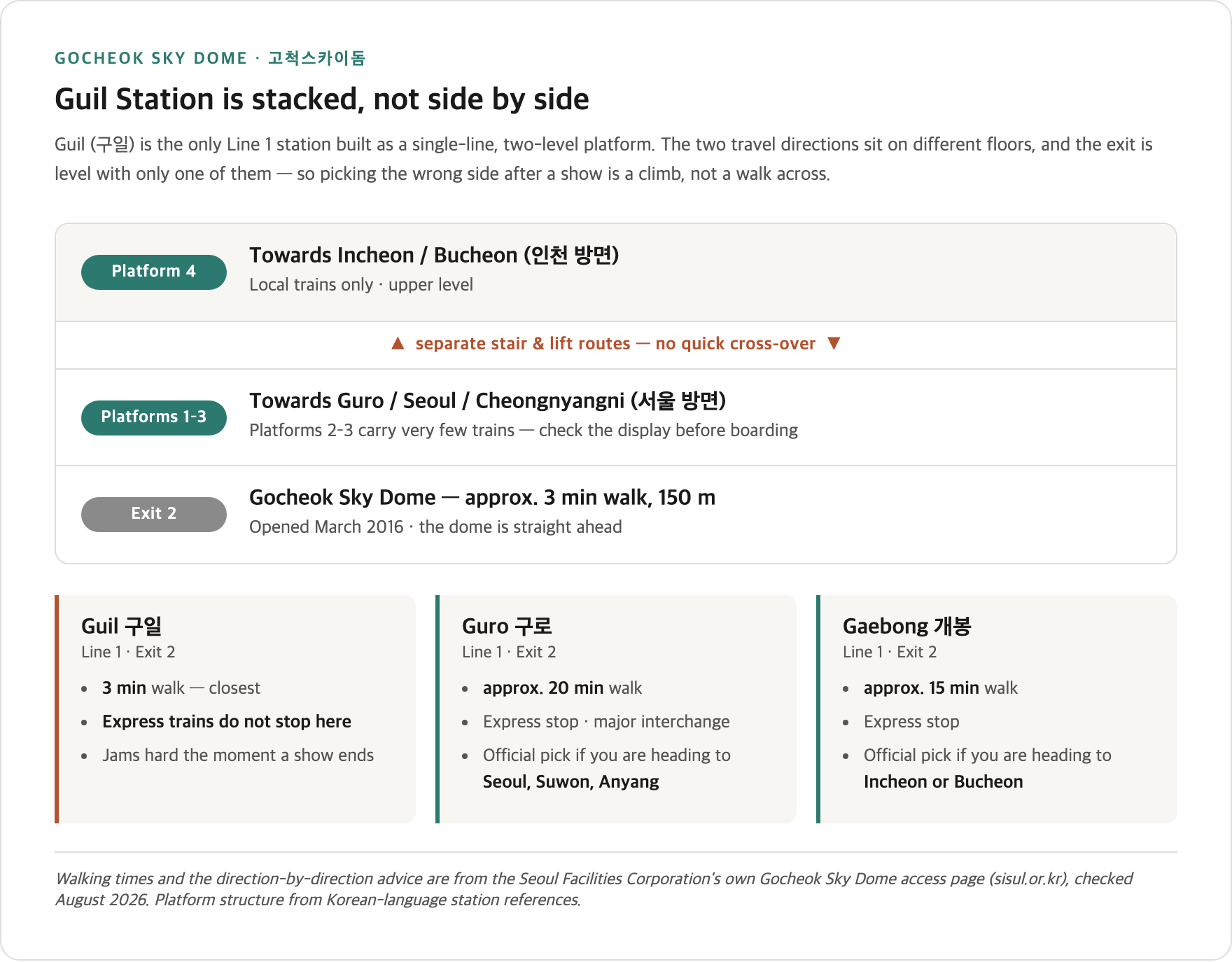
Guil is the only station on Line 1 built as a single-line, double-deck platform. Platforms 1 to 3 sit on the lower level and serve the Guro and Seoul direction; platform 4 sits above them and serves the Incheon direction. They are reached by separate stair and lift routes, and the exit is level with only one of them. A disability-access report from 2010 measured the gap in the bluntest possible way: reaching the Incheon-bound platform took one wheelchair lift, and reaching the Seoul-bound platform took three lift changes. Seoul Metro’s network-wide figures on platform gaps and boarding ramps — covered in our subway accessibility guide — give the current network picture; Guil’s split-level layout is a station-specific extreme within it.
At a normal station, boarding the wrong side costs you a walk across a footbridge. At Guil, in a crowd of twenty thousand people, it costs you a climb through the same stairwell everyone else is using.
Verified tip — Decide your direction before you tap in at Guil. The two directions are on different floors, connected by separate stair and lift routes rather than a simple cross-platform passage — a structure that Korean station references describe as unique on the line. Every English concert guide treats Guil as an ordinary two-platform station and only warns you about the queue.
Express trains skip Guil — and that is why Gaebong works
The second reason is that Guil gets no express service. On the Gyeongin stretch of Line 1, express trains call at Guro and Gaebong but pass straight through Guil. Korean press coverage in April 2026 framed this as the station’s long-standing grievance: it is the one stop on that run left off the express pattern, so at exactly the moment a full dome empties, half the trains going past do not stop.
This reframes the standard advice. “Walk to Gaebong because it is less crowded” is true, but the stronger reason is that Gaebong is an express stop and Guil is not. You are not just escaping a queue — you are moving to a platform where faster trains actually call.
The venue operator’s own access page goes further than any English guide by splitting the advice by direction. It names Guro Station, Exit 2, as an approximately 20-minute walk and recommends it for anyone heading towards Seoul, Suwon or Anyang; and Gaebong Station, Exit 2, as an approximately 15-minute walk recommended for anyone heading towards Incheon or Bucheon. English guides collapse both into “go to Gaebong,” which sends people the wrong way about half the time.
Verified tip — Guil is the only stop on that stretch of Line 1 that express trains skip, which is why the platform recovers so slowly after a show. Korean transit references also note that when congestion or delays get severe on a big Gocheok event day, staff have at times opened the normally near-dormant Yongsan-bound express platform to let express trains call. Do not count on it — but do read the platform displays instead of assuming, because platforms 2 and 3 carry very few trains on an ordinary day.
Reading a Korean Seat Map at Gocheok
English seating guides for Gocheok describe the bowl by floor: ground standing, first floor, second floor, third, fourth. The Korean ticketing screen does not use those words. It shows three-digit zone numbers, and if you do not know how they are laid out you are picking blind.
The Seoul Facilities Corporation’s official seating chart numbers the bowl like this:
| Level | Infield side (내야측) | Outfield side (외야측) |
|---|---|---|
| Lower bowl | 101–114 | 115–132 |
| Second level | 201–210 | 211–222 |
| Third level | 301–322 | 323–334 |
| Fourth level | 401–424 | 425–435 |
There are also lettered zones between sections 205 and 206 — T01–T07, T11–T17 and S01–S16 — with the VIP area and broadcast booth at dead centre. Two entrances are marked: 내야측입구 for the infield side and 외야측입구 for the outfield side.
The chart is drawn for baseball, and a concert promoter redraws the floor completely — the playing surface becomes standing sections, and the stage takes over one end. But the bowl numbering stays. So the practical rule is that the number tells you where you are around the ring, and the leading digit tells you how high. A 4xx seat is on the top level. English write-ups agree that upper corner positions sit steeply and far back, and that the baseball netting does not entirely disappear for concerts.
Verified tip — Korean ticket pages sell Gocheok by 구역 number, not by “second floor front side.” Learn the ranges before the sale opens: 100s are the lower bowl, 400s are the top, and within each level the lower half of the range is the infield side. English seating guides describe the venue by floor only, which is useless at the moment you have thirty seconds to click a zone.
The other thing worth knowing before you commit money: Korean promoters routinely sell explicitly labelled restricted-view seats (시야제한석) as their own discounted grade. If a listing seems cheap for its level, check the grade name rather than assuming you found a bargain. Prices for recent shows at both venues have run roughly ₩154,000–₩198,000 depending on grade (as of 2026) — factor that into what a week in Korea actually costs before you build a trip around one concert.
KSPO DOME: The Arena Is Inside a Park That Closes
KSPO DOME’s approach is the opposite problem. Nothing about the station is strange — Olympic Park Station is a large, modern interchange, and Exit 3 was built two levels deep with eight escalators specifically because this site generates arena crowds. Line 5 runs at B2 and Line 9 at B3, joined by a transfer corridor, and Line 9’s express trains stop here, which is genuinely useful: it puts Yeouido, the Express Bus Terminal and Gimpo Airport on a direct fast run. The Line 9 extension that made this possible only opened in December 2018, which is why some older guides still describe the venue as a Line 5 destination.
The complication is the park.
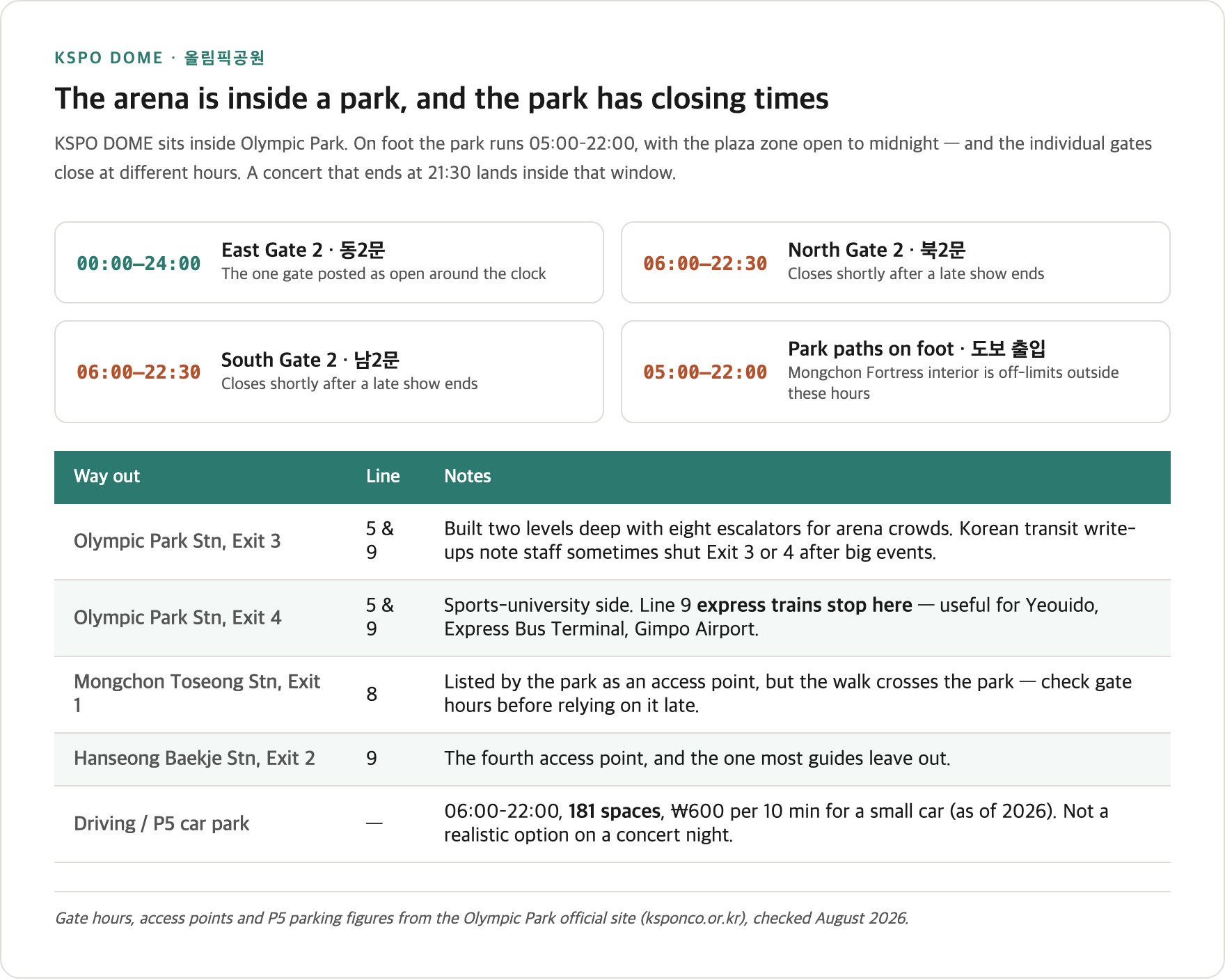
KSPO DOME does not sit on a street. It sits inside Olympic Park, and Olympic Park is an operated facility with posted hours. The operator’s own park-use page lists pedestrian and bicycle access as 05:00–22:00, with the plaza zone open until 24:00, and vehicle access as 06:00–22:00. Individual gates then close at their own times: East Gate 2 is listed as open 00:00–24:00, while North Gate 2 and South Gate 2 run 06:00–22:30. The interior of the Mongchon Fortress (몽촌토성) earthworks is closed outside park hours entirely, for heritage protection.
A K-pop concert routinely finishes between 21:30 and 22:30. That lands directly inside this window.
Verified tip — Olympic Park’s gates do not all close at the same time. The operator posts East Gate 2 as open around the clock, North and South Gate 2 as 06:00–22:30, and general pedestrian access as 05:00–22:00 with the plaza zone open to midnight. English pages that mention the park at all give a single blanket “5am to 10pm” and stop there. If your plan after the encore involves cutting through the park to Mongchon Toseong Station on Line 8, check which gate you are aiming at before the show rather than after it.
The same operator page lists four rail access points, not two: Olympic Park Station Exits 3 and 4 for both Line 5 and Line 9, Mongchon Toseong Station Exit 1 on Line 8, and Hanseong Baekje Station Exit 2 on Line 9. Most English guides name one or two. Hanseong Baekje in particular almost never appears, and it is one stop from Olympic Park on the same line.
There is one more thing Korean transit write-ups mention that no English guide does: when the crowd is heavy enough, staff sometimes close Exit 3 or Exit 4 after an event rather than let people funnel in. Treat the exit number on your ticket instructions as a suggestion, not a guarantee, and know where the alternatives are.
Verified tip — Driving is not the answer here either. The P5 car park, the closest to KSPO DOME, is listed by the operator as operating 06:00–22:00 with 181 spaces, at ₩600 per 10 minutes for a small car and ₩1,200 for a large one, free under 10 minutes (as of 2026). One hundred and eighty-one spaces for a fifteen-thousand-seat arena, on a lot that closes at 22:00. English guides warn that the parking exit queue runs 45 minutes or more; the more useful number is that there is almost nowhere to park in the first place.
Gocheok Sky Dome vs KSPO Dome: Which One Is Easier for a Visitor
Set side by side, the trade-off is seats against logistics. Gocheok holds more people — approximately 16,600 fixed seats against KSPO DOME’s approximately 15,000 — and is fully enclosed, but it sits on a single subway line with no express service and a platform that punishes a wrong turn. KSPO DOME seats fewer but sits on two lines, one of them express, inside a park with more hotel supply nearby.
If you have a choice — and occasionally you do, when a tour plays both — KSPO DOME is the easier night out, for reasons that have nothing to do with the room itself.
Olympic Park Station sits on two lines, one of which runs express services, and it feeds directly into central and western Seoul. Guil sits on one line, gets no express service, and has a platform structure that punishes a wrong turn. The Songpa area around Olympic Park has far more hotel supply than Guro does, so staying near the venue is a realistic option on the KSPO side and a stretch on the Gocheok side.
Gocheok’s advantages are different. It is fully enclosed and climate-controlled, so a January or August show is comfortable. It holds more people on the floor when a promoter builds out the standing sections, which means more standing tickets in the pool. And it is closer to the Line 1 corridor south-west of the city, which is convenient if you are coming from Incheon rather than from central Seoul.
For getting back to the airport at the end of a trip, neither venue is on a direct route — you will change at Seoul Station or Hongik University for the airport train either way. That is covered in the full set of Incheon Airport to Seoul options.
What You Need to Know
Your ticket does not tell you the venue’s rules. Prohibited items, bag limits, camera restrictions and re-entry are set per event by the promoter, not by the building, and are published in the Korean event notice. I could not find a single published re-entry policy for either venue that applies across all shows — assume you cannot leave and come back, and plan food and bathroom stops before doors.
Neither venue has real luggage storage. There are coin lockers at the subway stations, not at the arenas, and they fill on show days. If you are arriving straight from another city with a suitcase, deal with it before you get to the venue.
Last trains are not the same as “midnight.” Seoul’s last services vary by line, by direction and by station, and the last train out of Guil is not the same as the last train out of Guro. Check the actual time for your station and direction on the day rather than trusting a round number — the rules for how the fare system treats you if you get this wrong are in the Seoul subway guide.
Cash still matters at the margins. Merchandise stalls and small vendors around both venues are not uniformly card-friendly for foreign cards, and the situation is messier than it looks — see which Korean apps and machines reject foreign cards and how Korean ATMs handle overseas cards.
The venues are not the fan sites. Neither Gocheok nor KSPO DOME is an agency building, and if what you actually want is to stand outside a label headquarters, that is a different trip — see which K-pop company buildings in Seoul you can actually enter.
Practical Tips
-
Check your direction before tapping in at Guil. The Seoul-bound and Incheon-bound platforms are on different levels with separate access routes. Getting it wrong after a show costs far more time here than at an ordinary station.
-
Pick your backup station by where you are going, not by crowd size. The venue operator recommends Guro (approximately 20 minutes on foot) for Seoul, Suwon and Anyang, and Gaebong (approximately 15 minutes) for Incheon and Bucheon. Both are express stops. Guil is not.
-
Learn the Gocheok zone numbers before the sale. Lower bowl 101–132, second level 201–222, third 301–334, fourth 401–435, with the lower half of each range on the infield side. You will not have time to work this out live.
-
At KSPO DOME, take Line 9 if you can. The express calls at Olympic Park and runs straight to Yeouido, the Express Bus Terminal and Gimpo Airport. Line 5 works but is slower across the city.
-
Do not plan a late walk through Olympic Park. General pedestrian access is posted as 05:00–22:00 with the plaza zone open to midnight, and North and South Gate 2 close at 22:30. East Gate 2 is the one listed as open around the clock.
-
Load a transport card before the show, not after. Recharge machines at both stations get swamped when a venue empties — sort your T-money card in the morning.
-
Eat before doors. Both venues sit away from dense restaurant strips, and with re-entry unreliable, a convenience store run before you go in is the practical option.
Frequently Asked Questions
Is Gocheok Sky Dome indoor?
Yes, and permanently so. It is Korea’s first fully enclosed domed baseball stadium, and the roof is fixed rather than retractable — Seoul city’s own construction records describe it as a 완전돔, a full dome, with a translucent membrane roof that admits daylight but does not open. At least one English concert guide describes it as having a retractable roof; that is incorrect. Practically, that means a Gocheok show goes ahead in rain rather than being cancelled, and the building is air-conditioned in summer. It is not a guarantee of a dry seat: water has reached seats in 2016, 2017, 2020 and again on 22 August 2026, when about thirty ticket holders were moved from a third-base section during a sold-out game. The roof was repaired in 2021 and again before the 2026 season.
How do I get to KSPO DOME?
Olympic Park Station on Line 5 or Line 9, Exit 3, then roughly a five-minute walk. Line 9’s express trains stop at Olympic Park, which is the fastest approach from Yeouido, the Express Bus Terminal or Gimpo Airport. The park operator also lists Mongchon Toseong Station Exit 1 on Line 8 and Hanseong Baekje Station Exit 2 on Line 9 as access points. If the venue name draws a blank with a driver, use 올림픽체조경기장.
KSPO DOME or Gocheok Sky Dome — which is better?
For the show itself, KSPO DOME is a purpose-built circular arena and Gocheok is a converted baseball dome, so KSPO generally has a tighter bowl. For the logistics, KSPO DOME is easier: two subway lines, express service, more hotels nearby. Gocheok holds more people on the floor and is fully climate-controlled. If you are choosing between two dates of the same tour, choose on how you plan to get home.
Where should I stay near KSPO DOME?
The Songpa and Jamsil area, one or two stops away on Line 8 or Line 9, has by far the deepest hotel supply near the venue. Guro, near Gocheok, has much less. Staying central and commuting out is a reasonable alternative for either venue — getting around Korea covers the trade-offs.
How do I get from Gocheok Sky Dome to Incheon Airport?
There is no direct route. The normal approach is Line 1 towards Seoul, then change to the Airport Railroad at Seoul Station, or change at Sindorim and work across. Budget more time than a map app suggests if you are leaving straight after a show, because the first leg out of Guil is the slow part. Full options are in Incheon Airport to Seoul.
Can I leave the venue and come back in during a concert?
Assume no. Re-entry is set per event by the promoter rather than by the venue, and I could not find a standing published policy for either building that applies across all shows. The Korean event notice for your specific concert is the only reliable source, and it is usually posted a few days before.
Are there lockers at Gocheok Sky Dome or KSPO DOME?
Not in any dependable, centralised form. Coin lockers exist at the subway stations rather than inside the arenas, and they fill early on event days. Plan to travel light rather than to store something.
What time should I actually arrive?
It depends on what you have to do. If you have a mobile ticket and no merchandise plans, one to two hours before showtime is enough. If you need to collect a physical ticket with your passport, add time — pickup counters close before showtime, not at showtime. If you want merchandise, the queue commonly forms two to three hours before doors. Make sure your phone has working data before you rely on any of this.
Related Questions
- K-pop Company Buildings in Seoul: What You Can Actually Enter
- How to Attend a K-pop Music Show in Korea: The Routes That Still Work
- Seoul Subway: Tap-Out Rules That Changed in 2026
- Noraebang in Korea: The Rules Korean Guides Spell Out and English Ones Don’t
- Korea’s Year-End Music Festivals: Can You Actually Get In?