Gyeongbokgung Tickets: Free Days, Tuesday Closure, Hanbok Rule
Updated for August 2026
Quick Answer
Gyeongbokgung (경복궁) costs ₩3,000 for adults and closes every Tuesday. Entry is free in qualifying hanbok, free for foreign visitors aged 18 and under, and free for everyone on the last Wednesday of the month. It is not free on ordinary Wednesdays, even though the other palaces are moving to that. Hours shift five times a year, and last admission is an hour before closing.
The Full Answer
Gyeongbokgung is the first stop on almost every Seoul itinerary, and the surface facts are everywhere: the ₩3,000 ticket, the guard ceremony at ten and two, the hanbok rental shops along the street outside. That layer is well covered in English and there is no point repeating it.
The layer underneath is not, and it is where visits go wrong. Several of the palace’s rules changed in the last two years — a nationwide free-entry expansion that Gyeongbokgung opted out of, a combined ticket that got cheaper and longer, a written hanbok dress code that refuses several of the outfits rental shops hand out, and an age exemption that treats foreign visitors differently from Korean ones.
I read the Korea Heritage Service’s Royal Palaces and Tombs Bureau pages (궁능유적본부) in August 2026 — hours, fees, the hanbok guideline, the tour schedule and the Gyeongbokgung notice board — along with the Korean press coverage of the free-entry expansion announced on 26 May 2026. I also read the English guides currently ranking for the obvious searches. Several quote a combined-ticket price and validity period the official fee table no longer uses, several still list a youth fare that was abolished, and at least one widely syndicated English article says Gyeongbokgung is free every Wednesday. It is not.
None of this is an argument against going. It is the handful of places where the palace does not behave the way an English guide told you it would.
Opening Hours, and the Tuesday That Is Not Always Tuesday
Gyeongbokgung changes its hours five times a year rather than the two seasons most English guides describe. Last admission is a full hour before closing, and staff begin moving visitors toward the exits roughly thirty minutes before that closing time.
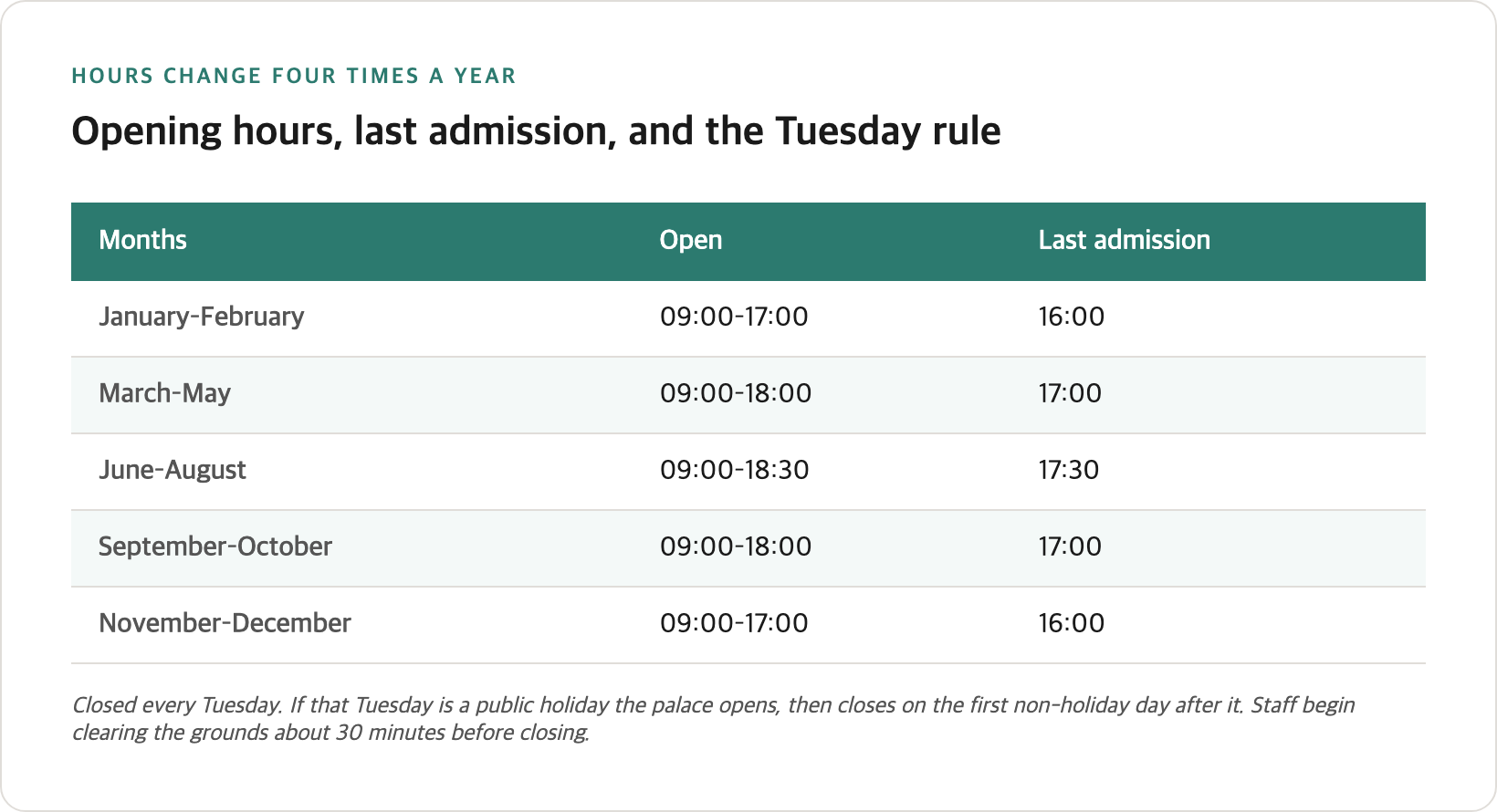
The closure day is the single most useful thing to check against your dates. Gyeongbokgung closes every Tuesday. Changdeokgung, Changgyeonggung, Deoksugung and the Joseon Royal Tombs close on Mondays instead, and Jongmyo closes on Tuesdays alongside Gyeongbokgung. That split is deliberate — it means there is always a palace open — but it also means “the palaces are closed on Mondays” and “the palaces are closed on Tuesdays” are both wrong as blanket statements.
The holiday exception is written into the official rule and worth reading carefully. If the Tuesday falls on a public holiday, including a substitute holiday, the palace opens that day and instead closes on the first non-holiday day after it. In practice that usually means a Wednesday closure in a holiday week — which is exactly the week when a visitor who checked “closed Tuesdays” once, months ago, turns up to a locked gate. If your dates fall inside the Chuseok holiday, what changes in Seoul over Chuseok covers what to check for the palaces and museums on those days.
The closure cascades. On a Tuesday there is no guard ceremony, no guided tour, and no night session. A Tuesday plans nothing at Gyeongbokgung at all, which is why the two free museums described further down matter more than they look.
What It Costs, and Who Does Not Pay
The headline number is ₩3,000 for an adult (as of 2026), and it has been ₩3,000 since 2005. The interesting part is the exemption list, because the age thresholds are not the same for everyone.
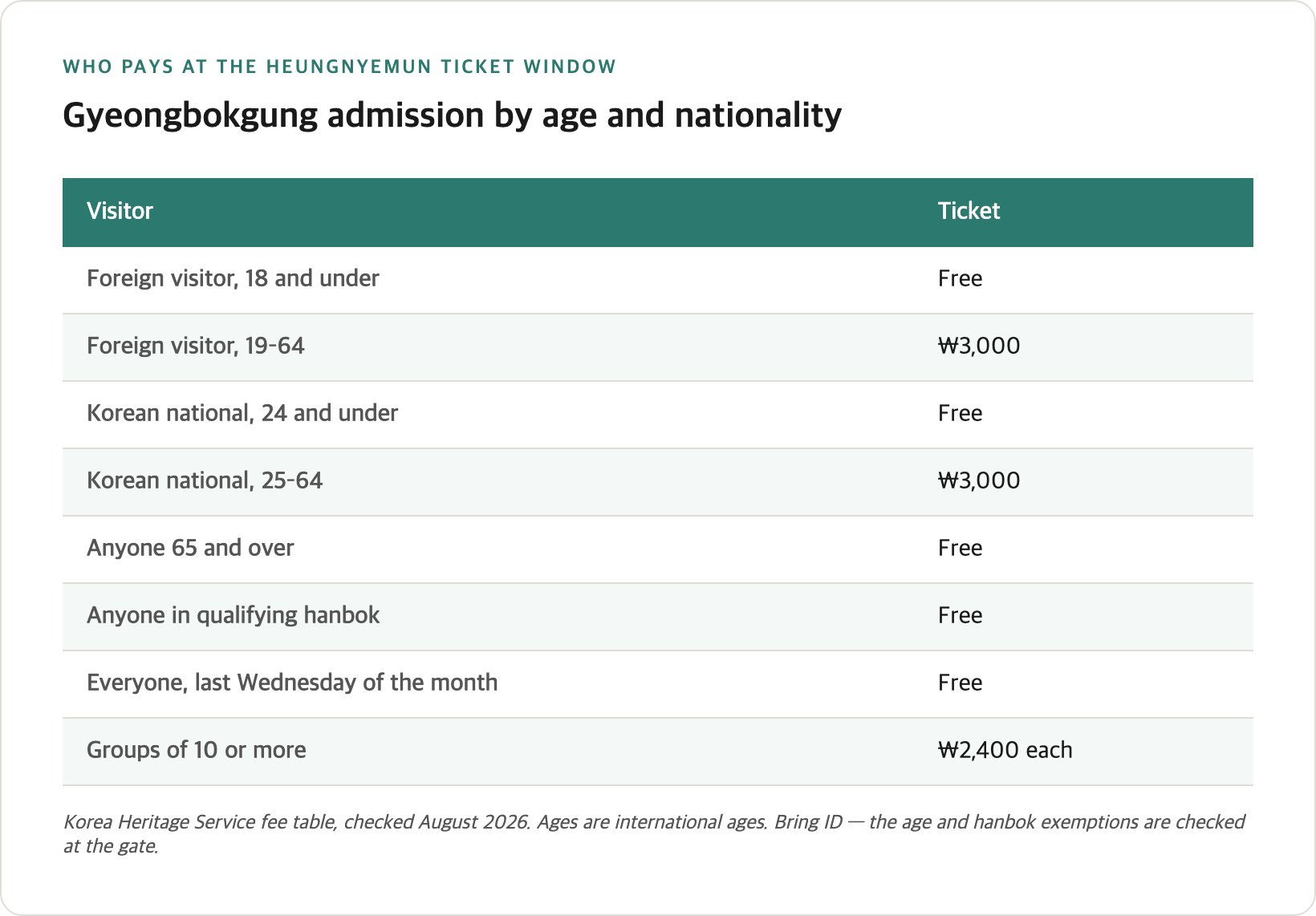
Local tip — The free-entry age is not the same for foreign and Korean visitors. The Korea Heritage Service fee table exempts Korean nationals aged 24 and under but only foreign visitors aged 18 and under. A 22-year-old exchange student from abroad pays ₩3,000; the 22-year-old Korean friend standing next to them does not. English guides describe a single “adults 19–64” band and miss the asymmetry entirely.
There is a second, more useful half to that rule. Foreign visitors aged 7 to 18 used to pay a discounted ₩1,500 youth fare, and that fare is gone — the current official table has no youth row for Gyeongbokgung at all, only “adult” and free. Most of the English guides ranking today still quote ₩1,500 for ages 7–18, and so, at the time of checking, did the Korea Heritage Service’s own legacy cha.go.kr pages. If you are travelling with teenagers, they are free, whatever the guide said and whatever the older government page says.
One practical note on the age rules: these are international ages, not the traditional Korean count. That distinction stopped being ambiguous in law in 2023, but it still trips people up — the Korean age system is worth two minutes before you rely on an age threshold anywhere in Korea.
Bring something that proves age and nationality. The exemptions are checked at Heungnyemun Gate rather than assumed, and a passport is the document that settles both questions at once.
The Free-Wednesday Change That English Guides Got Wrong
This is the fact most likely to send you to the palace on the wrong day in 2026.
In March 2026 the government amended the Framework Act on Culture to expand “Culture Day” (문화가 있는 날) from the last Wednesday of the month to every Wednesday, effective 1 April 2026. English coverage followed, and at least one widely distributed English article published in April 2026 states that all four major palaces — Gyeongbokgung included — offer free entry every Wednesday.
Then, on 26 May 2026, the Royal Palaces and Tombs Bureau published how it would actually implement that, and Gyeongbokgung was carved out.
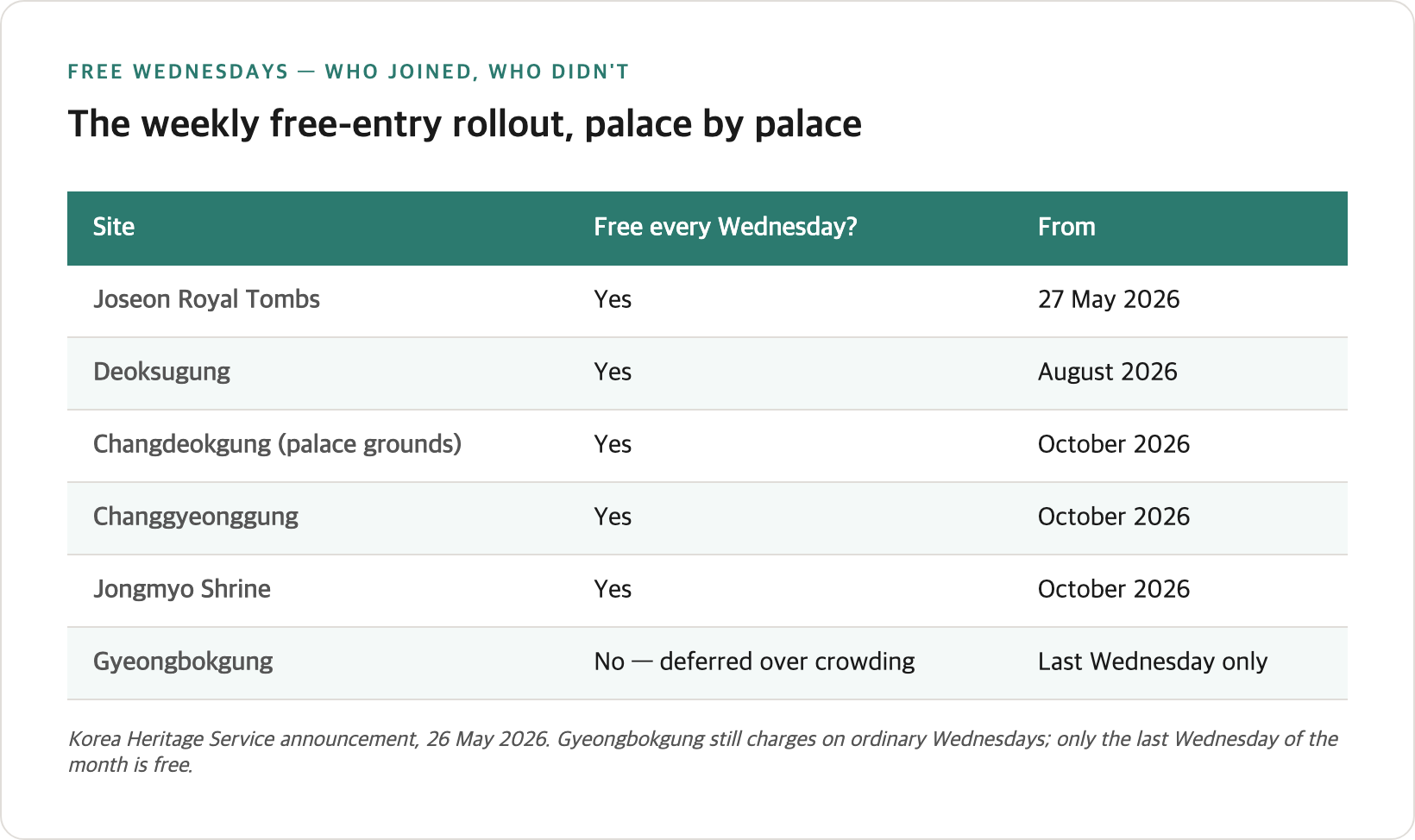
Local tip — Gyeongbokgung is the one site excluded from the weekly free-entry rollout. The Royal Tombs went free every Wednesday from 27 May 2026, Deoksugung from August, and Changdeokgung, Changgyeonggung and Jongmyo from October. Gyeongbokgung’s turn was deferred indefinitely, with the bureau citing visitor crowding and on-site safety. For Gyeongbokgung, free entry is still the last Wednesday of the month only. English articles announcing “all four palaces free every Wednesday” are describing a plan Gyeongbokgung did not join.
The practical read: if you want a free Wednesday and your dates are flexible, an ordinary Wednesday now gets you Deoksugung for nothing, and from October also Changdeokgung’s grounds, Changgyeonggung and Jongmyo. Gyeongbokgung on that same Wednesday still costs ₩3,000. Only the last Wednesday of the month is free at all five. If you want to combine palaces in one day, this palace day itinerary shows which days each combination works.
Note also that free entry to Changdeokgung has never included the Secret Garden, which is a separately ticketed, capacity-limited timed tour. That exclusion survives every version of these schemes.
The Hanbok Exemption Has a Written Dress Code
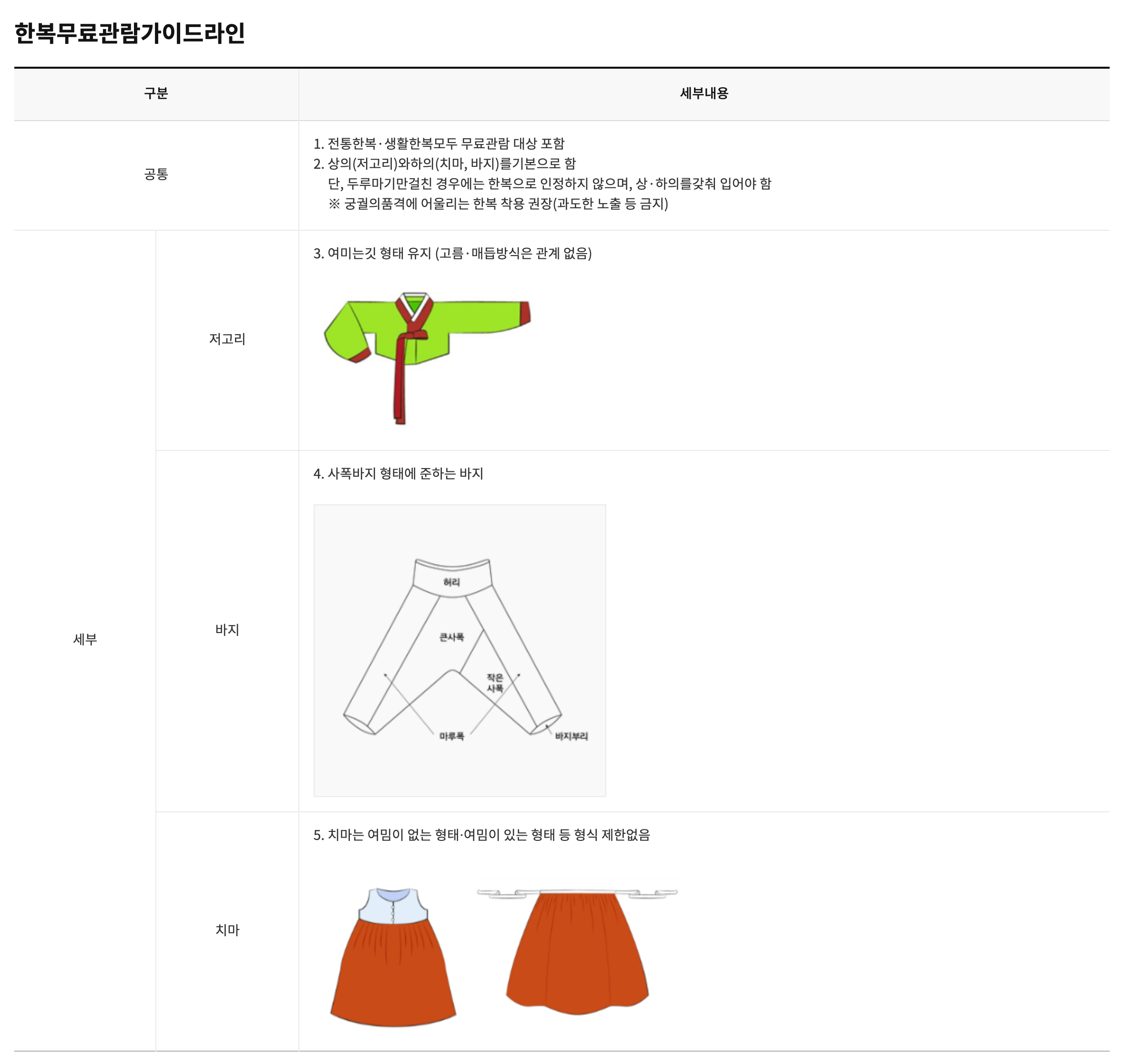
Wearing hanbok gets you in free — that much every English guide says, and it has been policy since 2013 across all four palaces, Jongmyo and the Royal Tombs. What the English guides do not carry is that the exemption is governed by a published, illustrated guideline, and that several outfits sold as hanbok by rental shops fail it.
The guideline, reproduced at the top of this article, comes down to one structural test: you need a separate top and a separate bottom. A jeogori (저고리) with a wrap-over collar, and either a skirt or trousers cut in the traditional sapok (사폭) silhouette. Skirts are otherwise unrestricted. Ribbon and knot style do not matter.
Local tip — An outer robe worn on its own does not qualify, and neither does a one-piece hanbok dress. The guideline explicitly refuses a durumagi (두루마기) worn alone, and in April 2026 the bureau confirmed to Korean media that a cheollik (철릭), a gonryongpo (곤룡포) or a magistrate’s robe also fails, because these are outerwear — wearing one over ordinary clothes is, in the bureau’s words, the equivalent of wearing a coat over your underwear. The same two-piece test rules out a single-piece hanbok dress, a jeogori over jeans or a T-shirt, hanbok trousers with a T-shirt, and a T-shirt-shaped garment sold as a jeogori. A fusion hanbok with a proper wrap collar passes. Rental shops near the palace stock all of the failing styles as photogenic “hanbok”, and English guides say “wear hanbok, enter free” and stop there — which is why refusals at the gate recur in Korean-language accounts.
If you would rather book the outfit before you arrive, GetYourGuide lists a hanbok rental bundled with palace entry from ₩10,000 (checked September 21, 2026). Two things to hold in mind before you book. First, a bundled ticket is ₩3,000 you may not need — if the outfit passes the two-piece test above, entry is already free, and you are paying for admission you would have been waved through on. Second, no listing we have seen states whether its outfits meet the Korea Heritage Service guideline. Booking ahead does not settle the question the gate actually asks. Check the photographs against the jeogori-and-separate-bottom test before you pay, and if the shop offers a one-piece dress or an outer robe alone, pick something else.
Two riders worth knowing. The guideline also asks for clothing “befitting the dignity of the palace” and discourages excessive exposure, which is the clause staff fall back on for a very short or unfastened jeogori. And the hanbok exemption applies at the evening sessions as well as during the day, which matters more than it sounds — see below.
The rule was under review as of April 2026, with the bureau saying it would consider bringing traditional forms such as the cheollik inside the definition at the next revision. Nothing had changed on the published guideline at the time of checking, so treat the two-piece test as current and check the guideline page again close to your trip.
The Combined Palace Ticket Is ₩6,000, Not ₩10,000
If you plan to see more than one palace, there is a combined ticket — and the figure in circulation in English is out of date.
| Combined ticket | Buying separately | |
|---|---|---|
| Price | ₩6,000 | ₩9,000 |
| Validity | 6 months from purchase, one entry each | n/a |
| Covers | Gyeongbokgung, Changdeokgung, Changgyeonggung, Deoksugung, Jongmyo | — |
| Excludes | Changdeokgung’s Secret Garden | Secret Garden ticketed separately |
| Where to buy | Ticket offices at the four palaces and Jongmyo | Each ticket office |
Local tip — The combined ticket is ₩6,000 and valid for six months. English guides — and several ticket resellers — still describe a “Royal Palace Pass” at ₩10,000 valid for three months. That was the older product. The current official fee table lists ₩6,000, six months, five sites, with Changdeokgung’s Secret Garden excluded. At Gyeongbokgung it is sold at the Heungnyemun ticket office only, not at the National Folk Museum side entrance, and refunds are only possible at the palace where you bought it and only while every coupon is still attached.
The saving is ₩3,000 against buying all five separately, so it pays for itself the moment you visit both Gyeongbokgung and Changdeokgung. It is not a fast-track pass and it does not skip a queue.
The same fee page lists two products aimed at people who live nearby rather than visitors: a lunchtime pass at ₩5,000 valid three months for Gyeongbokgung or Changdeokgung, and a season pass at ₩30,000 for those two palaces. Neither is likely to suit a short trip, but they explain the extra windows you may see at the ticket office.
Changing of the Guard, and What Cancels It
The ceremony is the reason many visitors time their arrival, and it is free to watch — it takes place in the Heungnyemun courtyard and the Gwanghwamun gate area, outside the ticket line.
| Programme | Times | Length |
|---|---|---|
| Changing of the guard | 10:00, 14:00 | about 20 min |
| Gwanghwamun sentry ceremony | 11:00, 13:00 | about 10 min |
| Guard corps open drill | 09:35, 13:35 | about 15 min |
| Guard patrol ceremony (Sungnyemun–Insadong route on Sundays) | 15:00–16:00, weekends and holidays in March–May and September–November | about 60 min |
The four-programme schedule is the first thing English guides usually miss. Most list only the 10:00 and 14:00 changing ceremony, so visitors who arrive at 11:20 assume they have missed everything for three hours when they have in fact just missed a sentry ceremony and have another at 13:00.
Local tip — A heat alert cancels the whole programme, not just one performance. The Korea Heritage Foundation suspends the changing ceremony, the sentry ceremony, the open drill and the standing gate duty together whenever the Ministry of the Interior and Safety’s severe heat alert (폭염중대경보) is in force, to protect performers in full costume. This is not hypothetical: the bureau posted a suspension notice for Gyeongbokgung on 5 August 2026 during Seoul’s record heat and a resumption notice on 7 August, with normal operation returning on the 8th. Rain, heavy fine dust and demonstrations in the Gwanghwamun area also cancel it. English guides list the times as if they were fixed.
If the ceremony is the point of your visit, the palace’s Korean-language notice board carries these suspension notices the same day, usually a day or two ahead of a forecast heat event. The ceremony also does not run on Tuesdays, since it follows the palace’s closure day.
Night Opening: How the Tickets Are Actually Split
Gyeongbokgung runs illuminated evening sessions in blocks rather than year-round, typically one in late spring and one in early autumn. The first-half 2026 session ran from 13 May to 14 June, 19:00–21:30 with last admission at 20:30, closed Mondays and Tuesdays, at ₩3,000.
What is worth knowing is how the daily allocation is divided, because it is not first-come-first-served across one pool:
- 3,000 tickets a day sold online through Interpark, maximum four per person. For the first-half 2026 session, booking opened at 10:00 on 4 May, nine days before the run began.
- 300 tickets a day held back for foreign visitors, sold on the day at the palace, maximum two per person, on production of a passport or other proof of foreign nationality. The notice sets the allocation but does not name a window, so ask at the ticket office on arrival.
- Hanbok wearers enter free, and the free-admission categories are verified at the gate rather than booked.
The two pools are separate, which is the part worth holding on to: “sold out online” tells you nothing about the same-day foreign allocation, and a qualifying hanbok bypasses the ticket entirely. This one is not a gap in the English coverage — Creatrip’s English guide carries the foreign on-site allocation accurately — but it is missing from most of the independent English write-ups.
The second-half 2026 session is now confirmed. The bureau posted it on 18 August 2026: the run is 2 September to 2 October, 19:00–21:30 with last admission at 20:30, closed Mondays and Tuesdays, at ₩3,000. Online booking opens at 10:00 on 26 August 2026 and closes at 23:59 on 1 October. The daily allocation is 3,300 — 3,000 online plus the 300 same-day tickets for foreign visitors — and free-admission categories are on top of that, with no cap on numbers. Dates shift from block to block, so check the bureau’s Gyeongbokgung notice board for the session you are travelling for.
Evening sessions are outdoor and go ahead in rain. Paths are unlit in places and the ground is uneven.
Free Guided Tours, by Language
The palace runs free guided tours with no reservation needed for individuals, which is one of the better-value things on offer and barely mentioned in English guides. They start from the information desk just inside Heungnyemun Gate and run 60 to 90 minutes.
| Language | Times |
|---|---|
| English | 11:00, 13:30, 15:30 |
| Japanese | 10:00, 14:30 |
| Chinese | 10:30, 15:00 |
| Korean | Every 30 minutes to an hour, 10:00–16:00 (15:30 in winter) |
Groups of ten or more must book in advance, and sessions cap at about 30 people. Note the 15:30 English slot specifically — a number of English guides list it as 15:00, which is the Chinese-language time.
When the Palace Is Closed, Two Free Museums Are Not
This is the fix for a Tuesday arrival, and the thing to know is that neither museum requires a palace ticket.
The National Palace Museum of Korea (국립고궁박물관) sits just outside the palace wall on Hyoja-ro, connected to Gyeongbokgung Station. Admission is free, no booking, and it is open on Tuesdays — it closes on the last Monday of the month instead. It runs 09:30–17:30 most days, and until 21:00 on Saturdays and on the last Wednesday of the month.
The National Folk Museum of Korea (국립민속박물관) is inside the palace grounds but has its own entrance from Samcheong-ro and its own free admission. It opens 09:00–18:00 from March to October and 09:00–17:00 from November to February, with Wednesday evenings extended to 20:00 in the warmer months. Its only closures in 2026 are 1 January, Seollal, Chuseok and occasional maintenance days.
Put together: on a Tuesday, when Gyeongbokgung itself is shut, you can still spend a full free morning and afternoon on the same block. Neither museum should be confused with the much larger National Museum of Korea at Ichon, which is a different institution on the other side of the river.
Getting There, and What Is Nearby
Take the subway to Gyeongbokgung Station on Line 3; Exit 5 comes up inside the National Palace Museum concourse and walks you to the ticket office without crossing a road. If you need a step-free route, the street-level elevator is at Exit 4 instead, and there is no second one — Seoul subway accessibility explains why one accessible route per station means exactly one exit. Gwanghwamun Station on Line 5 is the alternative if you want to approach along the plaza and catch the sentry ceremony on the way in. A T-money card is the simplest way to pay for either.
Google Maps will not route you door to door here, so plan the walk in Naver Map or Kakao Map first; the wider picture is in the getting around Korea guide. The ticket office takes cards, but hanbok rental shops around Bukchon vary — the cash or card situation and the state of Korean ATMs are both worth understanding first. Admission here is small change against the rest of a trip; the week in Korea cost breakdown shows where the money actually goes.
The walk east through Bukchon Hanok Village to Changdeokgung makes a natural half-day and the combined ticket covers both. Lunch is the other direction: Tongin Market’s yeopjeon coin lunchbox is an eight-to-ten-minute walk west into Seochon from Gyeongbokgung Station, and its coin counter closes at 15:00 on weekdays — well before the market itself does. A jjimjilbang is the standard Korean answer to a day spent walking on stone. Longer trips out of the city, such as a DMZ tour, need their own booking lead time and will not fit the same day. Lotte World Tower’s Seoul Sky observation deck is the usual English-itinerary pairing, but it is a forty-minute subway ride the other way and works better as its own outing.
What You Need to Know
-
Closed every Tuesday. If that Tuesday is a public holiday the palace opens and closes on the next non-holiday day instead. Changdeokgung, Changgyeonggung and Deoksugung close on Mondays.
-
Free entry is the last Wednesday of the month only. Gyeongbokgung did not join the every-Wednesday rollout that the other palaces are phasing in through 2026.
-
The hanbok exemption is a written dress code. Separate top and bottom, wrap-over collar. Outer robes worn alone and one-piece hanbok dresses are refused.
-
Foreign visitors 18 and under are free, and the old ₩1,500 youth fare is gone. Korean nationals are free to 24.
-
The combined ticket is ₩6,000 for six months, not ₩10,000 for three, and it excludes Changdeokgung’s Secret Garden.
-
The guard ceremony is suspended entirely during severe heat alerts, as it was on 5–7 August 2026, and does not run on Tuesdays.
-
Night sessions hold 300 same-day tickets for foreign passport holders, separate from the online allocation. The notice sets the number but not the window, so ask at the ticket office.
-
The adult ticket is ₩3,000 (as of 2026), unchanged since 2005. The Korea Heritage Service said in August 2026 that it will publish a revised fee schedule in November for application from 1 January 2027, so this figure has a known expiry.
Practical Tips
-
Check whether your date is a Tuesday — and whether it is a holiday Tuesday. A holiday shifts the closure to the following non-holiday day, which catches people who checked once and stopped.
-
Aim for the last Wednesday of the month if free entry is the goal. Any other Wednesday, Gyeongbokgung still charges even though Deoksugung and, from October, three more sites do not.
-
Check a rental hanbok against the two-piece test before you pay for it. Separate top and bottom, wrap-over collar. A cheollik or gonryongpo on its own looks the part and does not get you in free.
-
Buy the ₩6,000 combined ticket at the Heungnyemun window if you are seeing two or more palaces, and remember the Secret Garden is not in it.
-
Arrive for 09:35 or 11:00, not just 10:00 and 14:00. The open drill and the sentry ceremony fill the gaps between the two changing ceremonies.
-
Take a passport even for a day in the city. It is what proves the under-19 and foreign-visitor exemptions and what buys a same-day night-session ticket.
-
If the palace is closed, do the two museums. Both are free, neither needs a palace ticket, and both open on Tuesdays.
Frequently Asked Questions
How much does Gyeongbokgung cost in 2026?
₩3,000 for an adult (as of 2026), a price unchanged since 2005. Groups of ten or more pay ₩2,400 each. Foreign visitors aged 18 and under are free, as are Korean nationals aged 24 and under and anyone 65 or over. The Korea Heritage Service said in August 2026 that it will announce a revised fee schedule in November 2026 for application from 1 January 2027, so expect this to change.
What day is Gyeongbokgung closed?
Every Tuesday. If that Tuesday is a public holiday, including a substitute holiday, the palace opens and closes instead on the first non-holiday day afterwards — usually the Wednesday. Note that Changdeokgung, Changgyeonggung, Deoksugung and the Joseon Royal Tombs close on Mondays rather than Tuesdays, so there is always a palace open.
Is Gyeongbokgung free every Wednesday now?
No. Culture Day expanded to every Wednesday from April 2026 and the Royal Palaces and Tombs Bureau is phasing the palaces into it — Royal Tombs from May 2026, Deoksugung from August, Changdeokgung, Changgyeonggung and Jongmyo from October. Gyeongbokgung was deferred over crowding and safety concerns. At Gyeongbokgung, free entry remains the last Wednesday of the month only.
Does any hanbok get me in free?
No. The official guideline requires a separate top and bottom — a jeogori with a wrap-over collar plus a skirt or sapok-cut trousers. A durumagi, cheollik or gonryongpo worn alone counts as outerwear and is refused, as are one-piece hanbok dresses and a jeogori over jeans or a T-shirt. Fusion and everyday hanbok are fine as long as they pass the two-piece test.
When is the changing of the guard, and can it be cancelled?
At 10:00 and 14:00, roughly 20 minutes, with a sentry ceremony at 11:00 and 13:00 and an open drill at 09:35 and 13:35. It does not run on Tuesdays. The whole programme is suspended during a severe heat alert — it was cancelled from 5 to 7 August 2026 and resumed on the 8th — and rain, heavy fine dust and nearby demonstrations also cancel it.
Can I still get into the night opening if it is sold out online?
Possibly. Alongside the 3,000 tickets sold online each night, the palace holds 300 for foreign visitors to buy on the day, two per person, on production of a passport. The notice does not name a specific window, so ask on arrival. Visitors in qualifying hanbok enter free without booking at all. Sessions run in blocks rather than year-round, so check the bureau’s notice board for current dates.
Is the combined palace ticket worth it?
If you are visiting two or more of the five sites, yes. It is ₩6,000 and valid for six months from purchase, against ₩9,000 to buy all five separately, and it is sold at the ticket offices rather than online. It does not include Changdeokgung’s Secret Garden, which is a separate timed ticket, and it is not a queue-skipping pass.
What can I do there on a Tuesday when it is closed?
The National Palace Museum of Korea, just outside the wall at Gyeongbokgung Station, and the National Folk Museum of Korea, inside the grounds with its own Samcheong-ro entrance, are both free, both open on Tuesdays, and neither needs a palace ticket. The National Palace Museum closes on the last Monday of the month instead.
Related Questions
- How to Rent a Hanbok Near Gyeongbokgung — What Isn’t in the Price
- Changdeokgung and the Secret Garden: The Timed Ticket That Sells Out
- DMZ Tour: Booking Rules, Dress Code, and Why It Gets Cancelled
- Seoul Subway: Tap-Out Rules That Changed in 2026
Featured image: Photo by Louie Nicolo Nimor on Unsplash